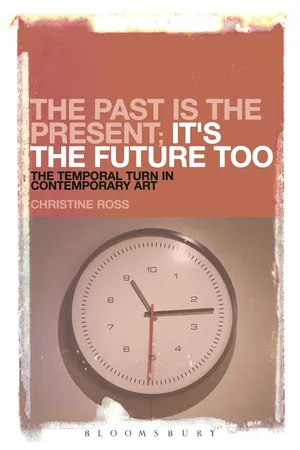
Ross first provides an interdisciplinary overview of contemporary studies on time, focusing on findings in philosophy, psychology, sociology, communications, history, postcolonial studies, and ecology. She then illustrates how contemporary artistic practices play around with what we consider linear time. Engaging the work of artists such as Guido van der Werve, Melik Ohanian, Harun Farocki, and Stan Douglas, allows investigation though the art, as opposed to having art taking an ancillary role. The Past is the Present; It's the Future Too forces the reader to understand the complexities of the significance of temporal development in new artistic practices.
eBook - ePub
The Past is the Present; It's the Future Too
The Temporal Turn in Contemporary Art
- 360 pages
- English
- ePUB (mobile friendly)
- Available on iOS & Android
eBook - ePub
About this book
The term 'temporality' often refers to the traditional mode of the way time is: a linear procession of past, present and future. As philosophers will note, this is not always the case. Christine Ross builds on current philosophical and theoretical examinations of time and applies them to the field of contemporary art: films, video installations, sculpture and performance works.
Information
Chapter 1
Temporal Investigations in Contemporary Art, Social Sciences, and the Humanities: A Comparative View
It is common to generalize about time—to anthropomorphize it; to project our fears, hopes, needs, desires, and losses on it; to acknowledge it as an autonomous dimension acting in the world according to its own laws while paradoxically making it so intimate to our beings that it becomes our being; to dis-historicize or naturalize what are in fact conceptualizations, constructions, and highly mediated experiences of time. These various attributions help us live our lives, even though they too easily suspend the question of the interplay between subjective and objective realities of time. It is also the case that the field of time studies is amazingly large, which means that different concepts from different disciplines get effortlessly blurred into each other to define it, often leading to contradictory understandings of time. It is also difficult—especially in relation to artworks which exist to be perceived, performed, and apprehended—to go with the challenge of investigating a dimension which never simply appears and is only obliquely graspable. Hence, before we move on to the actual artworks, a few specifications are called for in response to some of the most pressing questions about time: what is the difference between time and temporality, non-phenomenal and phenomenal time?; how has modern western philosophy defined it?; what are the main disciplines addressing time today?; and what is the current state of time studies? These precisions will help us circumscribe more tightly what it means to say that the forwardness of moving images and bodies, in the temporal turn of contemporary art, is suspended; that temporal passing is contemporized; that history is temporalized and historicity presentified. It will also help to situate contemporary art historically, in relation to other contemporary disciplinary studies on time. This comparative approach will show that time studies are far from consensual, although some of their findings do overlap. They mostly coexist as a variety of internal (disciplinary) debates. Art is a unique participant in these debates. Its originality comes from its reiterated attempt to connect phenomenologically and historically oriented investigations of time. As we will see, the temporal turn is motivated by the commitment to elaborate images, sounds, and performances that aesthetically translate contemporary experiences of temporal discontinuity and inconsistency. While western philosophy has tended and sometimes still tends to look for what makes time a continuous reality or phenomenon, the temporal turn presupposes, acts upon, and activates a discontinuous time. It never lets go of interested time. Although it acknowledges a certain level of indiscernibility of the past, present, and future, the temporal is a turn in which the past, present, and future persist sufficiently to allow for forms of realignments. It is a turn constitutive of a regime of historicity in which the temporal category of the present is thickened by its proximity to the past and to the future.
The Modern (Western) Philosophy of Time, or the Impossible Question: What is Time?
As elegantly observed by philosopher of science Étienne Klein, notions commonly used to define time—change, movement, flow, passage, duration, causality, irreversibility, nonspatial continuum, dimension—are not so easily interchangeable.1 They fall short of providing a definitive definition of time. Such a unified characterization is impossible—not only because the meaning and conceptualization of time differ historically, but also because the history of the conceptualization of time is a history of debates between conflicting conceptualizations whose spectrum unfolds between two limit positions: between the claim that time exists in our phenomenal apprehension of it and the claim that time does not exist. The elusiveness intrinsic to any definition of time derives as well from the fact that we never perceive time per se, but events, change, and movement in time. Hence, to try to answer the questions “which aspect of time is being addressed?,” “how is time being addressed in recent art?,” and “why has time become so significant to contemporary artistic practices?” is to enter a labyrinth of concepts, relays, and contradictory perspectives. Klein’s observation, however, effectively discloses four important aspects about time, which help to circumscribe the temporal turn I am trying to describe here.
First: time’s particular relation to change. Aristotle identified time with motion and concluded that time requires change: it depends on change since it is unperceivable without change. Still, today, change (transformations in nature, in our environment, in the people we know, in our own bodies) is understood as the phenomenon that makes time tangible to us. Time appears first and foremost through change. But, at least since eighteenth-century western philosophy, time ceases to be reducible to change. A distinction must be made between time and phenomenal time, for indeed when we say that things change in time and that change is the manifestation of the passage of time, there is more to time than change. It is a fact that in the realm of philosophy, after Newton’s postulation of the absoluteness of time, which posits time as independent from the existence or non-existence of external things, and Kant’s claim that time is a type of intuition—an a priori—impressed by the mind on experience, time is no longer considered to be the measurement of movement, and movement has become subordinate to time.2 This means that our search for the temporal in art cannot be reduced to a search for change of/in the image, of/by the performer.
Second: Klein’s observation pertains to the relation between time and mind. Time is recursively understood as depending on our own existence. With Kant, time is posited not as a characteristic of things as they are in themselves, existing autonomously from the human faculties to take hold of them, but as a mental a priori condition for the possibility of knowing things in the world. This standpoint, however, fails to account for the fact that planets and stars precede us; that the time of the universe is not simply human. Moreover, as recently pointed out by Couzens Hoy, the Kantian ordering “that puts mind before time” has been fundamentally challenged by the Heideggerian phenomenological tradition which argues that “temporality is a condition for the possibility of subjectivity,” preceding the human subject as it were.3 It is not, though, that the reversed order—the priority of time over mind—is closer to the truth of time. Rather, it is that the very principle of priority (the priority of mind over time or of time over mind) must be fundamentally questioned, as it is sometimes in the field of contemporary art.
Third: Klein’s point signals how time is compartmentalized according to disciplinary perspectives and hierarchies. This hierarchization reveals that some times are labeled as more real than others. The most common distinction is the one established between physical time and psychological time, the first considered to be objective and real, and the latter subjective and unreal (prone to illusion). These distinctions end up creating divides between different temporal deployments instead of allowing for a deeper understanding of how they relate. Even phenomenology has its problems in this regards for it simply bypasses the problem of distinction by ignoring any allegation concerning the transcendence of experience, including the existence of objective time. It simply affirms that temporality—lived time as it manifests itself in human existence—is real time because temporality “must always be experienced as real.”4 But the tension between objective, subjective, and phenomenal times cannot simply be discarded. Indeed, although the metaphysical question of the reality or non-reality of objective time (“is time a ‘real thing’ that is ‘all around us’, or is it nothing more than a way of speaking about and measuring events?”5) remains unresolved to this day, its irresolution is nevertheless productive for it has generated significant developments both in physics and aesthetics. This is why I find Philip Turetzky’s philosophical definition of time as “a boundary condition on phenomena”6 particularly insightful. To say that time is a boundary condition on phenomena—a boundary condition on things that appear—is to highlight that, in western thought, time might not be definable as such but its function can be delineated as a delimiting function that never completely erases its supplemental dimension—a function that becomes quite palpable, as we will see, in contemporary art. This boundary function is a constant, although what it actually borders changes from one philosophical system to another, depending on the degree of phenomenality accorded to time. Turetsky explains well the consistency and diversity of the bordering role of time:
[…] all such variations will exhibit one of the following four boundary structures […]: 1. as something which does not itself appear but which acts as the most immediate constraint on what does appear; 2. as itself a phenomenon which somehow encompasses and constrains all other phenomena; 3. as something neither strictly a phenomenon nor something which does not itself appear but something intermediate between the two which constrains phenomena (or mediates the relations between what appears and what does not); 4. as a double limit where two sorts of time are posited, one on each side of the boundary between phenomena and what does not appear.7
The definition of time as a boundary condition on phenomena has the merit of not discarding time in favor of temporality (lived, phenomenal time). Indeed, although it is more tangible to speak about phenomenal time, non-phenomenal time always weighs on phenomenal time as an ideal or a metaphysical mystery. There is no point in denying this mystery, which persists in our apprehending of time.
And fourth: in his Critique of Pure Reason (1781/87), Kant completed the inversion of the Aristotelian subordination of time to movement and initiated the deployment of time for itself.8 From this inversion on—an inversion that liberated time as an object of inquiry in its own right, but which will also posit it as mind dependent—time became crucial to the development of philosophy. It is not that subsequent philosophical investigations were interested in the nature of time as such. Rather, time became the boundary through which to understand the processes of consciousness (perception, memory, intuition, etc.) and subjectivity, according to principles of unity, flow, continuity, and freedom. Kant’s thesis on time has been largely discussed and is well known by now. His main argument is that, although there is no knowledge of objects without sense experience (as postulated by the empiricists, Locke in particular), not all knowledge is derived from sense experience insofar as a priori (transcendental and universal) conditions must exist to allow knowledge and experience. All knowledge and experience of objects presuppose transcendental conditions that make it possible to empirically know the world. Time has a special status in such an unfolding of knowledge: it is experienced through the senses but it is also ideal. Objects cannot be experienced atemporally, but this does not entail that time is a property of things in themselves, which would exist beyond our ability to grasp them. Kantian time is more fundamentally an a priori, a universal and necessary condition that makes any knowledge and experience of objects possible. As explained by Turetsky: “Time has the structure of the absolute mathematical flow of Newtonian time, and likewise cannot be discovered through any sense experience; time is an a priori condition of any possible experience. Kant’s fundamental characterization of the nature of time is that time is ‘the formal a priori condition of all appearances whatsoever.’”9 Nineteenth- and twentieth-century traditions rely on this emancipation of time in relation to movement to scrutinize the dynamics of temporal succession and to emphasize the significance of temporal passing—a scrutiny grounded on a shared criticism of the Kantian distinction between noumena (things in themselves) and phenomena (things as they appear).10 As Turetsky has acutely observed, be it the analytic tradition, which deliberates about McTaggart’s problem of the non-existence of time; the phenomenological tradition, which focuses on the unity of temporal appearances; or the Bergsonian tradition, which meditates upon temporal synthesis: these traditions accept the empiricist project of tying all possible reality to appearances; they focus on time as closely connected to existence; and, as such, consistently seek to affirm the continuity of time, the irrevocability of its passing. Especially in the phenomenological tradition (Husserl, Heidegger, Merleau-Ponty), but also with Nietzsche, Bergson, and Proust, modern philosophy and literature attend to the passage of time while attempting (I follow Couzens Hoy’s insight here) to reconcile itself with temporal passing and the losses entailed by such a passage. Husserl’s description of duration and succession as intentional experiences shows them as constituting, in their flow, their own unity: duration and succession appear to a unified consciousness and time consciousness is a consciousness that unifies a continuously occurring flow of intentionalities.11 Heidegger’s postulation that temporality is the very medium of the authentic subject suggests that being-in-the-world is not a waiting for time to pass but an existing temporally characterized by “the unity of expecting, retaining, and enprésenting”—a unity that connects the future to the past to the present.12 Bergson’s postulation that time is a pure duration that can be intuited as one and whole beyond the measured task-oriented temporalities of daily life presumes the existence of a durée that is quantitatively indivisible yet always dividing itself qualitatively into past and present as the past incessantly prolongs itself into the present so that the present may pass. All of these postulates (Husserl’s, Heidegger’s and Bergson’s) rely on a rich set of related beliefs in: the existence of time; the agency of consciousness or intuition to grasp the continuity, connectedness, and persistence of time; and the subject’s ability to attend to and perhaps affect the passage of time.13 In the temporal turn of contemporary art, this belief in the passage of time is fundamentally questioned, and the possibility of disorganizing it is set into play.
To summarize our four points: the “temporal” in art cannot be reduced to a change of or in the image; the principle of priority (the priority of mind over time or of time over mind) must be radically problematized; the understanding of time as a boundary condition on phenomena has the advantage of acknowledging that, whereas phenomenal time is more tangible and decipherable, non-phenomenal time constantly weighs on phenomenal time as an ideal or a metaphysical mystery; and the postulate of temporal passing as “the becoming present of future events and then their becoming past” is contestable. These are the main guidelines which will channel our appraisal of the temporal experimentations at play in recent media arts.
The Time-image
One of the central contemporary studies proposing an understanding of the image as fundamentally temporal is without doubt Gilles Deleuze’s Cinema 2: The Time-Image, first published in French in 1985 and translated into English in 1989. The book proposes a study of postwar cinema notably pre-dated by Orson Welles’s Citizen Kane (1941), mostly covering the period of Italian neorealism and French new wave. Its main claim is by now well known: in these films, a purely optical and sound situation replaces the sensory-motor situation of traditional realism.14 The purely optical and sound situation is one in which perception (the characters’ perception) ceases to extend itself into action to become related to thought. The perceivers are not so much actors of/in their environments than pure seers wandering in a variety of any-spaces-whatever. This is so precisely because the optical situation replaces sensory-motor action. Such a shift entails that, in the image, distinctions between subjectivity and objectivity, the imaginary and the real, the actual and the virtual, the present and the past become irrelevant: “We run in fact into a principle of indeterminibility, of indiscernibility: we no longer know what is imaginary or real, physical or mental, in the situation, not because they are confused, but because we do not have to know and there is no longer even a place from which to ask. It is as if the real and the imaginary were running after each other, as if each was being reflected in the other, around a point of indiscernibility.”15 This indiscernibility is surely the main property of the time-image. It says two things about the time-image. First, time is now anterior to normal movement: it ceases to be generated by movement. This explains the predominance of aberrant movement—the dispersion of centers, for example. Aberrant movement has this particularity of presenting (and not representing) the “everythingness” of time to the spectators straightforwardly and immediately:
What aberrant movement reveals is time as everything, as ‘infinite opening’, as anteriority over all normal movement defined by motivity [motricité]: time has to be anterior to the controlled flow of every action, there must be ‘a birth of the world that is not completely restricted to the experience of our motivity’ and ‘the most distant recollection of image must be separated from all movements of bodies’. If normal movement subordinates the time of which it gives us an indirect representation, aberrant movement speaks up for an anteriority of time that it presents to us directly, on the basis of the disproportion of scales, the dissipation of centres and the false continuity of the images themselves.”16
Second, the time-image is a site of indiscernibility insofar as the three temporal categories of the past, present and future coexist but “tend ultimately to become confused by slipping into the s...
Table of contents
- Cover
- Title
- Contents
- List of Figures
- Acknowledgments
- Introduction
- Chapter 1: Temporal Investigations in Contemporary Art, Social Sciences, and the Humanities: A Comparative View
- Chapter 2: Ecology
- Chapter 3: Potentiality
- Chapter 4: Ruination Gone Wrong
- Chapter 5: Simultaneity I
- Chapter 6: Simultaneity II
- Chapter 7: The Historical Sublime, or Longue Durée Revisited
- Notes
- Index
- Copyright
Trusted by 375,005 students
Access to over 1.5 million titles for a fair monthly price.
Study more efficiently using our study tools.
Frequently asked questions
Yes, you can cancel anytime from the Subscription tab in your account settings on the Perlego website. Your subscription will stay active until the end of your current billing period. Learn how to cancel your subscription
No, books cannot be downloaded as external files, such as PDFs, for use outside of Perlego. However, you can download books within the Perlego app for offline reading on mobile or tablet. Learn how to download books offline
We are an online textbook subscription service, where you can get access to an entire online library for less than the price of a single book per month. With over 1.5 million books across 990+ topics, we’ve got you covered! Learn about our mission
Look out for the read-aloud symbol on your next book to see if you can listen to it. The read-aloud tool reads text aloud for you, highlighting the text as it is being read. You can pause it, speed it up and slow it down. Learn more about Read Aloud
Yes! You can use the Perlego app on both iOS and Android devices to read anytime, anywhere — even offline. Perfect for commutes or when you’re on the go.
Please note we cannot support devices running on iOS 13 and Android 7 or earlier. Learn more about using the app
Please note we cannot support devices running on iOS 13 and Android 7 or earlier. Learn more about using the app
Yes, you can access The Past is the Present; It's the Future Too by Christine Ross in PDF and/or ePUB format, as well as other popular books in Art & Art Theory & Criticism. We have over 1.5 million books available in our catalogue for you to explore.