Though the Civil War ended in April 1865, the conflict between Unionists and Confederates continued. The bitterness and rancor resulting from the collapse of the Confederacy spurred an ongoing cycle of hostility and bloodshed that made the Reconstruction period a violent era of transition. The violence was so pervasive that the federal government deployed units of the U.S. Army in North Carolina and other southern states to maintain law and order and protect blacks and Unionists.
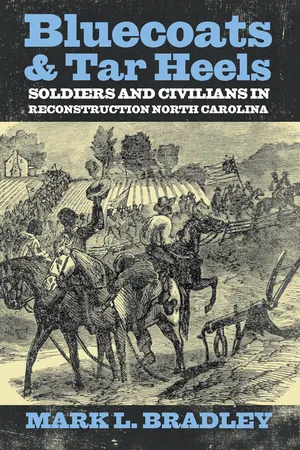
Bluecoats and Tar Heels: Soldiers and Civilians in Reconstruction North Carolina tells the story of the army's twelve-year occupation of North Carolina, a time of political instability and social unrest. Author Mark Bradley details the complex interaction between the federal soldiers and the North Carolina civilians during this tumultuous period. The federal troops attempted an impossible juggling act: protecting the social and political rights of the newly freed black North Carolinians while conciliating their former enemies, the ex-Confederates. The officers sought to minimize violence and unrest during the lengthy transition from war to peace, but they ultimately proved far more successful in promoting sectional reconciliation than in protecting the freedpeople.
Bradley's exhaustive study examines the military efforts to stabilize the region in the face of opposition from both ordinary citizens and dangerous outlaws such as the Regulators and the Ku Klux Klan. By 1872, the widespread, organized violence that had plagued North Carolina since the close of the war had ceased, enabling the bluecoats and the ex-Confederates to participate in public rituals and social events that served as symbols of sectional reconciliation. This rapprochement has been largely forgotten, lost amidst the postbellum barrage of Lost Cause rhetoric, causing many historians to believe that the process of national reunion did not begin until after Reconstruction. Rectifying this misconception, Bluecoats and Tar Heels illuminates the U.S. Army's significant role in an understudied aspect of Civil War reconciliation.
eBook - ePub
Bluecoats and Tar Heels
Soldiers and Civilians in Reconstruction North Carolina
- 382 pages
- English
- ePUB (mobile friendly)
- Available on iOS & Android
eBook - ePub
About this book
Information
Publisher
The University Press of KentuckyYear
2009Print ISBN
9780813133850
9780813125077
eBook ISBN
9780813138848
Chapter One
THE WARRIOR AS PEACEMAKER
Sherman and the Bennett Place Negotiations
Of the eleven states that comprised the Confederacy, North Carolina was the last to secede from the Union. Only after the fall of Fort Sumter and President Abraham Lincoln’s call for seventy-five thousand troops to suppress the rebellion did North Carolina succumb to the “secession mania” that had already swept the Deep South states. But Unionism and other forms of anti-Confederate dissent were far from extinguished in North Carolina. Although the state furnished more than 120,000 men to the Confederate army, Unionist sympathizers hid out in the eastern swamps and in the mountains bordering Tennessee. Many North Carolina Unionists—in the east, they were called “buffaloes,” and in the west, “tories”—actively resisted the Confederate government as guerrillas; others, including several thousand former slaves, enlisted in federal regiments. In 1864, a burgeoning peace movement briefly threatened to carry North Carolina out of the Confederacy. The state’s central counties, or “Quaker Belt,” became a haven for Unionists, deserters, and draft dodgers, many of them preying on helpless civilians. In early 1865, the problem became so acute that a force of six hundred troops was transferred from the frontlines in Virginia to round them up. The bitterness and rancor resulting from the conflict between Tar Heel Unionists and Confederates would persist long after the Civil War had officially ceased, resulting in an ongoing cycle of violence and bloodshed.
Despite the presence of federal troops along its coast for most of the war, North Carolina remained a strategic backwater until the conflict’s final months. While the major campaigns and battles raged elsewhere, the Union army contented itself with chipping away at the Tar Heel State’s coastline or with making an occasional foray across the western border of the state. In January 1865, however, the federal juggernaut began its invasion of North Carolina in earnest. Fort Fisher fell on January 15, closing Wilmington as a blockade running port and thus severing “the Life-line of the Confederacy”—so-called because Gen. Robert E. Lee’s Army of Northern Virginia had long relied on that entrepôt as its sole source of supplies from the outside world. For nine months, Lee’s army had defended Richmond, Virginia, the Confederate capital, but the closing of Wilmington rendered the fate of both Richmond and the Confederacy’s principal field army precarious at best. Wilmington itself fell on February 22.
During the first week of March, three Union forces were poised to overrun North Carolina. After a devastating march through South Carolina, Maj. Gen. William T. Sherman’s army of sixty thousand troops was winding northward into the vast longleaf pine forests of the Tar Heel State, while Maj. Gen. John M. Schofield’s thirty-thousand-man force was marching inland from New Bern and Wilmington toward a junction with Sherman at Goldsboro. At Greeneville, Tennessee, Maj. Gen. George Stoneman was preparing to lead his four-thousand-strong cavalry division on a destructive raid through the western part of the state. In mid-March, the Confederate army in North Carolina under Gen. Joseph E. Johnston attempted to crush elements of Sherman’s and Schofield’s forces at Wyse Fork, Monroe’s Crossroads, Averasboro, and Bentonville, but the Southerners lacked the numerical strength to defeat even a part of the federal force. After the junction of Sherman and Schofield at Goldsboro, the heavily outnumbered Johnston rested his army near Smithfield, anxiously awaiting Lee’s order to join him. Both Lee and Johnston believed their only hope lay in combining and then crushing Sherman before he could reach the forces commanded by the Union army’s general-in-chief, Lt. Gen. Ulysses S. Grant, besieging Richmond and Petersburg. There was just one problem: Sherman’s 90,000 effectives alone equaled the Confederates’ combined strength, with Grant fielding an additional 115,000 troops. By the spring of 1865, only a miracle could save the Confederacy.
Governor Zebulon B. Vance of North Carolina had seen the handwriting on the wall for several months. On January 18, 1865, Vance wrote Georgia governor Joseph E. Brown that their chief duty was “to hold the demoralized and trembling fragments of society and law together and prevent them from dropping to pieces until the rapidly hastening end of our struggle shall be developed.” Vance, however, was powerless to prevent the disintegration of his state’s social and legal fabric resulting from the presence of the contending armies. The closing days of the war brought untold suffering and privation to thousands of North Carolinians, underscoring Sherman’s declaration, “War is cruelty, and you cannot refine it.” Both Union and Confederate armies lived off the land, prompting former North Carolina governor Charles Manly to condemn the “horrid deeds” and “atrocious acts” of Yankees and Rebels alike. “Between the two fires desolation, plunder, & actual starvation await us,” Manly wrote. “God help the country.” In mid-April 1865, anxious Tar Heels held out scant hope for generous terms from the hated Sherman, yet that is precisely what the Union commander offered his defeated foe, much to the astonishment of outraged Northerners.1

County map of North Carolina at the beginning of 1870 (by L. Polk Denmark, from The Formation of the North Carolina Counties, 1663–1943, by David Leroy Corbitt. Raleigh: North Carolina Department of Archives and History, 1950)

U.S. Army posts in North Carolina, 1865–1877 (by Mark A. Moore)
Shortly before dawn on April 12, 1865, two riders galloped up to Sherman’s headquarters in the courthouse square at Smithfield, North Carolina. They bore momentous news from Grant: Lee had surrendered the Army of Northern Virginia at Appomattox Court House on April 9. Grant’s message quoted verbatim the surrender terms, which permitted Lee’s officers and men to return home, “not to be disturbed by the U.S. authorities as long as they observe their parole and the laws in force where they reside.” Sherman was overjoyed at the news that signaled the collapse of the Confederacy. “I hardly know how to express my feelings, but you can imagine them,” he wrote Grant. “The terms you have given Lee are magnanimous and liberal.” Sherman added that should Johnston “follow Lee’s example[,] I shall of course grant the same.” Unfortunately for Sherman, Johnston’s Army of Tennessee appeared to be retreating more rapidly than he could pursue. On the morning of the twelfth, the Confederates were camped beyond Raleigh, the state capital, about thirty miles to the northwest and well beyond Sherman’s grasp. Although he outnumbered the Confederates by more than three to one, Sherman realized that he could not compel Johnston’s surrender. The question that now confronted Sherman was this: Would Johnston capitulate, or would he allow his army to disperse into guerrilla bands? Sherman feared that if Johnston chose the latter course, the war could be protracted indefinitely.2
On the evening of April 12, as Union columns converged on Raleigh, Sherman met with a delegation from Governor Vance. The two representatives, University of North Carolina president David L. Swain and Confederate senator William A. Graham, bore a letter from Vance requesting “a personal interview . . . for the purpose of conferring upon the subject of a suspension of hostilities, with a view to further communications with the United States, touching the final termination of the existing war.” Vance’s letter indicated that the Tar Heel governor was anxious to negotiate separate peace terms, and it reminded Sherman of a proposal he had made to Governor Joseph E. Brown of Georgia the previous September. Sherman had offered to pay for his army’s supplies and cease his policy of destruction if Brown ordered the withdrawal of all Georgia troops from the Confederate army. Although Brown did not respond, Sherman believed that the Georgia governor would have cooperated but for fear of reprisal. Recalling President Abraham Lincoln’s encouragement of the Brown peace overture, the general therefore decided to repeat the experiment with Vance. “I will aid you all in my power to contribute to the end you aim to reach,” Sherman wrote Vance, “the termination of the existing war.” Even after Vance fled Raleigh upon receiving word of Graham and Swain’s capture, Sherman offered him and other government officials safe passage to the state capital and promised to retain Vance as governor.3
On the morning of April 13, Union soldiers entered Raleigh, and Sherman established his headquarters at the Governor’s Palace. Meanwhile, Sherman’s Confederate counterpart, General Johnston, was at Greensboro eighty miles to the west trying to convince a defiant President Jefferson Davis that “it would be the greatest of human crimes for us . . . to continue the war.” After questioning Johnston’s second-in-command, Gen. P. G. T. Beauregard, and then polling his cabinet, Davis realized that only he and Secretary of State Judah P. Benjamin still advocated fighting on. The Confederate president reluctantly yielded to the majority and dictated a message to Sherman, requesting a cease-fire “to permit the civil authorities to enter into the needful arrangements to terminate the existing war.” Johnston signed the letter and ordered it sent at once to Sherman in Raleigh. But Davis had no intention of negotiating with the Lincoln government and resumed his southward flight even before the arrival of Sherman’s reply.4
Johnston’s dispatch reached Sherman’s headquarters at midnight on April 15. Sherman informed Johnston that he was “fully empowered to arrange with you any terms for the suspension of further hostilities” between their armies. Ignoring Johnston’s request for a cease-fire “to permit the civil authorities” (italics added) to negotiate, Sherman wrote, “I undertake to abide by the same terms and conditions as were made by Generals Grant and Lee at Appomattox Court-House on the 9th instant.” Sherman also promised to secure a general cease-fire from Grant, and he assured Johnston, “I really desire to save the people of North Carolina the damage they would sustain by the march of this army through the central or western parts of this state.” In a letter to Grant and Secretary of War Edwin M. Stanton, Sherman stated that he would offer Johnston the same terms Grant had given Lee and be “careful not to complicate any points of civil policy.”5

Maj. Gen. William T. Sherman (Library of Congress)
Due to a subterfuge on the part of the Union cavalry commander, Brig. Gen. Judson Kilpatrick, Sherman’s message did not reach Johnston until Easter Sunday, April 16. Kilpatrick tried to convince Sherman that Johnston had engineered the delay to make his escape. But Sherman refused to be taken in and noted that Johnston “could not stop the movement of his troops till he got my letter, which I hear was delayed all day yesterday by your adjutant’s not sending it forward.” Sherman’s faith in Johnston’s sincerity was repaid when he received a dispatch from the Confederate cavalry commander, Lt. Gen. Wade Hampton, proposing a conference halfway between Kilpatrick’s headquarters at Durham’s Station and Hampton’s headquarters at Hillsborough. “The war is over—occupation’s gone!” Sherman blurted, quoting Shakespeare’s Othello.6
On the morning of April 17, as Sherman was boarding a train en route to his conference with Johnston, a coded message from Stanton arrived at the depot announcing Lincoln’s assassination. Sherman ordered the telegraph operator to keep the message confidential until his return, and the federal commander likewise said nothing about it to his subordinates. Instead, Sherman waited until he met with Johnston at the James Bennett farmhouse about five miles west of Durham’s Station. According to Sherman, beads of sweat formed on Johnston’s brow as he read Stanton’s message, and the Confederate commander pronounced Lincoln’s death “the greatest possible calamity to the South.” Sherman said that he dreaded “the effect of this act on the country at large and on the armies,” particularly his forces camped around Raleigh.
When Johnston reminded Sherman that his mission was to arrange an armistice to enable the civil authorities to negotiate, the latter objected because the U.S. government refused to recognize the Confederacy. Nevertheless, Sherman told Johnston that he wanted to spare the South further devastation, and he spoke in a tone that the Confederate commander believed “carried conviction of sincerity.” Sherman thereupon offered Johnston the terms that Grant had given Lee at Appomattox Court House. Johnston conceded that Grant’s terms were indeed generous—to a surrounded foe, that is. He then noted that his army was camped around Greensboro, eighty miles west of Sherman’s army at Raleigh. Why not negotiate for the surrender of all the remaining Confederate forces, Johnston suggested, and make one job of it? Sherman was skeptical and asked how he proposed to guarantee the surrender. Johnston replied that he could obtain President Davis’s personal authorization.
The two men discussed possible surrender terms. Sherman said that he had recently conferred with Lincoln, and the late president had been anxious to get the southern men back to their homes as soon as possible. The Union commander added that the northern people harbored no vindictive feelings against the southern soldiery, though they felt far less charitable toward Davis and other southern political leaders. It soon became apparent to Johnston that Sherman would refuse to grant amnesty to Davis and his cabinet, an essential condition for the obvious reason that Davis would likely regard it as such. For his part, Sherman remained doubtful of Johnston’s ability to fulfill his end of the bargain. The generals ended their conference around mid-afternoon to give Johnston time to communicate with Davis and enable Sherman to reach Raleigh before word of Lincoln’s assassination could spread. They agreed to meet again at the Bennett house at noon the next day.7
When Sherman returned to Raleigh, he discovered that news of Lincoln’s assassination had already spread throughout the capital. A crowd of angry soldiers met him at the depot, shouting: “Don’t let Johnston surrender!” According to an Illinois major, “The army is crazy for vengeance. If we make another campaign it will be an awful one. . . . We hope Johnston will not surrender. God pity this country if he retreats or fights us.” That night, Sherman strengthened the guard patrolling Raleigh, posted pickets on all roads into town, and ordered all unauthorized soldiers found on the streets arrested and jailed. The Union commander spent an anxious night riding through the camps of his armies, calming his men. He later claimed that without his efforts, “Raleigh would have been destroyed.” Indeed, one of Sherman’s subordinates, Maj. Gen. John A. Logan, had to threaten a mob of his men with cannon fire at point-blank range to prevent them from laying waste to the capital.8
Given the vengeful temper of their men and the daunting prospect of pursuing “a dissolving and fleeing” foe, it was hardly surprising that Sherman’s subordinates urged him to grant generous terms to Johnston. One general even suggested that if it became necessary, Sherman should offer Jefferson Davis a seagoing vessel to make his escape. Although he did not mention it at the time, Sherman may have recalled his promise to Mayor James M. Calhoun of Atlanta the previous September: once peace was at hand, “you may call on me for anything—Then will I share with you the last cracker, and watch with you to shield your homes & families against danger from every quarter.” Sherman’s conciliatory attitude was bolstered by his conversations with Lincoln at City Point in March. Sherman recalled that the late president “contemplated no revenge—no harsh measures, but quite the contrary, and that [the Rebels’] suffering and hardships in the war would make them the more submissive to Law.” Although Sherman’s decision to offer his enemy generous terms was based on strategic considerations, it was also consistent with his previous thinking.9
While Sherman conferred with his generals, Johnston consulted two Confederate cabinet members, Secretary of War John C. Breckinridge and Postmaster General John H. Reagan, at Hampton’s headquarters near Hills-borough. The Confederate...
Table of contents
- Cover
- Title
- Copyright
- Contents
- List of Illustrations
- Acknowledgments
- Prologue: Taking on Mission Impossible
- 1. The Warrior as Peacemaker: Sherman and the Bennett Place Negotiations
- 2. Military Rule by Default: Schofield’s One-Month Regime
- 3. An Uncertain Relationship: The Interaction of Soldiers and Civilians in 1865
- 4. The Return of Civil Government
- 5. The Struggle for Civilian Supremacy
- 6. Military Reconstruction under Sickles
- 7. Military Reconstruction under Canby
- 8. North Carolina Rejoins the Union
- 9. Fighting Terrorism: The Army and the Klan
- Epilogue: Reconciliation with a Vengeance
- Appendix: Regional and Ethnic Origins of Federal Troops in North Carolina, 1868–1870
- Notes
- Bibliography
- Index
Trusted by 375,005 students
Access to over 1.5 million titles for a fair monthly price.
Study more efficiently using our study tools.
Frequently asked questions
Yes, you can cancel anytime from the Subscription tab in your account settings on the Perlego website. Your subscription will stay active until the end of your current billing period. Learn how to cancel your subscription
No, books cannot be downloaded as external files, such as PDFs, for use outside of Perlego. However, you can download books within the Perlego app for offline reading on mobile or tablet. Learn how to download books offline
Perlego offers two plans: Essential and Complete
- Essential is ideal for learners and professionals who enjoy exploring a wide range of subjects. Access the Essential Library with 800,000+ trusted titles and best-sellers across business, personal growth, and the humanities. Includes unlimited reading time and Standard Read Aloud voice.
- Complete: Perfect for advanced learners and researchers needing full, unrestricted access. Unlock 1.5M+ books across hundreds of subjects, including academic and specialized titles. The Complete Plan also includes advanced features like Premium Read Aloud and Research Assistant.
We are an online textbook subscription service, where you can get access to an entire online library for less than the price of a single book per month. With over 1.5 million books across 990+ topics, we’ve got you covered! Learn about our mission
Look out for the read-aloud symbol on your next book to see if you can listen to it. The read-aloud tool reads text aloud for you, highlighting the text as it is being read. You can pause it, speed it up and slow it down. Learn more about Read Aloud
Yes! You can use the Perlego app on both iOS and Android devices to read anytime, anywhere — even offline. Perfect for commutes or when you’re on the go.
Please note we cannot support devices running on iOS 13 and Android 7 or earlier. Learn more about using the app
Please note we cannot support devices running on iOS 13 and Android 7 or earlier. Learn more about using the app
Yes, you can access Bluecoats and Tar Heels by Mark L Bradley in PDF and/or ePUB format, as well as other popular books in History & American Civil War History. We have over 1.5 million books available in our catalogue for you to explore.