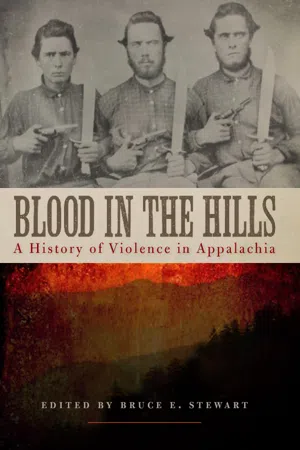
To many antebellum Americans, Appalachia was a frightening wilderness of lawlessness, peril, robbers, and hidden dangers. The extensive media coverage of horse stealing and scalping raids profiled the region's residents as intrinsically violent. After the Civil War, this characterization continued to permeate perceptions of the area and news of the conflict between the Hatfields and the McCoys, as well as the bloodshed associated with the coal labor strikes, cemented Appalachia's violent reputation. Blood in the Hills: A History of Violence in Appalachia provides an in-depth historical analysis of hostility in the region from the late eighteenth to the early twentieth century. Editor Bruce E. Stewart discusses aspects of the Appalachian violence culture, examining skirmishes with the native population, conflicts resulting from the region's rapid modernization, and violence as a function of social control. The contributors also address geographical isolation and ethnicity, kinship, gender, class, and race with the purpose of shedding light on an often-stereotyped regional past. Blood in the Hills does not attempt to apologize for the region but uses detailed research and analysis to explain it, delving into the social and political factors that have defined Appalachia throughout its violent history.
- 422 pages
- English
- ePUB (mobile friendly)
- Available on iOS & Android
eBook - ePub
About this book
Information
Publisher
The University Press of KentuckyYear
2011Print ISBN
9780813175829
9780813134277
eBook ISBN
9780813140285
Topic
GeschichteSubtopic
Nordamerikanische GeschichteChapter 1
Violence, Statecraft, and Statehood
in the Early Republic
The State of Franklin, 1784–1788
In December 1784, a small contingent of upper Tennessee Valley political leaders met in Washington County, North Carolina’s, rustic courthouse to discuss the uncertain postrevolutionary political climate that they believed threatened their regional political hegemony, prosperity, and families. The Jonesboro delegates fatefully decided that their backcountry communities could no longer remain part of their parent state and that North Carolina’s westernmost counties (at the time Washington, Sullivan, and Greene counties) must unite and form America’s fourteenth state.1 From 1785 through 1788, the leaders of the Franklin separatist movement struggled to secure support for their state from the U.S. Confederation Congress, the North Carolina General Assembly, high-profile national political figures, and their bitterly divided neighbors. Throughout the three-year effort to win Franklin’s admission into the union, violence and the threat of violence plagued the political movement.
Despite involving a relatively small number of western residents and the state of Franklin’s brief existence, Amerindian clashes, internal political factionalism, and divisive western political policies resulted in a high level of backcountry bloodshed in the upper Tennessee Valley. From supposed violent tendencies culturally engrained in the region’s Scotch-Irish residents to the anarchic impulses unleashed by mountain isolation, there is no shortage of explanations for Appalachian frontier violence. When the rise and fall of the state of Franklin and the corresponding level of regional hostilities are briefly examined, many of these earlier raisons d’être regarding postrevolutionary Appalachian violence are replaced with more compelling explanations grounded in specific historical circumstances and a complex collision of political and economic forces. The violence surrounding the state of Franklin resulted from the intersection of three primary causes: national and regional postrevolutionary political instability, fierce regional and state economic and political competition, and finally skillful and determined Amerindian diplomatic and martial resistance to western encroachment. In the end, culture and physiography proved much less important factors than the struggle for regional economic and political hegemony in the chaos surrounding the state of Franklin.
Since the “discovery” and “invention” of Appalachia in the last decades of the nineteenth century, local color writers, missionaries, reformers, and scholars have offered their own ideas regarding the root causes of Appalachian violence. Two of the earliest and most persistently reoccurring arguments offered to explain the perception of a hyperviolent mountain culture by relying upon ethnic and cultural generalizations and a fundamental misunderstanding of Appalachia’s past, both of which are challenged by the socioeconomic conditions surrounding the state of Franklin. Beginning in the 1880s, the outbreak of feuds and labor militancy associated with the trauma accompanying rural industrialization resulted in the application of the principles of social Darwinism to Appalachia in order to decipher the underlying factors behind mountain violence.2 The fallacious notion that nearly all southern Appalachians descended from Scotch-Irish immigrants gave birth to the idea of the “Appalachian Highlander,” who carried a cultural and historical propensity to act “clannish”; live outside of the law; and, most important, repeatedly and unabashedly engage in acts of violence.3 In his 1989 work Albion’s Seed: Four British Folkways in America, historian David Hackett Fischer updates the cultural comparison of southern Appalachia to the Scottish Highlands. Fischer argues that in what he labels as “border culture,” Highlands Scots, driven from their homes during the eighteenth-century clearances, carried their culture to Ireland (Ulster) and eventually on to the Appalachian Mountains. Fischer contends that several of the defining characteristics of this “border culture,” including individualism, “autarchy,” and “retributive justice,” created a “climate of violence in the American backcountry.”4
Out of the search for an explanation for the perceived persistence of this violent and clannish “border culture” in the southern mountains emerged the theory of Appalachian isolation and the resulting cultural stagnation. In short, the absence of trade and transportation connections, geographic distances, and geological obstacles retarded cultural, political, and economic growth in the region. According to scholars, educators, and reformers, Appalachian isolation preserved both positive and negative aspects of Scotch-Irish culture and prevented the “modernization” and “Americanization” of the southern mountains. When married to the “border culture,” in theory, Appalachian isolation perpetuated generational and trans-Atlantic mountain violence and offered a clear explanation for the brutal Indian wars of the eighteenth century, the Civil War bushwhacking and feuding of the nineteenth century, and the labor militancy of the twentieth century.5
Of course, Appalachian scholars have spent the better part of fifty years demonstrating that both the “Appalachian Highlander”/“border culture” and isolation theories are at best exaggerated and at worst historically inaccurate.6 As one historian notes, the Scotch-Irish were not nearly as culturally predisposed to violence as many scholars have asserted. Despite the Scotch-Irish bringing “fighting techniques like biting and eye-gouging to the colonies,” preexisting frontier conditions in the areas they settled were far more critical in determining the levels of backcountry violence than were ethnic origins.7 Furthermore, “assumptions about the cultural homogeneity” of southern Appalachia represent a “gross misrepresentation” of the region’s ethnic diversity.8 A cursory glance at the socioeconomic conditions in the upper Tennessee Valley during the Franklin separatist movement provides further evidence that ethnicity and isolation played very little role in the persistence of frontier violence in the southern mountains. First, the upper Tennessee Valley’s population at the end of the eighteenth century was relatively diverse and far from being homogeneously Scotch-Irish. In a survey conducted of the roughly 31,913 residents of the Tennessee country in 1790, approximately 83.1 percent were English, 11.2 percent were Scotch-Irish, and 2.3 percent were Irish. Additionally, the 1790 census also included Germans, Welsh, Dutch, Swiss, Alsatians, Africans, and French Huguenots.9 Many of the leading figures in the Franklin movement and the opposition party (Tiptonites) belonged to these minority groups, including Franklin governor John Sevier (French Huguenot), adjutant general of the Franklin militia George Elholm (Danish), and leading anti-Franklinite Evan Shelby (Welsh).10
The “isolation theory” also proves historically inaccurate as an explanation for Franklin-related violence. Appalachian scholars have effectively demonstrated that Appalachia has never been isolated from the rest of North America. Historian Wilma A. Dunaway convincingly argues that from the moment of Euroamerican contact, Appalachia’s indigenous residents participated in a “capitalist export economy” that linked the region to global pelt markets. As Euroamerican settlements developed and advanced across the mountain backcountry, local and regional markets expanded that connected Amerindian and Euroamerican mountain communities to local, regional, and international markets. These market connections served as the conduits for not only the exchange of goods and services but also the transference of culture, technology, and information. As geographer Gene Wilhelm contends, “The idea that the Appalachian Mountains acted as a physical barrier … hardly stands up against the evidence at hand.” In his examination of early eastern Tennessee, historian David C. Hsiung thoroughly debunks the idea that the antebellum upper Tennessee Valley was cut off from the outside world. He argues, “East Tennessee’s road system and economic ties should dispel any notions that the region has been like a fly trapped in amber, isolated and untouched for generations.”11 Appalachian scholars’ identification of the existence and continued expansion of private and public roads, repeated demands for further internal improvements, and evidence of regional market connections across southern Appalachia have largely dispelled the antebellum “isolation theory.”12
Ethnicity and geographic isolation ultimately do not explain the high levels of violence and fear that surrounded the Franklin statehood movement. However, postrevolutionary political instability within the national, state, and local governments and a high-stakes competition for control over the region’s emerging commercial economy and political system do stand as compelling causes underlying the anarchy of Tennessee Valley separatism. In his sweeping examination of the underlying factors behind America’s fluctuating homicide rates, historian Randolph Roth argues that frontier regions and communities were not intrinsically violent due to their cultural or ethic composition. Instead, Roth identifies four historical variables that he believes determined the level of backcountry homicide rates: confidence that a government is “stable” and effective at defending person and property, belief in the “legitimacy” and integrity of a government, level of community cohesion fostered by socioeconomic and political bonds, and community acceptance of the authority of a ruling class. Roth’s analysis of the correlation between political stability and violence is particularly revealing when applied to the upper Tennessee Valley during the Franklin separatist movement. Roth states, “If no government can establish uncontested authority and impose law and order, if political elites are deeply divided and there is no continuity of power or orderly succession, men can … take up arms on behalf of particular political factions or racial groups and kill without restraint.”13
Following the American Revolution, the national government struggled under the weight of the severely restrictive Articles of Confederation, war debts, specie shortages (British pound), currency deflation, the loss of British markets, and the destruction of America’s urban centers of commerce and the merchant fleet. Additionally, the United States proved incapable of protecting its western frontier from Amerindian resistance movements, foreign threats (Spain and Great Britain), and Western separatists.14 The North Carolina state government found itself in a very similar situation during the postwar years. North Carolina’s political leadership confronted a growing postrevolutionary Cherokee resistance movement on its western fringes, significant war debt, and disaffected western communities.15 The dire economic and political situation of both the national and the North Carolina governments created a geopolitical climate in the upper Tennessee Valley that was clouded by uncertainty and fostered widespread citizen discontent.
The Franklin statehood movement emerged out of this political uncertainty and the policies enacted by both the Confederation Congress and the North Carolina Assembly aimed at solving these economic and diplomatic challenges. The beginning of the Franklin statehood movement was a direct result of a piece of North Carolina legislation aimed at ameliorating the state’s postrevolutionary economic crisis. One of the many strategies the national government developed to reduce the national debt required that states with sizeable tracts of western lands either cede their territory to the federal government or face the prospect of being saddled with steep taxes on these lands. The national government in turn planned to divide up the ceded western lands, sell the tracts, and use the proceeds to reduce the national debt. Beginning in 1780, several of these states, including New York (1780) and Virginia (1781), relinquished their western territory to the national government. North Carolina’s political leadership was divided over the western land-cession issue. Many of the state’s eastern political leaders argued that the state’s investments in infrastructural development and Indian diplomacy made the territory simply too valuable to turn over to the national government. However, with the intentionally obscured support of western political figures, including many future leaders of the state of Franklin, the state finally ceded its western lands with the passage of the Cession Act in April 1784.16

John Sevier (1745–1815), engraving. Courtesy of the North Carolina State Archives.
Despite the fact that many of the leading men of the upper Tennessee Valley lobbied and voted in support of the Cession Act, after the legislation’s passage, many of the region’s political and economic leading figures publicly criticized the legislation and used manufactured outrage to promote the creation of a new state out of their communities. The first official discussion related to the creation of an independent state occurred just four months after the passage of the Cession Act. During the legislature’s August meeting in Jonesboro, the forty delegates to the as yet unnamed Franklin Assembly decried their “abandonment” by the state of North Carolina with the passage of the Cession Act, relayed their fears that they were being thrown to the Indian “savages,” and expressed their desire to form an independent state. As news of the Jonesboro meeting reached eastern North Carolina, the state’s political leadership quickly realized that western political and business leaders had duped them into passing the legislation. A few months later, North Carolina repealed the Cession Act, a decision that unleashed a wave of partisan anger across the Tennessee Valley and left many western residents unsure about who held political authority in their own neighborhoods.17
The decision to repeal the Cession Act triggered the December 1784 Jonesboro meeting, in which the first signs of political factionalism developed among the leaders of the upper Tennessee Valley. Proponents of statehood argued that the formation of a new state would allow them to direct their taxes toward improving their own regional infrastructure, encourage emigration into the region, and create a state government responsive to the demands of westerners. Former Revolutionary War hero turned Tennessee Valley politician John Sevier, a man destined to serve as the state of Franklin’s only governor, initially led the opposition to the statehood proposal. Sevier and other statehood opponents warned that political separatism was a very radical proposition and asserted that North Carolina’s expansion of backcountry defenses and repeal of the Cession Act eliminated the primary grievances of western residents. Despite his initial reluctance to support statehood, William Cocke, one of Sevier’s most trusted advisors and the state of Franklin’s most skilled diplomat, ultimately convinced Sevier to join the movement. By the closing of 1784, North Carolina’s passage and repeal of the Cession Act had opened a deep fissure that polarized the Tennessee Valley’s communities. A region once united by Indian warfare, the struggle for American independence, and a shared political and economic agenda succumbed to the political chaos and partisanship fostered by the North Carolina Assembly’s wavering western policies and the manipulative political machinations of an ambitious cabal of Tennessee Valley political and economic leading men.18
The political partisanship and regional instability that began with the Cession Act and...
Table of contents
- Cover
- New Directions in Southern History
- Title
- Copyright
- Contents
- List of Illustrations
- Preface
- Introduction Bruce E. Stewart
- 1. Violence, Statecraft, and Statehood in the Early Republic: The State of Franklin, 1784–1788 Kevin T. Barksdale
- 2. “Devoted to Hardships, Danger, and Devastation”: The Landscape of Indian and White Violence in Wyoming Valley, Pennsylvania, 1753–1800 Kathryn Shively Meier
- 3. “Our Mad Young Men”: Authority and Violence in Cherokee Country Tyler Boulware
- 4. The “Ferocious Character” of Antebellum Georgia’s Gold Country: Frontier Lawlessness and Violence in Fact and Fiction John C. Inscoe
- 5. “A Possession, or an Absence of Ears”: The Shape of Violence in Travel Narratives about the Mountain South, 1779–1835 Katherine E. Ledford
- 6. Violence against Slaves as a Catalyst in Changing Attitudes toward Slavery: An 1857 Case Study in East Tennessee Durwood Dunn
- 7. “These Big-Boned, Semi-Barbarian People”: Moonshining and the Myth of Violent Appalachia, 1870–1900 Bruce E. Stewart
- 8. “Deep in the Shades of Ill-Starred Georgia’s Wood”: The Murder of Elder Joseph Standing in Late-Nineteenth-Century Appalachian Georgia Mary Ella Engel
- 9. Race and Violence in Urbanizing Appalachia: The Roanoke Riot of 1893 Rand Dotson
- 10. Assassins and Feudists: Politics and Death in the Bluegrass and Mountains of Kentucky T. R. C. Hutton
- 11. “A Hard-Bitten Lot”: Nonstrike Violence in the Early Southern West Virginia Smokeless Coalfields, 1880–1910 Paul H. Rakes and Kenneth R. Bailey
- 12. “The Largest Manhunt in Western North Carolina’s History”: The Story of Broadus Miller Kevin W. Young
- 13. The Murder of Thomas Price: Image, Identity, and Violence in Western North Carolina Richard D. Starnes
- List of Contributors
- Index
Trusted by 375,005 students
Access to over 1.5 million titles for a fair monthly price.
Study more efficiently using our study tools.
Frequently asked questions
Yes, you can cancel anytime from the Subscription tab in your account settings on the Perlego website. Your subscription will stay active until the end of your current billing period. Learn how to cancel your subscription
No, books cannot be downloaded as external files, such as PDFs, for use outside of Perlego. However, you can download books within the Perlego app for offline reading on mobile or tablet. Learn how to download books offline
Perlego offers two plans: Essential and Complete
- Essential is ideal for learners and professionals who enjoy exploring a wide range of subjects. Access the Essential Library with 800,000+ trusted titles and best-sellers across business, personal growth, and the humanities. Includes unlimited reading time and Standard Read Aloud voice.
- Complete: Perfect for advanced learners and researchers needing full, unrestricted access. Unlock 1.5M+ books across hundreds of subjects, including academic and specialized titles. The Complete Plan also includes advanced features like Premium Read Aloud and Research Assistant.
We are an online textbook subscription service, where you can get access to an entire online library for less than the price of a single book per month. With over 1.5 million books across 990+ topics, we’ve got you covered! Learn about our mission
Look out for the read-aloud symbol on your next book to see if you can listen to it. The read-aloud tool reads text aloud for you, highlighting the text as it is being read. You can pause it, speed it up and slow it down. Learn more about Read Aloud
Yes! You can use the Perlego app on both iOS and Android devices to read anytime, anywhere — even offline. Perfect for commutes or when you’re on the go.
Please note we cannot support devices running on iOS 13 and Android 7 or earlier. Learn more about using the app
Please note we cannot support devices running on iOS 13 and Android 7 or earlier. Learn more about using the app
Yes, you can access Blood in the Hills by Bruce E. Stewart in PDF and/or ePUB format, as well as other popular books in Geschichte & Nordamerikanische Geschichte. We have over 1.5 million books available in our catalogue for you to explore.