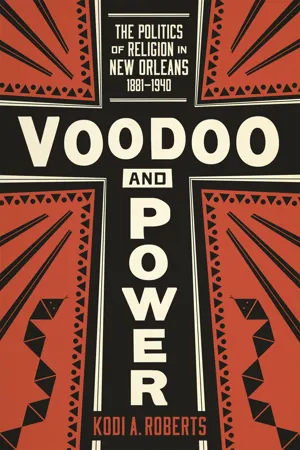
The racialized and exoticized cult of Voodoo occupies a central place in the popular image of the Crescent City. But as Kodi A. Roberts argues in Voodoo and Power, the religion was not a monolithic tradition handed down from African ancestors to their American-born descendants. Instead, a much more complicated patchwork of influences created New Orleans Voodoo, allowing it to move across boundaries of race, class, and gender. By employing late nineteenth and early twentieth-century first-hand accounts of Voodoo practitioners and their rituals, Roberts provides a nuanced understanding of who practiced Voodoo and why.Voodoo in New Orleans, a melange of religion, entrepreneurship, and business networks, stretched across the color line in intriguing ways. Roberts's analysis demonstrates that what united professional practitioners, or "workers, " with those who sought their services was not a racially uniform folk culture, but rather the power and influence that Voodoo promised. Recognizing that social immobility proved a common barrier for their patrons, workers claimed that their rituals could overcome racial and gendered disadvantages and create new opportunities for their clients.Voodoo rituals and institutions also drew inspiration from the surrounding milieu, including the privations of the Great Depression, the city's complex racial history, and the free-market economy. Money, employment, and business became central concerns for the religion's practitioners: to validate their work, some began operating from recently organized "Spiritual Churches, " entities that were tax exempt and thus legitimate in the eyes of the state of Louisiana. Practitioners even leveraged local figures like the mythohistoric Marie Laveau for spiritual purposes and entrepreneurial gain. All the while, they contributed to the cultural legacy that fueled New Orleans's tourist industry and drew visitors and their money to the Crescent City.
- 248 pages
- English
- ePUB (mobile friendly)
- Available on iOS & Android
eBook - ePub
About this book
Information
I
LAVEAU AND ANDERSON
1
THE LEGACY AND CULTURE OF VOODOO IN NEW ORLEANS
In September 1947 the New Orleans Item published an intriguing story about a housewife on Carrolton Avenue who had become alarmed one morning when, while sweeping her front steps, she discovered three slices of cake “unobtrusively tucked under her doorstep.”1 Frightened for her life, the woman immediately called the police. According to the Item, the woman had nearly fainted, and the police, rather than dismissing the woman as a crank caller, had “listened with concern.” The author of the article turned to local culture to explain the woman’s alarm and the authorities’ accompanying concern, suggesting that as residents of New Orleans, both the woman and the police had recognized the seemingly innocuous cake as a threat “all at once”: to them, it was obvious that the cake was a gris-gris, the material manifestation of a Voodoo ritual. The police learned in the course of their investigation that the woman was a landlady who had filed eviction notices for some of her tenants, and they now believed that those tenants were retaliating via Voodoo. The Item claimed that “analysis” had suggested that the cake contained nail parings, pulverized rent receipts, a tomcat’s antenna whiskers, “remains of a rooster’s virility,” and the grease from a candle burned to Saint John the Baptist, all of which positively identified the cake to the locals as a gris-gris and the work of Voodoo.
It is difficult to imagine what analysis or source could have yielded such detailed results to this journalist, but his report does point to his knowledge of the material culture and rituals associated with Voodoo. In the article, the author traces the origins of Voodoo from Africa to tropical islands off its coast, finally to New Orleans’s own Congo Square, Bayou St. John, and the Crescent City’s “greatest practitioner of all,” its most famous nineteenth-century Voodoo queen, Marie Laveau. While he claims that Voodoo had diminished in both influence and importance in New Orleans by the mid-twentieth century, he also maintains that it pervaded the entirety of the city and that its practitioners were both Black and white. The author indicates that the central rhetoric and ideology of Voodoo revolved around the concept of power. He compares communism, the most feared political ideology in the United States in the mid-twentieth century, to Voodoo, the most menacing cultural practice in New Orleans. He claims that just as the rhetoric of “party-liners” was littered with persistent use of the term unity, the rhetoric of Voodoo practitioners similarly revolved around the concept of “power,” even in matters of love, employers, and life and death.2
While apparently favoring sensationalism and folklore over research that would include the perspective of actual practitioners, the author of the aforementioned article does hit on some points that are important for understanding how and why workers and their clients engaged in the religious and magical rites known as hoodoo or Voodoo. By the mid-twentieth century, Voodoo as a collection of religious and magical practices was familiar to many in and around the city of New Orleans. A group of saints, most of whom are recognizable from Roman Catholic and Christian lore, were employed by practitioners along with a group of magical formulas and mystical texts to secure social and economic benefits in the material world.
The author of the article in the New Orleans Item suggests, as have many of his contemporaries and scholars since, that Voodoo as practiced in New Orleans originated in Africa or Haiti. Unfortunately, the legal proscriptions against slaves’ meeting together or with freed people in antebellum Louisiana and regulations against fortune-telling, practicing medicine without a license, and obtaining money “under false pretenses” after emancipation made practitioners of Voodoo subject to legal prosecution and thus loath to practice in the open. The clandestine nature of these rituals made it unlikely that any outsider would obtain firsthand knowledge of the rituals or belief structure of Voodoo practitioners. It was similarly unlikely that any practitioner would record his own or his coreligionists’ activities, for fear of legal reprisals. The questionable legal status of these practices also made their institutionalization difficult, complicating the establishment of uniform standards of practice or inclusion for a canon or community of Voodoo practitioners in New Orleans. Thus, the set of practices employed by practitioners, the belief structures that informed them, and the origin and lineage of those practices went almost completely undocumented by any inside, reliable source for nearly the entire nineteenth century. It is therefore difficult to establish when and where Voodoo as practiced in New Orleans originated.
Further, the rituals and beliefs reported by practitioners in the early twentieth century were extraordinarily malleable. Evidence suggests that rituals varied from one practitioner to the next, probably owing to the absence of an institutionalized structure or authority. So in addition to the lack of evidence regarding the origins of Voodoo in New Orleans in the nineteenth century, what evidence we have about practices in the succeeding period suggests that those practices may have been dynamically shifting to meet the needs of practitioners. This in turn implies that what workers, clients, and outsiders classified as Voodoo by the turn of the twentieth century may have differed drastically not only from any predecessors in Haiti or antecedents in Africa but also from similar practices in nineteenth-century New Orleans. Therefore, this study approaches Voodoo as both geographically and temporally specific to New Orleans from the end of the nineteenth to the middle of the twentieth century. Rather than being essentially African as scholars to date have claimed, New Orleans Voodoo as practiced in this period was a dynamic set of historically contingent spiritual and religious practices whose practitioners drew overwhelmingly on the immediate social and economic contexts of the early twentieth-century United States and of New Orleans specifically for the purpose, direction, and shape of their rituals and ideology.
In effect, then, while presumptive on the question of origins, the aforementioned New Orleans Item article may have hit the proverbial nail on the head in asserting the cultural pervasiveness of Voodoo in New Orleans and the centrality of power to the rituals. Many Western religions have attempted to separate spiritual concerns from the material world. By contrast, practitioners of Voodoo in early twentieth-century New Orleans employed these rituals with the understanding that they would yield tangible benefits in their lives. Those rituals were, generally speaking, attempts to counter what practitioners viewed as disadvantages in power. The power clients and workers sought to obtain was most often social or economic. They frequently attempted to employ Voodoo to take fuller control of the individuals with whom they interacted and the material circumstances under which they interacted with them. Workers necessarily provided services for a fee, and their clients expected an immediate result in exchange for that fee. In turn, workers offered money, candles, and other ritual “sacrifices” or payment to the saints and spirits employed, expecting observable returns in exchange. Voodoo is therefore a business, perhaps in a more obvious way than some other American religions. Despite its potential to alter uneven power relations, the racial stigma attached to Voodoo in the Jim Crow U.S. South made it unappealing to those with access to more traditional avenues of social and economic influence. This racialization was buttressed by a focus on Voodoo’s purported origins in dark corners of Haiti and Africa. Thus, Voodoo was most frequently employed by those who believed themselves to be at a social and economic disadvantage or felt constrained by social norms of class, racial, and gender classification. It might be most accurate to say that Voodoo as practiced in New Orleans generally revolved around the promise of power for those who lacked power in relation to whatever adversary they challenged via ritual and magic.
Long regarded as the most powerful Voodoo practitioner in New Orleans, Marie Laveau became the symbol of Voodoo’s influence in the city. Since her death in 1881, Marie Laveau has become a cultural icon in New Orleans. Her celebrity, while widespread across racial, cultural, and geographic lines, was not unambiguous. She was well known enough that after her death numerous local newspapers published accounts of her life, some national periodicals mentioned her in connection with stories about Voodoo, and she was also mentioned in a number of academic studies. However, not everyone in New Orleans welcomed the association of the city and its population with the cultural legacy of Voodoo. Negative perceptions in periodicals and local-color stories of the religious practices of Marie Laveau seemed to be a part of a stigma, due again to the racist equating of savagery with Blackness, and Blackness with Voodoo. Thus, the infamous queen and Voodoo were associated with immorality, backwardness, and superstition. In spite of these stigmas, however, Marie Laveau’s legend became part of the complex cultural landscape of New Orleans, and thus her legacy carried, along with the negative perspectives on Voodoo, associations with everything that made New Orleans unique and intriguing.
The Laveau Legacy
It was increasingly common by the twentieth century for those who identified themselves as professional practitioners of Voodoo, or workers, to claim descent from the famous Voodoo queen to mark her as the source of their own spiritual power and lend authenticity to their rites. While Voodoo was associated with cultural backwardness and immorality, Laveau was a powerful figure in New Orleans folklore. Thus, on occasion even those attempting to eschew the barbarism and immorality attributed to Voodoo practitioners proudly claimed connections to Laveau.
Unpacking this ambiguity is key to understanding how Voodoo overcame the stigma of racialization and cultural marginalization to become a highly recognizable, even highlighted component of New Orleans’s exotic culture. By the early twentieth century, Voodoo had become woven into the cultural tapestry of the Crescent City. Despite attempts to racialize and thereby demonize the practices of workers and their clients by claiming that they were employed only by gullible Blacks and the most lowly whites, citizens and outsiders of both races and genders began to identify Voodoo as a component of the rich and unusual cultural landscape that characterized New Orleans. The mythology surrounding Marie Laveau as a figure, the seemingly infinite permutations of her biography, and the debates among those who remembered her or stories about her reveal attempts to lay claim to Marie Laveau by any number of groups and individuals in the city, not just the African American population. African Americans, Afro-Creoles, white New Orleanians, workers, Catholics, and Spiritualists all put their own spin on the Laveau legacy in attempts to somehow claim association with one of the most famous figures in the city’s history. By the twentieth century her supposed tomb had become a tourist attraction, with sightseers crossing her crypt with red brick as part of faux Voodoo rituals and leaving offerings as part of quotidian cemetery tours. Whether or not claims made on the Laveau legacy were accurate, the association with power, economic savvy, and local culture evoked by her name help to explain why even locals who eschewed association with Voodoo attempted to lay claim to Laveau.
In turn, the mythology that arose around the figure of Laveau included accounts of her practicing almost every ritual, economic, and social tradition associated with early twentieth-century Voodoo. In recounting Laveau’s rituals as identical to their own, workers active decades after Laveau’s death depicted themselves as having staunchly held to trends and rituals she created or popularized. It is likely that they frequently read their present practices into the mythology in order to legitimize their work in the eyes of clients and colleagues. Their practice of these rituals established Marie Laveau as a cultural icon central to their brand of Voodoo. Following Laveau’s death, many believers traveled to her gravesite to ask for favors and thereby claim some of her power as their own. While many other saints and spirits populated the metaphysical landscape of Voodoo in New Orleans, Marie Laveau was the central personality and source of power for many of the workers in the early twentieth century. Workers were ideologically linked to Laveau, who was culturally anchored to New Orleans. Therefore, for workers as well as the clients who sought them out and the outsiders who remembered Laveau as one of the city’s most important cultural icons, Voodoo was indelibly etched on the culture of New Orleans.
The goal here is to unpack the meaning of the widely varied, frequently contradictory accounts of the life, power, and spiritual work of Marie Laveau. Other scholars have done careful research to distinguish between the historical Marie Laveau and the legends that arose after her death.3 Rather than retreading that scholarship, I will demonstrate how the Laveau mythology functioned for the workers for whom she was such an important figure and how debates about that mythology by New Orleanians seemingly uninvolved in Voodoo mark Laveau as a figure, and Voodoo as a cultural artifact, in the collective consciousness of the city. As important as the ostensibly Catholic saints that populated the pantheon of Voodoo practitioners, by the early twentieth century the recently deceased Voodoo queen was viewed by practitioners and outsiders as the originator, innovator, and archetype of Voodoo as practiced in New Orleans. Her mythohistorical biography as told and retold by New Orleanians marked her and her work as unquestionably linked to the social and economic politics of race and entrepreneurship in early twentieth-century New Orleans. Therefore, by examining the specific stories told about Laveau, we can begin to understand how the unique cultural milieu of New Orleans shaped and characterized the practice of Voodoo. In short, the Laveau mythology, the precedents it set, and the way in which Voodoo practitioners both reacted to and shaped it to fit their circumstances constitute what is distinctive about the practice of Voodoo in New Orleans. In turn, the existence and the collective image of Voodoo is one of the most unique aspects of the culture of the Crescent City.
From Whence Voodoo Came
With the evidence available to date, there can be very little certainty about when and how Voodoo originated in New Orleans. Scholars have traced the name Voodoo in its many variations to both Africa and Europe. This apparent contradiction results in large part from the fact that any attempt to etymologize the term involves comparisons with similar terms in whatever culture the researching scholar views to be the root culture of Voodoo. Without any account by practitioners of when and how they began to use the term, its origin is as uncertain as the phenomenon it describes. The first French settlements in the colony of Louisiana were established in 1699. Scholars who privilege a discussion of African origins in attempting to understand Voodoo in New Orleans look to the earliest importations of slaves to the French colony, which began in earnest after 1716 in the face of labor shortages that were problematic for the economic development of southern Louisiana.4 This approach is predicated on the supposition that spiritual practices retained from Africa are the root of Voodoo as practiced in New Orleans. The clearest support for this position comes from comparisons between traditions observed in Louisiana and those common in regions of Africa from which enslaved people in the colony hailed. This approach is problematic in that we have little or no evidence of what slave religion was like in French colonial Louisiana. The earliest accounts of slave religion come from vague eighteenth-century travel accounts and histories of French Louisiana. It is likely that non-Christian religious practices among slaves would have been clandestine. As early as 1724, colonial authorities began implementing the Code Noir in Louisiana to govern the behavior of enslaved Africans. That code required, among other provisions, that slaves be baptized Roman Catholics and that they be married within the Catholic Church.5 This would have effectively made practice of any African religion illegal and punishable by colonial authorities. That being said, some of the earliest descriptions of the spiritual practices of slaves, by colonial authorities in Louisiana or practitioners themselves, appear in reports relating to the trials of slaves prosecuted for some form of spiritual practice.
Outside of this kind of primary-source data, the earliest histories of Voodoo date to the 1790s for Haiti and the 1880s for New Orleans. Unfortunately, there has been a great deal of doubt regarding the credibility of these histories. In his essay “Conventionalization, Distortion and Plagiarism in the Historiography of Afro-Caribbean Religion in New Orleans,” the anthropologist Stephan Palmié examines the literature produced on New Orleans Voodoo in both English and French and argues convincingly that there has been rampant plagiarism by authors on the subject, who substitute descriptions of Vodun ceremonies in Haiti and especially the chanson africaine recorded in the Caribbean accounts of Moreau de St.-Méry at the end of the eighteenth century, for firsthand accounts of practices in New Orleans.6 Acceptance of the salacious, racialized image of New Orleans Voodoo propagated by authors in the nineteenth and twentieth centuries based on these questionable accounts has brought into question the value of accounts produced well into the last decade of the twentieth century. Further, the questionable authenticity of earlier reports on Voodoo in New Orleans and the lack of more credible scholarship specifically establishing African origins of known rituals or practitioners in the city suggest that trying to understand Voodoo as the product of African cultural retentions may be less helpful than a focus on periods for which we can speak to the work of specific practitioners and rites.
The more meticulous scholarship produced since the dawn of the millennium, largely concerned with the m...
Table of contents
- Cover
- Title Page
- Copyright Page
- Dedication
- Contents
- Acknowledgments
- Introduction: Voodoo as American Culture
- Part I. Laveau and Anderson
- Part II. The Work
- Epilogue: “The Worst Kind of Religion”
- Notes
- Bibliography
- Index
Trusted by 375,005 students
Access to over 1.5 million titles for a fair monthly price.
Study more efficiently using our study tools.
Frequently asked questions
Yes, you can cancel anytime from the Subscription tab in your account settings on the Perlego website. Your subscription will stay active until the end of your current billing period. Learn how to cancel your subscription
No, books cannot be downloaded as external files, such as PDFs, for use outside of Perlego. However, you can download books within the Perlego app for offline reading on mobile or tablet. Learn how to download books offline
Perlego offers two plans: Essential and Complete
- Essential is ideal for learners and professionals who enjoy exploring a wide range of subjects. Access the Essential Library with 800,000+ trusted titles and best-sellers across business, personal growth, and the humanities. Includes unlimited reading time and Standard Read Aloud voice.
- Complete: Perfect for advanced learners and researchers needing full, unrestricted access. Unlock 1.5M+ books across hundreds of subjects, including academic and specialized titles. The Complete Plan also includes advanced features like Premium Read Aloud and Research Assistant.
We are an online textbook subscription service, where you can get access to an entire online library for less than the price of a single book per month. With over 1.5 million books across 990+ topics, we’ve got you covered! Learn about our mission
Look out for the read-aloud symbol on your next book to see if you can listen to it. The read-aloud tool reads text aloud for you, highlighting the text as it is being read. You can pause it, speed it up and slow it down. Learn more about Read Aloud
Yes! You can use the Perlego app on both iOS and Android devices to read anytime, anywhere — even offline. Perfect for commutes or when you’re on the go.
Please note we cannot support devices running on iOS 13 and Android 7 or earlier. Learn more about using the app
Please note we cannot support devices running on iOS 13 and Android 7 or earlier. Learn more about using the app
Yes, you can access Voodoo and Power by Kodi A. Roberts in PDF and/or ePUB format, as well as other popular books in History & North American History. We have over 1.5 million books available in our catalogue for you to explore.