Popular images of women during the American Civil War include self-sacrificing nurses, romantic spies, and brave ladies maintaining hearth and home in the absence of their men. However, as DeAnne Blanton and Lauren M. Cook show in their remarkable new study, that conventional picture does not tell the entire story. Hundreds of women assumed male aliases, disguised themselves in men's uniforms, and charged into battle as Union and Confederate soldiers—facing down not only the guns of the adversary but also the gender prejudices of society. They Fought Like Demons is the first book to fully explore and explain these women, their experiences as combatants, and the controversial issues surrounding their military service.
Relying on more than a decade of research in primary sources, Blanton and Cook document over 240 women in uniform and find that their reasons for fighting mirrored those of men—-patriotism, honor, heritage, and a desire for excitement. Some enlisted to remain with husbands or brothers, while others had dressed as men before the war. Some so enjoyed being freed from traditional women's roles that they continued their masquerade well after 1865. The authors describe how Yankee and Rebel women soldiers eluded detection, some for many years, and even merited promotion. Their comrades often did not discover the deception until the "young boy" in their company was wounded, killed, or gave birth.
In addition to examining the details of everyday military life and the harsh challenges of -warfare for these women—which included injury, capture, and imprisonment—Blanton and Cook discuss the female warrior as an icon in nineteenth-century popular culture and why -twentieth-century historians and society ignored women soldiers' contributions. Shattering the negative assumptions long held about Civil War distaff soldiers, this sophisticated and dynamic work sheds much-needed light on an unusual and overlooked facet of the Civil War experience.
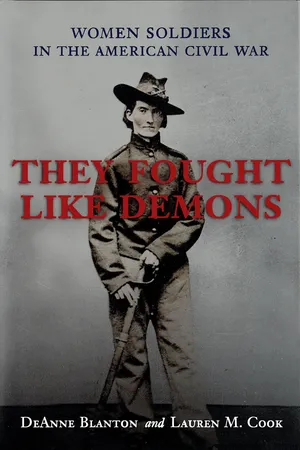
eBook - ePub
They Fought Like Demons
Women Soldiers in the American Civil War
- 277 pages
- English
- ePUB (mobile friendly)
- Available on iOS & Android
eBook - ePub
About this book
Information
Subtopic
American Civil War HistoryIndex
History1
“THEY FOUGHT LIKE DEMONS”
A Military History of Women in Combat
Women soldiers were present as combatants in numerous battles, skirmishes, and campaigns from the beginning of the Civil War to the end. Women fought for their country from the engagement at Blackburn’s Ford, Virginia, on July 18, 1861, to the surrender of the last Confederate army. They served in both the eastern and western theaters throughout four years of bloody conflict. Women soldiers were wounded, maimed, and killed in action, and just like men with whom they served, they inflicted their share of pain and death. Despite the fact that they were not required to perform military service and indeed were barred from enlisting as soldiers, women nevertheless served the Union and Confederacy as armed combatants. Testimonials of their comrades leave no doubt about their effectiveness on the field of battle or their bravery under fire.
After the First Battle of Bull Run, the first major clash of armies of the Civil War, a Confederate soldier from Georgia wrote home to his wife that “there were a great many fanatic women in the Yankee Army—some of whom were killed. I was pointed to one of their graves. I knew that I could not be mistaken as to the spot for her foot was sticking out of the ground.” The name of that dead woman may never be known, but the identities of other Union women present at Bull Run on July 21, 1861, are available. Louisa Hoffman fought with the 1st Ohio Infantry. A woman called Charlie, described as large, coarse featured, and stubborn, also fought for the Union. A little more than a year later, Charlie was again on the same field, fighting in the second battle that occurred near Manassas. Frances Jamieson from Kentucky entered the field at First Bull Run serving as a first lieutenant under the command of her husband, a captain.1
Two women destined for notoriety after the Civil War also fought that day in Virginia. Sarah Emma Edmonds, alias Pvt. Franklin Thompson, served with the 2nd Michigan Infantry. After an exhausting and terrifying day of battle, Edmonds was among the unscathed, and for days thereafter she helped care for some of the 1,124 Union wounded.2
On the opposing side, Loreta Janeta Velazquez, alias Lt. Harry T. Buford, stood with the Confederates. Velazquez arrived at First Manassas as an independent officer, not regularly commissioned and without a command. Given the confusion and disorganization of armies in the early months of the war, irregular soldiers were tolerated. Velazquez attached herself to Gen. Barnard Bee’s command, and like Edmonds, came through the day’s contest unharmed. Manassas was not her first battle, however. Coming to Virginia earlier that month, she witnessed the preliminary fight at Blackburn’s Ford on July 18, after which she was temporarily placed in command of a company, all its officers having been killed or wounded during the engagement.
Later, in October 1861, Velazquez was present at the Battle of Ball’s Bluff near Leesburg, Virginia. Confederate forces literally drove the Union troops into the Potomac River, with the Federals ultimately taking more than nine hundred casualties, many of whom died not from bullets but from drowning. As usual, Lieutenant Buford did not have a formal command but merely attached herself to a brigade. When ordered to take charge of a company missing its officers, Velazquez did so. She was fortunate that most of the fighting was in the woods, for she was still too inexperienced to know much about maneuvering men in battle.3
Like many of the other soldiers present at the bluff that day, Velazquez recalled the carnage with a shudder. However, her brief service with Confederate armies had already taught her that “such scenes… are inseparable from warfare, and those who take up arms must steel themselves against them.” The steely Velazquez, still unable to secure a regular commission, spurned an offer to become a recruiting agent for the Confederacy and left the eastern theater for the west, spending her own money, writing her own orders, and searching for adventure. She was next engaged in a small action in the western theater near Woodsonville, Kentucky, on December 17, 1861.4
Other women soldiers also served in the western theater in 1861. A female corporal who enlisted in the 1st Kansas Infantry under the alias Alfred J. Luther was among the 873 Union soldiers wounded on August 10, 1861, at the Battle of Wilson’s Creek, the only major battle fought in Missouri. Luther’s comrades later vowed that the corporal was a brave and strong soldier, with an excellent reputation as a fighter.5
Women’s participation in the western theater of operations increased in 1862. Of the approximately four thousand Union troops at the Battle of Mill Springs, Kentucky, on January 19, at least two were women. One of these was an unnamed woman of Scottish descent, serving in a Kentucky regiment. The other was a woman serving under the alias Frank Deming in the 17th Ohio Infantry.6
A little less than a month later, at least two women soldiers were engaged in the Battle of Fort Donelson in Tennessee. The action commenced on February 13 with a Federal attack and ended on the fifteenth with the surrender of the remaining Confederates in the fort. On the Union side was Frances Louisa Clayton, who sustained a wound during the fighting. On the Confederate side was soldier of fortune Loreta Velazquez, who arrived at the fort prior to the battle. She honorably performed her share of trench and picket duty and was among the lucky ones who escaped before the capitulation to Union forces. Still the adventurer, Velazquez followed the movements of the Confederate army and fought at the Battle of Shiloh, which proved to be her last battle. On the evening of April 7, 1862, after the second day’s fighting, she was wounded in the arm and shoulder by flying shrapnel while on burial detail.7
Velazquez was not the only woman at the Battle of Shiloh. There were at least five others, four on the Union side and one Confederate. Nor was Velazquez the only woman wounded in the two days of fighting near Pittsburg Landing. Union soldier Jane Short, alias Charley Davis, was shot in the hand, but the wound was not serious. Another Union woman, fighting at the side her brother, was seriously injured in the leg and shoulder but survived. A third Union woman was not so fortunate. Killed in action during the battle, her identity will probably never be known. The fourth Union woman, Frances Hook, emerged physically unharmed but emotionally devastated. Her only brother was killed in the desperate fight. Confederate soldier Mary Ann Pitman, alias Second Lieutenant Rawley, and her company of independent cavalry from Tennessee also took to the field at Shiloh.8
Confederate soldier Mary Ann Clark was also in the western theater in 1862. Serving in Gen. Braxton Bragg’s army at the beginning of the Confederate campaign into Tennessee and Kentucky, she was “wounded in the thigh a considerable piece above the knee” at the Battle of Richmond, Kentucky, on August 30, 1862. One of 451 Confederate casualties, Clark fell into Union hands and became a prisoner of war. She survived her wound, survived her incarceration, and was ultimately paroled.9
Two more Confederate women saw action in the west. The Battle of Perryville, Kentucky, on October 8, 1862, was a Union victory that ended Confederate Gen. Braxton Bragg’s invasion of Kentucky. On the morning after the battle, a woman wounded in the left side was found by a Union burial detail, having lain untended on the chilly field all night. Another Confederate woman at Perryville was unharmed in the fight and continued her service in the Army of Tennessee. A native of Louisiana, this anonymous woman later saw action at the Battle of Murfreesboro from December 31, 1862, through January 2, 1863.10
Three other women combatants fought at Murfreesboro, all for the Federals, who referred to the battle as Stones River. A young woman serving under the alias of Frank Martin received a wound in the shoulder. Frances Clayton, a veteran of Fort Donelson, witnessed her husband’s death just a few feet in front of her. Nevertheless, she did not falter in battle. When the call came to fix bayonets, Clayton stepped over his body and charged. The third Union woman combatant at Stones River, a sergeant, was also a veteran, having served approximately sixteen months in the Army of the Cumberland. Nearly four months later, a comrade remarked, “It seems very strange that a woman could endure the hardships of a soldier.” Not only did the sergeant endure the deprivations of a soldier’s life on campaign, but she did so with an additional burden that no male soldier was ever required to carry. During the Battle of Stones River, the sergeant fought while in the fifth month of pregnancy.11
As in the western theater, in 1862 the number of women combatants on record increased in the eastern theater. Marian McKenzie, a light-complexioned, blue-eyed soldier who stood only five feet two inches tall, served through the Shenandoah Valley campaign. Under the alias Henry Fitzallen, McKenzie took the field in this campaign that commenced on March 5, 1862, and lasted until nearly the end of the year. The operations in the valley resulted in a dozen skirmishes and battles. McKenzie survived them all.12
Shortly after the Shenandoah Valley campaign began, the ill-fated Peninsula campaign was launched, beginning on March 17,1862, when Union forces under the command of Gen. George McClellan embarked from Alexandria, Virginia. The plan called for Union troops to invade the peninsula between the York and James Rivers. The bluecoats were to move up the peninsula to take Richmond, capital of the Confederacy. Peninsular operations lasted until August 20, 1862, when McClellan’s defeated army completed its evacuation of the peninsula. The armies involved were engaged in a total of eighteen skirmishes, actions, and battles over the five months of the campaign. Martha Lindley, alias Pvt. Jim Smith of the 6th U.S. Cavalry, fought with her regiment on the peninsula until June, when she was detailed to hospital duty acting as orderly for the regimental surgeon.13
Sarah Edmonds witnessed the entire Peninsula campaign, from the hopeful start at Alexandria to the bloody disasters of the Seven Days to the sullen retreat to Fortress Monroe. As the campaign moved into full swing in April 1862, Private Thompson (Edmonds) was detailed as regimental postmaster and mail carrier, a job she retained for more than four months. During the siege of Yorktown from April 5 to May 4, Edmonds was almost constantly in the saddle, carrying mail and dispatches between the front and Fortress Monroe. On May 5, after a partial day of carrying battle orders, she ceased her courier duty just long enough to pick up her musket and fight in the Battle of Williamsburg. At the Battle of Seven Pines on May 31 and June 1, the exhausted private was given hospital duty, a task that included burying the dead.14
The Union Army of the Potomac fought its way to Richmond, struggling to the outskirts of the city by June 4. While the army camped, Private Thompson resumed mail carrier duty until the Seven Days’ Battles, when she again picked up her gun and fell into the ranks of her regiment. The Seven Days’ Battles began Wednesday, June 25, with a small affair at Oak Grove. Thursday witnessed the Battle of Mechanicsville, with Gaines’ Mill the next day. There was maneuvering by both armies on Saturday, followed by the Battle of Savage’s Station on June 29 and Frayser’s Farm the following day. The bloody Seven Days ended on Tuesday, July 1, when the Federals were soundly repulsed at Malvern Hill. Gen. Robert E. Lee’s Confederates had defeated McClellan, forcing the Union army to retreat from Richmond.15
Edmonds was not the only woman who fought in the Seven Days’ Battles. An anonymous woman soldier served with her husband in the 1st New York Cavalry. At Savage’s Station, the wife saved her husband’s life by carrying him off the field when he was wounded. She received a flesh wound in the process. She dressed his wounds in a field hospital, and when the Confederates forced a Union retreat, the hospital was captured and both she and her husband became prisoners of war. An unnamed woman in a New Jersey regiment also took part in the Seven Days battles. On the Confederate side, Lucy Matilda Thompson Gauss fought in the 18th North Carolina Infantry. Both the New Jersey woman and Gauss were fairly new to life in the army, and the Seven Days’ Battles were their baptism of fire. The New Jersey woman had another baptism in her future. During the Seven Days she was in the first trimester of pregnancy.16
As the Peninsula campaign drew to a close in August 1862, another Union army, this one under John Pope, began forming in northern Virginia. Even before he was sure that McClellan was leaving the peninsula, Confederate Gen. Robert E. Lee sent troops to oppose Pope. Fighting began in early August. On the twenty-second, Confederate cavalry under command of J. E. B. Stuart led a raid on Catlett’s Station, Virginia, and captured Pope’s entire baggage train. One of the Union soldiers guarding the train and captured in the raid “proved to be a woman in disguise.”17
A week later, the Second Battle of Bull Run began and raged for several violent days at the end of August 1862. The Union again suffered defeat, with more than one thousand soldiers killed. According to an army doctor, among the dead was a soldier known only as Margaret. She suffered minor wounds early in the battle but refused to leave the field to seek medical attention. Later that day she was mortally wounded. Sarah Edmonds also fought at Second Manassas. Along with other elements of McClellan’s army, her regiment had come to the aid of Pope.18
Edmonds next saw action at the Battle of Antietam, this time without her regiment. Still acting as a mail carrier, Private Thompson was dispatched from Washington, D.C., with mail, orders, and other documents for McClellan’s army, now operating in Maryland against the Confederates, who had crossed the Potomac River early in September 1862. On the morning of September 17 the Confederate Army of Northern Virginia, posted in defensive positions around Sharpsburg, was attacked by the Army of the Potomac. Thus began the Battle of Antietam, the bloodiest single day of combat in American history, with casualties close to twenty-five thousand. Edmonds stayed throughout the battle to tend to the wounded. When the gunfire finally subsided, she walked the fields with other soldiers looking for wounded among the bodies. One of the soldiers she assisted was a woman whose wounds proved fatal.19
Including Edmonds and the unknown soldier she discovered, eight women combatants are known to have been involved in the Battle of Antietam. Seven were Union, one was Confederate, and five numbered among the casualties. Catherine Davidson fought with the 28th Ohio Infantry. She was wounded so badly in the right arm that surgeons amputated it at the midpoint between the shoulder and elbow. Mary Galloway was shot in the neck in the morning’s fighting. She rolled into a ravine, where she lay for thirty-six hours unable to move and in great pain until she was found by friendly troops and taken to a field hospital. Both Davidson and Galloway survived their injuries. The fourth female casualty at Antietam was a soldier from New Jersey, the same woman who had fought at the Seven Days’ Battles while pregnant. She was in her second trimester when she and her regiment arrived at Antietam, yet she did not shirk her duty. She recovered from her wound and returned to her regiment. The anonymous Confederate woman was not so fortunate. She was killed in action during the fierce and sanguinary first phase of the battle, in what became known as The Cornfield.20
Rebecca Peterman, known as Georgianna in the press, served in the 7th Wisconsin Infantry at Antietam...
Table of contents
- Cover
- Title Page
- Copyright Page
- Dedication
- Contents
- Illustrations
- Acknowledgments
- Introduction “Entrenched in Secrecy” Women Soldiers of the Civil War
- 1 “They Fought like Demons” A Military History of Women in Combat
- 2 “To Dress and go as a Soldier” Means and Motivations
- 3 “A Fine Looking Soldier” Life in the Ranks
- 4 “Fairly Earned her Epaulettes” Women Soldiers in the Military Service
- 5 “Why they Detained her i Can’t Imagine” The Prisoner of War Experience
- 6 “I Would Rather have been shot Dead” Women Soldiers as Casualties of War
- 7 “A Congenital Peculiarity” Women Discovered in the Ranks
- 8 “Romantic Young Ladies” Female Soldiers in the Public Consciousness
- 9 When Jennie Came Marching Home Women Soldiers in the Postwar Years
- 10 Beyond Heroes or Harlots The Changing Historical Perspective
- Conclusion “I Love my Country” A Summation of Women’s Military Service
- Appendix: The Female Warrior Bold
- Bibliography
- Notes
- Index
Trusted by 375,005 students
Access to over 1.5 million titles for a fair monthly price.
Study more efficiently using our study tools.
Frequently asked questions
Yes, you can cancel anytime from the Subscription tab in your account settings on the Perlego website. Your subscription will stay active until the end of your current billing period. Learn how to cancel your subscription
No, books cannot be downloaded as external files, such as PDFs, for use outside of Perlego. However, you can download books within the Perlego app for offline reading on mobile or tablet. Learn how to download books offline
Perlego offers two plans: Essential and Complete
- Essential is ideal for learners and professionals who enjoy exploring a wide range of subjects. Access the Essential Library with 800,000+ trusted titles and best-sellers across business, personal growth, and the humanities. Includes unlimited reading time and Standard Read Aloud voice.
- Complete: Perfect for advanced learners and researchers needing full, unrestricted access. Unlock 1.5M+ books across hundreds of subjects, including academic and specialized titles. The Complete Plan also includes advanced features like Premium Read Aloud and Research Assistant.
We are an online textbook subscription service, where you can get access to an entire online library for less than the price of a single book per month. With over 1.5 million books across 990+ topics, we’ve got you covered! Learn about our mission
Look out for the read-aloud symbol on your next book to see if you can listen to it. The read-aloud tool reads text aloud for you, highlighting the text as it is being read. You can pause it, speed it up and slow it down. Learn more about Read Aloud
Yes! You can use the Perlego app on both iOS and Android devices to read anytime, anywhere — even offline. Perfect for commutes or when you’re on the go.
Please note we cannot support devices running on iOS 13 and Android 7 or earlier. Learn more about using the app
Please note we cannot support devices running on iOS 13 and Android 7 or earlier. Learn more about using the app
Yes, you can access They Fought Like Demons by DeAnne Blanton,Lauren Cook Wike in PDF and/or ePUB format, as well as other popular books in History & American Civil War History. We have over 1.5 million books available in our catalogue for you to explore.