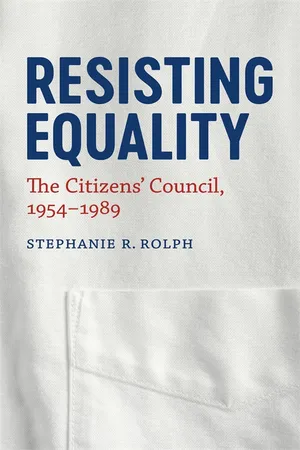
In Resisting Equality Stephanie R. Rolph examines the history of the Citizens' Council, an organization committed to coordinating opposition to desegregation and black voting rights. In the first comprehensive study of this racist group, Rolph follows the Citizens' Council from its establishment in the Mississippi Delta, through its expansion into other areas of the country and its success in incorporating elements of its agenda into national politics, to its formal dissolution in 1989.Founded in 1954, two months after the Brown v. Board of Education decision by the U.S. Supreme Court, the Council spread rapidly in its home state of Mississippi. Initially, the organization relied on local chapters to monitor signs of black activism and take action to suppress that activism through economic and sometimes violent means. As the decade came to a close, however, the Council's influence expanded into Mississippi's political institutions, silencing white moderates and facilitating a wave of terror that severely obstructed black Mississippians' participation in the civil rights movement. As the Citizens' Council reached the peak of its power in Mississippi, its ambitions extended beyond the South. Alliances with like-minded organizations across the country supplemented waning influence at home, and the Council movement found itself in league with the earliest sparks of conservative ascension, cultivating consistent messages of grievance against minority groups and urging the necessity of white unity. Much more than a local arm of white terror, the Council's work intersected with anticommunism, conservative ideology, grassroots activism, and Radical Right organizations that facilitated its journey from the margins into mainstream politics.Perhaps most crucially, Rolph examines the extent to which the organization survived the successes of the civil rights movement and found continued relevance even after the Council's campaign to preserve state-sanctioned forms of white supremacy ended in defeat. Using the Council's own materials, papers from its political allies, oral histories, and newspaper accounts, Resisting Equality illuminates the motives and mechanisms of this destructive group.
- 240 pages
- English
- ePUB (mobile friendly)
- Available on iOS & Android
eBook - ePub
About this book
Trusted by 375,005 students
Access to over 1.5 million titles for a fair monthly price.
Study more efficiently using our study tools.
Information
CHAPTER 1
BORN INTO DEFIANCE
There is going to be a tremendous upsurge of conservatism during the next four, eight, and twelve years. And as this moves like a tidal wave, we will be carried to victory. Conservatism is on the march now for the first time in thirty years—and we are part of the conservative movement. —LOUIS HOLLIS, CITIZENS’ COUNCIL ADMINISTRATOR
Either we will all stay white together, or we will be integrated county by county and state by state.” That statement appeared in the Citizens’ Council’s first official pamphlet in November 1954, a moment when white unity in Mississippi seemed split over the future of the state’s public school system.1 Four months had passed since the founding of the Council’s first chapter in Indianola, Mississippi, and its first official publication signified a shift from its shadowy beginnings at the local level to statewide activism, a move that marked the organization’s realization that local intimidation tactics would not be sufficient to resist changes to the state’s racial practices. For Council leaders, white moderates in the state posed a greater threat to segregation than black activist organizations like the National Association for the Advancement of Colored People (NAACP). Consequently, white unity was their central objective, and that focus led them to decades of partnerships and through an evolution of white supremacy that traveled an arc from overt racial terrorism to race-neutral conservatism.
In the organization’s beginnings the Council’s message was little more than a naked endorsement of white supremacy that reflected its early provincialism. Upon its founding, the Council proposed that white leaders in each community patrol local black activism using economic intimidation to discourage it. As the Council movement became public, however, the role of ideology and the cultivation of resistance vernacular became increasingly important as a way to unify whites across the state. But the Council model was not new or unique. Conservative opposition to the New Deal, criticisms of federal power, and the Dixiecrat revolt in 1948 signaled a groundswell of resistance from both the intellectual elite and the grassroots. Increasing evidence of black activism and the announcement of Brown v. Board of Education in May 1954 crystallized those fears and activated white reaction. When the Citizens’ Council emerged as a potential solution in October 1954, it did so in a prepared environment that contained familiar ideology and potential colleagues. What distinguished the Council movement from peer organizations that predated Brown, however, was its ability to translate conservative ideas into a language of defiance for local whites in predominantly black counties and towns. Resistance to desegregation mandates in these communities was assured, but the Council’s presence and propaganda tied that resistance to lofty principles of constitutional integrity and local control. Council-guided resistance, then, manifested as more than violence and intimidation tactics. From its earliest moments, its leaders articulated ideals that would long outlast the issues that initiated the organization’s formation.
The ideas that shaped Council-led resistance existed decades before the Supreme Court’s announcement of Brown. Conservative intellectuals began to draw attention in the 1930s for their opposition to the New Deal and their advocacy for isolationism during World War II. While most Americans celebrated the end of the war, conservative ideologues wondered if recent socialist victories in Western Europe would prove contagious in the United States, given the federal government’s rapid expansion under Franklin Roosevelt’s administration.2 In a slightly different way, white southerners witnessed the bureaucratic expansion with similar alarm. As the federal government offered economic assistance through work programs and other forms of federal aid, threats to the South’s racial hierarchy seemed imminent. The convergence of those two frames of resistance helped forge an alliance that would link white resistance to the civil rights movement and create a philosophy that could preserve white power even if its current manifestations, segregation and disfranchisement, did not survive.
Conservative intellectuals writing in the 1930s and 1940s remained relatively unknown outside of their own circles. Albert Jay Nock, Friedrich A. Hayek, Peter Viereck, Bernard Iddings Bell, and others wrote extensively about their philosophy instead of their politics, a choice that rendered grassroots activism unlikely. Their approach emphasized ideology over policy, a deliberate prioritization that rejected progressive ideals as a guide for social improvement.3 In particular, they disapproved of the wave of social welfare measures and government regulation that preceded World War I and reappeared in some form during the New Deal. In short, conservative intellectuals did not believe the government was obliged to improve the daily lives of its citizens. The conservative movement that began to grow in opposition to the New Deal identified the progressive philosophy as wholly destructive and linked its approach to the totalitarian regimes that initiated World War II.4 As early as 1935, Albert Jay Nock, an inspiration for many of the conservative writers who gained popularity in the 1950s and 1960s, wrote that the differences among fascism, communism, and socialism were nearly imperceptible. It was more accurate, he argued, to discuss what they shared: a firm allegiance to the state as the ultimate source of authority and wisdom alongside an “equivalent depletion of social power.”5 The state itself was “antisocial,” he continued, and moved “grudgingly towards any purpose that accrues to society’s advantage.” The nature of state power, he argued, was forever bent toward accumulating more power.6
Nine years later, in 1944, Friedrich A. Hayek’s The Road to Serfdom issued similar warnings. Hayek’s experiences as a witness to the creeping totalitarianism in Europe during the 1930s alarmed him in its assault on individual liberty. An Austrian economist, Hayek’s work pointed to the danger of centralized power, especially regarding economic policy.7 The emphasis on outcomes of equality and social justice, he argued, often distracted citizens from the means by which governments could achieve them. Speaking specifically of socialism (although Hayek, like Nock, identified little to distinguish isms from each other), Hayek explained that the achievement of its end required the total abolition of individual production, private ownership, and entrepreneurship. In their place would appear a central planning body, one that could hope to represent no more than a minority of its citizens.8 Done for moral purposes to achieve equitable ends, such moves were not within the purview of the state, a body that should only act to establish long-standing laws that could persist in changing times, always protecting the individual in pursuit of his own path.9
In 1949, Peter Viereck, a poet and political philosopher who taught at Mount Holyoke, moved closer to defining conservatism as the solution to the fears that Nock, Hayek, and others identified as endemic to both Europe and the United States. In Conservatism Revisited, Viereck described conservatism as “self restraint; preservation through reform . . . balance . . . nostalgia” and “unbroken historical continuity.” At its “fire-center” was what Viereck identified as an “emotional élan . . . a reverence for the dignity of the individual soul.”10 His remarks described a cyclical movement of ideas and progress, one that was organically grown in the traditions of man as an individual. Viereck’s conservatism stood in contrast to what he identified as “rationalist liberalism,” a position that embraced “abstract blueprints” instead of concrete solutions. The liberal impulse, he asserted, defined freedom without embodying it.11
Economy and state growth were not the only institutional threats that postwar conservative intellectuals identified, however. Education, in their estimation, was especially vulnerable to state control and indoctrination. In 1952, Bernard Iddings Bell published his warning against federally supported school systems, an issue that white southerners would find especially helpful in articulating their opposition to Brown’s ruling in 1954. In Crowd Culture, Bell described the public school system in the United States as a “large-scale government monopoly.” Increasing standardization and conformity, he explained, would inevitably weaken individualism and dissent while lowering the expectations for achievement. The mediocrity that resulted, he explained, “frets and frustrates the more able while it flatters the incompetent.”12
Certain threads of conservatism remained sequestered within academe and circulated only through disciplinary journals, but in the years between 1945 and 1954, conservative publications for popular audiences multiplied. Publications like The Freeman, American Mercury, Human Events, and Facts Forum articulated the fears of their readers regarding the reach of the federal government, communism, and social justice. Unlike previous writings that plotted the philosophy of conservatism but disconnected from issues, these publications foregrounded current events as platforms for ideological debate.13
It was within the pages of these publications that most conservative intellectuals honed their craft. Men like Albert Jay Nock, Frank Meyer, Friedrich Hayek, and Frank Chodorov developed a following through their commentaries and reflections on current events. In the process they contributed to the popularization of conservative philosophy among white Americans across the country. The priority that these publications gave to limited government and local control challenged what their contributors saw as the Left’s obsession with morality and justice as guiding principles. Instead, the writers who shaped conservative media in the postwar, pre-Brown years offered concrete approaches to governance that promised to survive shifting circumstances and eliminate complexity. To put a finer point on their contribution, conservative intellectuals offered stability in the midst of sweeping global and national changes. That alternative became more meaningful as the Cold War escalated and the challenge to white supremacy became more visible.14
Magazines like Human Events, American Mercury, and later, National Review, represented an appeal to wider audiences, but Dan Smoot’s Facts Forum went one step further by encouraging its readers to participate in opinion-making and ideological debate. Each month, the newspaper featured a survey question, asking readers to send in their answers for publication in the following issue. It also headlined a question that guest writers answered from both a pro and con position, an approach meant to underscore the newspaper’s commitment to balanced reporting and encourage more local participation in political debates. To further that objective, editors urged their readers to organize local “Forums” and “become salesmen for . . . basic American qualities.”15
In addition to its print work, Facts Forum extended into more modern media venues in its radio and television broadcasts. In October 1953, the State of the Nation television and radio series began, a program that profiled state governors in an interview format. The Facts Forum Washington broadcasts hosted political figures as its guests, providing a free format for senators and members of Congress to articulate their positions on specific issues and win public support in the process. In addition to those two programs, Dan Smoot hosted a weekly radio broadcast that focused on the “pro and con arguments of . . . vital problems facing America.”16 These broadcasts reached a number of cities throughout the nation in the 1950s. In March 1953, the program premiered on WJPR, a Greenville, Mississippi, radio station. One year later, two other Mississippi cities, Meridian and Jackson, had picked up the broadcasts.17 In November 1953, the program achieved national exposure when its public affairs program, Answers for America, appeared on the American Broadcasting Company (ABC) network in prime time.18
Facts Forum served as a blueprint for conservative white activism, not only in delineating the steps to effective organizing, but also in the accessibility it gave to conservative ideology. The requests for reader participation alongside articles by conservative intellectuals like Ludwig von Mises, William F. Buckley Jr., and James Burnham made an intriguing formula that helped transform conservative philosophy into daily conversations about politics. It also forged alliances among white Americans who might have little else in common outside of their support for conservatism. H. L. Hunt, an oil tycoon from Texas known for his libertarian leanings, was its chief investor, although by 1953 Facts Forum claimed several regular contributors.19 Hunt’s support points to the financial underpinnings that an operation like Facts Forum required. More importantly, it suggests an early alliance between members of the financial elite and diverse coalitions of white readers, many of whom were transitioning from working-class roots to middle-class status.
Facts Forum went further to ensure its appeal to a diverse audience of white Americans by giving space to southern segregationists like Georgia’s governor Herman Talmadge, Mississippi senator James Eastland, and John Birch member and future Citizens’ Council administrator Medford Evans, who became managing editor of the publication in 1954. In its February 1955 issue, the debate question chosen for the pro/con debate asked, “Do you think that this recent segregation decision was good for America?” The affirmative answer to the question revealed the way in which Facts Forum could claim balanced debate, yet drive home its conservative message. In its support of the Brown decision, the pro-desegregation statement managed to amplify all of the consequences that white conservatives and segregationists predicted when explaining their opposition to the decision. The tone of the editorial was glib in its appraisal, describing the ruling as evidence of “progressive American democracy’s twentieth century victory over the forces of reaction, bigotry, and prejudice.” With that designation elucidated in the opening remarks, the insights that followed drew attention to the misguided motivations of the court. The statement’s author encouraged readers to recognize the true hero of the monumental decision, President Dwight D. Eisenhower, whose “quiet, determined, dedicated efforts . . . created the conditions—the national attitude, the national atmosphere—which made that school segregation decision possible.” Eisenhower’s actions were “unmotivated by fear of pressure of groups, with no thought of glory or political gain.” His appointment of Chief Justice Earl Warren (a figure that segregationists and conservatives alike held in low esteem) was a sound decision. Warren was “a nice guy who deserved some kind of reward for supporting Ike politically,” even though critics decried his lack of experience, a fact that the editorial’s author found refreshing. “Where previous Chief Justices had found themselves tied down by judicial precedents and hedged about by narrow legalisms,” the statement read, Warren was able to supersede the “lifeless letter of the law and interpret our Constitution as a living, dynamic instrument of government.” This approach allowed for application of “twentieth century concepts of what freedom and equality mean.”20 The utopian tone that this argument embodied while flouting process, precedent, and tradition is obvious. It drove home the point that Warren’s motivations grew out of a grasp for political gain and a complete and willful disregard for the Constitution and its limits. The emphasis on ends over means was something that conservative intellectuals like Hayek and Nock railed against in their writings.
What the pro statement insinuated through satire, the con statement made plain. Eschewing the relaxed, casual approach to process, the con argument began its answer with a clear condemnation of the court’s overreach. “The Supreme Court’s decision,” the statement asserted, “is not a judicial interpretation. . . . It is a political decision, grounded not in law, but in Earl Warren’s notions about psychiatry and sociology.” Forced desegregation was likely to infringe upon the “only real land of opportunity for Negroes in the world—the South,” by eliminating jobs and destroying long-standing relationships between blacks and whites there. The court’s interference in these relationships, the statement continued, sought to replace “Christian love” with political power, a disastrous approach to human relationships and a certain path to centralized authority at the expense of state sovereignty.21
As these editorials illustrate, publications like Facts Forum thrived by articulating escalating anxieties among white Americans. The access to conservative ideology that the publication provided nurtured fear and shaped it into a broader political discourse. Facts Forum took otherwise sterile conservative theories of power and translated them into a language that could be applied to contemporary issues of foreign policy, economy, an...
Table of contents
- Cover
- Title Page
- Copyright Page
- Dedication
- Contents
- Acknowledgments
- Introduction
- 1 Born into Defiance
- 2 Nurtured in Fear, 1954–1957
- 3 From the Capital City to the Nation’s Capital, 1958–1960
- 4 The Center Weakens, 1961–1962
- 5 Abandoning the Harvest, Plowing New Fields, 1963–1964
- 6 Flight and White Reunion: The Citizens’ Council after 1964
- Conclusion
- Notes
- Bibliography
- Index
Frequently asked questions
Yes, you can cancel anytime from the Subscription tab in your account settings on the Perlego website. Your subscription will stay active until the end of your current billing period. Learn how to cancel your subscription
No, books cannot be downloaded as external files, such as PDFs, for use outside of Perlego. However, you can download books within the Perlego app for offline reading on mobile or tablet. Learn how to download books offline
Perlego offers two plans: Essential and Complete
- Essential is ideal for learners and professionals who enjoy exploring a wide range of subjects. Access the Essential Library with 800,000+ trusted titles and best-sellers across business, personal growth, and the humanities. Includes unlimited reading time and Standard Read Aloud voice.
- Complete: Perfect for advanced learners and researchers needing full, unrestricted access. Unlock 1.5M+ books across hundreds of subjects, including academic and specialized titles. The Complete Plan also includes advanced features like Premium Read Aloud and Research Assistant.
We are an online textbook subscription service, where you can get access to an entire online library for less than the price of a single book per month. With over 1.5 million books across 990+ topics, we’ve got you covered! Learn about our mission
Look out for the read-aloud symbol on your next book to see if you can listen to it. The read-aloud tool reads text aloud for you, highlighting the text as it is being read. You can pause it, speed it up and slow it down. Learn more about Read Aloud
Yes! You can use the Perlego app on both iOS and Android devices to read anytime, anywhere — even offline. Perfect for commutes or when you’re on the go.
Please note we cannot support devices running on iOS 13 and Android 7 or earlier. Learn more about using the app
Please note we cannot support devices running on iOS 13 and Android 7 or earlier. Learn more about using the app
Yes, you can access Resisting Equality by Stephanie R. Rolph in PDF and/or ePUB format, as well as other popular books in Politics & International Relations & North American History. We have over 1.5 million books available in our catalogue for you to explore.