In Reconstruction in the Cane Fields, John C. Rodrigue examines emancipation and the difficult transition from slavery to free labor in one enclave of the South -- the cane sugar region of southern Louisiana. In contrast to the various forms of sharecropping and tenancy that replaced slavery in the cotton South, wage labor dominated the sugar industry. Rodrigue demonstrates that the special geographical and environmental requirements of sugar production in Louisiana shaped the new labor arrangements. Ultimately, he argues, the particular demands of Louisiana sugar production accorded freedmen formidable bargaining power in the contest with planters over free labor.
Rodrigue addresses many issues pivotal to all post-emancipation societies: How would labor be reorganized following slavery's demise? Who would wield decision-making power on the plantation? How were former slaves to secure the fruits of their own labor? He finds that while freedmen's working and living conditions in the postbellum sugar industry resembled the prewar status quo, they did not reflect a continuation of the powerlessness of slavery. Instead, freedmen converted their skills and knowledge of sugar production, their awareness of how easily they could disrupt the sugar plantation routine, and their political empowerment during Radical Reconstruction into leverage that they used in disputes with planters over wages, hours, and labor conditions. Thus, sugar planters, far from being omnipotent overlords who dictated terms to workers, were forced to adjust to an emerging labor market as well as to black political power.
The labor arrangements particular to postbellum sugar plantations not only propelled the freedmen's political mobilization during Radical Reconstruction, Rodrigue shows, but also helped to sustain black political power -- at least for a few years -- beyond Reconstruction's demise in 1877.
By showing that freedmen, under the proper circumstances, were willing to consent to wage labor and to work routines that strongly resembled those of slavery, Reconstruction in the Cane Fields offers a profound interpretation of how former slaves defined freedom in slavery's immediate aftermath. It will prove essential reading for all students of southern, African American, agricultural, and labor history.
eBook - ePub
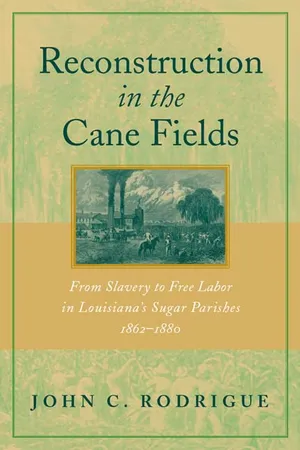
Reconstruction in the Cane Fields
From Slavery to Free Labor in Louisiana's Sugar Parishes, 1862--1880
- 256 pages
- English
- ePUB (mobile friendly)
- Available on iOS & Android
eBook - ePub
Reconstruction in the Cane Fields
From Slavery to Free Labor in Louisiana's Sugar Parishes, 1862--1880
About this book
Information
1
LOUISIANA SUGAR—AMERICAN SLAVERY
The anxieties attending the cultivation of sugar are great and so much depends upon the judicious employment of labour, it is scarcely possible to exaggerate the importance of experience in directing it, and of the power to insist on its application.
—William Howard Russell, My Diary North and South
The Old South comprised many diverse localities, each in its own way unique, but none matched southern Louisiana in its distinctiveness. A legacy of French and Spanish imperial ambitions engulfed by the Anglo-American world, and a bastion of Roman Catholicism encircled by evangelical Protestantism, southern Louisiana was—as it is to this day—a place unto itself. Its ante- and postbellum uniqueness, however, also owed to Queen Sugar’s reign in the land where cotton was king. Southern Louisiana was a slave society, but that was only half the truth: it was also a sugar society. The demands of sugar production and the historical development of slavery in the American South together—rather than either one alone—gave the region its identity. Combining features of New World sugar production and American slavery, Louisiana sugar plantations were a tertium quid.
Southern Louisiana’s peculiarity as a sugar society within the slave South is the central theme of the sugar region’s history between the close of the eighteenth century and the Civil War. From its beginnings in 1795 and rapid growth in the following decades, sugar cultivation altered the area’s social, political, economic, and physical landscape. Slavery was not unknown in Louisiana before sugar’s introduction, but sugar transformed southern Louisiana from a society with slaves into a slave society. Sugar production defined the plantation system and gave rise to a distinctive slaveholding elite as well as to large, complex slave communities. Louisiana sugar plantations shared much with antebellum cotton plantations, but the worlds of cotton and sugar differed in as many ways before the Civil War as they would after it.
Before the war, sugar plantations dominated the region of southeastern Louisiana encompassing the parishes of Ascension, Assumption, Iberville, Jefferson, Lafourche, Orleans, Plaquemines, St. Bernard, St. Charles, St. James, St. John the Baptist, St. Mary, Terrebonne, and West Baton Rouge. Although a singular entity, the sugar region was thought of as three distinct localities: the Mississippi “coast” (land along the river from Baton Rouge to the Gulf of Mexico), the Lafourche district, and Bayou Teche. Many smaller bayous throughout the area also hosted plantations. Over centuries, levees had formed along the waterways, from which the delta’s alluvial bottoms sloped gently to the vast swampland. The fecund strips of land between levee and swamp made up a small proportion of the region’s total area, but they spawned the sugar plantations and the way of life that attended them.1
The nineteenth-century Louisiana sugar industry faced exigencies universal to sugar production as well as environmental constraints particular to southern Louisiana. Since conditions for its cultivation were not ideal, sugarcane was considered a forced crop. A tropical product, it requires a mild climate, moderate and well-distributed rainfall, and a growing season of about eighteen months. In Louisiana, rain is plentiful but seldom evenly distributed. Because south Louisiana lies in the subtropics, frost becomes a possibility by late fall. Louisiana planters, compelled to harvest the cane before winter, faced a growing season of only ten months. The 1817 introduction of ribbon cane—which matured rapidly and was more resistant to frost—alleviated planters’ environmental concerns somewhat, but it did not solve their central dilemma. Sugar may have been well suited to the area’s environment—that is, within a social order committed to commodity production and slave labor—yet there would always remain what one scholar has called a “lack of complete harmony between land and product.”2
This lack of harmony was partly reconciled by Jean Etienne de Boré, the legendary “Savior of Louisiana,” in 1795. Born in the Illinois country in 1741, educated in France, and formerly a member of the King’s Household Guard, Boré acquired a plantation near New Orleans in 1781. Nearly bankrupt as an indigo planter, he turned to sugar production in the mid-1970s and, using techniques imported by slave and free-black refugees from Haiti, produced Louisiana’s first commercial crop of granulated sugar. Boré’s success gave rise to a new era in Louisiana, which before then had been more a remote colonial outpost than a thriving plantation society. Settlers had cultivated sugarcane as early as the 1750s, but they had not been able to get the cane juice to granulate and so used it instead for molasses. While Louisiana planters had long relied upon the labor of enslaved Africans by the late eighteenth century, Boré’s demonstration that sugar could be produced profitably led the way for southern Louisiana to become a plantation-based slave society.3
The sugar region’s destiny unfolded several years later with the Louisiana Purchase in 1803. Soon afterward, Americans flocked to the new territory, many bringing slaves. In 1812 Louisiana entered the Union as a slave state. The slave population of the sugar parishes (excluding New Orleans) mushroomed from just under 10,000 in 1810 to more than 42,000 by 1830, while the white population doubled from 11,500 to just over 24,000 during the same years. Both slave and white populations of the sugar region again more than doubled between 1830 and 1860, by which time slaves outnumbered whites 88,439 to 60,356. Although Louisiana had a small white majority in 1860, the sugar parishes were home to a substantial black majority.4
However overpowering, the Anglo and African tidal wave could not wash away the foundations of Louisiana’s cultural landscape. The French language, the Roman Catholic Church, the civil code, and the somewhat more tolerant racial attitudes, mixed with a dash of Iberian flavor from the period of Spanish rule (1763–1803), created a culture unique to North America. Joining descendants of French settlers and enslaved Africans were a number of other ethnic groups, including the free people of color. Sugar added to this ethnocultural mélange. The combination of sugar and the ethnically diverse population has traditionally spiced life in southern Louisiana, which constitutes the northern reaches of Latin America as much as it does the southern reaches of the United States.
Nonetheless, the French connection was not indomitable. With the Anglo migration, the established population was forced to confront a culture predicated upon British political and legal traditions, evangelical Protestantism, cotton culture, and rigid notions of race. The French cultural foundation remained intact, but after Louisiana became a state the Anglos soon achieved political and economic ascendancy. Such immigrants to southern Louisiana as the Palfreys of the Teche and the Pughs of the Lafourche exemplified nineteenth-century American nabobs who established themselves within the dominant planter elite.5
American migration coincided with sugar’s geographic expansion and increased production. While some newcomers immediately engaged in growing sugarcane, others at first planted cotton. Southern Louisiana’s soil often proved inadequate to cotton cultivation, however, and periodic falls in price convinced planters that sugar would be more profitable. By the mid-1830s, sugar dominated the area south of Baton Rouge; almost 700 farms and plantations made sugar, and production surpassed 100,000 hogsheads (wooden casks in which raw sugar was shipped; they weighed about 1,100 pounds when full). The industry’s growth accelerated in the 1840s—a true boom period. After 1841, annual production failed to reach 100,000 hogsheads only once before the Civil War. By 1849, 1,536 farms and plantations—the greatest number in any single year of the slave era—produced almost 250,000 hogsheads. After 1850 the industry underwent consolidation. In 1859, 1,308 sugar establishments—228 fewer than a decade earlier—produced 221,840 hogsheads. The record 1861 crop, which yielded almost 460,000 hogsheads, was the last crop before the federal invasion of southern Louisiana and the last one made exclusively with slave labor. Much of this harvest was sitting on the wharves when federal forces occupied New Orleans in May 1862.6
* * *
The exigencies of sugar cultivation and the geography of southern Louisiana defined annual routine on antebellum sugar plantations. A central fact of plantation life was the overlapping crop seasons; planters saved about one-fifth of their harvested cane for planting. The year’s labors began in mid-January with spring planting, which had to be completed by early March since slaves had many other duties to perform and because cane needed time to mature by fall. Slaves did not plant an entire crop each year. A perennial, sugarcane yields multiple harvests. Louisiana planters usually expected three harvests from a single planting. Thus they spoke of “plant” cane, “first rattoons” (second year), and “second rattoons” (third year).7
With planting done, slaves—men and women—cultivated the crop over the next four months. They hoed the young stalks carefully, since poorly hoed cane quickly became choked with weeds or grass. Such work occupied the slaves until late June, when the cane crop was “laid by,” since it no longer required cultivation, and planters set their slaves to other tasks. They cleared ditches and canals, repaired plantation roads, maintained levees, and attended to other crops, especially corn. Because the sugar mill required vast amounts of wood for processing the harvest, slaves devoted much time to gathering and cutting it in Louisiana’s bounteous cypress swamps. Late summer and early fall were devoted to readying the mill and completing any undone chores. Always seeking to increase their improved acreage, planters saw to the clearing and draining of unimproved land—work so disagreeable that they often hired unskilled white laborers rather than jeopardize the health of valuable slaves.8
Few planters could expect to complete the myriad tasks of a sugar plantation during the crop season. Thus, they depended upon their slaves to perform certain duties on their own time for compensation; this “slaves’ economy” also served as a concession by planters for the arduous nature of sugar cultivation. Beyond their daily assigned tasks, slaves collected or chopped wood; repaired levees, roads, and ditches; and worked extra hours at harvest. In return, planters permitted slaves to grow vegetables on their garden plots, to raise chickens or hogs, and to collect Spanish moss—all of which they sold to the planter or in nearby towns. Slaves were sometimes paid cash for their goods or labor, but more often they received credit on the plantation books, with which they purchased both necessities and certain luxury items. Slaves conducted their activities under their owners’ watchful eyes, but the slaves’ economy gave them experience in quasi-market behavior as well as a sense of independence that served them well after emancipation.9
Even with the slaves’ cooperation, plantations rarely ran without a hitch. The prevailing conditions were usually something close to controlled chaos. Planters were often beset by any number of contingencies during the crop season, including frost in winter, floods in spring, and either torrential thunderstorms or weeks of drought in summer, not to mention infestations of parasitic insects or the ravages of predatory animals, especially rats. Even more unpredictable was the Mississippi River itself, which could offer little warning before embarking upon its destructive course. Rarely did a year go by that planters did not suffer one or more of these environmental calamities.
Assuming the crops survived until mid-October, they would then be ready for commencement of the sugar harvest, commonly known as the “rolling season.” Here a planter’s instinct, experience, and even daring came into play, for the longer sugarcane ripens, the higher its juice’s saccharine content, resulting in more and higher-quality sugar. By delaying the rolling season, however, a planter increased the chances of exposing the cane to frost, which could destroy it. Once the planter gave the word, slaves spent about two weeks cutting and storing plant cane for next year’s crop. By late October, the entire community eagerly anticipated the cutting of cane for the mill. After the local priest’s traditional blessing of the crop, slaves—organized in gangs and wielding razor-sharp knives—took to the fields, where they commenced the back-breaking, repetitive task of severing the cane from its roots, stripping its leaves from the stalk, and cutting away its unripened joints. Cane cutters, male and female, worked to the pace of the slave in the first or “lead row,” a prized position occupied by the fastest cutter. Other gangs, often composed of children and the elderly, gathered up and loaded the stalks onto horse-drawn carts for transport to the mill. Once the mill had started, synchronization between it and field operations was critical, for while the mill needed a steady supply of cane, the juice in the stalks spoiled within about two days if unprocessed. Planters had to ensure that field and mill work were in harmony.10
At the sugar mill, slaves placed the cane on a conveyor belt that carried it to the mill proper, which usually consisted of a set of three rollers. Other slaves fed the cane into the rollers, which crushed it to extract the juice. From here, the juice was purified by being boiled in a series of between three and five kettles. As the liquid heated, impurities floated to the top and were ladled off by slaves. Each kettle was smaller than the previous one and the heat under it more intense, so more impurities were removed. This process required precise coordination. Heated kettles could lie empty for only a few moments, and the juice could not remain in the kettle too long after the impurities were removed. Therefore, the sugar maker—usually a white man but sometimes a free man of color—had to know exactly when to pass the juice to the next kettle.11
With the impurities gone, granulation, or the “strike,” took place. This was the critical moment. Determining when the syrup had reached a consistency sufficient to granulate required every bit of the sugar maker’s skill and experience. When ready, the syrup was poured into large, shallow vats and stirred. Crystals soon appeared, and successive layers of syrup were then poured over the first. With granulation completed, slaves transferred the raw sugar into hogsheads, from which molasses, a by-product, drained. At this stage, the product was not white sugar but rather brown sugar, which planters shipped to refiners in New Orleans, St. Louis, or northern cities for further processing.
While the rolling season continued relentlessly for two months, contingencies interfered with almost every harvest. The mill periodically had to be shut down for either repairs or delays in the cane supply. Rain also interrupted cane cutting, as planters did not want the unpaved roads to become rutted by heavy, cane-laden carts. Moreover, rarely did a rolling season not see a hard freeze. If a freeze seemed likely, the planter stopped the mill and sent his slaves to the fields to “windrow” standing cane. Windrowing entailed cutting the cane, setting it down in the furrows, and covering it with the leaves and the tops of the stalks. Planters debated windrowing’s effectiveness in protecting cane, but most subscribed to it.12
Although the community viewed it as a festive occasion, the rolling season tested both master and slave. In addition to cutting cane by day, slaves also took rotating night shifts, known as “watches,” at the mill. The heat, fire, boiling juice, and long hours all combined to make sugar mill work as dangerous as it was arduous. The rolling season stretched slaves, who were usually sleep-deprived, to the limits of physical endurance. Consequently, it was an article of faith among planters that slavery was essential to their operations, since free workers would not submit to such conditions. “[I]t may be conceded,” remarked a visitor to the sugar region in 1861, “that nothing but ‘involuntary servitude’ could go through the toil and suffering required to produce sugar.”13
The slaves’ working lives and material conditions, however deplorable to modern sensibilities, are best viewed within their historical context. The lot of most European peasants, and of many urban wage earners in the North and in Europe at mid-nineteenth century, was probably only marginally better than that of slaves. Southern proslavery theorists made great political capital of industrialization’s horrors, yet even some critics of slavery believed that American and European wage laborers endured conditions worse than those of southern slaves. The permanency of their legal status set slaves apart from all other rural or urban workers. But the slaves’ working conditions must be gauged by the standards of the mid-nineteenth century, not those of today, and they must be divorced, as far as possible, from the issue of the slaves’ legal status.14
Likewise, the demands on the planter, if qualitatively different from those placed on slaves, were also exacting. ...
Table of contents
- Cover
- Title Page
- Copyright Page
- Dedication
- Contents
- Illustrations
- Acknowledgments
- Abbreviations
- Introduction
- 1: Louisiana Sugar—American Slavery
- 2: The Sweetness of Freedom
- 3: Land and Labor after the War
- 4: Sugar and Suffrage
- 5: Persistence and Progress
- 6: “Of a Move About Disposition”
- 7: The Rewards of Wage Labor
- 8: Ambiguities of Redemption
- Epilogue: The Sugar War of 1887
- Appendix
- Bibliography
- Index
Trusted by 375,005 students
Access to over 1.5 million titles for a fair monthly price.
Study more efficiently using our study tools.
Frequently asked questions
Yes, you can cancel anytime from the Subscription tab in your account settings on the Perlego website. Your subscription will stay active until the end of your current billing period. Learn how to cancel your subscription
No, books cannot be downloaded as external files, such as PDFs, for use outside of Perlego. However, you can download books within the Perlego app for offline reading on mobile or tablet. Learn how to download books offline
Perlego offers two plans: Essential and Complete
- Essential is ideal for learners and professionals who enjoy exploring a wide range of subjects. Access the Essential Library with 800,000+ trusted titles and best-sellers across business, personal growth, and the humanities. Includes unlimited reading time and Standard Read Aloud voice.
- Complete: Perfect for advanced learners and researchers needing full, unrestricted access. Unlock 1.5M+ books across hundreds of subjects, including academic and specialized titles. The Complete Plan also includes advanced features like Premium Read Aloud and Research Assistant.
We are an online textbook subscription service, where you can get access to an entire online library for less than the price of a single book per month. With over 1.5 million books across 990+ topics, we’ve got you covered! Learn about our mission
Look out for the read-aloud symbol on your next book to see if you can listen to it. The read-aloud tool reads text aloud for you, highlighting the text as it is being read. You can pause it, speed it up and slow it down. Learn more about Read Aloud
Yes! You can use the Perlego app on both iOS and Android devices to read anytime, anywhere — even offline. Perfect for commutes or when you’re on the go.
Please note we cannot support devices running on iOS 13 and Android 7 or earlier. Learn more about using the app
Please note we cannot support devices running on iOS 13 and Android 7 or earlier. Learn more about using the app
Yes, you can access Reconstruction in the Cane Fields by John C. Rodrigue in PDF and/or ePUB format, as well as other popular books in History & North American History. We have over 1.5 million books available in our catalogue for you to explore.