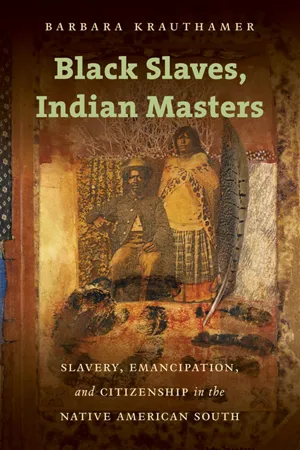
From the late eighteenth century through the end of the Civil War, Choctaw and Chickasaw Indians bought, sold, and owned Africans and African Americans as slaves, a fact that persisted after the tribes' removal from the Deep South to Indian Territory. The tribes formulated racial and gender ideologies that justified this practice and marginalized free black people in the Indian nations well after the Civil War and slavery had ended. Through the end of the nineteenth century, ongoing conflicts among Choctaw, Chickasaw, and U.S. lawmakers left untold numbers of former slaves and their descendants in the two Indian nations without citizenship in either the Indian nations or the United States. In this groundbreaking study, Barbara Krauthamer rewrites the history of southern slavery, emancipation, race, and citizenship to reveal the centrality of Native American slaveholders and the black people they enslaved.
Krauthamer’s examination of slavery and emancipation highlights the ways Indian women’s gender roles changed with the arrival of slavery and changed again after emancipation and reveals complex dynamics of race that shaped the lives of black people and Indians both before and after removal.
eBook - ePub
Black Slaves, Indian Masters
Slavery, Emancipation, and Citizenship in the Native American South
- 232 pages
- English
- ePUB (mobile friendly)
- Available on iOS & Android
eBook - ePub
Black Slaves, Indian Masters
Slavery, Emancipation, and Citizenship in the Native American South
About this book
Information
1
Black Slaves, Indian Masters
Race, Gender, and Power in the Deep South
In the early nineteenth century, Choctaw and Chickasaw men and women embraced the idea of acquiring black people as property, equating blackness with lifelong, hereditary, and degraded servitude. First in Mississippi and then after their removal in the 1830s to Indian Territory (now Oklahoma), wealthy and middling Choctaws borrowed, bartered, and paid cash on the barrel to buy enslaved black people from nearby white slave owners, professional slave traders, and each other. Through the antebellum period, growing numbers of Choctaws and Chickasaws calculated their personal wealth by counting the slaves they had purchased.1
The practice of owning people of African descent as property—slaves—emerged in large measure from Choctaws’ and Chickasaws’ heightened participation in the antebellum market economy and, like other market-oriented endeavors taken up by southern Indians, altered social and economic relations within Indian communities and among Indians and their white neighbors. But buying, selling, and owning African-descended people as property was not simply like other market practices that took root in southern Indian nations. Slaveholding, and the associated transactions of profiting from owning and exploiting black people’s labor and reproduction, required that Native peoples engage decidedly new meanings of property, race, and gender that had lasting consequences for Indians and African Americans alike. Slaveholding Choctaws and Chickasaws did not blindly adopt and imitate the racial ideology of their Euro-American neighbors in Mississippi but instead crafted and refined their own ideologies of racial identification and differentiation that reflected the particular social, economic, and political conditions of their time and place. Racial categories, which encompassed not only blackness but also conceptions of Indianness and whiteness, were never static but were made and remade from the late eighteenth century through the antebellum era. During this time, Choctaws and Chickasaws engaged new forms of property ownership, personal wealth, and shifting gender roles, and also contended with the mounting local and federal assaults on Indian sovereignty and land title in the southern states.
CHATTEL SLAVERY DID NOT EMERGE in the Choctaw and Chickasaw Nations until the early years of the nineteenth century, but neither the institution of human bondage nor its bedrock ideology of racial hierarchy materialized out of thin air in Indian communities. Beginning in the late seventeenth century, generations of Choctaw and Chickasaw men and women became well acquainted with the social and economic dynamics of the European colonial slave societies taking shape around them. This chapter begins with an overview of indigenous practices of unfreedom and captivity and Indian enslavement in the French and English colonies. The aim is not to suggest a clear and unbroken trajectory from captivity to slavery. Nor is the intention to imply that antebellum chattel slavery in the Choctaw and Chickasaw Nations was a largely benign variation of older, indigenous forms of unfreedom. Rather, the brief discussion of indigenous captivity and Indians’ own enslavement by European colonists is meant to suggest a historical narrative that recognizes a meaningful and shifting Native presence in the long history of American chattel slavery.
Through the first quarter of the century, Choctaws and Chickasaws gained a familiarity with slavery in the French and British colonies that was intimate and brutal. By the time the French built their posts at Biloxi and Mobile at the turn of the seventeenth century, English traders from Carolina had already made their way along Cherokee and Creek paths to the Tombigbee River and the Chickasaw villages hundreds of miles west of the Eastern Seaboard. European colonial authorities pursued trade alliances with southern Indians as part of an imperial strategy to advance their own business interests while constraining their European rivals’ territorial and commercial expansion. Late seventeenth-century and early eighteenth-century English alliances with the Chickasaws established Chickasaw male warriors as “commercial slave traders,” and within a few decades, Chickasaws earned the lasting reputation of being fearsome and superior warriors.2 Starting in 1702, French authorities, seeking to thwart the expansion of British-Indian trade farther into the lower Mississippi valley, negotiated alliances with Choctaws that included provisions for the purchase of Indian slaves.
British and French traders obtained Indian slaves by tapping into existing indigenous practices of raiding and captive taking. Choctaws and Chickasaws had long seized male and female captives during wartime as a means of obtaining spiritual and physical replacements for loved ones lost in war.3 Like other Native peoples, such as the Cherokees, Choctaws and Chickasaws usually put male captives to death after a period of ritualized torture. On one occasion in 1752, for example, Choctaws whipped a captive Chickasaw warrior for three days and planned on burning him to death on the fourth day, but he escaped. In the same year, Chickasaws tortured two captive Choctaw warriors “in a most barbarous Manner, takeing of their Scalps and cutting out their Bowels before they were dead.”4 Captive women and children were spared such a bloody fate and instead were adopted into their captor’s kin group to bolster the population and symbolically replace those who had been killed in war. Because clan membership and descent followed the female line, Choctaw and Chickasaw women, especially those who had lost kin in war, bore the responsibility of determining captives’ fate. They decided whether a man should be spared from execution and which women and children should be adopted as kin or held as subordinates or servants.
Armed and compensated by colonial authorities, Indian warriors in the lower Mississippi valley increasingly sought captives not to avenge the loss of kin but to gain valuable objects—the captives themselves—that could be exchanged for European manufactures such as duffels, guns, metal wares, liquor, and jewelry.5 Through much of the eighteenth century, European traders supplied these goods to Choctaw and Chickasaw headmen, local leaders who wielded political and spiritual power in their communities. Ethnohistorians have shown that in the Southeast, Indian headmen adapted long-standing indigenous diplomatic protocols to accommodate trade and military alliances with colonial partners. Powerful headmen had long achieved their status, established their spiritual power, gained the respect of their communities, and confirmed their authority through demonstrated success as hunters and warriors. Leaders bore the responsibility of distributing resources—the bounty of a deer hunt and also communal food crops—and thus demonstrated their power through the circulation of goods rather than their accumulation. In the eighteenth century, Choctaw and Chickasaw headmen, like their Creek and Cherokee counterparts, received trade goods from colonial allies and oversaw their distribution to warriors, their families, and the other members of the community. From the vantage of Native peoples, foreigners and the goods they bore possessed spiritual power, including the potential for chaos. Local leaders thus sought to rein in and access that power through their diplomatic relationships with outsiders and also through the circulation of exotic European goods among their people.6
British officials in Carolina armed and rewarded Chickasaw and Creek war parties for destroying Choctaw settlements and turning over Choctaw captives for enslavement in the British colonies. In 1708 Carolina trader and diplomat Thomas Nairne found that the Chickasaws enjoyed “the Greatest Ease” taking enemy captives to “get a Booty” from the British.7 French authorities, in turn, compensated Choctaws for the Indian captives they seized. In 1721, for example, during a period of warfare between Choctaw and Chickasaw settlements, Louisiana authorities sought “to incite [Choctaw warriors] to do well” by paying handsomely for every Chickasaw scalp and each of “the slaves that they bring in.”8 Chickasaw and Choctaw warriors targeted any number of indigenous peoples within an approximately 200-mile radius of their settlements in northeastern and central-eastern Mississippi. These slaving expeditions wreaked havoc on indigenous communities, disrupting local economic and demographic stability and precipitating lasting changes in the organization of local and regional populations.9 Colonial intrusions also dramatically altered Indians’ motives for taking captives and the consequences of capture.
Once in the hands of British traders, Indian captives, mainly women, were taken to Charleston and sold to planters who enslaved them alongside African women and men on South Carolina and Barbados rice and sugar plantations. The predominance of Indian women among the captives sold to British planters is suggested in the inventory of the slaves owned in 1715 by John Wright: fifteen black men and seventeen women, of whom thirteen were identified as Indians.10 A pamphlet promoting settlement in South Carolina instructed Anglo-American men of modest means to purchase “a good Negro man and a good Indian woman.” Wealthier colonists were directed to acquire African men, along with “Fifteen Indian women to work in the Field” and another “Three Indian Women as Cooks” and to attend to “Household-Business.”11 According to historian Alan Gallay, an estimated 24,000 to 51,000 Indians, including approximately 2,000 Choctaws, were sold into the British slave trade between 1670 and 1715. During this period, Carolina enjoyed a lively trade in Indian slaves, as the number of the colony’s exported Indian slaves exceeded the number of its imported African slaves.12
Beginning in the 1720s, the colonial trade in Indian captives/slaves quickly gave way to a thriving transatlantic trade in enslaved Africans. The number of enslaved Africans imported to North America swelled in the middle of the eighteenth century, with close to 19,000 Africans enslaved in Louisiana by 1769 and nearly 40,000 in South Carolina by 1750. The extensive transatlantic and domestic importation of black slaves into the lower Mississippi valley meant that the black population expanded alongside the burgeoning white population. Indeed, like South Carolina, Mississippi had a black majority that remained in place well into the nineteenth century.13
With this dramatic expansion of the enslaved African population, Choctaws’ and Chickasaws’ roles in the context of colonial slavery shifted. Increasingly, enslaved Indians, and also the children born to enslaved Indian and African unions, were described in racial terms of blackness, a reflection of the hardening association of blackness and enslavement.14 No longer desired as slaves by colonial planters, Indians were instead often pressed into service as slave catchers, policing both the territorial divide between the colonies and Indian country and the ever-more-rigid distinctions of race and status that defined colonial slave societies. Hoping to preclude any concerted acts of resistance or rebellion among Africans and Indians, Carolina and Louisiana lawmakers routinely demanded that their Indian allies catch and surrender runaway African slaves, often including this requirement into their treaties and diplomatic agreements with southern Native peoples. In 1726 French officials urged Louisiana’s lawmakers to “take prompt and sweeping action against runaway [African] slaves” by employing “neighborhood Indians” to capture them.15 Not long after England gained control of the French territory east of the Mississippi River, Choctaws and Chickasaws received the following directive at a 1765 assembly with the English governor of the newly designated West Florida: “We farther Expect you will agree to bring in any Negroes who may desert their Masters Service, for which a proper reward will be allowed to the Person who Shall execute this Service.”16
Though Indians generally had little choice but to follow French and British authorities’ demands that they capture and return fugitive slaves, they were never simply hapless pawns in a colonial game of dividing and conquering subjugated peoples.17 To the contrary, many southern Indians routinely discerned opportunities to pursue their own interests while making good on their commitments to their colonial allies.18 This is well illustrated by Choctaw warriors’ tactical responses to the 1729 Natchez attack on Fort Rosalie, a French outpost along the eastern banks of the Mississippi River just north of New Orleans. In the winter of 1729, Natchez Indians in Louisiana, distressed by the spread of disease and alcohol that too often accompanied the expansion of French settlement and had diminished the Natchez population by half since the arrival of the French, attacked the nearby French settlers at Fort Rosalie. The raiding parties killed about 240 French men, women, and children and seized another fifty French women, along with approximately 300 enslaved Africans. French commanders of the besieged fort reported that the Natchez warriors “did no harm to the negroes, having them feast on the cattle of the French, intending to go and sell them later to the English of Carolina.”19 Three African captives who escaped from the Natchez corroborated this account, informing French authorities that their captors had intended to deliver them to the English-allied Chickasaws for sale to Carolina slave traders.20
Not long after the attack, French authorities dispatched their Choctaw allies to retaliate against the Natchez by sacking their villages and retrieving the African captives. Like the Natchez, Choctaw warriors calculated the Africans’ value in the context of colonial slavery. They assessed their own ability to use the recovered captives to tip the balance of power in their trade and diplomatic relations with the French. Choctaw leaders thus held out for favorable ransoms before handing over the recaptured Africans. One Choctaw leader, for example, informed the French that he would not “return the negroes who had been captured from the Natchez” unless the French supplied him with goods “at the English prices.” Alibamon Mingo, a prominent Choctaw leader of the Chickasawhay towns—the southernmost of the principal Choctaw divisions and one that had been battered by Chickasaw raiders—stood firm when demanding compensation. He maintained that his warriors would only relinquish the Africans after he had received “4 pieces of limburg cloth, besides a coat, a gun, a white blanket” and many more items that the French calculated as “goods in proportion to their worth for each negro.”21 Caught up in the web of geopolitical alliances and enmities that linked Choctaws and Chickasaws to the French and British colonies, enslaved African women and men became valuable objects of exchange in Choctaw and Chickasaw trade and diplomatic relations with colonial authorities.
Records of the Choctaw headmen’s negotiations with the French suggest that their reasons for holding on to the African captives went beyond simply improving their bargaining position and point to the complex genesis of chattel slavery among southern Indians. Some Choctaws retained the African captives to use as servants in their own villages. One Choctaw leader, “little chief of the Yellow Canes,” indicated that he intended to hold on to his captives “for the purpose of serving his warriors.” As late as April 1730, French authorities learned that Choctaw warriors “had carried away a number of negroes to their country.”22 Notably, Choctaw warriors retained African men and not women to be their servants, which was a change from the previous custom in Indian raiding and captive taking. The African men held by Choctaw warriors endured physical hardships and violence that rivaled the onerous conditions of enslavement under French masters. In 1731 three African men under the command of Alibamon Mingo sought out the French authorities while en route to Mobile. The men asked to be reclaimed by the French because, they explained, “The Indians make us carry some packages, which exhausts us, mistreat us much, and have taken from us our clothing.” The officer who spoke with the three...
Table of contents
- Cover Page
- Black Slaves, Indian Masters
- Copyright Page
- Dedication
- Contents
- Illustrations
- Acknowledgments
- Introduction
- 1 Black Slaves, Indian Masters
- 2 Enslaved People, Missionaries, and Slaveholders
- 3 Slave Resistance, Sectional Crisis, and Political Factionalism in Antebellum Indian Territory
- 4 The Treaty of 1866
- 5 Freedmen’s Political Organizing and the Ongoing Struggles over Citizenship, Sovereignty, and Squatters
- 6 A New Home in the West
- Conclusion
- Notes
- Bibliography
- Index
Trusted by 375,005 students
Access to over 1.5 million titles for a fair monthly price.
Study more efficiently using our study tools.
Frequently asked questions
Yes, you can cancel anytime from the Subscription tab in your account settings on the Perlego website. Your subscription will stay active until the end of your current billing period. Learn how to cancel your subscription
No, books cannot be downloaded as external files, such as PDFs, for use outside of Perlego. However, you can download books within the Perlego app for offline reading on mobile or tablet. Learn how to download books offline
Perlego offers two plans: Essential and Complete
- Essential is ideal for learners and professionals who enjoy exploring a wide range of subjects. Access the Essential Library with 800,000+ trusted titles and best-sellers across business, personal growth, and the humanities. Includes unlimited reading time and Standard Read Aloud voice.
- Complete: Perfect for advanced learners and researchers needing full, unrestricted access. Unlock 1.5M+ books across hundreds of subjects, including academic and specialized titles. The Complete Plan also includes advanced features like Premium Read Aloud and Research Assistant.
We are an online textbook subscription service, where you can get access to an entire online library for less than the price of a single book per month. With over 1.5 million books across 990+ topics, we’ve got you covered! Learn about our mission
Look out for the read-aloud symbol on your next book to see if you can listen to it. The read-aloud tool reads text aloud for you, highlighting the text as it is being read. You can pause it, speed it up and slow it down. Learn more about Read Aloud
Yes! You can use the Perlego app on both iOS and Android devices to read anytime, anywhere — even offline. Perfect for commutes or when you’re on the go.
Please note we cannot support devices running on iOS 13 and Android 7 or earlier. Learn more about using the app
Please note we cannot support devices running on iOS 13 and Android 7 or earlier. Learn more about using the app
Yes, you can access Black Slaves, Indian Masters by Barbara Krauthamer in PDF and/or ePUB format, as well as other popular books in Social Sciences & North American History. We have over 1.5 million books available in our catalogue for you to explore.