- 160 pages
- English
- ePUB (mobile friendly)
- Available on iOS & Android
eBook - ePub
About this book
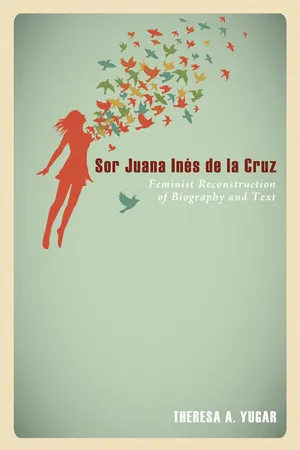
In Sor Juana Ines de la Cruz: Feminist Reconstruction of Biography and Text, Yugar invites you to accompany Sor Juana Ines de la Cruz, a seventeenth-century protofeminist and ecofeminist, on her lifelong journey within three communities of women in the Americas. Sor Juana's goal was to reconcile inequalities between men and women in central Mexico and between the Spaniards and the indigenous Nahua population of New Spain. Yugar reconstructs a her-story narrative through analysis of two primary texts Sor Juana wrote en sus propias palabras (in her own words), El Sueno (The Dream) and La Respuesta (The Answer). Yugar creates a historically-based narrative in which Sor Juana's sueno of a more just world becomes a living nightmare haunted by misogyny in the form of the church, the Spanish Tribunal, Jesuits, and more--all seeking her destruction. In the process, Sor Juana "hoists [them] with their own petard." In seventeenth-century colonial Mexico, just as her Latina sisters in the Americas are doing today, Sor Juana used her pluma (pen) to create counternarratives in which the wisdom of women and the Nahua inform her sueno of a more just world for all.
Information
Topic
Teologia e religioneSubtopic
Chiesa cristianasection i
Feminist Historical Reconstruction
chapter 1
Introduction
Gustavo Gutiérrez, foremost Liberation theologian in Latin America, argues that the arrival of European conquerors in sixteenth-century pre-Hispanic America turned the “world inside out.”1 It was a “violent clash of thinking [between] Europeans [and] the spiritual world of the ancient Mexicans.”2 Prior to the encounter between the peoples of Spain and New Spain—now modern-day Mexico—the ancestors of the Nahua Aztec people lived in harmony with the land and its multiple ecosystems, and with their gods, goddesses and the cosmos. This vieja civilización (ancient civilization) spoke Nahuatl.3 Its worldview was planetary and cosmocentric, which is to say it revolved around the earth, sky, clouds, rain, seeds and plants.4 It was characterized by equilibrium, duality, complementarity, and balance.5 The people of this ancient civilization respected the interrelatedness of all life forms, including animals, humans, and deities, male and female. The universe was not fixed or static but constantly changing.6 For the Nahua people the earth was a celestial body.
In a three-year period, from 1519 to 1521, conquistadors (conquerors) from the Iberian Peninsula, more specifically Spain, changed all that.7 Their presence on the continent disrupted the equilibrium and harmony that had existed in the region between the sexes, the land, the cosmos, the gods and goddesses, and human and nonhuman nature. Spaniards themselves testified that upon their arrival that this newly found territory was un paradiso (a paradise) or, sueño (dream).8 Spanish rule turned this paradise into “a living hell for the natives.”9 The years that followed were a living nightmare. The colonial enterprise in New Spain was a watershed moment because it was the nadir of the subjugation of women and the indigenous population by outside forces.10
In Quechua, the indigenous language of the Incas in Peru, the word pachacuti literally means a “cosmic cataclysm.”11 Today it indicates hope for the restoration of the balance that was disrupted upon the arrival of Spaniards and others to Spanish America. Pachacuti points to the beneficial transformation of oppressive ideologies, social systems and structures that have historically denied the native population on the Latin American continent their full humanity as agents in their own right. In Spanish it is a sueño. In Nahuatl, the language of the Mesoamerican people, it is temictli. The dream, sueño, or temictli, embraces all of the inhabitants of the region, whether from in or outside of Spanish America’s borders. Harmony on the continent can only occur if the two civilizations, Spaniard and the non-Spaniard, can recognize the beauty and ancient wisdom in each of their cultures.
Sor (Sr.) Juana Inés de la Cruz (1648/51–1695),12 the seventeenth-century Latina philosopher and theologian, exemplifies one approach to this “cosmic cataclysm.” In her time, as for the indigenous population, Sor Juana engaged in the work of transformative change. Her life and writings critiqued patriarchal ideologies and social structures that denied the full self-actualization of the people in her social location, Spaniard, non-Spaniard, man or woman. For Sor Juana to achieve this sueño, she considered the epistemological question of what it meant to be human from both an anthropological and theological perspective. The realization of the dream demanded that the narrative and the oral traditions of her ancestors, the Mesoamerican Nahua people, be heard and affirmed by all people in her post-conquest world. Their cosmic worldview and belief systems needed to be reclaimed in their own right. In Sor Juana’s her-story, the ancient wisdom of the Nahua people held the answer to harmony in her region and the epistemological question of what it meant to be human after the conquest.
In El Sueño (The Dream), Sor Juana refers to the conquest as sacrílego rüido (sacrilegious noise).13 She does not identify the origins of the conflict but we can discern nuances in her dream as she ponders the two competing forces. From her personal experiences of sexism and racism, Sor Juana critiques patriarchal oppressive social systems, structures, and ideologies, but then widens the conversation to a larger consideration of this issue in the Church and her seventeenth-century society. Thus, Sor Juana’s life and texts appear very feminist in that they move from the personal to the political. Central to her analyses is the exposure of the complicity of the Roman Catholic Church in the oppression and degradation of the indigenous population in Latin America.
In La Respuesta (The Answer), Sor Juana identifies women in the Christian tradition and the Church who used their education in the service of the Church. She mentions, a Gertrude, a Teresa, and a Brigid,14 who through their studies served the Church in positive ways.15 Sor Juana also notes, two native Mexican nuns, one from the Convent of Regina and the other from the Convent of the ...
Table of contents
- Title Page
- Foreword
- Preface
- Acknowledgements
- Section 1: Feminist Historical Reconstruction
- Chapter 1: Introduction
- Chapter 2: The Historical Context for Understanding Sor Juana’s Her-Story
- Chapter 3: A Feminist Historical Reconstruction of the Biography of Sor Juana Inés de la Cruz
- Section 2: Feminist Textual Analysis
- Chapter 4: La Respuesta (The Answer)
- Chapter 5: El Sueño (The Dream)
- Chapter 6: A Paradigm for a Latina Liberative Ecclesiology
- Bibliography
Trusted by 375,005 students
Access to over 1.5 million titles for a fair monthly price.
Study more efficiently using our study tools.
Frequently asked questions
Yes, you can cancel anytime from the Subscription tab in your account settings on the Perlego website. Your subscription will stay active until the end of your current billing period. Learn how to cancel your subscription
No, books cannot be downloaded as external files, such as PDFs, for use outside of Perlego. However, you can download books within the Perlego app for offline reading on mobile or tablet. Learn how to download books offline
Perlego offers two plans: Essential and Complete
- Essential is ideal for learners and professionals who enjoy exploring a wide range of subjects. Access the Essential Library with 800,000+ trusted titles and best-sellers across business, personal growth, and the humanities. Includes unlimited reading time and Standard Read Aloud voice.
- Complete: Perfect for advanced learners and researchers needing full, unrestricted access. Unlock 1.5M+ books across hundreds of subjects, including academic and specialized titles. The Complete Plan also includes advanced features like Premium Read Aloud and Research Assistant.
We are an online textbook subscription service, where you can get access to an entire online library for less than the price of a single book per month. With over 1.5 million books across 990+ topics, we’ve got you covered! Learn about our mission
Look out for the read-aloud symbol on your next book to see if you can listen to it. The read-aloud tool reads text aloud for you, highlighting the text as it is being read. You can pause it, speed it up and slow it down. Learn more about Read Aloud
Yes! You can use the Perlego app on both iOS and Android devices to read anytime, anywhere — even offline. Perfect for commutes or when you’re on the go.
Please note we cannot support devices running on iOS 13 and Android 7 or earlier. Learn more about using the app
Please note we cannot support devices running on iOS 13 and Android 7 or earlier. Learn more about using the app
Yes, you can access Sor Juana Inés de la Cruz by Theresa A. Yugar in PDF and/or ePUB format, as well as other popular books in Teologia e religione & Chiesa cristiana. We have over 1.5 million books available in our catalogue for you to explore.