eBook - ePub
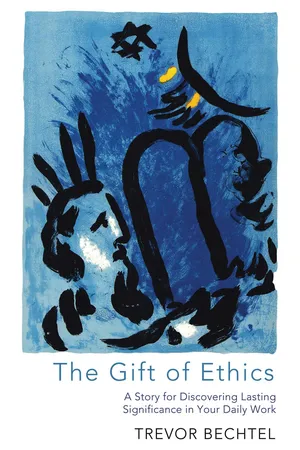
The Gift of Ethics
A Story for Discovering Lasting Significance in Your Daily Work
- 104 pages
- English
- ePUB (mobile friendly)
- Available on iOS & Android
eBook - ePub
The Gift of Ethics
A Story for Discovering Lasting Significance in Your Daily Work
About this book
Structured on the Beatitudes, The Gift of Ethics is a short, readable introduction to the major ideas in Christian ethics. Bechtel engages the reader through stories to draw out reflection on the good life.
Information
Topic
Theology & ReligionSubtopic
Christian Theologyone
Happiness
An Introduction to the Good Life
“Happy are those who mourn, for they will be comforted.”
Matthew 5:4
The Beatitudes, a set of short statements that Matthew reports Jesus as saying at the very beginning of the Sermon on the Mount, will form the backbone of this section on ethics in a biblical worldview. Each one of these statements is about a person or group of people who are surprisingly happy, as in the Beatitude which opens this chapter. At least as far back as the Greek philosopher Socrates, happiness has been at the heart of how wise people have understood ethics.
My favorite story about happiness is told in the film Life Is Beautiful. It is a story about an Italian Jewish family in the Second World War. In Life Is Beautiful the family has much to mourn, but through the father’s persistent happiness his son is able to find comfort. I believe that stories are the most useful way for us to begin to learn about ethics in a biblical worldview. I believe this because I believe that the Bible is itself first and foremost a story, and if we want to think about the Bible, we need to learn to think in stories.
In the rest of this chapter I want to tell this story and connect it to Jesus’ Beatitude about mourning and comfort. I also want to introduce the rest of this section of the book. First, let me say a bit more about the thesis of this chapter, which I’ll restate here: I believe that stories are the most useful way for us to begin to learn about ethics in a biblical worldview. In order to demonstrate this thesis, I need to show you why I believe stories are important. This is a question of the authority of stories. I should also be able to show you that stories do help us learn by example. I should be able to tell you a good story and show how it connects to ethics. I follow Socrates in believing that happiness is the heart of ethics. Life Is Beautiful is a good story for the purposes of my thesis, because it is a story about happiness and also a story with more than one worldview. In this way it serves as a good metaphor for a biblical worldview.
Introduction: Believing with/in Authority
Stories other than Life Is Beautiful might be useful too, but I believe that we need to think in terms of a story when we are learning about a worldview. Worldviews are stories that we tell ourselves about our world. I also believe that as often as we can, we need to let ourselves be guided by stories when we are trying to be ethical. In particular I believe that stories are more useful than goals or rules for the person or community who is trying to be ethical. I believe this because I believe that only stories have the richness to help us think about the complexities in our lives. Stories have the strength to sweep us up in their narrative or flow of events so that we can imagine ourselves actually living in the story. In addition to being strong in this way, stories are also noncoercive. That is to say that a story very rarely forces us to think or believe or do anything. Stories are so useful for people who want to think about ethics, because they are strong (complex) and voluntary (noncoercive).
Not everyone believes that stories are so useful for ethics. As I hint above, there are at least two other ways (goals and rules) of thinking about ethics in reference to the Christian religion. We’ll explore these in more detail later. For now I simply want to note that while I am stating what I believe to be true, other reasonable people disagree; furthermore, I cannot prove (in what we might call a mathematical or scientific sense) that stories are at the center of ethics. The world of ethics is not black and white. Does this mean that there is then no truth or that truth is merely a private matter so that what I believe is true for me but cannot be made to impinge on other people’s lives? This is an important question, and we will take it up again and again in different ways in the chapters that follow in this section. For now let me state simply that you, the reader, and I, the author, work together as a community of sorts to create truth. We are responsible to each other. Of course, this extends far beyond you and me. At the limit everyone who learns about or attempts to inhabit a common worldview has a responsibility to each other to consider the truth he and she share.
Therefore, the claim that stories are the most useful way for us to think about ethics is a claim that I am making and you are reading, and it is an important claim which attempts to ground our reality. The way that the Gospel writer Matthew begins and ends the Sermon on the Mount is a good example of the strength and voluntary nature of stories:
Now when Jesus had finished saying these things, the crowds were astounded at his teaching, for he taught them as one having authority, and not as their scribes (Matt 7:28–29).
It is interesting to note that nowhere in the Sermon on the Mount does Jesus claim authority for himself. He simply speaks as if he has authority. It is not Jesus who claims authority, or the disciples who claim authority on Jesus’ behalf; however, Jesus does have authority at the end of the Sermon on the Mount, for the crowds give it to him in their astonishment. Jesus works together with his audience to establish his claims.
Of course, Christians do not simply believe that Jesus was a good teacher. Christians believe that Jesus is the Son of God. Interestingly, Jesus himself, at this point in the story, is not particularly interested in having the good news that he is the Son of God spread about. Matthew reports:
When Jesus had come down from the mountain, great crowds followed him; and there was a leper who came to him and knelt before him, saying, “Lord, if you choose, you can make me clean.” He stretched out his hand and touched him, saying, “I do choose. Be made clean!” Immediately his leprosy was cleansed. Then Jesus said to him, “See that you say nothing to anyone; but go, show yourself to the priest, and offer the gift that Moses commanded, as a testimony to them.” (Matthew 8:1–4)
Teaching is something that anyone can do. Jesus teaches with authority and lets the crowd, with their own reaction, give credibility to his teaching. Healing is something that only God can do. It might be the proof that Jesus’ teaching is God’s teaching. I have spent so much ink on belief and authority at the very beginning of this section because I believe that it is very important to recognize that Jesus is more interested to have the crowd validate his teaching than to validate it himself, even though he could have! Jesus, even when he acts with authority at this point in the story, is not interested in having people blab about it. I believe that Jesus is also interested in working with his audience to create truth.
In fact, we get another clue to this at the very beginning of the Sermon on the Mount:
When Jesus saw the crowds, he went up the mountain; and after he sat down, his disciples came to him. Then he began to speak, and taught them, saying . . . (Matthew 5:1–2).
Note that it is not at all clear to whom Jesus is about to preach. There are crowds, and Jesus goes up a mountain (so that they can hear him? or at least see him?). There are also the disciples who come to Jesus. Jesus could be teaching the crowds, but why then does Matthew report that the disciples come to Jesus? Jesus’ teaching could be just for the disciples, but then why does he teach when there are so many people around? It is likely that Jesus aimed his teaching at the disciples but was happy for any in the crowd who wanted to listen to hear for themselves. In some ways Jesus has a double audience. He is a bit like a tour guide in a museum who does not mind attracting a crowd of nonpaying guests who voluntarily want to learn.
In this way, when I state that stories rather than rules or goals are where we should look to for authority, I recognize that I must convince you of my thesis. You may be convinced or you may not be convinced. In a very real way we are looking at the question of ethics in a biblical worldview together and are responsible to each other in this process. The material in these chapters is my best attempt to truthfully convince you about what I believe the best way to live a human life is, the best way to be happy. I hope that in your reading you will hold me accountable to that high goal. With this introduction in hand, let us move together to my favorite story about happiness.
Happiness in a Concentration Camp
We return to Life Is Beautiful. As Jews trapped in the holocaust, Guido and his son Joshua find themselves on a train from Italy to Germany, facing likely extermination in a concentration camp. Their uncle Eliseo is immediately gassed upon arrival. Guido hides Joshua from the Nazi guards and then works to convince Joshua that life in the camp is really just a game. The rules for game are these: if Joshua cries, complains that he wants his mother, or complains that he is hungry, he will lose points. Quiet boys who hide from the guards earn points. The person who wins the game will win a tank.
The stage is set; Guido and Joshua are in what is surely one of the saddest places our world has ever seen, but Joshua is primed to think that this is a game. Even though they are surrounded by sickness, misery, and death, Guido gives such a good performance that Joshua experiences the camp as one of the most fun experiences of his young life. When the guards yell at the prisoners, Guido “translates” their commands into instructions in the game. When Joshua despairs at his situation and asks to quit the game and go home, Guido lifts his spirt by telling him he is in the lead. At the end of the movie, Guido is led by the German prison guards to his execution. With Joshua watching Guido comically mimics the actions of the guards, much to Joshua’s amusement. American tanks roll into the camp soon thereafter, and Joshua wins this game.
Happiness can mean many things to many people. It can be a state of contentment, humor, or amusement. In this story it is also an activity. Guido works very hard at happiness, perhaps for himself, but surely for Joshua. Everything he does has the goal of creating, maintaining, and sustaining Joshua’s happiness. Joshua is willing to trust his father’s explanation that this concentration camp is, in fact, a happy place or, at the very least, a place where a fun, if very weird, game can be played. Joshua’s trust that his father understands what can count as happiness is what I think makes Life Is Beautiful so beautiful. That trust animates the world that his father is creating for him. The world that Guido creates is on one level deceitful—concentration camps are not happy places—but on other levels it is more truthful than the concentration camp itself. That is, and this is I think the important lesson that we can learn from Life Is Beautiful, happiness is not so much dependent on the harsh realities of our situation, nor is it a simple emotional state that we simply will (as if we can decide whether to be happy or not); instead, our happiness is connected both to our actions and to the actions of those around us. For Joshua happiness is the activity of trust.
What is happiness then for Guido? Guido must also experience many other feelings (despair, anger, mourning), but he rigorously maintains an amused attitude. This is certainly partly because it is necessary in order to build the fiction of the g...
Table of contents
- Title Page
- Preface
- Chapter 1: Happiness
- Chapter 2: Decisions
- Chapter 3: Gifts
- Chapter 4: Paradigms
- Chapter 5: Practices
- Chapter 6: Imagination
- Chapter 7: Rules
- Chapter 8: Righteousness
- Bibliography
Trusted by 375,005 students
Access to over 1.5 million titles for a fair monthly price.
Study more efficiently using our study tools.
Frequently asked questions
Yes, you can cancel anytime from the Subscription tab in your account settings on the Perlego website. Your subscription will stay active until the end of your current billing period. Learn how to cancel your subscription
No, books cannot be downloaded as external files, such as PDFs, for use outside of Perlego. However, you can download books within the Perlego app for offline reading on mobile or tablet. Learn how to download books offline
Perlego offers two plans: Essential and Complete
- Essential is ideal for learners and professionals who enjoy exploring a wide range of subjects. Access the Essential Library with 800,000+ trusted titles and best-sellers across business, personal growth, and the humanities. Includes unlimited reading time and Standard Read Aloud voice.
- Complete: Perfect for advanced learners and researchers needing full, unrestricted access. Unlock 1.5M+ books across hundreds of subjects, including academic and specialized titles. The Complete Plan also includes advanced features like Premium Read Aloud and Research Assistant.
We are an online textbook subscription service, where you can get access to an entire online library for less than the price of a single book per month. With over 1.5 million books across 990+ topics, we’ve got you covered! Learn about our mission
Look out for the read-aloud symbol on your next book to see if you can listen to it. The read-aloud tool reads text aloud for you, highlighting the text as it is being read. You can pause it, speed it up and slow it down. Learn more about Read Aloud
Yes! You can use the Perlego app on both iOS and Android devices to read anytime, anywhere — even offline. Perfect for commutes or when you’re on the go.
Please note we cannot support devices running on iOS 13 and Android 7 or earlier. Learn more about using the app
Please note we cannot support devices running on iOS 13 and Android 7 or earlier. Learn more about using the app
Yes, you can access The Gift of Ethics by Trevor George Hunsberger Bechtel in PDF and/or ePUB format, as well as other popular books in Theology & Religion & Christian Theology. We have over 1.5 million books available in our catalogue for you to explore.