Do you ever think you’re forgetting how to talk about God? Or never learned how?
Theology is nothing more—and nothing less—than speaking together about God. Still, a lot of us don’t know where to start.
In Speaking of God, pastor and theologian Anthony Siegrist helps readers recover a basic language around Christian theology. The sweeping epic of Scripture serves as the scaffold for this accessible book. In vivid and even humorous writing, Siegrist introduces us to scholars and pilgrims and traditions that disclose essential truths about God and Jesus Christ, as well as concepts like creation, sin, redemption, the church, and discipleship. By plumbing the works of theologians such as Augustine, Julian of Norwich, Antonia Gonzalez, and Kazoh Kitamori, Siegrist offers readers an introduction to Christian theology throughout the ages, emphasizing common threads of thought and practice across traditions.
Learning to talk about God requires courage and humility; this handbook of Christian theology will help you gain both. Join the deepest, longest conversation in the world.
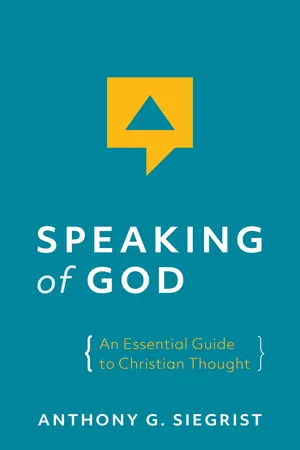
- 276 pages
- English
- ePUB (mobile friendly)
- Available on iOS & Android
eBook - ePub
About this book
Information
Topic
Teologia e religioneSubtopic
Denominazioni cristiane1
GETTING STARTED
I feel sometimes as if I were a child who opens its eyes on the world once and sees amazing things it will never know any names for and then has to close its eyes again.
—John Ames, in Gilead by Marilynne Robinson
Theology, at its most basic level, is nothing more than speaking together about God. It is an ongoing conversation, one that can intrigue us and draw us in. Whether we’re new to the discussion or have been involved in it for a lifetime, theology should be immersive and transformative. It should bring us joy.
I was in high school when I first encountered a really intriguing idea about God. It wasn’t the first conversation I had on the subject of God; far from it. I was involved in a Christian youth group and attended church. We talked about God, along with politics and sports, in the home where I grew up. But I can remember the morning when I first got the sense that this was all far bigger and far deeper than I had been led to believe.
My Bible class met on the first floor of my Christian high school, near the administrative offices. All the Bible classes met in rooms at that end of the school. We were surrounded by paper timelines of the Protestant Reformation, and had the sense that the administrators were listening through the hall door. The Reformation was the point in the sixteenth century when the church in the West broke apart—or as our teachers told the story, it was the point when the church got its act together, with our spiritual ancestors leading the way.
We were mindful of the proximity of the administrators when our teachers struggled to manage discussions about God and sex. On that particular morning, the teacher had drifted into some of the ideas that had been hot topics when he was in seminary. My sense was that he hadn’t prepared for class and was buying time until the bell rang. I was doodling in my notebook when he mentioned the name Karl Barth (1886–1968). Barth believed that the Bible wasn’t God’s Word in itself, our teacher said, but that it became God’s Word as we read it and as the Spirit enlivened it. That doesn’t quite do justice to Barth’s view of Scripture, but what mattered then was that I hadn’t heard that idea before—and that my teacher’s professors had thought the idea quite scandalous.
I was hooked. Could it be that the reading and study of Scripture meant more than trying to dig up whatever it was the author had meant? Could it be that thinking and intellectual work were spiritual activities? Could it be that the Spirit didn’t just move when worship music was blaring?
I was intrigued but not particularly driven. It wasn’t until the idea had bumped around in my head for a few days and I found myself in the library with no pressing assignments that I finally searched the stacks for something by Karl Barth. I found a slim volume with his name on the spine. The final h in his last name surprised me; it wasn’t how my teacher had pronounced it. The book hadn’t been checked out in years. I puzzled over it for an hour and left it in the library. Slim as that book was, I couldn’t make out what the Swiss theologian was going on about, and I couldn’t uncover even a trace of the potent ideas my teacher had described.
That was about twenty years ago—twenty years of books, conversations, and postsecondary degrees. I think I’m now officially a seasoned theology nut. But the ideas still excite me. I know that this is not everyone’s experience. Some people’s introduction to theology is more like my uncle’s introduction to lakes in northern Ontario. I was a boy of three or four when I went down to the lake to watch my extended family return from fishing. I remember seeing my uncle, a stout middle-aged man, sitting in the stern of a canoe pulled halfway out of the water. He sat there with a fishing rod in one hand and a paddle in the other. He lurched forward ever so slightly, getting ready to climb out of the canoe. Then it tipped. He flailed for something solid to grab, and finding nothing, flipped over like meat on a spit. The cold water and knee-deep muck made him gasp and sputter. As far as I know, he never regained trust in canoes, lake bottoms, or my other uncle, who should have been steadying the canoe. He couldn’t shake the worry that one wrong move might dump him once more into the drink. Beginning to study theology is sometimes like that. It can feel forced and ungrounded, and can leave us without any desire to try again.
One of the reasons theology can be intimidating is that theologians tend to have a lot to say. One of the best examples is the Italian theologian Thomas Aquinas (1225–74). For centuries a rumor persisted that Thomas could levitate. That probably was not true, but it is true that his writings fill a shelf by themselves. Early in Thomas’s life, when he first expressed his intention to join the Dominican monastic order and become a theologian, his brothers tried to change his plans by hiring a woman to seduce him. Legend says that Thomas overreacted a bit and chased her away with a fire iron. Later, while studying in Paris, he was bullied by classmates and called a “dumb ox.” That seems to have been an overreaction on the part of his classmates. Thomas is one of the most important theologians of the medieval period. He claims that theology is primarily about God, but he also points out that since God is the origin of everything, just about anything can find a place in a theological discussion.1 This gave him quite a bit to write about.
It has been a while since I was bested by that little Barth volume. Since then I have published a couple of academic books, but they would barely fill a soap tray. I certainly can’t levitate, but I have spent quite a bit of time helping people find their way around the Christian faith. This involves not only explaining the relevant vocabulary and history but also listening to conversations about faith and the big questions of life: How do we know if we are living well? How should we respond to the beauty we encounter every day? What about the pain and the ugliness? These are conversations about God and the implications of divinity; they are theological conversations. I’m sure that you have had conversations like these as well. If you have, it means your feet have already been in theological waters. These discussions are lively and deeply meaningful. When we consider theology in more formal ways, we are simply adding a level of care and organization to the talk about God we’re already doing.
Like any conversation, theology involves both speaking and listening; it involves discerning together what is true and what is good and what is beautiful. The challenge is that any good discussion requires a shared language. We live in a time when we have access to more information than previous generations, yet many of us are not as familiar with the people, concepts, and history of the Christian community as we would like to be. This makes participation challenging. It also means that our talk about Scripture and the Christian life is regularly reduced to emotivism (“I feel this . . .”) or Bible-thumping (“This verse says that . . .”). We’re also easily influenced by teachers and movements that have the same features of the shows we watch—slick graphics, heartwarming endings, or us-against-them posturing. We quickly lose the overwhelming sense of beauty that our talk about God ought to provoke. We crumple the mystery of the divine into the havoc of partisan politics.
Our lack of biblical and theological literacy means that our churches are having a hard time finding well-prepared lay leaders and that our ability to respond with faithfulness and creativity to large-scale cultural shifts is seriously hampered. Not long ago I found myself waiting for lunch beside a well-traveled church consultant and ordained Baptist minister. She assured me that these challenges are widespread. “It isn’t just that our communities don’t like change,” she said; “it’s that we don’t quite know what direction change should take us.” Many of our churches are flummoxed by the appearance in their midst of various bits and pieces of our global technological society. At a time when our broader culture seems to be going a hundred ways at once, it’s important that Christian communities nurture their ability to speak about God, about Scripture, and about our lives with care and attention.
Theology is a serious conversation, but it’s also implicitly humorous. We are, after all, trying to speak with precision about things like God and the origin of our own existence. We should be willing to laugh at ourselves. That being the case, theology still doesn’t lend itself well to short attention spans or little blurby statements. If our fast-paced global culture is being consistently reminded of anything, it’s that things of value take time to develop. In 2007, Carlo Petrini, the founder of the Slow Food movement, met the Prince of Wales. The Slow Food movement started in Italy (no surprise there) as a way of resisting the development of a fast-food franchise near Rome’s Spanish Steps. The British newspaper The Guardian featured an article about the meeting between Petrini and the British prince. It began this way: “Not since Jesus rustled up a feast from some fishes and a few loaves of bread . . . have we invested food with such spiritual qualities; and if food has become the faith of a decadent West, its high priest is Carlo Petrini. When the founder of the Slow Food Movement met the Prince of Wales last week it was hard to say who was having the audience.”2
Petrini’s message was that we should eat better—probably less as well, but certainly better. And “better” means slower. By now the term slow has been used to positively describe all kinds of things, but I want to suggest that it could be used to describe a good theological conversation. Slow theology is the product of careful attention and maturity. Learning to participate—or even better, to contribute—takes time. Fast food is fine if you want to fuel yourself the way you would fuel a car, but if you want something deep, a bit more refined and timeless, then you need to invest some focused attention.
A FORECAST
I don’t know if you’ve ever had someone tape a sporting event so you could watch it later. You probably told them not to tell you who won. Not knowing the outcome is what makes watching something like that the most engaging. In other situations, though, it’s good to know the general outline of the story so you can dig into the details.
Here is where this book is going. Think of it first as a little introductory handbook on Christian theology. The ancients would have called it an enchiridion, which means the same thing. Early in the sixteenth century, a Dutch scholar named Erasmus (1466–1536) wrote a little book known in English as the Handbook of a Christian Knight. He was trying to convince the friend of a friend that being a Christian required him to act like Christ, not just do some rituals. The English translation runs a little over one hundred pages. Many years before, Augustine of Hippo (354–430) wrote a little book usually called The Enchiridion of Augustine. Augustine was a reformed partier who admitted that in his youth he stole fruit and had too many lovers. Augustine and Erasmus are towering figures. My only connection to them as an author is that I think they were on to something when it comes to the need for handbooks. If you’ve got the gumption, read one of theirs instead of this. You should know, though, that Augustine’s handbook contains 122 chapters. This one only has 18—though, to be fair, his chapters are shorter.
In writing this book I’ve learned how hard it is to make a slim introduction. It’s difficult to know what details are essential, like which of the many important figures I should mention. It’s also difficult to know when to share personal bias. One of the first introductory theology books I read was by C. S. Lewis (1898–1963). Aside from a few peripheral moments like my encounter with Karl Barth, I didn’t get into much theology as a high school student. It wasn’t until several years later that I took another shot at something that sounded vaguely like a theology book. I was in Trinidad as a community volunteer assisting a church when I picked up a book by C. S. Lewis. Lewis was a scholar of classical languages and literature. I found a copy of his Mere Christianity in a church library in a little town that straddled the island’s main highway. Lewis’s clear prose and easy way of unfolding complex arguments drew me in. Mere Christianity was probably the first theology book I took seriously. I had read quite a bit before that, mostly novels, some biographies, and the panoply of books assigned at school. One summer when I broke my ankle I even skimmed my parent’s entire encyclopedia set. Yet there was something about the ideas Lewis opened up that I found more alluring. They seemed to matter.
I still have a deep respect for Lewis’s book, but one thing I’ve learned since is that there is no such thing as “mere” Christianity. There is no generic way to introduce this subject. Even attempting to use “unbiased” scientific and historical tools would do nothing more than give us an introduction with a certain type of bias. Learning to speak about God demands both courage and humility: courage because generic statements just won’t do; humility because our perspective is just that, our perspective. If we’re going to talk about God, we must own our words.
This can all be a little frustrating. Sometimes we just want to be told “the way things are.” We don’t want to mess with sorting various branches of the Christian family tree. The problem, though, is that “the way things are” is always the way you or I think they are. It’s the way we see things. This doesn’t mean objective reality doesn’t exist, just that we only have particular accounts of it, accounts shaded by human culture and our own experiences.
In Speaking of God, my intention is to be conscious of the variety of ways Christians see things but also to deliberately cross many of the traditional boundaries between Christian groups. To make my own biases a little more transparent, I will tell you more about myself here and throughout the book. In addition to studying and publishing, as I’ve mentioned already, it’s worth knowing that I pastor a Protestant church, more specifically a Mennonite church, in Canada’s capital city. Being Mennonite means that our congregation traces its roots to Radical Reformers of the sixteenth century. These Reformers, known as Anabaptists, were unique in that they didn’t think matters of faith should be enforced with violence. This is my current church home, but I’ve also worshiped and studied with Anglicans for nearly a decade. I taught at an evangelical college for almost the same amount of time. There are things I love about each of these communities and things that frustrate me.
Whatever our backgrounds might be, when we join the theological conversation we join a discussion that is well underway. So while we can’t speak about God generically, we can look to those who have come before to see how they have sorted the central issues from the peripheral ones. Just because most Christians agree on some things, like the divinity of Jesus and the triune character of God, doesn’t necessarily make the traditional perspective true. It does mean, however, that we should be careful about making off-the-cuff changes. In this book I’ll try to encourage us to honor traditional wisdom while remembering that a central assumption of Christianity is that we should be open to change—something we call repentance.
Like any book, this one has been influenced by a host of voices. I draw from a long list of scholars and pilgrims. As a pastor-theologian, I’ve become especially taken with ancient Christian thinkers who worked before the intellectual universe was chopped up into so many different fields of study. They moved with grace between what we would now think of as Christian doctrine, biblical studies, philosophy, psychology, rhetoric, and even, in some cases, math and the natural sciences. They were less concerned about being experts in one particular thing than they were with pulling it all together into a way of being that had integrity.
One of my working assumptions is that the Christian community needs people who can link things together. We need people with hybrid identities who can connect the rest of us. I’ve spoken to lots of people who understand their faith in a hybrid way, a blend of the charismatic movement and Eastern Orthodoxy, for example. I know Anglican-Anabaptists. Hybridity is messy, but these sorts of f...
Table of contents
- Front Cover
- Half Title Page
- Title Page
- Copyright Page
- Contents
- 1 Getting Started
- 2 A Wild Olive Shoot: A People with a Story
- 3 In the Beginning: Seeing the World
- 4 They Were Ashamed: Fallen Creatures
- 5 From the Land of Ur: Mission
- 6 Let Them Go and Gather Straw for Themselves: Slavery
- 7 And They Went into the Wilderness: Formation
- 8 Give Us a King: Providence
- 9 Do Justice and Love Kindness: Faithfulness
- 10 I Will Make a New Covenant: Anticipation
- 11 She Will Bear a Son: Incarnation
- 12 You Shall Call His Name Jesus: Reconciliation
- 13 He Shall Save His People from Their Sins: Atonement
- 14 They Were All Together in One Place: Connections
- 15 Eat This Bread and Drink This Cup: Practices
- 16 The Fruit of the Spirit: Character
- 17 I Saw a New Heaven and a New Earth: Hope
- 18 The Task of Theology
- Acknowledgments
- Notes
- Selected Bibliography
- Index
- The Author
Trusted by 375,005 students
Access to over 1.5 million titles for a fair monthly price.
Study more efficiently using our study tools.
Frequently asked questions
Yes, you can cancel anytime from the Subscription tab in your account settings on the Perlego website. Your subscription will stay active until the end of your current billing period. Learn how to cancel your subscription
No, books cannot be downloaded as external files, such as PDFs, for use outside of Perlego. However, you can download books within the Perlego app for offline reading on mobile or tablet. Learn how to download books offline
Perlego offers two plans: Essential and Complete
- Essential is ideal for learners and professionals who enjoy exploring a wide range of subjects. Access the Essential Library with 800,000+ trusted titles and best-sellers across business, personal growth, and the humanities. Includes unlimited reading time and Standard Read Aloud voice.
- Complete: Perfect for advanced learners and researchers needing full, unrestricted access. Unlock 1.5M+ books across hundreds of subjects, including academic and specialized titles. The Complete Plan also includes advanced features like Premium Read Aloud and Research Assistant.
We are an online textbook subscription service, where you can get access to an entire online library for less than the price of a single book per month. With over 1.5 million books across 990+ topics, we’ve got you covered! Learn about our mission
Look out for the read-aloud symbol on your next book to see if you can listen to it. The read-aloud tool reads text aloud for you, highlighting the text as it is being read. You can pause it, speed it up and slow it down. Learn more about Read Aloud
Yes! You can use the Perlego app on both iOS and Android devices to read anytime, anywhere — even offline. Perfect for commutes or when you’re on the go.
Please note we cannot support devices running on iOS 13 and Android 7 or earlier. Learn more about using the app
Please note we cannot support devices running on iOS 13 and Android 7 or earlier. Learn more about using the app
Yes, you can access Speaking of God by Anthony G. Siegrist in PDF and/or ePUB format, as well as other popular books in Teologia e religione & Denominazioni cristiane. We have over 1.5 million books available in our catalogue for you to explore.