- 380 pages
- English
- ePUB (mobile friendly)
- Available on iOS & Android
eBook - ePub
About this book
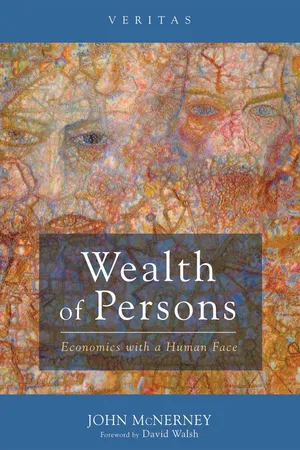
Thomas Piketty's Capital in the Twenty-First Century initiated a great debate not just about inequality but also regarding the failures found in the economic models used by theoreticians and practitioners alike. Wealth of Persons offers a totally different perspective that challenges the very terms of the debate. The Great Recession reveals a great existential rift at the core of certain economic reflections, thereby showing the real crisis of the crisis of economics. In the human sciences we have created a kind of "Tower of Babel" where we cannot understand each other any longer. The "breakdowns" occur equally on the personal, social, political, and economic levels. There is a need for an "about-face" in method to restore harmony among dissociated disciplines.
Wealth of Persons offers a key to such a restoration, applying insights and analysis taken from different economic scholars, schools of thought, philosophical traditions, various disciplines, and charismatic entrepreneurs. Wealth of Persons aims at recapturing an adequate understanding of the acting human person in the economic drama, one that measures up to the reality. The investigation is a passport allowing entry into the land of economic knowledge, properly unfolding the anthropological meaning of the free economy.
Information
Topic
PhilosophySubtopic
Ethics & Moral Philosophy1
The Great Recession Points Us to the Crisis of Economics
I. Introduction
This book can be best described as a quest, a search to find a way of unearthing and understanding something which, I believe, frequently lies hidden beneath the workings of the free market economic process. This is the centrality and true wealth of the acting human person who is at the kernel of the proper workings of the free economy. I remember during a trip to the University of California, Berkeley in the United States, I spent the first few days attempting to get my geographical bearings. I was working in the Haas Business School on research connected to my doctoral studies. But like any first-time visitor to San Francisco, I was also keen to catch a glimpse of the different sights, like the Golden Gate Bridge and the Pacific Ocean. One particular morning, I went down to the Berkeley marina near where I was staying, hoping to see across the bay. Unfortunately, the fog restricted visibility. My trip was seemingly made in vain. Just then, I asked a resident if she could point out to me the direction of the famous landmarks, so that I could try to make them out in the haze. She genially did so but also advised me that the best vantage point to see the famous bridge was up from the surrounding hills. I was directed to drive to the Grizzly Peak area in the Tilden Regional Park to get a better panorama. I took the woman’s advice and sure enough the view was breathtaking and well worth the effort. In order to gain a view of the broader vista it is often necessary to travel away from the particular spot and so look back upon the object of interest from a different perspective. This is true equally in the field of any kind of research and while the remit of our study is primarily a philosophical investigation into human action, we will focus on how this intersects with and applies to the economic drama of human life. Indeed, scholars repeatedly refer to the need for a multidisciplinary approach since we are dealing with a multidimensional reality when we come to study the human person. In a research paper the Nobel Prize–winning economist Daniel McFadden notes how the models economists use need considerable enhancement. He says, in fact, the typical “Homo economicus” model economists deal with is “a rare species.” So, he claims economics “should draw much more heavily on fields such as psychology, neuroscience and anthropology.”1
Earlier on, I spoke of the need to change my geographical location because the climatic conditions in the East Bay region prevented me from seeing the famous sights from the Berkeley marina. Apparently, just like in Ireland, the weather conditions are always a topic of conversation in the Bay Area. Mark Twain is alleged to have remarked, “The coldest winter I ever spent was a summer in San Francisco.” Berkeley is situated northeast of the city of San Francisco, so it is possible from there to catch glimpses of the city and its sights through what the Californians call the “high fog.” I use this example of shifting our horizons in order to see things more clearly because philosophy can offer a specific perspective and make a thought-provoking contribution to the investigation of what I call the truth and wealth of a “personcentric” economy. This is so even if in the Great Recession the human person became derailed from the prevailing economic paradigm.
There is always a tendency to “pass the parcel” and simply blame others for financial and economic implosions. But there is a concomitant need for a development in our understanding of human economic action. For instance, an all too common approach today is to say that the “free market economy” is a fundamentally flawed system because it is just about “greed.” This is somewhat simplistic because avarice, or what I would call “Gekkoism” (that is, the “Greed is good” mantra of Gordon Gekko, the main character of Wall Street), is part but not the totality of what caused the financial crash and subsequent recession. The usual perception is to say it happened because “unregulated laissez-faire capitalism was allowed to let rip and the greed of bankers . . . led them to an unprecedented degree of risk taking.”2 From this perspective, free-market economics created a monster machine of Frankensteinian proportions and we are the victims of what Saul Bellow calls “addition and subtraction.”3
Indeed, Thomas Piketty clearly sets out a case in Capital in the Twenty-First Century, which considers that free markets have built within them a “deep structure of inequality.”4 Therefore, there must be direct intervention by governments to intervene on behalf of the majority to address capitalism’s propensity to concentrate wealth in the hands of the few and so also fundamentally corrupting the democratic process. Piketty outlines how, if capitalist economies are simply left untethered, returns to capital will inevitably grow more rapidly than the economy as a whole. But he sees that “there are ways democracy can regain control over capitalism and ensure that the general interest takes precedence over private interests.” In his analysis he outlines how “the dynamics of wealth distribution reveal powerful mechanisms pushing alternatively toward convergence and divergence. Furthermore, there is no natural spontaneous process to prevent destabilizing, inegalitarian forces from prevailing permanently.” Piketty sees the intrinsic inequality of capital ownership arising from the “principle of accumulation” as being “difficult to accept and peacefully maintain within a single national community.” The conventional wisdom that economic growth is a “marvelous instrument for revealing individual talents and aptitudes” is mere subterfuge often used to “justify inequalities of all sorts” and results in “gracing the winners in the new industrial economy with every imaginable virtue.” Piketty maintains that we cannot “rely solely on market forces or technological progress” if we want to satisfy an economic system that is based on “democratic and meritocratic hope.” He foresees the rise of a new form of “patrimonial capitalism” based on the tendency in capitalism to develop into a concentration of wealth among the few. The remedy he advocates is a global tax of 2 to 5 percent on the “super-wealthy.”5
There is no doubt that Piketty’s book has provoked worldwide interest not just about the Great Recession but also about the nature of economics itself. In fact, a “Piketty bubble” exploded in terms of reviews and reactions to his work. When some writers in the Financial Times critiqued the work, Paul Krugman retorted, “inequality denial persists. There are powerful groups with strong interest in rejecting the facts, or at least in creating a fog of doubt.”6 I cannot go into a comprehensive analysis of Piketty’s contribution to the debate. But his fundamental solution to the conglomeration of wealth problem is addressed in terms of a “distributive approach” which, while being legitimate insofar as it goes, does not adequately deal with the actual importance role of “wealth creators” and wealth creation in the free economy. Piketty is strong on the description of income and wealth distribution but actually weak when it comes to a balanced explanation of the essential characteristics of the free market process.7 “Distribution” in itself does not sufficiently explain how wealth is created or the importance of its formation for the whole of society. In my view this is because Piketty does not wrestle with the “anthropological question” (see my reference in the preface to the preponderance of “anthropological anorexia” in the debate among economists) which helps explain the importance of “wealth-creation” and of the role of its “creators” in the free market process. This is to be understood not just in monetary terms but also in how the human “creativity” involved helps unfold the reality of the human person...
Table of contents
- Foreword
- Preface
- Acknowledgments
- Chapter 1: The Great Recession Points Us to the Crisis of Economics
- Chapter 2: The Free Economy at the Crossroads: Still Fit for Purpose?
- Chapter 3: Toward a Philosophy of Economic Order: Retrieving the Human Meaning of the Free Economy
- Chapter 4: Entrepreneurial Perspectives I: The Primacy of Person-Centered Economic Creativity in the Free Market Process
- Chapter 5: Entrepreneurial Perspectives II: A Philosophical Reflection on the Role of the Entrepreneur
- Chapter 6: Entrepreneurial Perspectives III: A Movement toward a Higher Anthropological Viewpoint
- Chapter 7: Entrepreneurial Perspectives IV: Eastern Awakenings and Western Alertness
- Chapter 8: The Real Wellspring of Human Wealth Revealed: An Example from the Foxford Mills Entrepreneurial Project
- Chapter 9: Toward a Philosophical Anthropology of the Free Market Economy: Recapturing the Human Wealth of its Person-Centered Roots
- Chapter 10: Being More: A Trinitarian Model Applied to Economic and Social Life
- Bibliography
Trusted by 375,005 students
Access to over 1.5 million titles for a fair monthly price.
Study more efficiently using our study tools.
Frequently asked questions
Yes, you can cancel anytime from the Subscription tab in your account settings on the Perlego website. Your subscription will stay active until the end of your current billing period. Learn how to cancel your subscription
No, books cannot be downloaded as external files, such as PDFs, for use outside of Perlego. However, you can download books within the Perlego app for offline reading on mobile or tablet. Learn how to download books offline
Perlego offers two plans: Essential and Complete
- Essential is ideal for learners and professionals who enjoy exploring a wide range of subjects. Access the Essential Library with 800,000+ trusted titles and best-sellers across business, personal growth, and the humanities. Includes unlimited reading time and Standard Read Aloud voice.
- Complete: Perfect for advanced learners and researchers needing full, unrestricted access. Unlock 1.5M+ books across hundreds of subjects, including academic and specialized titles. The Complete Plan also includes advanced features like Premium Read Aloud and Research Assistant.
We are an online textbook subscription service, where you can get access to an entire online library for less than the price of a single book per month. With over 1.5 million books across 990+ topics, we’ve got you covered! Learn about our mission
Look out for the read-aloud symbol on your next book to see if you can listen to it. The read-aloud tool reads text aloud for you, highlighting the text as it is being read. You can pause it, speed it up and slow it down. Learn more about Read Aloud
Yes! You can use the Perlego app on both iOS and Android devices to read anytime, anywhere — even offline. Perfect for commutes or when you’re on the go.
Please note we cannot support devices running on iOS 13 and Android 7 or earlier. Learn more about using the app
Please note we cannot support devices running on iOS 13 and Android 7 or earlier. Learn more about using the app
Yes, you can access Wealth of Persons by Fr. John McNerney in PDF and/or ePUB format, as well as other popular books in Philosophy & Ethics & Moral Philosophy. We have over 1.5 million books available in our catalogue for you to explore.