eBook - ePub
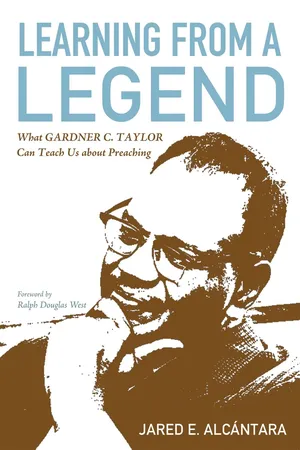
Learning from a Legend
What Gardner C. Taylor Can Teach Us about Preaching
- 154 pages
- English
- ePUB (mobile friendly)
- Available on iOS & Android
eBook - ePub
About this book
In April 2015, America's last pulpit prince died. When Gardner C. Taylor (1918-2015), former senior pastor of Concord Baptist Church in Brooklyn, departed this life at the age of ninety-six, the United States lost one of the greatest preachers of the twentieth century. Unfortunately, not enough preachers today know his name or why his preaching can enrich and bless the church today.
Learning from a Legend: What Gardner C. Taylor Can Teach Us about Preaching provides Christian preachers with much-needed lessons, wisdom, and insights from Dr. Taylor, the dean of American preaching. It highlights six lessons that Dr. Taylor can teach preachers in the twenty-first century about pain, redemption, eloquence, apprenticeship, context, and holiness. Not only did Dr. Taylor teach and preach these lessons, he lived them. Those wanting to learn more about Dr. Taylor's preaching while also sharpening their own preaching ought to read this book.
Information
Topic
Theology & ReligionSubtopic
Christian Ministry1
Pain: “Preaching with a Limp”
On hearing this, Jesus said, “It is not the healthy who need a doctor, but the sick.”
—Matthew 9:12
I do not know why the way of humankind’s social redemption must be lined in blood and sorrow. I only know that there is no other way.19
—Gardner C. Taylor
The story is told in Scotland of a young preacher who showed great promise in the pulpit. He was widely regarded among his peers, and his résumé circulated among prominent Christian leaders of his day. At a meeting of older preachers, the young man’s name was brought before the group and his gifts for pulpit eloquence set forth and celebrated. When the reading of his accolades was complete, one of the older ministers suggested that the young man was still deficient in one significant area. “Yes,” the old preacher told the gathering, “but he hasn’t been broken yet.” In the old preacher’s eyes, the young man had not yet achieved the last major qualification for fruitful ministry.
How odd that pain and preaching go together. It is no doubt a peculiar starting point for the opening chapter of a book about Gardner C. Taylor’s preaching. That stated, pain might actually be the right place to start. Those who preach to God’s people on a regular basis understand that pain has a way of finding them. Much of the weight the preacher carries is in isolation from others, sometimes out of choice and other times out of necessity. On Sunday mornings, no one is aware that the pastor wept last night over a wayward teenage daughter or son. No one sees the battle scars from political infighting behind the scenes. No one recognizes that underneath it all, at first glance the old habits of the sinful nature make the pastor feel woefully unqualified or (if the pastor is conceited) overqualified. Add to these the “burdensome joy of preaching,” as James Earl Massey calls it, and it feels impossible to carry such a load.20 What makes the load even more challenging is the tendency of Sundays to come upon us with an unyielding regularity, as if Sundays come every three days instead of every seven.
It’s a lot easier to preach about pain than it is to preach through pain. One is abstract and the other concrete. C. S. Lewis writing The Problem of Pain is a Christian apologist sounding off on the problem of evil. But, C. S. Lewis writing A Grief Observed is a Christian husband doubting God’s sovereignty after the death of his wife from cancer. The first is abstract. The second is concrete. The image that the homiletician Haddon W. Robinson uses to talk about preaching through pain is “preaching with a limp.” He also calls it preaching one’s way through a “dark tunnel.”21
The list is long of preachers who know and understand what Robinson means. The Protestant Reformer Martin Luther went through a period of such deep and long-lasting depression that he contemplated taking his own life. In a letter to a friend, one month removed from a physical and mental breakdown that sent him to the local hospital, Luther wrote: “I was for more than a whole week really in death and hell, my whole body stricken so that my limbs still tremble. I almost completely lost Christ in waves and storms of despair and blasphemy against God.”22 The African Methodist Episcopal preacher Jarena Lee faced countless obstacles when she was lobbying Richard Allen and the AME Church to allow women’s ordination. At the height of this movement, her husband of six years died unexpectedly. Overnight, Lee was a struggling single mother of two children, ages two and six months, materially poor and in poor health.23 Charles Haddon Spurgeon, the well-known pastor of the Metropolitan Tabernacle in London, also wound his way through a “dark tunnel.” In 1875, not long after an event celebrating twenty-one years of ministry at his church and the release of a published anthology of his sermons, Spurgeon found himself beset by rheumatism and gout. As biographer George Carter Needham puts it, “Gout and rheumatic pains came on with such rapidity and severity that removal from his home was impossible.” During several weeks of being homebound and incapacitated, Spurgeon wrote: “Feet and legs became useless except for suffering.”24 More recently, the evangelist Manuel L. Scott Sr. confessed to a group of pastors that he went through long seasons of Job-like sorrow during his pastorate. In a sermon delivered in 1981, he told a group of ministers gathered for the Hampton University Minister’s Conference: “There were days in my pastorate at Calvary [Scott’s church] when I could hardly see the sun anywhere.”25 Examples like these abound.
You don’t have to be in ministry long to find yourself joining the regiment of those who’ve preached with a limp. To use John Newton’s phrase, it won’t be long before one has been “trained awhile in the school of disappointment.”26 If you’ve been there or are there right now, you’re not alone. In fact, all you have to do is show up as a pastor, and the rest will come naturally.
NFL football players have a saying: “There’s a difference between being hurt and being injured. If you’re injured, you need to see a doctor. If you’re hurt, we’ll we see you on the field this Sunday. You can’t play injured, but you can play hurt.” The same is true for preaching. Sometimes, you’re injured and need to step away in order to heal. There’s a place and a time for that in ministry, especially if you’ve injured others and need to experience restoration. Other times, perhaps more often than you’d like, you’re hurt and need to figure out how to play hurt.
More than most, Gardner C. Taylor understood what it was like to “play hurt.” As someone who faced much heartache and loss, he knew how to preach through pain. One of the things we learn from Taylor is that pain is inevitable for those who are called to preach the gospel of Jesus Christ. What Taylor says about ministry in his sermons and lectures, and what he experienced over the course of his life bear witness to the preponderance of wounds and scars among those who preach and pastor. If you’ve been “broken on the wheels of living,” to borrow a phrase from Thornton Wilder, Taylor’s life reminds you that you are not beyond the bounds of God’s gracious provision. Preachers who have experienced pain can still preach with power.
Taylor’s Training in the “School of Disappointment”
Taylor grew up in the 1920s and 1930s during Jim Crow segregation in Baton Rouge, Louisiana. His father, Reverend Washington Monroe Taylor, was the senior pastor at Mt. Zion Baptist Church in Baton Rouge, one of the largest African American churches in the state. Although his family interacted well with their non-black neighbors and Taylor remembered playing with children of different races and backgrounds when he was young, he still faced significant challenges on account of unjust segregationist laws. The disparities in living conditions were grave and striking. In a March 2008 interview, for example, Taylor recounted:
I remember my father, for instance, talking about the Louisiana University farm animals on the left side as you go down the Highland Road near Louisiana State University. I remember him saying in his pulpit that they have better living conditions . . . for their cattle than we have for our people.27
In addition to the housi...
Table of contents
- Foreword
- Acknowledgments
- Introduction: The Last Pulpit Prince
- Chapter 1: Pain: “Preaching with a Limp”
- Chapter 2: Redemption: “We Would See Jesus”
- Chapter 3: Eloquence: “Your Words Should Sing”
- Chapter 4: Apprenticeship: Passing the Torch
- Chapter 5: Context: “I Sat Where They Sat”
- Chapter 6: Holiness: The Currency of Integrity
- Conclusion: P.R.E.A.C.H.!
- Bibliography
Trusted by 375,005 students
Access to over 1.5 million titles for a fair monthly price.
Study more efficiently using our study tools.
Frequently asked questions
Yes, you can cancel anytime from the Subscription tab in your account settings on the Perlego website. Your subscription will stay active until the end of your current billing period. Learn how to cancel your subscription
No, books cannot be downloaded as external files, such as PDFs, for use outside of Perlego. However, you can download books within the Perlego app for offline reading on mobile or tablet. Learn how to download books offline
We are an online textbook subscription service, where you can get access to an entire online library for less than the price of a single book per month. With over 1.5 million books across 990+ topics, we’ve got you covered! Learn about our mission
Look out for the read-aloud symbol on your next book to see if you can listen to it. The read-aloud tool reads text aloud for you, highlighting the text as it is being read. You can pause it, speed it up and slow it down. Learn more about Read Aloud
Yes! You can use the Perlego app on both iOS and Android devices to read anytime, anywhere — even offline. Perfect for commutes or when you’re on the go.
Please note we cannot support devices running on iOS 13 and Android 7 or earlier. Learn more about using the app
Please note we cannot support devices running on iOS 13 and Android 7 or earlier. Learn more about using the app
Yes, you can access Learning from a Legend by Jared E. Alcántara in PDF and/or ePUB format, as well as other popular books in Theology & Religion & Christian Ministry. We have over 1.5 million books available in our catalogue for you to explore.