eBook - ePub
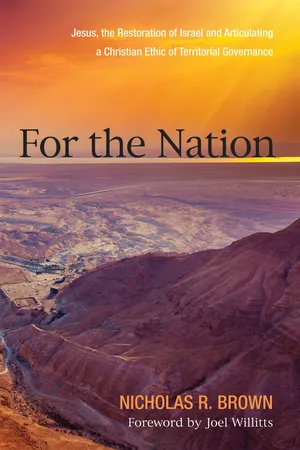
For the Nation
Jesus, the Restoration of Israel and Articulating a Christian Ethic of Territorial Governance
- 236 pages
- English
- ePUB (mobile friendly)
- Available on iOS & Android
eBook - ePub
For the Nation
Jesus, the Restoration of Israel and Articulating a Christian Ethic of Territorial Governance
About this book
The nature of the kingdom Jesus proclaims in the Gospels has long been a subject of intense theological debate. More recently the lines of this debate have dramatically shifted as several leading historical Jesus scholars and Christian social ethicists have argued that Jesus' kingdom proclamation most likely expresses a first century Jewish hope for Israel's restoration.
Yet while several are now sanguine that Jesus' kingdom vision constitutes nothing less than a full-throated restoration of Israel's nationality, they are just as certain it rejects a restoration of Israel's land. As such it has become increasingly fashionable to say that an authentic practice of the "kingdom" ethic that Jesus enunciates must necessarily be a-territorial.
The purpose of this work is to respond to these arguments and show why this can and indeed should not be the case. Through a careful and detailed process of historical investigation, biblical exegesis, theological exploration, and ethical analysis we will come to see that not only is the kingdom that Jesus proclaims inextricably landed, but also why such a kingdom is integral to articulating a Christian ethic of territorial governance.
Information
Topic
Sciences socialesSubtopic
Théologie chrétienne1
W(h)ither the Land? The De-territorialization of Jesus and the Kingdom of God in New Testament Scholarship
1.1 Introduction
One of the primary objectives governing this chapter and the next will be to investigate how and why such a wide swath of contemporary Christian thought, including that whose theological mien has been deeply shaped within the crucible of a post-Shoah sensibility, still remains largely resistant to the proposition of linking Jesus and his proclamation of the kingdom of God to a territorial restoration of Israel.
Toward that end I will attempt to sketch a representative overview of how that linkage has come to be viewed within recent historical Jesus scholarship and Christian social ethics by way of examining how influential voices within each have sought to evaluate the political and moral relationship existing between Jesus’ understanding of ἡ βασιλεία τοῦ θεοῦ and what W. D. Davies has aptly termed the “territorial dimensions of Judaism.”13 Furthermore, these chapters will also serve to locate and begin to critically interrogate some of the underlying theological, hermeneutical and moral presuppositions that have underpinned, or more precisely, undermined such efforts and thus made a positive territorial reading of both Jesus and the kingdom extraordinarily difficult, if not impossible, to, as it were, get off the ground.
1.2 Scholarly Incongruities and Puzzling Conundrums
Notwithstanding the significant strides that both these disciplines have made in recovering the political and national substrate of Jesus’ mission as well as their repeated demonstration of how that mission is suffused with various elements of Jewish restoration eschatology, to date only a handful of works from either field has formally addressed the question of whether Jesus’ own conception of the kingdom of God can be said to meaningfully include a territorial restoration of Israel.14 That this question has garnered such paltry consideration is a rather remarkable and even somewhat baffling development not only because several texts from the late Second Temple period regularly express the hope that a messianic figure, under Yahweh’s aegis, will re-gather Jewish exiles from the Diaspora and return them to Israel in order to re-take possession and rule over the land,15 but also because acquisition and governance of the land is, as Walter Brueggemann suggests, a “central, if not the central theme of biblical faith.”16
Indeed as Christopher Wright has argued, for Israel the land was never “just a neutral stage where the drama [of redemption] unfolds,” but instead has always remained an indispensible “part of the pattern of redemption” since “the social shape of Israel was intimately bound up with the economic issues of the division, tenure and use of the land.”17 Wright then is surely on to something when he states that Israel’s administration of the land acts as a sort of “covenantal measuring gauge” in that it “reveals both the temperature of the theological relationship between God and Israel, and also the extent to which Israel was conforming to the social shape required of them in consistency with their status as God’s redeemed people.”18
It is quite peculiar then why an eschatological expectation that features so consistently throughout a first-century Jewish worldview and that is of such a vital and integral importance to Israel’s theological, political, and moral gestalt would merit such scant attention, especially amongst those who are quite insistent that Jesus’ words and actions are nigh to inscrutable save for understanding them as the proclamations of a Jewish nationalist working within the framework of a restorative eschatology.
Moreover, it is equally noteworthy that the prevailing consensus reached by those select few who have addressed this topic is decidedly pessimistic. That is all but a tiny minority are sympathetic to the spirit if not the letter of Hans Kvalbein’s judgment that despite the fact that some of Jesus’ kingdom logia (e.g., Matt 5:5 || Luke 6:20) do betray a certain sense of spatiality, which in light of both the messianic expectations pervading his historical milieu as well as the territorial connotations conjured up by the terms bασιλεία and מְּלוּכָ֑, could reasonably be interpreted as intimating the reconstitution of a sovereign Davidic state, there is nevertheless “no reason to suppose that Jesus meant the land of Israel in a geographical sense when he spoke about the kingdom of God.” Rather as Kvalbein counsels and as most of his colleagues have concurred, the “promised land” to which Jesus refers, if he refers to it at all, is but “a typos of the coming kingdom.”19 In fact, it has become something close to an article of faith among many to assert that it is precisely Jesus’ steadfast refusal to ever explicitly link the kingdom of God with the re-establishment of Israel’s territorial borders, which not only most distinguishes him from other first-century messianic figures but which also makes both him and his gospel cut such an attractive and compelling political ethos insofar as both eschew “a politics of superiority that would deny to others the same human rights as those of its members[.]”20
That these perceived incongruities continue to persist, however—that is between the land’s central theological, political and ethical importance within the consciousness of ancient Israel and Second Temple Judaism and its apparent “spiritualization” or even abrogation by Jesus and Paul within early Christianity—poses an interesting conundrum since it raises the important question of whether the current lack of scholarly output and negative sentiment vis-à-vis Jesus’ and the kingdom’s territoriality is simply an accurate reflection of there being a diminishingly thin and supposedly “typological” historical and textual datum from which to work, or whether it is because, in the words of Matthew’s Jesus, we have eyes to see yet do not. In other words is the apparent absence or near absence of ostensible territorial references to the kingdom of God within the gospels, itself dispositive and incontrovertible proof of Jesus finally and unequivocally disavowing the persistent eschatological hope of restoring a sovereign Jewish political kingdom within Palestine? Or is it instead an indication of how that evidence has been (mis)read and handled, namely through a “Christian exegetical tradition [that has] habitually sought to separate the kingdom of God from Jewish territorial expectation.”21
Each of these questions in turn unveils a set of additional queries that makes the sense of tension surrounding this puzzle all the more acute and thus the need for further exploration and resolution all the more pressing. For suppose one decides to take the side of the majority opinion and stipulate that Jesus did in fact forsake...
Table of contents
- Title Page
- Foreword
- Introduction
- Chapter 1: W(h)ither the Land? The De-territorialization of Jesus and the Kingdom of God in New Testament Scholarship
- Chapter 2: From a Territorial State into State of Ethical Praxis: Discerning the Roots and Structure of the Kingdom’s De-territorialization in Christian Ethics
- Chapter 3: The Ground(s) on Which We Stand: De-territorializing the Kingdom of God in the Christian Imagination and Its Implications for Contemporary Theology and Ethics
- Chapter 4: A Restoration of Land and a Restoration of Justice Governance: Restoration Eschatologies in Prophetic Texts and Late Second Temple Literature
- Chapter 5: Jesus and the Kingdom: A Restoration of the Land and a Restoration of Just Governance for Israel and the Nations
- Bibliography
Trusted by 375,005 students
Access to over 1.5 million titles for a fair monthly price.
Study more efficiently using our study tools.
Frequently asked questions
Yes, you can cancel anytime from the Subscription tab in your account settings on the Perlego website. Your subscription will stay active until the end of your current billing period. Learn how to cancel your subscription
No, books cannot be downloaded as external files, such as PDFs, for use outside of Perlego. However, you can download books within the Perlego app for offline reading on mobile or tablet. Learn how to download books offline
Perlego offers two plans: Essential and Complete
- Essential is ideal for learners and professionals who enjoy exploring a wide range of subjects. Access the Essential Library with 800,000+ trusted titles and best-sellers across business, personal growth, and the humanities. Includes unlimited reading time and Standard Read Aloud voice.
- Complete: Perfect for advanced learners and researchers needing full, unrestricted access. Unlock 1.5M+ books across hundreds of subjects, including academic and specialized titles. The Complete Plan also includes advanced features like Premium Read Aloud and Research Assistant.
We are an online textbook subscription service, where you can get access to an entire online library for less than the price of a single book per month. With over 1.5 million books across 990+ topics, we’ve got you covered! Learn about our mission
Look out for the read-aloud symbol on your next book to see if you can listen to it. The read-aloud tool reads text aloud for you, highlighting the text as it is being read. You can pause it, speed it up and slow it down. Learn more about Read Aloud
Yes! You can use the Perlego app on both iOS and Android devices to read anytime, anywhere — even offline. Perfect for commutes or when you’re on the go.
Please note we cannot support devices running on iOS 13 and Android 7 or earlier. Learn more about using the app
Please note we cannot support devices running on iOS 13 and Android 7 or earlier. Learn more about using the app
Yes, you can access For the Nation by Nicholas R. Brown in PDF and/or ePUB format, as well as other popular books in Sciences sociales & Théologie chrétienne. We have over 1.5 million books available in our catalogue for you to explore.