eBook - ePub
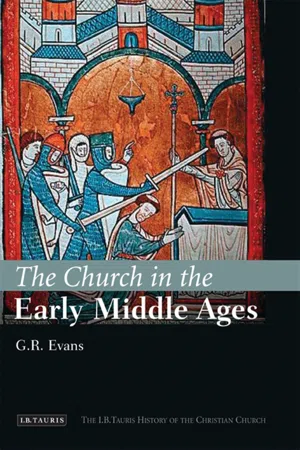
The Church in the Early Middle Ages
The I.B.Tauris History of the Christian Church
- 256 pages
- English
- ePUB (mobile friendly)
- Available on iOS & Android
eBook - ePub
About this book
The creation of a new history of the Church at the beginning of the third millennium is an ambitious but necessary project. Perhaps nowhere is it needed more than in re-describing the Church's development - its life and its thinking - in the period that followed the end of the 'early Church' in antiquity. The cultural, social and political dominance of Christendom in what we now call 'the West', from about 600-1300, made the Christian Church a shaper of the modern world in respects which go far beyond its religious influence. Writing with her customary authority, and with a magisterial grasp of the original sources, G. R. Evans brings this formative era vividly to life both for the student of religious history and general reader. She concentrates as much on the colourful human episodes of the time as on broader institutional and intellectual developments. The result is a compelling and thoroughly modern introduction to devotional and theological thought in the early Middle Ages as well as to ecclesiastical and pastoral life at large.
Information
CHAPTER 1
The Medieval History of the
Church in Time and Space
Church in Time and Space
The Church: time and eternity, space and infinity
Why write a history? The medieval historian did not see this question in the same way as a modern historian would do. He was always aware of time as a slot in eternity, a kind of quantitative anomaly in something which had no quantities or durations, and that made him sensitive to the cosmic implications of whatever story he had to tell about events in time. It encouraged him to be conscious of the story’s power to edify the reader. This question of its ‘place in eternity’ provided the supreme reference point of historical ‘truth’.
Keeping a written record was recognized to be important. The author of the Life of the late twelfth-century Hugh of Lincoln says in his Prologue that he is writing in order that the record may be preserved ‘in letters which will endure’ (tenacibus scribendo litteris).1 The chronicler was also, pragmatically, often concerned with proving a legal title to property, pinning down the right to land or some other form of grant. One should keep a written record of a transaction ‘because the life of man is brief and it makes it easier to prove the gift was made’, said Bracton (d.1268), the English legal authority.2 Charters granting land to monasteries, for example, were frequently renewed, with the insistence that this was a mere continuation of an existing state of affairs, nothing new but simply a reminder to contemporaries. So another reference point of ‘truth’ might be the preservation of a state of affairs, even when it related to something as mundane as the right to hold a small piece of land. In the absence of a documentary record it was not uncommon to forge what was missing. The record had simply not been made at the time, so the gap was filled; this was not taken to amount to falsification, for there was no fraud, just the filling of a gap in the written record.
This approach to ‘accurate’ record keeping, which placed more reliance on recording what ought have been said than the authenticity of the copy which said so, could affect the keeping of records at a much higher level. The canon law of the Church embodied a vast collection of ‘Ps-Decretals’ of invented popes, put together by a figure to whom the name of the sixth-century encyclopaedist Isidore became attached, lending this Ps-Isidore further credibility by association.3 It was not unknown for an author who wished to claim reliance on an older document to confess that, although he insisted that he or someone else had certainly once seen it, he could no longer produce it. Matthew Paris described how the original document on which he was relying in telling one story had been found in a hole in the wall, but had sadly crumbled to dust as soon as a fair copy (translation?) had been made in Latin.4 Giraldus Cambrensis (Gerald of Wales) defends his own account of the ancient privileges of the see of St David against any attempt to suggest that he had made them up with quod non res ficta vel frivola, non Arturi fibula.5
So ‘what is the truth’ is a question with certain nuances when it comes to reconstructing the history of the medieval Church. Contemporary writers might well take the view that it was more important to preserve the story than to be honest about admitting to gaps in the record. Historia was first and foremost ‘story’, in the double sense of being a narrative and an explanation. The aim was to give an account which would make the reader see things in a certain light, the light of a spiritual and edifying ‘truth’ which need not necessarily coincide with what we should now regard as ‘the facts’.
In any case, historical ‘fact’ was not limited to events of the sort to which history now restricts itself. There was no objection to including miracle and legend. When Geoffrey of Monmouth set out to write the History of the Kings of Britain in the 1130s, it was with the objective of linking the Anglo-Norman dynasty of English kings, who were really invaders from France and originally from the even more un-British Viking territories, with the legendary King Arthur, saviour of Britain. Improving and exemplary story could merge into ‘real’ history. The Norman poet Wace put Geoffrey of Monmouth’s story into Old French for presentation to the erstwhile French queen, Eleanor of Aquitaine, when she divorced the French king and married Henry II of England.6 Wace added the Round Table to the tale. It was further developed by Chrétien de Troyes who inserted the story of the quest for the Holy Grail (both the vessel used at the Last Supper and the cup in which Jesus’s blood was said to have been caught when his side was pierced as he hung on the Cross), with its insistence on the importance of purity to the successful finding of the Grail. Galahad, the knight whose special quest this was, was said to have been the son of Lancelot and the daughter of King Pelles, the Grail King. She could trace her ancestry back to Joseph of Arimathea and King David. Wolfram von Eschenbach’s Parzival describes the Grail differently, as a stone or perhaps ‘bread’, recalling the consecrated bread of the Mass, which prevents anyone who beholds it from dying for at least a week.7 ‘Real’ history could travel into story too. The life of Charlemagne becomes an Old Norse Karlamagnus Saga in the late thirteenth century.8
Medieval ecclesiastical (and secular) historians saw no objection to including miracles in their histories because that was in comfortable accordance with the assumption that the story to be told was ‘really’ set in the supernatural world and in the context of eternity. Bede did not for a moment imagine that a historian who wished to do his job properly was required to leave out the supernatural or the miraculous.9 Miracles, or at least marvels, had a place even in the historiography that is apparently addressed to a nonclerical readership, and in presentations of mere amusing anecdote. Gervase of Tilbury’s Otia imperialia (‘The Emperor at Leisure’)10 is the work of a twelfth-century English scholar-nobleman, a lawyer trained at Bologna, for a time a royal civil servant, who spent time at the court of Henry II of England, and wrote a book of amusements for the young prince Henry (which does not survive).11 This larger work, Otia imperialia, intended for the amusement of the Emperor Otto IV, became a huge encyclopaedia of geography and marvels. He describes the ‘marvels’ in much the same spirit of straightforward acceptance as the authors of saints’ lives describe miracles. They serve a similar purpose of heightening excitement and awakening awe.
The inclusion of miracles also has implications for the conception of evidence with which these authors were working. The very drama and impact of the miraculous could make a story seem more reliable. It altered or added to the acceptable range of chains of cause and effect that the marvellous could be that which is predictable within the laws of nature. But most important is the understanding that the divine plan can be seen to unfold in events. There is always a story behind the story, going beyond the recalling of the good examples set in previous generations, and that is the great narrative of salvation history which binds all together. Accordingly authors of medieval ecclesiastical histories commonly tell their tale as though it continued the historical narrative of Scripture. Orderic Vitalis (1075–1142) begins his Ecclesiastical History there and continues to the coming of the Holy Spirit, adding material in his first two books from apocryphal acts of the apostles. It is not until Book III of his History that he begins to set out the detailed information he has about the monasteries of Normandy. John of Salisbury reviews the earlier historians of the Church to whom he proposes to add himself as the chronicler of its most recent days. Luke wrote the Acts of the Apostles. Eusebius told the story of the young Church (adolescentis ecclesie). Then came Cassiodorus and Orosius and Isidore and Bede and others ‘it would be too tedious to list’. In John’s own times there have been several, whose names he gives with a detailed explanation of the part of the story each has covered. John’s proposal is to confine himself to pontificalis historia, papal history, and recent papal history since the Council of Rheims in 1148 at that, omitting everything else, for as a papal civil servant he is peculiarly well informed on that subject.12 This sort of historiography is a close cousin to an exegesis of Scripture which also sees a march of ages against an eternal backdrop. Rupert of Deutz composed enormous commentaries in which he endeavoured to bring out such a pattern.13
Medieval historians often begin with a review of events since the creation of the world, not only so as to include the Scriptural narrative in their chronology, but also so as to go forward into eternity. As they look forward beyond the present day, the history turns to prophecy. Although they fully recognized the divine inspiration of the biblical narrative, they see no reason to draw a hard line between the historical events narrated in Scripture and those of more recent times or even the future. Some things belong to this world. Some are eternal. The medieval Christian world took the Church to belong to the cosmic dimension; they did not consider it merely an institution of this world.
Another twelfth-century author, Hugh of St Victor, proposes in his De sacramentis ecclesiae to distinguish two ‘works’ of God, the ‘work of creation’ (opus creationis) and the ‘work of restauration’ (opus restaurationis). The story of the first, he says, is told in the Bible’s account, and the story of the second also unfolds there.14 But the second cannot be arrived at by reasoning alone. It is historical. And it continues. The story the Bible has to tell goes on into the present and future.15 Another notable example of the same approach is the work of the ‘prophet Abbot’ Joachim of Fiore (c.1135–1202). He organized all history into three periods (status). The first, described in the Old Testament, was the Age of the Father and ran from the creation of the world. The second, outlined in the New Testament and continuing for 42 generations, was the Age of the Son. The last, the Age of the Spirit, stretched into the future and was to be introduced by the rise of a new spiritual order. He prophesied the end of the world as we know it, which he believed would happen in the time of the ‘Last World Emperor’ of his own day.16 Joachim eventually toppled over the edge of Christian intellectual respectability, to be condemned by the Fourth Lateran Council (1215), but it was not his approach to history that got him into trouble.
Against these ambitious habits of thought, and this reaching for ideal examples and something beyond current events, we must set a very different reality when it comes to the question of what medieval authors writing about the Church knew of the geography and physical extent of the world they lived in. The understanding of the workings of the ‘real world’ which was possible for an individual medieval author was very limited. Some writers frankly admit to a rather local view of the Church and its doings. Ralph Glaber (c.980–c.1046) lived his life in the monasteries of Burgundy, and his view of the world gives special prominence to the rise and establishment of the Capetian dynasty of French kings.17 He contends that since Bede (c.672–735) in England and Paul the Deacon (c.730–c.799) in Italy there has been no one anxious to leave a history for posterity and each of these wrote only about his own geographical area. He knows that many things have happened in far-flung places and especially about the time of the millennium of the birth of Christ.18 The occurrence of the millennium stimulates him to remark on various most unusual events, and to stretch beyond the local history he really knows about.19
Orderic Vitalis (1075?–1142) says he has a knowledge narrowed by the fact that ‘monastic observance’ keeps him at home, but within those limitations he has done his best to describe ecclesiastical affairs (res ecclesiasticae). In particular he recognizes that matters Egyptian, Greek and Roman (res alexandrinas seu grecas vel romanas) are out of his reach. But his story of local events has its larger implications nevertheless. He learned while writing a commissioned history of Saint-Evroul that he needed to comment on the ‘good and evil’ in the behaviour of the great of the land.20
The approach of such historians shows how keenly they strove to give their local story a wider scene, and at the same time it is an indication of the unavoidable lack of evenness of texture in the resources they had available to them.
We shall see in later chapters the growth of the realization that the world looked different from the vantage point of the Islamic rulers of parts of North Africa and southern Europe, and also from Greek-speaking Eastern Europe. The big picture, the prophetic picture, was very big indeed and there writers felt able to move more freely in their imaginations. They did not have the same confidence when it came to the power blocks of the contemporary world. Nevertheless looking at history like this encouraged a view of the Church in which the particular and familiar is always seen against the immensities of eternity and infinity.
Historiography
The purpose of the medieval historian of the Church ‘in society’ was the edification of his readers. When John of Salisbury cited Cato, ‘The lives of others are our teachers’,21 he wanted to draw his reader’s attention to the lessons to be learned from the examples set by leading figures of the past. The idea was that the holding up of earlier spiritual heroes would encourage people to become spiritual heroes themselves. Thomas of Marlborough’s History of the Abbey of Evesham22 begins with the explanation of the purpose of historical writing. It is to ensure that the outstanding deeds of good men and the evil deeds of bad men alike should not die with them but should be recorded for the edification of future generations. Had this not been done, he points out, we should not know how to imitate the Fathers of the early Church, for we should know nothing of the example they set.
In a study such as this, concerned with interfaith as well as Christian issues in the history of Christianity and the Church, it is important not to lose sight of the historiographical questions which were occurring to those of other faiths. The preoccupation with the basis of the knowledge of historians became pervasive in Islam. Al-Biruni, who described Judaic, Christian, Manichee and Indian religions, wrote a Chronology in which he began from the principle that ...
Table of contents
- Cover
- About the Author
- Title Page
- Copyright
- Contents
- Preface
- Abbreviations
- Map: The Early Medieval Muslim World
- Map: Europe and the Holy Land in the Twelfth Century
- Introduction: Out of the Ancient World
- 1. The Medieval History of the Church in Time and Space
- 2. Spreading the Gospel: The Missionary Centuries
- 3. The Church Defines the Outsider
- 4. Imposing Order
- 5. Church and People
- 6. The Church Divided: East and West
- 7. Bringing the Outsiders In
- 8. Extreme Lives: The Religious Orders
- 9. The Church and the Intellectuals
- 10. Arts to the Glory of God
- Conclusion
- Notes
- Bibliography
Trusted by 375,005 students
Access to over 1.5 million titles for a fair monthly price.
Study more efficiently using our study tools.
Frequently asked questions
Yes, you can cancel anytime from the Subscription tab in your account settings on the Perlego website. Your subscription will stay active until the end of your current billing period. Learn how to cancel your subscription
No, books cannot be downloaded as external files, such as PDFs, for use outside of Perlego. However, you can download books within the Perlego app for offline reading on mobile or tablet. Learn how to download books offline
Perlego offers two plans: Essential and Complete
- Essential is ideal for learners and professionals who enjoy exploring a wide range of subjects. Access the Essential Library with 800,000+ trusted titles and best-sellers across business, personal growth, and the humanities. Includes unlimited reading time and Standard Read Aloud voice.
- Complete: Perfect for advanced learners and researchers needing full, unrestricted access. Unlock 1.5M+ books across hundreds of subjects, including academic and specialized titles. The Complete Plan also includes advanced features like Premium Read Aloud and Research Assistant.
We are an online textbook subscription service, where you can get access to an entire online library for less than the price of a single book per month. With over 1.5 million books across 990+ topics, we’ve got you covered! Learn about our mission
Look out for the read-aloud symbol on your next book to see if you can listen to it. The read-aloud tool reads text aloud for you, highlighting the text as it is being read. You can pause it, speed it up and slow it down. Learn more about Read Aloud
Yes! You can use the Perlego app on both iOS and Android devices to read anytime, anywhere — even offline. Perfect for commutes or when you’re on the go.
Please note we cannot support devices running on iOS 13 and Android 7 or earlier. Learn more about using the app
Please note we cannot support devices running on iOS 13 and Android 7 or earlier. Learn more about using the app
Yes, you can access The Church in the Early Middle Ages by G.R. Evans in PDF and/or ePUB format, as well as other popular books in History & European Medieval History. We have over 1.5 million books available in our catalogue for you to explore.