- 117 pages
- English
- PDF
- Available on iOS & Android
eBook - PDF
About this book
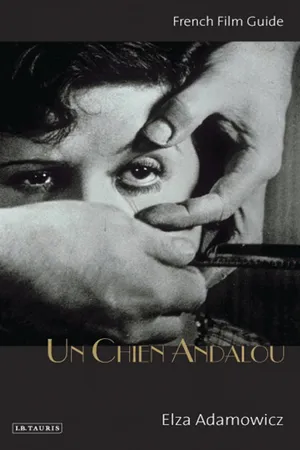
In 1929 Dali and Bunuel produced a seventeen-minute film "Un chien andalou". On its first screening, Federico Garcia Lorca called it 'a tiny little shit of a film'. Produced from a script said to be based on two dream images - a woman's eye slit by a razor, ants emerging from a hole in a man's hand - the film shocked audiences. It continues to fascinate, provoke, attract and alienate its viewers. Its eye-slitting sequence and use of dream-like images have influenced filmmakers from Alfred Hitchcock to David Lynch. Elza Adamowicz's fascinating book on "Un chien andalou" takes new approaches to the film, exploring how it can be seen both within and beyond the confines of Surrealism and reviewing its openness to so many readings and interpretations. She reassesses Dali and Bunuel's account of the film as a model surrealist work and its reception by the surrealist group, examines the unresolved tensions within the film itself and includes us as viewers - are we detectives or dreamers? She sets the film into the wider contexts of other texts and of its authors' own experiences, providing a wide and deep guide to this most enigmatic of works.
Information

30
U
N
C
H
I
E
N
A
N
D
A
L
O
U
10
The
producer
and
theatre-director
Pierre
Braunberger
bought
the
theatrical
rights
to
the
film
for
his
company
Studio-Film
(Baxter
1994:
88).
11
See
chapter
3
for
a
discussion
of
references
to
Spanish
culture
in
the
film.
12
Other
reviews
of
the
film
after
its
first
screening
include:
(in
Paris)
Comtesse
de
Beaumont
(1929),
Ghéon
(1929),
Lenauer
(1929);
(in
Barcelona)
Artigas
(1929),
Masoliver
(1929),
Piqueras
(1929);
(in
London)
Blakeston
(1929).
13
For
studies
of
Surrealism
and
the
cinema
see
Kyrou
(1963),
Matthews
(1971),
Short
(2002),
Richardson
(2006).
14
On
the
importance
of
Fantômas
for
the
surrealists,
see
Walz
(2000),
Eburne
(2008).
Table of contents
- Contents
- Introduction: It's dangerous to look inside
- 1. Producing 'Un chien andalou': myths of origin
- 2. Romantic melodrama or magic theatre?
- 3. Contexts and intertexts: between Fantomas and the fairground
- Conclusion
- Appendix 1: Synopsis
- Appendix 2: Credits
- Appendix 3: Selected bibliography
Trusted by 375,005 students
Access to over 1.5 million titles for a fair monthly price.
Study more efficiently using our study tools.
Frequently asked questions
Yes, you can cancel anytime from the Subscription tab in your account settings on the Perlego website. Your subscription will stay active until the end of your current billing period. Learn how to cancel your subscription
No, books cannot be downloaded as external files, such as PDFs, for use outside of Perlego. However, you can download books within the Perlego app for offline reading on mobile or tablet. Learn how to download books offline
Perlego offers two plans: Essential and Complete
- Essential is ideal for learners and professionals who enjoy exploring a wide range of subjects. Access the Essential Library with 800,000+ trusted titles and best-sellers across business, personal growth, and the humanities. Includes unlimited reading time and Standard Read Aloud voice.
- Complete: Perfect for advanced learners and researchers needing full, unrestricted access. Unlock 1.5M+ books across hundreds of subjects, including academic and specialized titles. The Complete Plan also includes advanced features like Premium Read Aloud and Research Assistant.
We are an online textbook subscription service, where you can get access to an entire online library for less than the price of a single book per month. With over 1.5 million books across 990+ topics, we’ve got you covered! Learn about our mission
Look out for the read-aloud symbol on your next book to see if you can listen to it. The read-aloud tool reads text aloud for you, highlighting the text as it is being read. You can pause it, speed it up and slow it down. Learn more about Read Aloud
Yes! You can use the Perlego app on both iOS and Android devices to read anytime, anywhere — even offline. Perfect for commutes or when you’re on the go.
Please note we cannot support devices running on iOS 13 and Android 7 or earlier. Learn more about using the app
Please note we cannot support devices running on iOS 13 and Android 7 or earlier. Learn more about using the app
Yes, you can access Un Chien Andalou by Elza Adamowicz in PDF and/or ePUB format, as well as other popular books in History & Art Theory & Criticism. We have over 1.5 million books available in our catalogue for you to explore.