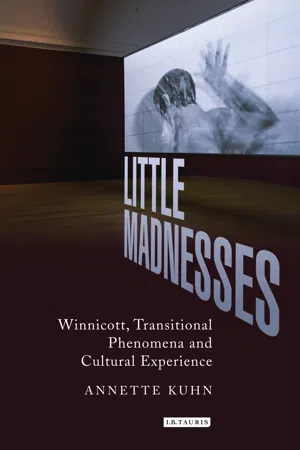
'Little madnesses' are our most deeply felt enthusiasms, investments and attachments in the sphere of culture. The term was coined by the child psychoanalyst Donald Winnicott, whose work on transitional phenomena grew out of his naming of the transitional object, and extended into preliminary explorations of the crucial role played by cultural experience in a life that feels satisfying. In our socially and culturally sanctioned little madnesses, everyone can find relief from the burden of having to maintain a clear boundary between inner and outer worlds, fantasy and reality, because it is in the space between them that we can find the enthusiasms and passions that excite our creative imaginations. This idea offers intriguing pathways towards understanding how we can engage effectively with the world at a public, social level without setting aside our inner lives, our emotions and our most deeply felt attachments.
In Little Madnesses, writers, artists, scholars and experts in a range of fields and disciplines explore the idea of transitional phenomena and consider its potential to extend and deepen our understanding of cultural experience in mental and social life, focusing on the importance of space, place and boundaries in cultural experience; on how we can negotiate media use and cultural identity; and on the aesthetic and creative aspects of cultural experience. Topics covered include cult films, computer use, installation art, trips to the cinema, museums and galleries, the agony and ecstasy of making art and the significance of life stage in cultural experience.
- 256 pages
- English
- ePUB (mobile friendly)
- Available on iOS & Android
eBook - ePub
About this book
Information
| 1 | Little Madnesses: An Introduction |
| |
The aim of this book is to develop and revitalise cultural theory, cultural practice and cultural policy by exploring the potential of the concepts of transitional objects and transitional phenomena to extend and deepen understanding of a range of aspects of cultural experience. These terms were introduced into object-relations psychoanalysis by the British paediatrician and child analyst Donald Woods Winnicott (1896–1971), who also gave the evocative name of ‘little madnesses’ to people’s most intensely felt enthusiasms, emotional investments and attachments within the sphere of culture.
Winnicott’s ideas are complex and nuanced, but he wrote and spoke them – in wide-ranging venues including specialised clinical papers, books and articles directed at parents and educators, and popular radio talks on childcare, parenting, and issues of adolescence – with beguiling and deceptive clarity (Winnicott 1964; Winnicott 1965; Winnicott 1986; Winnicott 2002).1 There is something pragmatic, kindly and accessible about his words that invokes in the reader or the listener a sense of recognition and concurrence rather than a critical response or an exegetical impulse. Winnicott makes sense. The situations, set-ups, feelings and relationships that he described feel intuitively familiar: they chime with what we already know about ourselves, while opening up fresh insights. They portray a recognisable world of attachments, and of ways of living well through our attachments: a world that Winnicott came to understand in a practical way, by observing the behaviour of adults, adolescents, children and infants for whom these attachments have been skewed or have failed; as well as of people who started life in an ordinary ‘good enough’ environment.
Along with the other contributors to Little Madnesses, I would say that Winnicott’s ideas are not the kind which lend themselves to being ‘applied’ in an after-the-fact manner. What they do, rather, is offer fresh ways of thinking about one’s current concerns – issues and questions that one is already thinking about or working on. One’s own thinking and preoccupations are engaged, in other words. In a very Winnicottian way (we shall see what this means later), Winnicott’s ideas seem to offer exactly the kind of discovery or answer you were unaware of seeking. One of Winnicott’s many appealing maxims is: ‘if I knew what I was doing, it wouldn’t be research’. This piece of wisdom seems especially apt here. If this introduction conveys a different impression – perhaps that the contributors to Little Madnesses regard themselves as ‘applying’ Winnicott’s ideas to something else, be that ‘something else’ cinema, perambulation, video games, or aesthetics, say – it will have failed to convey the open-minded spirit of enquiry that motivates this book. For once in contact with Winnicottian thinking, the ‘something else’ in question has a way of turning into a rather different, and usually surprising, something else.
* * *
Winnicott’s distinctive contribution to conceptualising the psychodynamics of cultural experience lay in his model of the processes through which humans develop a relationship, comfortable or otherwise, between the inner world of the psyche and the external world of objects. If well-balanced, Winnicott argued, this relationship is at the heart of the feeling that life is satisfying and enjoyable. It begins with the infant’s ‘theoretical first feed’. This is a reference to the baby’s discovery, as if all by itself, of the source of the food it needs; and to the experiencing of itself as creator of the needed object (the breast). This originary pattern of object-relating hinges upon illusion – ‘the mother makes it possible for the baby to have the illusion that the breast… has been created by impulse out of need’ (Winnicott 1988: 101) – and gives the baby confidence that the desired object can always be found, and thus the capacity to tolerate its absence. This is the grounding for the infant’s emergence from a state of fusion into involvement with external reality, ‘a place from which objects appear and in which they disappear’ (106).
Winnicott’s observations of infant behaviour led him to the conclusion that in this process the baby appears to be inhabiting and using an ‘illusory world which is neither inner reality nor external fact’ (Winnicott 1988: 106), a third space in which the infant appears to be claiming, with the tacit consent of those around it, a magical control over the world. Winnicott named this intermediate area transitional; transitional objects being the objects associated with this experience and transitional phenomena the techniques. Transitional objects, as is widely known, are the ubiquitous first ‘not-me’ possessions of very young children: the piece of rag or old blanket that for the toddler is her very own discovery and creation, and yet is accepted as belonging to the world outside herself. Transitional objects have a physical existence, and at the same time they are pressed into the service of inner, psychical, reality.
Transitional objects and transitional phenomena belong in an intermediate space between inner and outer worlds, partaking of both; and Winnicott noted that their part in negotiating the relationship between inner and outer reality is not confined just to infancy and childhood but persists throughout the lifespan:
Out of these transitional phenomena develop much of what we variously allow and greatly value under the headings of religion and art and also the little madnesses which are legitimate at the moment, according to the prevailing social pattern (Winnicott 1988: 107).
It is in this third area that cultural experience belongs. Reflecting on the state of mind – a kind of absentmindedness or reverie – associated with creativity and with what Winnicott called ‘maximally intense experiences’ (Winnicott 1991a: 135), Winnicott’s colleague Marion Milner noted that this state calls for a certain mental setting, ‘an attitude, both in the people around and in oneself, a tolerance of what may at moments look very much like madness’ (Milner 1971: 164). This is what Winnicott meant by his statement that ‘we are poor indeed if we are only sane’ (Winnicott 1958: 150) – that a modicum of madness is a requisite of sanity. It is in our socially and culturally sanctioned ‘little madnesses’ that we find respite from the adult’s burden of having to maintain a clear boundary between inner and outer worlds, between fantasy and fact. This is where we find the enthusiasms and the passions that excite our creative imaginations, where we may seek a mental and physical place, as adults, to play.
Winnicott’s insights on ‘the experience of things cultural’ took off from Freud’s concept of sublimation, the unconscious process through which sexual drives are diverted towards new, non-sexual, aims such as intellectual enquiry and artistic creation (Freud 1977). Winnicott’s contribution was to locate the place where the individual’s experience and use of culture have their origins, where they live and work, in the psyche, in the object-world, and in the interaction between the two; and also to consider how and why cultural experience can be part of a satisfying life, a life in which one has a ‘sense of being alive and inhabiting one’s own body’ (Milner 1987: 289). This is what is meant by ‘the location of cultural experience’, which is the title of one of Winnicott’s most celebrated essays (Winnicott 1991a). Cultural experience, in short, is an extension of the transitional phenomena of infancy and childhood: it belongs to the dynamics of the inner-world/outer-world encounter. Cultural experience is located – has its place – in the intermediate area between the individual psyche and the environment, partaking of both. This third area, the ‘potential space between the individual and the environment’ (1991a: 135, Winnicott’s emphasis), is that of play; and ‘playing leads on naturally to cultural experience and indeed forms its foundation’ (Winnicott 1991b: 143). Perhaps in response to Freud’s idea of sublimation as a redirection of the sexual drive, Winnicott adds that these are ‘body experiences’ that ‘belong to object-relating of a non-orgiastic kind’ (1991a: 136); and, crucially, that these experiences depend on ‘relaxation in conditions of trust based on experience’ (Winnicott 1991c: 75). The reference to bodily experience is a reminder of the observation that the psychical foundation of the relationship with external reality is in the ‘theoretical first feed’, in which the infant’s illusory relation with the breast gives it its first ‘material with which to create’ (Winnicott 1988: 106).
Winnicott noted that transitional phenomena are a resource that can be drawn on beyond childhood, and that they are the foundation of adult creativity and cultural experience – activities which, like playing, are located in ‘the potential space between the individual and the environment’. Potential space can be understood as a place that contains fantasy and reality, ‘me’ and ‘not-me’, and what in semiotic terms could be characterised as sign and referent. As such, it is the place where one learns to symbolise and communicate; and this in turn depends on the formation of subjectivity – of self as differentiated from, as well as part of, the external world:
Paraphrasing Winnicott, one could say that potential space lies between the symbol and the symbolised. To distinguish symbol from symbolised is to distinguish one’s thought from that which one is thinking about, one’s feeling from that which one is responding to. For symbol to stand independently of symbolised, there must be a subject engaged in the process of interpreting his perceptions (Ogden 1985: 137; see also Green 1995; Jernstedt 2000).
The quality of the potential space, Winnicott stressed, is something that varies from individual to individual (Winnicott 1991a: 138, since its circumstances, its environment, are themselves variable.2
As far as cultural experience is concerned, a key aspect of the outer-world dimension is what Winnicott called the inherited tradition: something that pre-exists, and exists independently of, the individual and is socially and culturally shared. It belongs ‘in the common pool of humanity, into which individuals and groups of people may contribute, and from which we may all draw if we have somewhere to put what we find’ (Winnicott 1991a: 133, Winnicott’s emphasis). Thus in potential space an individual can engage with the (external) inherited tradition whilst bringing something of their own inner world to it, both drawing upon and feeding into a personal style or idiom. In other words, cultural experience is one of the expressions of the perpetual interplay of inner and outer, of separateness and union. This is the pattern of the child’s absorbing play; and given favourable conditions – trust, confidence and a facilitating environment – it is the template for finding and expressing one’s own idiom in creative living. It is also the place of the endless possibility for discovering something in the world for oneself, for making it one’s own and making it live:
The interplay between originality and the acceptance of tradition as the basis for inventiveness seems to me to be just one more example, and a very exciting one, of the interplay between separateness and union (Winnicott 1991a: 134).
Like the theoretical first feed, the transitional object and playing, therefore, cultural experience is located in this third area, this potential space, between the individual’s inner psychic reality and the outside world. The capacity to play and the capacity to live creatively are grounded in similar psychical set-ups and processes: the negotiation of inner and external realities, the latter including cultural inheritance, the ‘inherited tradition’. Cultural experience is satisfying for the individual to the extent that the interaction takes place in a setting of relaxation, trust and reliability – in a good-enough holding or facilitating environment. This is the pattern and the foundation of the satisfaction, delight and joy that can be afforded by ‘maximally intense’ cultural experience.
This book is premised on the observation that the interplay of our inner and outer worlds is a lifelong process that is formed through early object-relating and in playing; and that this same process continues through adulthood in our various engagements with cultural experience. Winnicott did not develop this idea a great deal further than the allusion to art and religion. But his thinking does suggest fresh ways of exploring the interaction between the psychical and the social/cultural, between our inner and outer worlds, between our own creativity and the ‘inherited tradition’. It maps intriguing pathways towards an understanding of how we can engage with the world at a public, social, level without setting aside our inner lives, our emotions and our psychical investments. More specifically, it can shed light on the many ways in which people use, relate to, consume, enjoy, interact with and make their own cultural texts, objects and practices, both as individuals and as members of communities of different kinds.
* * *
There is a long tradition, from Freud onwards, of writings on art and literature – and latterly on newer popular media – by psychoanalysts. Alongside this, psychoanalytic thinking, terms and concepts have been widely deployed by scholars and researchers in non-psychoanalytic fields of enquiry – in the study of culture generally and of media and cultural texts more specifically. The most prominent of these contributions have been in the areas of literary theory, art theory and film theory, and in psychoanalytically informed readings and interpretations of literary, cinematic and media texts. This work draws overwhelmingly on terms and concepts adopted and adapted from the writings of Sigmund Freud and Jacques Lacan: voyeurism, fetishism, scopophilia, the mirror phase and theories of subjectivity, for example. Alongside this, Carl Jung’s thinking on archetypes has informed analysis of themes in literary and cinematic genres such as horror and science fiction. There are a number of widely cited ventures by analysts working in the object-relations tradition of Melanie Klein into readings and interpretations of themes and characterisations in fictions of various kinds (for example, Segal 1955), as well as some psychoanalytic interpretations of literature and art from a Winnicottian standpoint (for example, Rudnytsky 1993; Caldwell 2000). But comparatively speaking, object-relations psychoanalysis is not widely referenced disciplines other than psychoanalysis. It can certainly be argued that the Winnicottian model – the concepts of transition...
Table of contents
- Cover
- About the Author
- Title Page
- Copyright Page
- Contents
- List of Illustrations
- List of Contributors
- Foreword by Lesley Caldwell
- Acknowledgements
- 1. Little Madnesses: An Introduction
- Part 1 Spaces and Frames
- 2. Spaces and Frames: An Introduction
- 3. The Location of Virtual Experience
- 4. The Playing Spectator
- 5. Home Is Where We Start From
- 6. Soundspace
- Part 2 Media Users
- 7. Media Users: An Introduction
- 8. Pleasure and Adult Development: Extending Winnicott into Late(r) Life
- 9. Recoded Transitional Objects and Fan Re-readings of Puzzle Films
- 10. The Reality of the Experience of Fiction
- 11. On the Use of a Film: Cultural Experiences as Symbolic Resources
- Part 3 Cultural Experience and Creativity
- 12. Cultural Experience and Creativity: An Introduction
- 13. Cultural Experience and the Gallery Film
- 14. Making Space
- 15. The Little Madnesses of Museums
- 16. Found Objects and Mirroring Forms
- Notes
- Select Bibliography
Trusted by 375,005 students
Access to over 1.5 million titles for a fair monthly price.
Study more efficiently using our study tools.
Frequently asked questions
Yes, you can cancel anytime from the Subscription tab in your account settings on the Perlego website. Your subscription will stay active until the end of your current billing period. Learn how to cancel your subscription
No, books cannot be downloaded as external files, such as PDFs, for use outside of Perlego. However, you can download books within the Perlego app for offline reading on mobile or tablet. Learn how to download books offline
Perlego offers two plans: Essential and Complete
- Essential is ideal for learners and professionals who enjoy exploring a wide range of subjects. Access the Essential Library with 800,000+ trusted titles and best-sellers across business, personal growth, and the humanities. Includes unlimited reading time and Standard Read Aloud voice.
- Complete: Perfect for advanced learners and researchers needing full, unrestricted access. Unlock 1.5M+ books across hundreds of subjects, including academic and specialized titles. The Complete Plan also includes advanced features like Premium Read Aloud and Research Assistant.
We are an online textbook subscription service, where you can get access to an entire online library for less than the price of a single book per month. With over 1.5 million books across 990+ topics, we’ve got you covered! Learn about our mission
Look out for the read-aloud symbol on your next book to see if you can listen to it. The read-aloud tool reads text aloud for you, highlighting the text as it is being read. You can pause it, speed it up and slow it down. Learn more about Read Aloud
Yes! You can use the Perlego app on both iOS and Android devices to read anytime, anywhere — even offline. Perfect for commutes or when you’re on the go.
Please note we cannot support devices running on iOS 13 and Android 7 or earlier. Learn more about using the app
Please note we cannot support devices running on iOS 13 and Android 7 or earlier. Learn more about using the app
Yes, you can access Little Madnesses by Annette Kuhn in PDF and/or ePUB format, as well as other popular books in Art & Art Theory & Criticism. We have over 1.5 million books available in our catalogue for you to explore.