- 96 pages
- English
- ePUB (mobile friendly)
- Available on iOS & Android
eBook - ePub
About this book
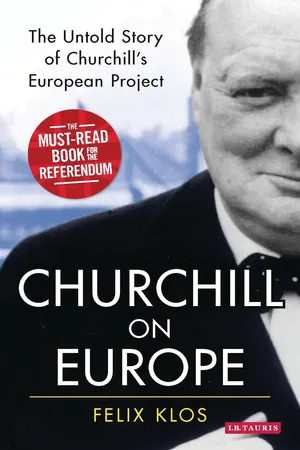
'When the Nazi power was broken, I asked myself what was the best advice I could give to my fellow citizens here in this island and across the channel in our ravaged continent. There was no difficulty in answering the question. My counsel to Europe can be given in a single word: Unite!'Sir Winston Churchill in 1947After the Second World War, with Europe in ruins, the victorious Winston Churchill swore to build a peace that would last.Together with a group of thinkers and politicians, Churchill began to build the institutions and the political will that would eventually lead to what we now know as the European Union.He believed in a united Europe, and wanted Britain to play a leading role. This book, based in part on new evidence, reveals his vision: Britain as a leading member of the European family. On the 23rd June this book asks us all to think carefully: what would Churchill have done?
Information
‘Europe Arise!’: Churchill’s European Campaign in Britain
In necessary contrast to the magniloquent rhetoric with which Churchill attempted to persuade the world of the rightness of the European ideal, he and his closest associates were ruthlessly pragmatic in ensuring British (read: Churchillian) leadership of the emerging European movement.
A day after the speech, Leo Amery told Duncan Sandys, ‘the great thing is that he should now follow up Zurich and not let the torch die down,’ suggesting that this was a foreign policy vision that would attract British voters and should be developed at the forthcoming party conference in Blackpool.1 Sandys, who was out of a job after losing his seat in the 1945 election, was encouraged to join the campaign by the letters he started receiving for his father-in-law immediately after the Zurich speech. He kept 16 special files in his office, all for different European countries, containing thousands and thousands of pleas from ordinary European citizens asking for Churchill to pursue European unity.2
Like the thousands of ordinary people that wrote to Churchill in September 1946, his political inner circle made an effort to encourage him further. Leo Amery, for instance, wrote to Churchill on 20 September, ‘you cannot leave the matter with one speech. This morning’s silly leader in the The Times shows how much more is needed in the way of follow up and amplification.’ Amery believed that Churchill could rouse Conservative voters with the idea of the United States of Europe and with a world vision that swapped the ‘mere black and white ideological fight between American mid Victorian individualism and Russian State slavery’ for a world organised in partner groups of nations, each with its own distinctive history and characteristics, as Churchill had originally proposed as wartime prime minister.3
Churchill needed little prodding to start his post-Zurich campaign. Before making his first moves, he needed to fully understand the lie of the land in the existing European movement. On 23 September, he sent Count Coudenhove-Kalergi – first port of call in all matters relating to European unity – a short and unceremonious telegram from his new London home in Hyde Park Gate demanding information: ‘Please send urgently full particulars of work and organisation of your Union.’4 Churchill was planning an informal strategy lunch at Chartwell and hoped to have a clearer idea of Coudenhove-Kalergi’s activities before then.
Invited to Chartwell to talk over the post-Zurich plans were three Conservative politicians of differing distinction: Leo Amery, Duncan Sandys and Bob Boothby. Amery had served in Churchill’s War Cabinet and, at the age of 72, was one of the wise old men of the Conservative Party. Sandys, who had been a junior minister in the war, rapidly became one of Churchill’s closest advisers. Boothby completed the initial nucleus of Churchill’s post-Zurich strategy team. A former private secretary to Churchill in the late 1920s, he was a supremely gifted but enigmatic, irascible and rakish Conservative MP. After embroiling himself in a scandal involving Czech gold in 1940, he never quite recovered his former status as a potential future prime minister. It did not help either that he started a semi-public, lifelong affair in the mid 1930s with Lady Dorothy, wife of his close colleague and fellow Conservative MP, Harold Macmillan. No wonder, then, that it was whispered in the corridors of Westminster that at his christening the good fairies had given Boothby every gift, except the ability to distinguish right from wrong.5
Whatever his shortcomings, Boothby was a known supporter of European unity. In February 1946 he started putting forward constructive proposals for Britain to take the lead in an integrated Western Europe. He was one of just a few politicians to see with Churchill the painful truth that Britain emerged from the war little better off than her neighbours across the Channel. ‘The smaller nations of Western Europe, of which we are one,’ he told the Commons in February, ‘cannot hope to survive politically or economically in isolation.’6
Little over half a year later, the Zurich speech gave Boothby a chance to rekindle his pre-war partnership with Churchill. On 22 September, he caught Churchill’s attention with an animated article in the News of the World entitled ‘Britain Must Take Lead in Building New Europe’. Boothby underlined the historical importance of the Zurich speech and urged broader acceptance of the temporary division of Europe into an Eastern and a Western sphere of influence. He sounded just one note of criticism: he was unhappy with the ambiguous silence about the part Great Britain was to play. ‘There can be no doubt,’ Boothby wrote. ‘Not only must we be in it [the United States of Europe], we must take the lead.’ He estimated Churchill essentially agreed with him. ‘Mr. Churchill can hardly mean that we should confine our support of a Western European Federation to applause from the side-lines. On a memorable occasion he himself offered complete union with Britain to France.’7
What held Amery, Sandys and Boothby together was that they had stood with Churchill long before he was adored around the globe as a hero of the West. In the 1930s, when Churchill’s voice was a voice in the wilderness, they were his friends. Then, Churchill was campaigning against the Government’s appeasement of Nazi Germany; now he proposed to ‘rouse the fervour of a crusade’ for the United States of Europe in which a newly federated Germany would play a full part.8
In fact, almost all of Churchill’s closest associates in the postwar campaign for a United Europe were drawn from the ranks of his pre-war supporters, who had met in a semi-secret group calling itself ‘The Focus’. The Focus, in the words of one of its more prominent members, was intended ‘for discussion and for the exercise of indirect influence through the political Parties and newspaper Editors and proprietors’.9 The central goal then had been to warn the Government and the public of the dangers of Nazism.
After reaching out to the more intimate nucleus of Conservatives, Churchill instructed Sandys, who quickly became the principal moving agent in the postwar campaign, to get in touch with the rest of the Focus to, as he put it, ‘meet again to discuss the present international situation’. They were informed that the ‘Handling Group’ that Churchill was mounting for a United Europe was differently conceived from the Focus in that it intended ‘bold, public and sustained action’ in the international sphere; not semi-secret, subtle and domestic influence.10
Reactions among the old Focus members were mixed. Dr Mallon, a former governor of the BBC, was highly enthused, while Lady Violet Bonham Carter, Churchill’s closest female friend and a governor of the BBC, Sandys reported, was a ‘trifle sulky’ after falling out with Churchill in the final years of the war. In the end, Churchill told Sandys to let the matter drop and start the campaign for European unity without the wider circle of the Focus, retaining the tight inner circle instead.11 Other Focus stalwarts like Harold Macmillan and Lady Violet would actively join the campaign a few months later. Soon after they did, Eugen Spier, a German Jewish refugee from Nazism who had helped pay for the activities of the Focus in the mid late 1930s, met with Churchill to discuss United Europe.12 On the condition of anonymity, he promised to raise a fund of between £5,000 and £10,000 to cover the immediate expenses of the new United Europe group.13 The old group had found a new cause.
On 24 September, a day after Churchill cabled Coudenhove-Kalergi for information on his Union, Duncan Sandys and Leo Amery talked for more than an hour in the latter’s huge Victorian home in London’s Embankment Gardens. Sandys told his host that he was quite prepared to make the European campaign his life’s work for the immediate future. Amery replied that he would be equally willing to spend a large portion of his time as an elder statesman sitting on any sort of committee.
That same day, Julian Amery, Leo’s 26-year-old son and soon to be Harold Macmillan’s son-in-law through his marriage to Catherine Macmillan, went to see Coudenhove-Kalergi and his wife in Gstaad in the Bernese Alps. Over mushroom soup and eggs, Coudenhove-Kalergi gave him a tour d’horizon of European politics. He proudly showed Julian his correspondence with General de Gaulle, seemingly undisturbed by the fact that De Gaulle, like Churchill, more often than not confined himself to polite acknowledgements by way of response. Coudenhove-Kalergi told Julian that he hoped sincerely that Sandys would organise a British group for European Union to match the groups he was building in Switzerland and France. He believed, self-assertively, that his lunchtime meeting with Churchill on 14 September inspired Churchill to speak on the tragedy of Europe at Zurich. In actual fact, the Foreign Office had already issued a statement to the press on the morning of the 14th saying that Churchill intended to deliver at Zurich ‘a considered statement on the present state and future of Europe’.14
On the 26th, Leo told Julian that ‘Winston was very keen’ about the European campaign and that he, Duncan Sandys and Bob Boothby were going to Chartwell in a few days for a strategy lunch. He would suggest to Churchill that Julian should go too. Julian’s opinions on European Union, however, differed from his father’s in one important aspect. Julian believed, he wrote, that ‘Pan-Europe will never work unless England goes into it wholeheartedly,’ while his father still showed reserve on that point because of Britain’s loyalty to the British Commonwealth of Nations. By September 1946, however, Leo had come around a good deal on this point and, Julian noted in his diary, ‘since the union of Europe will inevitably be very very loose for many years to come, the problem is probably only theoretical.’15
On Monday 30 September, a vivid and cloudless day, Leo Amery was first to arrive at Chartwell. He found Churchill busy cleaning out one of the artificial pools he had built on his property and fixing a small toy waterfall. There was something ‘delightfully boyish’, Amery thought, about Churchill’s love of beautifying his house before it would be given to the National Trust and turned into a museum.
Sandys, Boothby and Julian Amery soon joined the elder Conservative leaders. During the drive down to Chartwell both Sandys and Boothby were very irritated with Anthony Eden, a conspicuous absentee from the post-Zurich plotting team. Eden became under-secretary of state at the Foreign Office in 1931 and rose fast in the House of Commons. In 1934, at the age of 38, he received his first major appointment as Lord Privy Seal. He became Churchill’s foreign secretary in December 1940, remaining in post for the rest of the war and opposing the prime minister’s plans for the postwar creation of a Council of Europe. Despite having discreet hopes of succeeding Churchill as party leader after the painful election defeat of July 1945, Eden remained the crown prince and foreign policy expert of the Conservative Party.
It was a serious blow to Conservative Europeanists that Eden made no meaningful moves towards supporting Churchill’s design. In a major foreign policy speech that week in Watford, Eden did not mention the Zurich speech once, let alone defend it. Randolph Churchill told Julian that his father, too, was furious about Eden’s speech and was hoping for someone to answer it.16 For the time being, it seemed Eden was more in tune with the cautious, Euro-agnostic approach of his close friend the Labour foreign secretary Ernest Bevin than he was with that of the leader of his own party.
Arriving at Chartwell the younger men greeted Leo Amery and Churchill, dressed in his blue siren suit and a grey homburg hat with a large white goose feather sticking out.
The lunchtime talk boiled down to Churchill telling his guests that he meant to bring together leading continental statesman in a conference in London to start a European movement which he intended to lead personally. He thought Europe, including Germany, ripe for such a movement to ‘sweep right through and dominate every party’. Before the international meeting of leading European statesmen, he planned to constitute a committee and organisation in Britain, perhaps under the administrative direction of Leo Amery, which would be all-party, non-party and above-party.
‘Churchill was quite emphatic on the point of European unity,’ Julian wrote in his diary that day, as distinct from the strategic conception of a West European bloc. From Churchill’s brief remarks on the role of the Russians in the new Europe that day – ‘they must go back’ – it was evident that he embraced both the political ideal and the strategic conception. The Russian menace strengthened Churchill’s support for the European ideal; it was not the conditioning element.
Churchill closed by saying he believed that a United States of Europe was the only way of preventing another European war, and that the United States of America, to which European quarrels had been a constant liability in the first half of the century, would eventually welcome and embrace his plans. He grew progressively keener and towards the end of the lunch instructed his guests to organise a public meeting in the Royal Albert Hall in the autumn of 1946 to inaugurate the European movement in England – a timeline which eventually proved a bit too ambitious.
Amery the elder set out the next day to inform potential members of the British committee, who were leading public figures, about Churchill’s intentions. ‘Churchill is by no means minded to let the matter rest with a single speech, but is really anxious to follow it up,’ he told Sir Walter Layton, the wealthy Liberal Party politician and newspaper proprietor who was deemed ‘most useful in view of his connection with the News Chronicle and the Economist’.17
A few days later, Churchill was due to speak at the concluding session of the Conservative Party Conference in Blackpool. Addressing a mass meeting in Blackpool’s Winter Gardens, Churchill kept his promise of continuing the Zurich message: ‘We wish to be happy and prosperous, and will only give our support to the political parties, whatever they may be called, who will vote for a United States of Europe.’ He pledged to devote his last measure of devotion to creating a European Union and to take on a leading role in propagating the idea in Britain and abroad.18
Wholly satisfied with the Blackpool address, Leo Amery wrote to suggest to Churchill possible continental allies for the European campaign. ‘I think you will find the M.R.P. in France [Robert Schuman’s Christian democratic political party], and the Catholics generally in Europe, the most helpful element in the campaign for a united Europe.’19 The Catholics were certainly attracted by Churchill’s historical and spiritual conception of Europe as essentially representing Christendom – the medieval and early modern Catholic geopolitical power bloc covering most of geographic Europe. From the ranks of the Christian democrats eventually emerged the men now considered to be the founding fathers of the European Union: Konrad Adenauer of Germany, Robert Schuman of France and Alcide De Gasperi of Italy.
Well before the onset of winter in 1946, Churchill started to think about a statement of purposes and to round up prospective members for what would become known as the British United Europe Committee. On Thursday 10 October, Churchill invited Sandys, Amery and Boothby to a meeting in his room in the House of Commons. He told them that he was especially keen to secure good Labour representation on the committee so as to avoid any impression of a party stunt in the foreign policy arena. The Amerys prepared a draft definition of purposes for the committee, which was then amended and added to by Boothby and Sandys before Churchill could take it home for the weekend for further consideration.20 A week later, during another hourlong meeting in his room in the Commons, Churchill presented his definitive conclusion that the British movement should start with a small handling committee of eight or so members. David Maxwell-Fyfe, a younger Conservative MP who had acted as one of the lead British prosecutors at the Nuremberg trials, was chosen as second-string administrative leader of the committee behind Amery, and Churchill promised to write to potential Labour supporters.
Churchill further reported to the inner circle that day that he had...
Table of contents
- Frontcover
- Praise for the full unabridged edition
- Title Page
- Copyright Page
- Contents
- Introduction
- ‘Something That Will Astonish You’: Churchill’s European Vision
- ‘Europe Arise!’: Churchill’s European Campaign in Britain
- Conclusion
- Notes
- Bibliography
- Back Cover
Trusted by 375,005 students
Access to over 1.5 million titles for a fair monthly price.
Study more efficiently using our study tools.
Frequently asked questions
Yes, you can cancel anytime from the Subscription tab in your account settings on the Perlego website. Your subscription will stay active until the end of your current billing period. Learn how to cancel your subscription
No, books cannot be downloaded as external files, such as PDFs, for use outside of Perlego. However, you can download books within the Perlego app for offline reading on mobile or tablet. Learn how to download books offline
Perlego offers two plans: Essential and Complete
- Essential is ideal for learners and professionals who enjoy exploring a wide range of subjects. Access the Essential Library with 800,000+ trusted titles and best-sellers across business, personal growth, and the humanities. Includes unlimited reading time and Standard Read Aloud voice.
- Complete: Perfect for advanced learners and researchers needing full, unrestricted access. Unlock 1.5M+ books across hundreds of subjects, including academic and specialized titles. The Complete Plan also includes advanced features like Premium Read Aloud and Research Assistant.
We are an online textbook subscription service, where you can get access to an entire online library for less than the price of a single book per month. With over 1.5 million books across 990+ topics, we’ve got you covered! Learn about our mission
Look out for the read-aloud symbol on your next book to see if you can listen to it. The read-aloud tool reads text aloud for you, highlighting the text as it is being read. You can pause it, speed it up and slow it down. Learn more about Read Aloud
Yes! You can use the Perlego app on both iOS and Android devices to read anytime, anywhere — even offline. Perfect for commutes or when you’re on the go.
Please note we cannot support devices running on iOS 13 and Android 7 or earlier. Learn more about using the app
Please note we cannot support devices running on iOS 13 and Android 7 or earlier. Learn more about using the app
Yes, you can access Churchill on Europe by Felix Klos in PDF and/or ePUB format, as well as other popular books in Politics & International Relations & World War II. We have over 1.5 million books available in our catalogue for you to explore.