- 352 pages
- English
- ePUB (mobile friendly)
- Available on iOS & Android
eBook - ePub
About this book
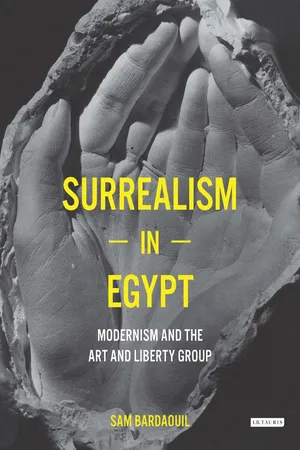
In the thick of the Second World War, the Cairo-based Surrealist collective Art et Liberte were pioneering new art forms and mounting subversive exhibitions that sent shockwaves across local artistic circles. Born with the publication of their Manifesto Long Live Degenerate Art on December 22nd, 1938, the group rejected the convergence of art and nationalism, aligning themselves with a complex, international and evolving Surrealist movement spanning cities such as Paris, London, Mexico City, New York, Beirut and Tokyo. Art and Liberty created a distinct reworking of Surrealism, which provided a generation of disillusioned Egyptian and non-Egyptian artists and writers, men and women alike, with a platform for cultural reform and anti-Fascist protest. Surrealism in Egypt is the first comprehensive analysis of Art and Liberty's artworks, literature and critical writings on Surrealism. By addressing the group's long-lost and often misconstrued legacy, and drawing on a substantial body of previously unpublished primary documents and more than 200 field interviews, the author charts Art and Liberty's significant contribution towards a new definition of Surrealism.Moving beyond the polarizing dichotomies of Saidian Orientalism, this book rewrites the history of Surrealism itself - advocating for a new definition of the movement that reflects an inclusive vision of art history.
Information
1
ART AND LIBERTY: A PREHISTORY
The prehistory of Art and Liberty is surprisingly located roughly one century prior to their first exhibition in 1940. On August 15, 1835, an official decree (firman) was issued by Muhammad Ali, arguably the founder of modern Egypt,1 to establish a museum to rescue Egyptian antiquities from foreign plundering:
Foreigners are destroying ancient edifices, extracting stones and other worked objects and exporting them to foreign countries. […] Having considered these facts, the government […] has decided to display them for travelers who visit the country, to forbid the destruction of ancient edifices in Upper Egypt, and to spend the greatest possible care on their safekeeping.2
This initiative was proposed by Rifa‘a al-Tahtawi (1801–73), one of Ali’s close advisors and the director of the newly established school of languages. Al-Tahtawi was one of approximately forty delegates from Ali’s first student mission to Paris in 1826, a practice that would continue into the twentieth century.3 While in Paris he was fascinated and at once perplexed by the European affinity to visual experience.4 “One of the characteristics of the French is to stare and get excited at everything new,”5 he wrote in his lengthy 1834 account of the time he spent there.6
The nineteenth century witnessed the birth of modern archeology, with Egyptology at the forefront, and the consequent flourishing of the encyclopedic museum.7 Within an imperialist colonial context, major historical collections were amassed. This was the heyday of the ethnographic exhibition where objects under glass, on pedestals, or hung—literally and metaphorically—signified an order of cultural hierarchies. Artworks were presented within exhibition displays through which specific ideologies were promulgated. Classifications and hierarchies were established, canons were written and art history, or rather the art of writing history, was set. Soon, other platforms of display followed suit: world fairs, national pavilions, even department stores all participated in the visual ordering of the world. The “expositions universelles”8 with their extravagant scale and wide popularity were particularly instrumental: cultural difference was being staged as entertainment and the “Other” as an object of attraction and wonder. To better comprehend the process of exoticization by which “Otherness,” in this case “Egyptianness,” was being framed and presented through museum displays and world fairs, we need to locate these practices within the much broader colonial aspirations that were at play and that were deeply seated within complex systems of power that resulted from the significant changes within Europe’s economic and political landscape that were triggered by the Industrial Revolution. Moreover, we must also consider how colonial expansionism and nationalism are tightly connected.
Colonial Subjects and Paraded Objects
The configuration of Colonialism from the late eighteenth century onwards is inextricably linked to the economic advancements and challenges that resulted from the Industrial Revolution. On the one hand, the colonies were seen as sources of fundamental supplements necessary for both the provision of raw materials for an increasingly developing machine-based industrial sector and for the nourishment of the metropole’s expanding population. On the other hand, the colonies became ripe sources of wealth for the colonizing powers that used them as markets for their new industrial goods, now made available due to the technological inventions of the Industrial Revolution. In Egypt, the negative impact of these economic shifts was mostly felt in the textile industry from which some of the most significant labor movements in Egypt consequently emerged.9 Besides the replacement of manual laborers with newly imported machines, artists and artisanal guilds found themselves unable to compete with the inexpensive manufactured cloth that was becoming increasingly available in the local market. A population boom coupled with a staggering lag in industrialization caused an economic stagnation that was dependent on the fluctuating market price of cotton, Egypt’s main commodity.10
The worsening conditions of urban and rural laborers due to the introduction of new technologies, as well as the overall plight of the working class were topics that Art and Liberty would take up in their literary work, in their writings of social criticism, as well as in their visual production.11 By the turn of the twentieth century, Egypt’s cotton industry had become so intertwined with the global trade network of the British Empire, who in safeguarding its economic interests, relied on its colonial hegemony over Egypt to ensure favorable market conditions for foreign investors. To cite Jyoti Puri in her book Encountering Nationalism:
Driven by the needs of colonialism, a flourishing capitalism helped create a world economy, international monetary markets and international financial institutions, resulting in interdependent but highly unequal economies. An “international division of labor,” under which colonial powers extracted raw materials from and then sold to the colonies was the trademark of this capitalist world market.12
The conterminous spread of Colonialism and Capitalism is arguably one of the main reasons why Communism, in its various guises, was adopted as a counter-position not only to Capitalism, but also as a mechanism of active resistance against Colonialism. This may well explain why Communism found fertile soil in Egypt from as early as the post-First World War period.13 This also helps shed light on why it particularly attracted intellectuals and activists from ethnic and cultural minority groups such as the Jewish and Greek communities in Egypt, who unlike their Egyptian counterparts, did not subscribe to the nationalist project and its emphasis on the Pharaonic heritage, as a counter-position to Colonialism.14 This is certainly the case with Art and Liberty who included several Greek and Jewish Egyptians amongst its ranks.
The economical hierarchies and unequal division of labor and markets that were embedded within the colonial/capitalist system were mirrored in the mechanisms of visual display that employed the exhibition format as a site of cultural and political control. The nineteenth-century rediscovery of Egypt by Europe’s imperialist powers and the consequent expatriation and display of its arts coincided with a predominantly European interest in setting up the “world as picture.”15 The exhibition space became a site of control that had the final word on everything within it. The exhibition became a space “able to create subjects who conceive of themselves as separate from and superior to the objects of their study.”16 The “civilized gaze”17 of the viewer was the ultimate stage in a process of re-semanticization that began upon the removal of the object from its original context. This is well illustrated, for instance, in an 1867 caricature by Honoré Daumier (1808–79) titled À l’Éxposition Universelle – Section Égyptienne (reprinted 1920). A conservative bourgeois family gazes rather awkwardly at the Egyptian hieroglyphs in the Egyptian Pavilion at the 1867 World Fair in Paris (Plate 1.1). Daumier, as the picture reveals, has allowed his imagination unrestricted editorial freedom. His renderings of Egyptian hieroglyphs are far removed from reality. He even introduced an elephant’s head in what looks like the Hindu deity, Ganesh. Unaware of these inaccuracies, the unsuspecting family, and later on the readers of the magazines where Daumier’s satire appeared under the title Oh comme ils sont moches les Égyptiens, derive what they perceive as objective truth about Egyptian art, which once circulated widely enough, becomes public knowledge. Through the act of looking that permeates the entire gallery, unchallenged knowledge is established. The colonial subject is, therefore, framed within a preconceived set of cultural and geographical parameters that become part of a closed-ended narrative.
The Egyptian visitors to cities like Paris or London in the second half of the nineteenth century could not help but notice and comment on the conflation of several aspects of their culture within systems of visual and spatial representation that were problematic, to say the least. In the first chapter of his seminal Colonising Egypt, Timothy Mitchell gives a detailed account of the impressions of several Egyptian students and delegates who witnessed this machinery of representation and sums up the overall sentiment towards such display as follows:
Characteristic of the Europeans’ way of life was their preoccupation with what an Egyptian author described as intizam al-manzar, the organization of the view. Outside the world exhibition, it follows paradoxically, one encountered not the real world but only further models and representations of the real. Beyond the exhibition and the congress, beyond the museum and the zoo—everywhere that non-European visitors went, they found the technique and the sensation to be the same.18
Egyptian artifacts, along with the diverse cultural—and acculturated—objects from the colonies were being paraded central stage in museological displays that reinforced much-contested notions of Otherness. In addition, and in following a widely popular practice from the previous century’s world fairs, human subjects were also imported to inhabit the exhibition space lending the display an aura of authenticity. The Éxpositions Coloniales come to mind. Consider, for instance, the 1886 Colonial and Indian Exhibition of London, where thirty-four Indian artisans were on display, and whose purpose, as the Prince of Wales stated at the exhibition’s opening, was to “stimulate commerce and strengthen the bonds of union now existing in every portion of her Majesty’s Empire.”19 Another example that comes to mind is Berlin’s Colonial Exhibition of 1896. Mounted ten years after its London counterpart of 1886, it included three colonial villages that were constructed from raw materials shipped in from Africa and the South Pacific, in which a number of natives representing the various German colonies of the time were on display. In this case, and to cite David Ciarlo in his book Advertising Empire, through: “displaying ‘wild peoples’ who were contained and controlled within a colonial village, […] the colonialists strove to erode popular anxieties about the ‘Dark Continent’ by visibly demonstrating a complete mastery over all of its known dangers.”20
Paris, perhaps more than any other city, was the site of some of the most spectacular colonial exhibitions. The scope of their displays produced such a strong impact that an Egyptian writer, upon visiting the Colonial Exhibition of 1931, wrote:
The Colonial Exhibition is the talk and scene of the day. […] Behold the Islam’s white and yellow mosques […] the ornately decorated houses of Tunisia […] the cafés of Marrakesh with its embellished cushions […] A Damascene palace with a spacious courtyard of several gardens […] Damascus street stores […] an Indochinese Palace, which upon entering it, would transport you to a world of legends […] the proud Chinese house […] the Indian statue bestowing grace like a king on his throne […] the engravings of the native Americans.21
The author goes on to praise the great lengths that the organizers had gone to in order to assure the authenticity of displays, mostly by bringing natives of the represented countries, along with indigenous animals, to animate these temporary constructions. He reserved his most fervent admiration, however, for an Egyptian magician who, while not representing Egypt in an official capacity, was the most popular attraction at the entire fair. Even within the colonial context, national pride had to have the final word.22 Ironically, the Colonial Exhibition of 1931, as we later discover in Chapter 4 dedicated to Art and Liberty’s unconventional exhibition practices, prompted the Surrealists in Paris to stage a counter-exhibition where the mechanisms of display they employed marked a subversive shift in the approach to exhibition making.
Nationalism, Art and the Power of Display
The fascination with the power of display, or more appropriately the display of power, that was felt by that Egyptian writer in 1931 was shared a century earlier by al-Tahtawi. Throughout his stay in Paris that lasted close to a decade, al-Tahtawi had come to understand the power that visual display could have on the beholder and the narratives it could disseminate. A museum of ancient Egyptian artifacts can effectively demonstrate not only the cultural, but equally the political singularity of Egypt as an independent, self-determining state. This is perhaps the first and most significant incident in the history of modern Egypt where one could witness a conscious recruitment of the ancient past in the construction of the modern present through the visual ordering of re-imagined objects within systems of display that signify a pre-ordained ideological intent. In other words, the conflation of art and propaganda for the construction of a distinct national identity, whereby a sense of temporal and geographical continuity is articulated via physical objects that function as reconstructed images of a distinct past. Here, the objects in question stem from Egypt’s Phara...
Table of contents
- Cover
- Title Page
- Copyright Page
- Contents
- List of Figures
- List of Plates
- Acknowledgments
- Introduction
- 1 Art and Liberty: A Prehistory
- 2 Fascism at Home: Towards a New Reading of Art and Liberty’s Founding Manifesto of December 22, 1938
- 3 Word to Picture, Picture to Word: The Literary and Pictorial Imagery of Art and Liberty
- 4 Art and Liberty and the Reworking of Surrealism
- 5 Art and Liberty and British Surrealism: Parallels and Overlaps
- 6 From Theory to Practice: The Exhibition as Protest, Art as Rupture
- 7 A Legacy Interrupted: From Art and Liberty to Bread and Liberty
- 8 Post-War Rupture: Art and Liberty and the Beginning of the End
- Conclusion: Art and Liberty Reconsidered Beyond Orientalism and the Post-Colonial Lens
- Appendix
- Notes
- Bibliography
- Plates
Trusted by 375,005 students
Access to over 1.5 million titles for a fair monthly price.
Study more efficiently using our study tools.
Frequently asked questions
Yes, you can cancel anytime from the Subscription tab in your account settings on the Perlego website. Your subscription will stay active until the end of your current billing period. Learn how to cancel your subscription
No, books cannot be downloaded as external files, such as PDFs, for use outside of Perlego. However, you can download books within the Perlego app for offline reading on mobile or tablet. Learn how to download books offline
We are an online textbook subscription service, where you can get access to an entire online library for less than the price of a single book per month. With over 1.5 million books across 990+ topics, we’ve got you covered! Learn about our mission
Look out for the read-aloud symbol on your next book to see if you can listen to it. The read-aloud tool reads text aloud for you, highlighting the text as it is being read. You can pause it, speed it up and slow it down. Learn more about Read Aloud
Yes! You can use the Perlego app on both iOS and Android devices to read anytime, anywhere — even offline. Perfect for commutes or when you’re on the go.
Please note we cannot support devices running on iOS 13 and Android 7 or earlier. Learn more about using the app
Please note we cannot support devices running on iOS 13 and Android 7 or earlier. Learn more about using the app
Yes, you can access Surrealism in Egypt by Sam Bardaouil in PDF and/or ePUB format, as well as other popular books in Art & History of Contemporary Art. We have over 1.5 million books available in our catalogue for you to explore.