Did American racism originate in the liberal North? An inquiry into the system of institutionalized racism created by Northern Jim Crow
Jim Crow was not a regional sickness, it was a national cancer. Even at the high point of twentieth century liberalism in the North, Jim Crow racism hid in plain sight. Perpetuated by colorblind arguments about “cultures of poverty,” policies focused more on black criminality than black equality. Procedures that diverted resources in education, housing, and jobs away from poor black people turned ghettos and prisons into social pandemics. Americans in the North made this history. They tried to unmake it, too.
Liberalism, rather than lighting the way to vanquish the darkness of the Jim Crow North gave racism new and complex places to hide. The twelve original essays in this anthology unveil Jim Crow’s many strange careers in the North. They accomplish two goals: first, they show how the Jim Crow North worked as a system to maintain social, economic, and political inequality in the nation’s most liberal places; and second, they chronicle how activists worked to undo the legal, economic, and social inequities born of Northern Jim Crow policies, practices, and ideas.
The book ultimately dispels the myth that the South was the birthplace of American racism, and presents a compelling argument that American racism actually originated in the North.
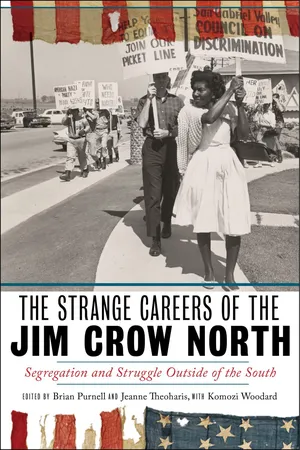
eBook - ePub
The Strange Careers of the Jim Crow North
Segregation and Struggle outside of the South
- 352 pages
- English
- ePUB (mobile friendly)
- Available on iOS & Android
eBook - ePub
The Strange Careers of the Jim Crow North
Segregation and Struggle outside of the South
About this book
Information
1
A Murder in Central Park
Racial Violence and the Crime Wave in New York during the 1930s and 1940s
Shannon King
“I had never before been so aware of policemen, on foot, on horseback, on corners, everywhere,” remembered James Baldwin, Harlem native, describing his arrival home in early June of 1943. Police presence had increased since the winter of 1941 after a series of robberies and assaults by blacks upon whites inspired white newspapers to define the illegal acts a “crime wave.” White New Yorkers sent a flood of angry letters to Mayor Fiorello H. La Guardia and Police Commissioner Lewis J. Valentine. Thus, during the spring of 1942, the confluence of the crime-scare stories and whites’ demands for safety had transformed Harlem into a zone of police violence.
Home to attend his father’s funeral, Baldwin could not have known that less than ten years after the Harlem Riot of 1935, the area would explode again. But that happened in August 1943 when Harlem experienced its second racial uprising. This outpouring of anger occurred on August 1 and 2 after a white police officer, James Collins, shot and wounded Robert Bandy, a soldier on leave. Even twenty years later, after Harlem experienced yet another paroxysm of racial violence, Baldwin bore witness to the community’s unrelenting occurrences of police brutality. His argument in 1943 proved even truer in 1966: “Harlem is policed like occupied territory.”1
This chapter explores black New Yorkers’ encounters with violence between the Harlem riots of 1935 and 1943, and their demands for equitable policing. Black people’s criticisms of their experiences of underprotection and overpolicing at the hands of law enforcement brings to light their efforts to challenge Jim Crow practices that defined the New York Police Department (NYPD), but often remained hidden in plain sight. Race riots have preoccupied historians who focus on this period of the Jim Crow North’s history, but attention on those subjects, I argue, has blinded us to blacks who demanded safety as a pivotal aspect of their citizenship and community rights.2
The NYPD, as law enforcement and therefore agents of the state, both overpoliced and underprotected black New Yorkers. Black citizens understood policing as a civil right. By centering Harlemites’ demands for safety, this chapter illuminates blacks’ vulnerabilities to state-sponsored violence as conditions of Jim Crow policing in New York City. The story of police underprotection of black New Yorkers likely echoes across the entire Jim Crow North.
In the aftermath of the Harlem rebellion of March 19, 1935, triggered by the rumor that Lino Rivera, an Afro–Puerto Rican Harlemite, had been killed by the police, La Guardia commissioned an investigation into the uprising’s causes. The investigation’s controversial report evidenced a pattern of institutionalized racism in five areas: relief, housing, youth services (education and recreation), health care (and hospital services), and criminal justice (crime and police). The mayor concealed the report from the public because he feared it would damage his administration’s reputation. On matters of racial equality, convenience and expedience, more than justice and democracy, motivated even the most liberal northerners.
La Guardia was not alone among northern liberals in prioritizing his own political or personal interests at the expense of black people’s civil rights. Newspapers in New York City provided sensational portrayals of black criminality, but buried mundane stories about blacks who demanded safety from crime and police brutality. Thus, as black New Yorkers initiated their own anticrime drives to make up for police underprotection, they checked white dailies’ stories of “crime waves” and “Negro thugs,” and they argued that La Guardia’s failure to remedy Jim Crow conditions outlined in the report perpetuated inequities.
White dailies’ racist narratives during the 1930s and 1940s served as ideological forebears of the “culture of poverty” thesis.3 They interpreted crimes committed by blacks as social problems associated with poverty, not inveterate conditions of the Negro race. White dailies’ crime-laden narratives about blacks and white citizens’ fears drove the NYPD’s Jim Crow policies of overpolicing through brutality and underpolicing through neglect. The way liberals policed black neighborhoods in Harlem and Bedford-Stuyvesant revealed less about black criminal behavior and more about the methods, and failures, of white liberal governance. White New Yorkers and the white dailies constructed blacks as criminals and leveraged their political power to punish black citizens as threats to white security. Whether blacks were actual criminals or their criminality was just a figment of white imaginations, newspaper stories about crime and blackness contributed to a widespread NYPD practice that rendered black citizens unworthy of protection and subject to suppression.
Words became black people’s weapons against these malpractices. In the late 1930s, black New Yorkers initiated a letter-writing campaign, and the black press published a series of editorials, urging Mayor La Guardia and Commissioner Valentine to protect black people from rape, petty theft, and burglary. Black New Yorkers expressed fear of, and anger against, intraracial crimes, especially against black women and children. They argued that racism explained the NYPD’s underprotection of black citizens. Framing safety and police protection as a civil right, they criticized the police for “Jim Crow policing.” These policies and practices promoted unequal protection and punishment of black citizens for no other reasons than the neighborhoods where they lived and the color of their skin.4
As blacks spotlighted police negligence, crimes against whites precipitated a law-and-order campaign. To halt the movement of blacks to Bedford-Stuyvesant, Brooklyn, in the late 1930s, the Midtown Civic League (MCL) claimed that black crime constituted a “crime wave.” Black Brooklynites condemned MCL’s racist allegations. After three blacks killed a white youth in Central Park in 1941, white dailies apprised readers of the outbreak of “muggings.” By singling out and publicizing crimes committed by blacks on whites, and dubbing them “crime waves,” white news media manufactured racial panic. Such stories rendered invisible black citizens who required adequate police protection. They crowded out the black press’s standing demands for adequate police protection. These exaggerated media-driven narratives, depicting black areas as crime zones, triggered a letter-writing campaign by white New Yorkers, who demanded that La Guardia protect them from “negro thugs.” Others insisted that La Guardia favored blacks because of their political support in the 1941 mayoral election, and that the mayor failed to punish black criminals. Motivated by white dailies and white complaints, Police Commissioner Valentine assigned more patrolmen to target areas to protect white people. Police violence and harassment against blacks increased.5
Aghast at the mayor’s instant protection of white citizens, the black community mobilized to expose the color-conscious policing practices of the NYPD, the media-manufactured “crime wave,” and police neglect and brutality. Black New Yorkers explained juvenile delinquency as a symptom of poverty and unequal access to municipal sources. They framed Valentine’s law-and-order campaign as a proxy for La Guardia’s failure to enact recommendations detailed in the earlier report on the causes of the Harlem race riot. They demanded protection and experienced punishment. This pattern became a defining characteristic of policing practices and politics in the Jim Crow North.
***
In New York City, racism became manifest through police brutality, especially during Prohibition and the Great Depression, when political and cultural discussions of urban crime served as coded language for the class and race differences that blackness connoted.6 Harlem, once the cultural hub of black America, became ground zero for two race riots. After the first riot in 1935, Mayor La Guardia commissioned a group of white and black leaders and social scientists, such as labor leader A. Philip Randolph, poet Countee Cullen, and Howard University’s E. Franklin Frazier, to investigate the cause of the riot. While they researched, the number of police officers in Harlem increased. The NYPD detailed five hundred policemen to guard the district.7
The report, Mayor La Guardia’s Commission on the Harlem Riot of March 19, 1935, not only pinpointed racism among white civilians, but in each of the five areas, it also argued that the general neglect to serve black citizens caused the uprising. The Pittsburgh black daily, the Courier, noted that “the report . . . holds Mayor La Guardia personally responsible for the jim crow conditions in the city.” Wary about exposing the culpability of his administration, La Guardia never released the report. Yet in July 1936, the New York Amsterdam News, a black weekly, secured a copy and printed sections.8 Thereafter, a committee of twenty-seven leaders of the community, including the Reverend William Lloyd Imes of St. James Presbyterian Church, Mrs. Mabel K. Staupers of the National Association of Colored Graduate Nurses, and Mr. James E. Allen of the NAACP (National Association for the Advancement of Colored People), met the mayor on July 22 and, making a reference to the increased police presence since the riot, asked for the “withdrawal of the ‘police army of occupation in Harlem.’”9 While La Guardia claimed he “would not tolerate police brutality in Harlem nor in any other section of Manhattan,” he also claimed no power over the police force, and that Police Commissioner Valentine was “a responsible commissioner.” The mayor offered Harlem’s leadership little in the way of implementing the report’s recommendations. He acknowledged the economic plight of Harlemites, but explained there was nothing he could do about it.10
After the initial meeting, La Guardia requested the committee to form a delegation of five that would meet periodically with him to discuss the report’s recommendations. Throughout the remainder of the 1930s, Harlemites complained about police brutality. In 1937, the New York Amsterdam News charged, “Police terror in New York City must go.” The newspaper stated that police brutality should not happen in “‘a land of the free and the home of the brave.’ But it can, and does, happen here, even two years after the Harlem rioting and the more recent revelations of the Mayor’s Commission on Conditions in Harlem.”11 Mayor La Guardia proved more capable of meeting to discuss social problems in Harlem than of doing anything substantive to alleviate those problems.
“The Spirit of Fascism” and the 1930s Crime Waves
During the late 1930s, southern black migrants and Afro-Caribbean immigrants, as well as black New Yorkers, moved to Brooklyn. Affordable housing and less congested living spaces drew them to the Bedford-Stuyvesant section. Between 1930 and the 1950s, Brooklyn’s black population tripled; Bedford-Stuyvesant became, according to the New York Times, “Brooklyn’s Harlem.”12 In July of 1937, the Bethel African Methodist Episcopal Church endeavored to purchase the “white debt-ridden” Grace Congregational Church, at Stuyvesant and Jefferson Avenues in Bedford-Stuyvesant. Sumner Sirtl, the leader of the Midtown Civic League (MCL), protested black settlement in that section, and especially Bethel AME’s attempts to purchase the white-owned church. According to Sirtl, “[C]ertain white realtors have the habit of renting houses to colored people without making any repairs thereby depreciating the value of property.” Denying racial discrimination, he charged that blacks neglected to request repairs to their homes. “Now, white people demand repairs on the houses they rent from realtors. As a rule, colored families don’t. Therefore, the houses run down. Slum conditions start. Whites move out. All because the colored people don’t demand their repairs. They should!”13
Throughout the remainder of the year and the decade, Sirtl and the MCL tried to incite f...
Table of contents
- Cover
- Title Page
- Copyright Page
- Contents
- Introduction. Histories of Racism and Resistance, Seen and Unseen: How and Why to Think about the Jim Crow North
- 1. A Murder in Central Park: Racial Violence and the Crime Wave in New York during the 1930s and 1940s
- 2. In the “Fabled Land of Make-Believe”: Charlotta Bass and Jim Crow Los Angeles
- 3. Black Women as Activist Intellectuals: Ella Baker and Mae Mallory Combat Northern Jim Crow in New York City’s Public Schools during the 1950s
- 4. Brown Girl, Red Lines, and Brownstones: Paule Marshall’s Brown Girl, Brownstones, and the Jim Crow North
- 5. “Let Those Negroes Have Their Whiskey”: White Backtalk and Jim Crow Discourse in the Era of Black Rebellion
- 6. Segregation without Segregationists: How a White Community Avoided Integration
- 7. “You Are Running a de Facto Segregated University”: Racial Segregation and the City University of New York, 1961–1968
- 8. A Forgotten Community, a Forgotten History: San Francisco’s 1966 Urban Uprising
- 9. “The Shame of Our Whole Judicial System”: George Crockett, Jr., the New Bethel Shoot-In, and the Nation’s Jim Crow Judiciary
- 10. “We’ve Been behind the Scenes”: Project Equality and Fair Employment in 1970s Milwaukee
- 11. The Media and H. Rap Brown: Friend or Foe of Jim Crow?
- 12. Stalled in the Movement: The Black Panther Party in Night Catches Us
- Acknowledgments
- About the Editors
- About the Contributors
- Index
Trusted by 375,005 students
Access to over 1.5 million titles for a fair monthly price.
Study more efficiently using our study tools.
Frequently asked questions
Yes, you can cancel anytime from the Subscription tab in your account settings on the Perlego website. Your subscription will stay active until the end of your current billing period. Learn how to cancel your subscription
No, books cannot be downloaded as external files, such as PDFs, for use outside of Perlego. However, you can download books within the Perlego app for offline reading on mobile or tablet. Learn how to download books offline
Perlego offers two plans: Essential and Complete
- Essential is ideal for learners and professionals who enjoy exploring a wide range of subjects. Access the Essential Library with 800,000+ trusted titles and best-sellers across business, personal growth, and the humanities. Includes unlimited reading time and Standard Read Aloud voice.
- Complete: Perfect for advanced learners and researchers needing full, unrestricted access. Unlock 1.5M+ books across hundreds of subjects, including academic and specialized titles. The Complete Plan also includes advanced features like Premium Read Aloud and Research Assistant.
We are an online textbook subscription service, where you can get access to an entire online library for less than the price of a single book per month. With over 1.5 million books across 990+ topics, we’ve got you covered! Learn about our mission
Look out for the read-aloud symbol on your next book to see if you can listen to it. The read-aloud tool reads text aloud for you, highlighting the text as it is being read. You can pause it, speed it up and slow it down. Learn more about Read Aloud
Yes! You can use the Perlego app on both iOS and Android devices to read anytime, anywhere — even offline. Perfect for commutes or when you’re on the go.
Please note we cannot support devices running on iOS 13 and Android 7 or earlier. Learn more about using the app
Please note we cannot support devices running on iOS 13 and Android 7 or earlier. Learn more about using the app
Yes, you can access The Strange Careers of the Jim Crow North by Komozi Woodard, Brian Purnell,Jeanne Theoharis, Brian Purnell in PDF and/or ePUB format, as well as other popular books in History & African American History. We have over 1.5 million books available in our catalogue for you to explore.