There is probably no task in the world of sales that causes more sleepless nights, sweaty palms, and frustrated salespeople, sales executives, and business owners than acquiring new customers. The vast majority of salespeople would prefer to never have to call on a prospect. The process is fraught with rejection, frustration, and wasted time and effort.
- 69 pages
- English
- ePUB (mobile friendly)
- Available on iOS & Android
eBook - ePub
About this book
Information
Topic
Negocios y empresaSubtopic
VentasChapter 1
Introduction
There is probably no task in the world of sales that causes more sleepless nights, sweaty palms, and frustration for salespeople, sales executives, and business owners than that of acquiring new customers. The vast majority of salespeople would prefer to never have to call on a prospect. The process is fraught with rejection and wasted time and effort. Add to that, the changes in the economy, the proliferation of electronic communications, and the explosion of new competitors, and you have something that borders on a nightmare for salespeople.
Acquiring new customers is becoming the one place in the sales process that defines success for companies and for individual salespeople. Do it better than average, and you have a shot at success. Do it less than average, and you probably won’t survive.
Regardless of the kind of business you’re in, the market, the product, or the state of the economy, there are ways to do it better and to improve your results. As in every other sophisticated endeavor, there are insights and practices that rise up to the surface because of their proven effectiveness. The purpose of this E-book is to shine light on some of those practices so that you’ll be better able to acquire new customers.
Let’s begin by putting it in perspective. The following diagram describes what I call “The Fundamental Sales Strategy” for a selling organization in general, and each individual salesperson in particular.
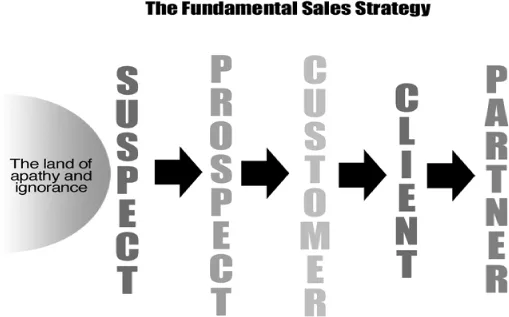
This describes the fundamental process for a selling organization. Notice the globe at the left-hand side of the process. This indicates the land of “apathy and ignorance.” Who lives in the land of apathy and ignorance? People who hopefully will buy your product or service. They don’t know you exist, so they are ignorant of you. They don’t care that you exist. Their lives and businesses have been okay without you, so they are apathetic to your very existence.
The first task of any sales system is to reach into the land of apathy and ignorance and identify those people whom you suspect may one day do business with you. We call those “suspects.” Having identified a set of suspects, the sales system must then learn something about them, so that some can be discarded and others moved to the next step in the process: “prospects.”
Typically, a prospect is a suspect who has a legitimate need for what you offer. (He’s not a student researching you for an academic project, for example.) A prospect typically is a person or unit of people who have the ability to make the decision about buying your product or service, and, perhaps most importantly, a prospect can pay for your product or service. Not every suspect meets these criteria, so a number of them fall by the wayside, never become prospects, and never enter our system.
This is a good time to make this point: At every step of the process, there are qualitative differences in each class. For example, some prospects are of higher quality than others. Some customers (the next class) are better than others.
Not only that, but it is the job of the sales system (and, sometimes the salesperson) to methodically and efficiently move people from one place on the process to the other. Because this is a process that requires skills, processes, tools, and so on, we can forever become better at that process.
So, although some sales systems can do an adequate job of moving suspects to prospects, others can do it better. The focus of every sales system should be to forever become better.
Back to our fundamental sales process.
Once you, or your system, have identified a prospect, you now must interact with that individual or company to such an extent that they give you money for what you have. When that transaction takes place, you have created a “customer.”
But you are not done yet. Now, you must work with that customer and convince him to purchase something additional, or more of the same. When that customer buys routinely and regularly, you have moved him to become a “client.”
And you are still not finished. You must now interact with some of those clients in such a way as to convince them to buy almost everything they can from you, and, become so close to you and your company that they don’t think of you as a vendor anymore, but rather as a “partner.” Only a handful of clients will ever get to this status, but when they do, they become extremely profitable to you and your company.
As you can see, there are three fundamental processes embedded in this overarching process:
1. Acquiring customers.
2. Creating clients.
3. Developing partners.
Your success as a selling organization depends on your ability to systematize these processes.
In this E-book, we’re going to look closely at the first part of this process. One of the advantages of beginning with the big picture perspective is that it informs our decisions about where to start our new customer process. Let’s start at the end.
Before we begin identifying suspects, we need to create a picture of what the ideal suspect looks like. In order to do that, let’s look at our current partners (in other words, our best customers), and see if we can discern anything they have in common. Are they roughly the same size, in the same industries, with the same philosophy, buying patterns, customers, management style, and so on? If we can discover a few similarities among them, then we can use that information to help us uncover the best suspects for the front end of the system.
For example, let’s say we discover that our partners annual sales are between $5 and $10 million, are privately owned, and make component parts for appliance manufacturers and automotive suppliers.
What does that tell us about who we should look for when we start identifying suspects? Organizations with those same characteristics. The best candidates to become customers will look a lot like our partners.
Now that we have established what the ideal suspect looks like, we can begin working in earnest. The next step is not prospecting, it is “suspecting.” When we “suspect,” we create a list of people who might turn into prospects. This list then becomes the material with which we work as we turn some of them into prospects.
Think of suspects as coming from two different fundamental approaches: passive and active. I like to use the following analogy to illustrate this principle: Imagine a fisherman in the middle of Lake Michigan. He has a couple of lines in the water. On these, he’s rigged his bait and a bobber, and cast them where he wants them. Once that’s done, there’s not a whole lot he can do, other than check on them from time to time. But, since he’s a serious fisherman, he has invested heavily in fishing for salmon. So, he’s got the right rod, the right lure, the right line, and the fish finder in the boat that alerts him to the presence of the fish. He spends about 70 to 80 percent of his time, energy, and money fishing for salmon. However, that doesn’t mean he won’t pull in something that bites on one of his passive lines. He’s fishing passively with about 20 percent of his time, and actively with the other 80 percent.
That’s the formula I generally recommend. First, develop your passive approach(es) to identifying suspects. This could be things like a Website, Yellow Page ads, relationships with channel partners, and relationships with centers of influence, and so on. Once you have the relationship or the mechanism in place, you pretty much just wait to see if it turns up something.
However, your major investment of time and money comes from your active approach. This means that you think about ways to acquire lists of suspects and that you invest time and money in those processes.
Here’s a list of some of those possibilities:
1. Buy a list. This is the information age, and lists are available for almost every conceivable set of characteristics. For example, this afternoon I could contact a list broker and ask for a list of names, addresses, phone numbers, size of business in numbers of employees, and e-mail addresses for manufacturers (or any one of a couple of hundred classifications) within a set of telephone area codes. I could have that downloaded to my computer by the end of the day.
Information selling is now a major industry in this country and there are lots of providers. Just do a Google search on “list brokers” and find a couple you would like to work with. You’ll be amazed at what information you can purchase.
2. Get referrals from your customers. Probably the best way to meet a prospect for the first time is to be introduced by someone you both know and respect. Before that can happen, you need to get the name and details for the person who you want to meet. That means you must ask your current customers for referrals.
The best way to do this is to visit your customers face-to-face, have a conversation about your products/services and their satisfaction with them, and then ask them specific questions to generate lists of names. For example, don’t ask, “Who do you know?” Instead, ask, “Who is one of your vendors who could use our service?” or “Which one or two people in your committee would be possible candidates?” By asking a series of specific questions instead of general ones, you’ll direct their thinking in more productive routes.
3. Rub shoulders with groups of suspects. If you have precisely defined your target suspects, then you should spend some time thinking and researching this question: “Where do they go?” The answers can vary from trade fairs to association meetings to other suppliers. The most unusual answer to this was from a client who sold reference books to lawyers. In order to meet them, he discovered that many of them would frequent a local pub on Fridays. He then made it a practice to show up and rub shoulders them, meeting with them in a social situation.
If you can identify where they go, then you can see about getting a list from someone who organizes or administers that event or meeting place. Or you can just show up and collect business cards.
4. Advertise in publications and Websites. There is a reason why advertising has been around for so long. One way to collect lists of suspects is to advertise in the publications or Websites they view, offer something free or inexpensive, and collect the names and details. The people who respond to the ads move themselves one step closer to being prospects in that they, by responding, show they have an interest in what you offer, and are willing to take action.
5. Partner with someone else who sells something compatible to them. The key word here is “compatible.” Again, if you have done a thorough job of describing what the ideal suspect looks like, you can then ask, “What else do they buy?” or “Who else do they do business with?” That should lead you to some companies and eventually to people who may have a vested interest in sharing their lists with you in exchange for something of value from you.
6. Take a survey ...
Table of contents
- Cover Page
- Title Page
- Copyright Page
- Contents
- Preface
- 1. Introduction
- 2. It’s All About the Risk
- 3. Planning for Effective Appointment Setting
- 4. A Special Pre-Call Touch: A Creative Way to Make Prospecting Appointments
- 5. Components of a First Call—Questions
- 6. Components of a First Call—Building Rapport
- 7. Components of a First Call—The Elevator Speech
- 8. An “Enticer”—Your Ace in the Hole
- 9. Nurturing Prospect Opportunities
- 10. Questions and Answers
- Index
- About the Authors
Trusted by 375,005 students
Access to over 1.5 million titles for a fair monthly price.
Study more efficiently using our study tools.
Frequently asked questions
Yes, you can cancel anytime from the Subscription tab in your account settings on the Perlego website. Your subscription will stay active until the end of your current billing period. Learn how to cancel your subscription
No, books cannot be downloaded as external files, such as PDFs, for use outside of Perlego. However, you can download books within the Perlego app for offline reading on mobile or tablet. Learn how to download books offline
Perlego offers two plans: Essential and Complete
- Essential is ideal for learners and professionals who enjoy exploring a wide range of subjects. Access the Essential Library with 800,000+ trusted titles and best-sellers across business, personal growth, and the humanities. Includes unlimited reading time and Standard Read Aloud voice.
- Complete: Perfect for advanced learners and researchers needing full, unrestricted access. Unlock 1.5M+ books across hundreds of subjects, including academic and specialized titles. The Complete Plan also includes advanced features like Premium Read Aloud and Research Assistant.
We are an online textbook subscription service, where you can get access to an entire online library for less than the price of a single book per month. With over 1.5 million books across 990+ topics, we’ve got you covered! Learn about our mission
Look out for the read-aloud symbol on your next book to see if you can listen to it. The read-aloud tool reads text aloud for you, highlighting the text as it is being read. You can pause it, speed it up and slow it down. Learn more about Read Aloud
Yes! You can use the Perlego app on both iOS and Android devices to read anytime, anywhere — even offline. Perfect for commutes or when you’re on the go.
Please note we cannot support devices running on iOS 13 and Android 7 or earlier. Learn more about using the app
Please note we cannot support devices running on iOS 13 and Android 7 or earlier. Learn more about using the app
Yes, you can access Prospecting for New Clients by Dave Kahle in PDF and/or ePUB format, as well as other popular books in Negocios y empresa & Ventas. We have over 1.5 million books available in our catalogue for you to explore.