
eBook - ePub
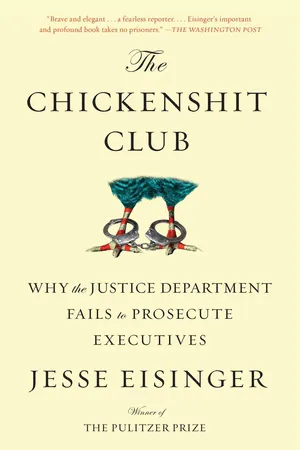
The Chickenshit Club
Why the Justice Department Fails to Prosecute Executives
- 400 pages
- English
- ePUB (mobile friendly)
- Available on iOS & Android
eBook - ePub
About this book
Winner of the 2018 Excellence in Financial Journalism Award
From Pulitzer Prize–winning journalist Jesse Eisinger, “a fast moving, fly-on-the-wall, disheartening look at the deterioration of the Justice Department and the Securities and Exchange Commission…It is a book of superheroes” (San Francisco Review of Books).
Why were no bankers put in prison after the financial crisis of 2008? Why do CEOs seem to commit wrongdoing with impunity? The problem goes beyond banks deemed “Too Big to Fail” to almost every large corporation in America—to pharmaceutical companies and auto manufacturers and beyond. The Chickenshit Club—an inside reference to prosecutors too scared of failure and too daunted by legal impediments to do their jobs—explains why in “an absorbing financial history, a monumental work of journalism…a first-rate study of the federal bureaucracy” (Bloomberg Businessweek).
Jesse Eisinger begins the story in the 1970s, when the government pioneered the notion that top corporate executives, not just seedy crooks, could commit heinous crimes and go to prison. He brings us to trading desks on Wall Street, to corporate boardrooms and the offices of prosecutors and FBI agents. These revealing looks provide context for the evolution of the Justice Department’s approach to pursuing corporate criminals through the early 2000s and into the Justice Department of today, including the prosecutorial fiascos, corporate lobbying, trial losses, and culture shifts that have stripped the government of the will and ability to prosecute top corporate executives.
“Brave and elegant…a fearless reporter…Eisinger’s important and profound book takes no prisoners” (The Washington Post). Exposing one of the most important scandals of our time, The Chickenshit Club provides a clear, detailed explanation as to how our Justice Department has come to avoid, bungle, and mismanage the fight to bring these alleged criminals to justice. “This book is a wakeup call…a chilling read, and a needed one” (NPR.org).
From Pulitzer Prize–winning journalist Jesse Eisinger, “a fast moving, fly-on-the-wall, disheartening look at the deterioration of the Justice Department and the Securities and Exchange Commission…It is a book of superheroes” (San Francisco Review of Books).
Why were no bankers put in prison after the financial crisis of 2008? Why do CEOs seem to commit wrongdoing with impunity? The problem goes beyond banks deemed “Too Big to Fail” to almost every large corporation in America—to pharmaceutical companies and auto manufacturers and beyond. The Chickenshit Club—an inside reference to prosecutors too scared of failure and too daunted by legal impediments to do their jobs—explains why in “an absorbing financial history, a monumental work of journalism…a first-rate study of the federal bureaucracy” (Bloomberg Businessweek).
Jesse Eisinger begins the story in the 1970s, when the government pioneered the notion that top corporate executives, not just seedy crooks, could commit heinous crimes and go to prison. He brings us to trading desks on Wall Street, to corporate boardrooms and the offices of prosecutors and FBI agents. These revealing looks provide context for the evolution of the Justice Department’s approach to pursuing corporate criminals through the early 2000s and into the Justice Department of today, including the prosecutorial fiascos, corporate lobbying, trial losses, and culture shifts that have stripped the government of the will and ability to prosecute top corporate executives.
“Brave and elegant…a fearless reporter…Eisinger’s important and profound book takes no prisoners” (The Washington Post). Exposing one of the most important scandals of our time, The Chickenshit Club provides a clear, detailed explanation as to how our Justice Department has come to avoid, bungle, and mismanage the fight to bring these alleged criminals to justice. “This book is a wakeup call…a chilling read, and a needed one” (NPR.org).
Frequently asked questions
Yes, you can cancel anytime from the Subscription tab in your account settings on the Perlego website. Your subscription will stay active until the end of your current billing period. Learn how to cancel your subscription.
At the moment all of our mobile-responsive ePub books are available to download via the app. Most of our PDFs are also available to download and we're working on making the final remaining ones downloadable now. Learn more here.
Perlego offers two plans: Essential and Complete
- Essential is ideal for learners and professionals who enjoy exploring a wide range of subjects. Access the Essential Library with 800,000+ trusted titles and best-sellers across business, personal growth, and the humanities. Includes unlimited reading time and Standard Read Aloud voice.
- Complete: Perfect for advanced learners and researchers needing full, unrestricted access. Unlock 1.4M+ books across hundreds of subjects, including academic and specialized titles. The Complete Plan also includes advanced features like Premium Read Aloud and Research Assistant.
We are an online textbook subscription service, where you can get access to an entire online library for less than the price of a single book per month. With over 1 million books across 1000+ topics, weâve got you covered! Learn more here.
Look out for the read-aloud symbol on your next book to see if you can listen to it. The read-aloud tool reads text aloud for you, highlighting the text as it is being read. You can pause it, speed it up and slow it down. Learn more here.
Yes! You can use the Perlego app on both iOS or Android devices to read anytime, anywhere â even offline. Perfect for commutes or when youâre on the go.
Please note we cannot support devices running on iOS 13 and Android 7 or earlier. Learn more about using the app.
Yes, you can access The Chickenshit Club by Jesse Eisinger in PDF and/or ePUB format, as well as other popular books in Business & Business Ethics. We have over one million books available in our catalogue for you to explore.
Information
Chapter One
âTHERE IS NO CHRISTMASâ
ON A GRIM DAY IN september 2003, with hurricane Isabel brewing off the East Coast, federal prosecutor Kathy Ruemmler prepared for the governmentâs third interview with an Enron witness. The investigation into the top officers at the collapsed energy giant was stalled. Ruemmler knew the prosecutors had to flip someone.
She had just joined as the youngest member of the Enron Task Force, the special SWAT team the Justice Department had assembled to dig into what had been one of the richest and most admired companies in the world. Now it had been revealed to be one of the biggest frauds in American business history. At a passing glance, the thirty-two-year-old assistant US attorney looked fresh faced and friendly, with her shoulder-length blond hair and clothing that was a step up from the typical government servantâs. But she had a steeliness that she could wield at will. Her warm blue eyes hardened when she was deposing a witness.
Her teammate in those days was Sam Buell. Before joining the task force, Buell, thirty-nine, had prosecuted Boston mob cases. He was tall and clean cut. His short, reddish hair framed a wide, gentle face that sat above broad shoulders. Buell, the son of schoolteachers, had grown up in Milton, Massachusetts, outside of Boston. Self-deprecating and easygoing, he looked like a favorite high school math teacher. Witnesses liked him in spite of themselves. Buell and the task force had been laboring over the case for months now. They were going after Jeff Skilling and Ken Lay, Enronâs top officers. Ruemmler and Buell spent most of their time shuttling from DC to Houston, where the two of them would drive from their dingy government-rate hotel rooms to an abandoned space at the top of Houstonâs run-down federal courthouse, a 1960s-era squat white cube in the middle of downtown Houston.
They passed through building security unencumbered. Here it was already 2003, and they still didnât even have BlackBerrys. Upstairs, their clunky computers balanced on cardboard boxes atop chipped metal desks. The whole place was so run-down that it was fodder for jokes. A defense attorney bringing a tony client for an interview once cracked, âIt looks like an OSHA violation in here!â During the first winter, most of them had come down with miserable respiratory infections. Were the offices infecting them? Or was it just the pressure of their task? They had no document management system and no way even to email the FBI agents assigned to the investigation, who were just a few blocks away. With this pathetic setup, they were taking on an infernally complex company in the most important corporate fraud case in memory, against a legion of defense lawyers from the best firms in the world.
The country had invaded Iraq six months earlier. Madonna kissed Britney Spears and Christina Aguilera on the MTV Video Music Awards show. The American tennis star Andy Roddick won what would be the only major tournament of his career: the US Open championship. But Ruemmler barely noted outside events, significant or trivial. She had no time for anything but the case. During these eighteen-hour days, when she could only sneak in a frozen pizza and a shower, Ruemmler would sometimes marvel that she had ended up here. She had grown up in Richland, Washington, a rural corner of the Northwest, where both of her parents worked at the giant Hanford nuclear facility on the Columbia River, her father as a computer engineer and her mother in a toxicology lab. Unlike most of her Justice Department colleagues, Ruemmler hadnât gone to an elite eastern college. Sheâd been thrilled to get into the local University of Washington, and before she left to attend Georgetown University Law Center, she had been out of the Northwest only three times.
Yet Ruemmler had landed a plum job: assistant US attorney; a federal prosecutor in the DC office. Sheâd been handling violent crime and narcotics cases when Leslie Caldwell, head of the Enron Task Force, reached out. Ruemmler hadnât had much experience prosecuting financial fraud. Sheâd been reading the papers and coming across the same phrase: if normal financial fraud was âalgebra,â the articles intoned, Enron was âadvanced calculus.â She felt intimidated. But Caldwell assured her the Enron Task Force would be only a six-month detail.
⢠⢠â˘
Twice, the Enron prosecutors had brought in one of their most promising witnesses, Dave Delainey, the head of Enronâs energy trading division. Heâd stuck with his story, brushing aside questions from the prosecutors and the FBI agent assigned to this part of the investigation. They werenât giving up, though, and that morning they felt certain they had discovered a dangling thread that might help them unravel his story.
As Ruemmler and Buell went through the many emails Delainey had sent to his head trader, they found a huge gain the company had made trading in Californiaâs energy markets in the late 1990s. Enron didnât want to tell shareholders it was a volatile trading shop. Instead, the company line for Wall Street had been that Enron was a stable, fast-growing operation. CEO Jeff Skilling had downplayed Enronâs trading, once saying on CNBC that it was âjust a small portionâ of its business.1 Enron was just a âlogisticsâ business, heâd say, meaning that Enron helped speculators but wasnât one itself. A big trading gain, such as the one Ruemmler and Buell discovered, hinted at the reality. Speculation dominated the companyâs culture and contributed an outsized portion of its profits. Once, after a trader had lost close to a half billion in one day, Skilling came down to the trading floor and exhorted the traders to âman up.â Get back out there and make more trades. Win it back.
Instead of having Enron disclose those trading profits, Delainey and his executives hid them. They stashed the millions of dollars of earnings and created a cover story: it was setting aside those profits for a possible legal settlement.
Ruemmler and Buell had figured out that this reserve, this âcookie jar,â was a lie. Poring over the companyâs intentionally complicated and messy financial statements one more time, theyâd noticed that a year after creating the reserve, Enron had lost millions in another division and dipped into that moneyâreserved for legal costsâto cover the losses and make it look like it had made money that quarter. That accounting hocus-pocus was illegal, and Delainey and his top trader had emailed about it. But theyâd used a lot of trader jargon, and the emails were vague enough that a jury would need them decoded. The prosecutors understood how the scam had been pulled off but believed they couldnât prove it yet.
Delainey could explain that little scam, but thatâs not why they needed to flip him. Complex white-collar investigations required finding ârabbisâ to guide you through the transactions. Even the smartest outsiders couldnât rely on the documents. They were conducting an old-fashioned investigation. They needed someone on the inside. If they could flip Delainey, they could take the prosecution all the way to the top. They could begin to build a case that Jeff Skilling had lied to investors and the public.
ALL BULLSHIT
That led them, in the middle of the hurricane, to haul Dave Delainey and his expensive lawyers into a windowless conference room in the Bond Building in Washington, DC, for a third time.
Buell and Ruemmler and their expert FBI agent had new verve; they took command of the interview from the start. Buell had a hunch Delainey wanted to cooperate. Getting him over to their side, however, required breaking down his instinct to deny and minimize his culpability. Delainey had long been an Enron true believer. A clean-cut Canadian, heâd been awed by the testosterone-flooded Enron trading culture. Hard-charging, sure, but they werenâtâcouldnât beâcriminals.
Few corporate white-collar fraudstersânot egregious Ponzi schemers or boiler room operators but perpetrators at large, respectable companiesâstart out thinking they will commit a crime. As one academic study, âWhy Do They Do It?: The Motives, Mores, and Character of White Collar Criminalsâ put it, most white-collar criminals are âindividuals who find themselves involved in schemes that are initially small in scale, but over which they quickly lose control.â2
They tell themselves, âIâll just do it this quarter so we donât miss the number, and then Iâll stop it and undo what Iâve done.â They donât think of themselves as crooks. Itâs just a short-term fix. Then they use the device again and again until they have no choice but to keep up the charade. They start rationalizing what theyâre doing. It may be aggressive, but itâs not wrong. Itâs not theft. The bad guys arenât lying just to prosecutors. They are lying to their shareholders, their colleagues, and their families. And they are lying to themselves.
The prosecutorâs job is to crack through that self-justification and self-delusion. Thatâs what Ruemmler and Buell were going to do that morning, in that room, with Delainey.
The two stuck with their plan to stay calm, to both be the good cops, and keep asking questions about the emails. They would reason with him, confronting him with the evidence, though selectively, to test his credibility. Their advantage was that Delainey didnât know exactly which documents interested the prosecutors, as well as who else from Enron was talking and what they were saying. As Ruemmler and Buell ground him down on the emails, his story began to collapse. A couple hours into the conversation, it happened: Delainey glanced over and signaled a silent plea for help to his lawyers: John Dowd of Akin Gump and a promising young associate named Savannah Guthrie, who would later coanchor the Today show.
Dowd was a legend, one of the premier defense lawyers in the country. Big and aggressive, heâd vow to fight the government from every rampart in Washington. He had some quirks. Using just two fingers, heâd bang out his emails in twenty-eight-point purple Comic Sans font. âWho He?â heâd email-bellow to his associates. He toned it down for Buell, who saw a familiar character in Dowd, a brash and street-smart working-class Bostonian. They would chat about the Red Sox. Dowd was no intellectual, but he was savvy and knew how to help his clients. Buell and Ruemmler made it clear where the email evidence was taking Dowdâs client. The attorney understood it perfectly.
Dowd asked if he and Guthrie could confer with their client and then left the room.
They were gone for about fifteen minutes. When they came back in, Ruemmler noticed that Delaineyâs demeanor had changed. He now slumped in his chair. A moment passed in silence. He then spokeâmumbled, really: âIt was all bullshit.â
As Kathy Ruemmler snuck a quick a look at her partner, she saw the smallest of smiles on his face.
GEORGE BUSH AND âKENNY BOYâ
When Enron filed for bankruptcy in December 2001, the implosion devastated a major US city, Houston, both economically and psychologically. Fortune magazine had named Enron âAmericaâs most innovative companyâ six years straight for having changed the way that gas and electricity moved around the country. The magazine CEO had named Enronâs board one of the top five in America.3 Former secretaries of state Henry Kissinger and James Baker had lobbied for the company. Nelson Mandela had come to Houston to receive the Enron Prize for Distinguished Public Service.
The Enron scandal reached all the way to the president and vice president of the United States. George W. Bush and Dick Cheney had run in the same business and social circles as the Enron executives. Bushâs family had made its money in Texas energy; Cheney, only a few years earlier, had been the CEO of the energy services giant the Halliburton Company, then based in Dallas. Ken Lay, Enronâs founder, was a longtime Bush family friend and major Republican donor. Bush, as is his way with intimates, had given Lay a nickname: âKenny Boy.â Lay had once hosted a fund-raiser for Senator John Ashcroft, a Republican from Missouri, who was expected to make a bid for the 2000 presidency. Now Ashcroft was Bushâs attorney general, the top law enforcement officer in the United States.4
The country fell into recession in late 2000. It was reeling from the bursting of the biggest stock market bubble the world had seen, which had inflated through most of the 1990s before collapsing mercilessly in March 2000. Over the next few years, new companies reported accounting problems with alarming regularity: Tyco, Adelphia, HealthSouth, WorldCom. But Enronâs collapse was the most spectacular. The pandemic of corporate greed and criminality felt so consequential that it wasnât outlandish to think that Enronâs failure might be the seminal financial event of a generation.
Enronâs significance would recede, however, and the lessons it holds for white-collar enforcement would be forgotten. Despite Enronâs political might, the US government aggressively investigated the fraud at the energy trading company and prosecuted dozens of individuals, including the top officers of the company. Lay, Skilling, and Andrew Fastow, the chief financial officer, were all found guilty. Skilling and Fastow went to prison; Lay would have gone, too, but he died of a massive heart attack in 2006, just three months before his sentencing. In all, the government charged thirty-two people associated with the Enron frauds, including Wall Street bankers whoâd facilitated the deceptions.5 The government did indeed take down rogue executives not that long ago.
Many people look at the crimes at Enron, WorldCom, Adelphia, Tyco, and the generation of post-stock-market-bubble-bursting prosecutions and think the crimes were so egregious that the prosecutions must have been easy. But thatâs only with the benefit of hindsight. What Kathy Ruemmler, Sam Buell, and the rest of the Enron Task Force did was not simple and never inevitable. If the task force hadnât had resources, time, intelligence, and patience, Lay and Skilling may not have been prosecuted at all or could have easily been acquitted. The prosecutorial team went up against the best defense lawyers in the country. The public brayed for faster action. The team had its share of stumbles, blowing some of its trials. Lay didnât use email; Skilling rarely did. So the government lacked direct, incriminatory evidence of their guilt. But in the big cases, the task force prevailed. These were not accidents. The Enron prosecution team made smart strategic decisions, secured necessary resources, learned from their mistakes, used aggressive tactics, and ran the major trials well.
Despite this success, the Justice Department took the wrong lesson from Enron. Over the next decade, the task forceâs legacy, at least for the subsequent leaders of the Justice Department, lay more in its mistakes than its successes. Courts reversed the government in key cases. The defense bar and Justice Department officials came to view the Enron prosecutors as reckless and abusive rather than sufficiently aggressive to meet the prosecutorial challenge. Today itâs an open question whether the Justice Department would be capable of taking on Enron the same way the task force did.
ASSEMBLING THE TEAM
In the early years of the George W. Bush administration, its Department of Justice compiled a sterling record of corporate prosecutions. Larry Thompson, Bushâs first deputy attorney general, understood that the DOJ had to respond assertively to the unfolding crisis. Thompson joined the administration in 2001, just as the corporate accounting scandals were breaking. Stock markets were collapsing. The public was furious. By the end of its run, the early Bush-era Department of Justice had prosecuted almost every major accounting fraud from the early 2000s. Not just Enron but also WorldCom, Adelphia, Global Crossing, and Qwest Communications among them. At the state level, the Manhattan district attorney prevailed in cases against the top corporate officers of Tyco.6
Prosecutors took losses, too. They werenât taking on the easiest cases and juicing their stats with easy victories. One of the more unfathomable losses was the acquittal of Richard Scrushy, the head of hospital and rehab clinic operator HealthSouth. Prosecutors charged him with thirty-six coun...
Table of contents
- Cover
- Dedication
- Authorâs Note on Sourcing and Methods
- Introduction
- Chapter One: âThere is no Christmasâ
- Chapter Two: âThat Dog donât Huntâ
- Chapter Three: The Silver Age
- Chapter Four: âUnitedly Yoursâ
- Chapter Five: The Backlash
- Chapter Six: Paul Pelletierâs White Whale
- Chapter Seven: KPMG Destroys Careers
- Chapter Eight: The Hunt for AIG
- Chapter Nine: No Truth and no Reconciliation
- Chapter Ten: The Law in the city of Results
- Chapter Eleven: Jed Rakoffâs Radicalization
- Chapter Twelve: âThe Government Failedâ
- Chapter Thirteen: A Tollbooth on the Bankster Turnpike
- Chapter Fourteen: The Process is Polluted
- Chapter Fifteen: Rakoffâs Fall and Rise
- Chapter Sixteen: âFight for Itâ
- Acknowledgments
- About the Author
- Notes
- Index
- Copyright