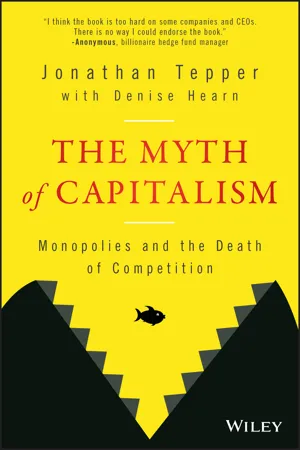
The Myth of Capitalism tells the story of how America has gone from an open, competitive marketplace to an economy where a few very powerful companies dominate key industries that affect our daily lives. Digital monopolies like Google, Facebook and Amazon act as gatekeepers to the digital world. Amazon is capturing almost all online shopping dollars. We have the illusion of choice, but for most critical decisions, we have only one or two companies, when it comes to high speed Internet, health insurance, medical care, mortgage title insurance, social networks, Internet searches, or even consumer goods like toothpaste. Every day, the average American transfers a little of their pay check to monopolists and oligopolists. The solution is vigorous anti-trust enforcement to return America to a period where competition created higher economic growth, more jobs, higher wages and a level playing field for all. The Myth of Capitalism is the story of industrial concentration, but it matters to everyone, because the stakes could not be higher. It tackles the big questions of: why is the US becoming a more unequal society, why is economic growth anemic despite trillions of dollars of federal debt and money printing, why the number of start-ups has declined, and why are workers losing out.
eBook - ePub
The Myth of Capitalism
Monopolies and the Death of Competition
- English
- ePUB (mobile friendly)
- Available on iOS & Android
eBook - ePub
Chapter One
Where Buffett and Silicon Valley Billionaires Agree
There's class warfare, all right, but it's my class, the rich class, that's making war, and we're winning.—Warren Buffett
Warren Buffett is an icon for Americans and capitalists everywhere. For decades, his annual letters have taught and educated Americans about the virtues of investing. In many ways, Buffett has become the embodiment of American capitalism. He's called the annual meetings of his investment firm Berkshire Hathaway a “Celebration of Capitalism” and has referred to his hometown of Omaha as the “cradle of capitalism.”1 Yet Buffett is the antithesis of capitalism.
He has become a folk hero because of his simplicity. Even as he became America's second wealthiest man, he has lived in the same home and avoided a lavish lifestyle. He makes billions not because of dirty greed but because he loves working. Books about him, such as Tap Dancing to Work, capture his jaunty ebullience.
As a person he is remarkably consistent. His daily eating includes chocolate chip ice cream at breakfast, five Coca-Colas throughout the day, and lots of potato chips. His investing is as consistent as his eating. For decades, he has recommended buying businesses with strong “moats” and little competition.
The results have shown how right he is. Warren Buffett gained control of Berkshire for around $32 per share when it was a fading textile company, and turned it into a conglomerate that owns businesses with little competition. The stock is now worth about $300,000 per share, making the entire company worth more than $495 billion.
For decades, Americans have learned from Buffett that competition is bad and to avoid companies that require any investment or capital expenditures. American managers have absorbed his principles.
Buffett loves monopolies and hates competition. Buffett has said at his investment meetings that, “The nature of capitalism is that if you've got a good business, someone is always wanting to take it away from you and improve on it.” And in his annual reports, he has approvingly quoted Peter Lynch, “Competition may prove hazardous to human wealth.”2 And how true that is. What is good for the monopolist is not good for capitalism. Buffett and his business partner Charlie Munger always tried to buy companies that have monopoly-like status. Once, when asked at an annual meeting what his ideal business was, he argued it was one that had “High pricing power, a monopoly.”3 The message is clear: if you're investing in a business with competition, you're doing it wrong.
Unsurprisingly, his initial business purchases were newspapers in towns with no competition. According to Sandy Gottesman, a friend of Buffett, “Warren likens owning a monopoly or market-dominant newspaper to owning an unregulated toll bridge. You have relative freedom to increase rates when and as much as you want.”4 Back in the days before the Internet, people got their news from their local paper. Buffett understood that even a fool could make money with a monopoly, “If you've got a good enough business, if you have a monopoly newspaper… you know, your idiot nephew could run it.”5 With that line of reasoning, in 1977 Buffett purchased the Buffalo Evening News. He bought this newspaper and then launched a Sunday edition to drive his competitor, the Buffalo Courier-Express, out of business. By 1986, the renamed Buffalo News was a local monopoly.6
In many ways, Warren Buffett is like Steph Curry of the Golden State Warriors. Curry is the master of the three-point shot. But if you look more closely at his record, you'll see that he mainly shoots uncontested three-point shots. He'll regularly stand several feet behind the three-point line. At first, defenders didn't even defend. Who would shoot from that far away? At one point in 2016, he made 35 out of 52 shots from between 28 and 50 feet. Scoring is a lot easier without competition.7
Over the years, Buffett followed his philosophy of buying into industries with little competition. If he can't buy a monopoly, he'll buy a duopoly. And if he can't buy a duopoly, he'll settle for an oligopoly.
His record speaks for itself. Buffett was one of the biggest shareholders in Moody's Corporation, a ratings agency that shares an effective duopoly with Standard & Poor's. (You might remember they rated the toxic subprime junk bonds that blew up the economy as AAA gold). He and his lieutenants bought shares in DaVita, which has a price gouging duopoly in the kidney dialysis business. (They have paid hundreds of millions to resolve allegations of illegal kickbacks.) He's owned shares in Visa and MasterCard, which are a duopoly in credit card payments. He also owns Wells Fargo and Bank of America, which dominate banking in many states. (Wells Fargo recently created millions of fraudulent savings and checking accounts in order to charge more fees to depositors.) In 2010, he fully acquired railroad Burlington Northern Santa Fe, which is a local monopoly at this stage. He has owned Republic Services Group, a company that bought its largest competitor, to have a duopoly in waste management. He has owned UPS, which has a duopoly with FedEx in domestic shipping. He bought all four major airline stocks after they merged and turned into an oligopoly. Lately he's been buying utility companies that are local monopolies.
We could go on listing Buffett's investments, but you're probably noticing a pattern here. He really doesn't like competition. By all accounts, he's a fine human being, but he's a monopolist at heart.
Buffett has found his soul mates with 3G Capital Partners, a Brazilian investment firm that controls 50% of the US beer market. The US beer sector has now become a duopoly. Now they're trying to dominate the packaged food sector. In 2013 Buffett partnered with 3G to buy the H.J. Heinz Company, which two years later he merged with Kraft Foods to become Kraft Heinz. This gave them complete dominance in many areas of the supermarket shelf like ketchup. They tried to buy Unilever in 2017, which would have given them even more ownership of dominant brands, but Unilever turned them down. Alas, Kraft Heinz Unilever was not meant to be.
If Warren Buffett is the embodiment of American capitalism, then billionaire Peter Thiel is Silicon Valley's Godfather.8 They could not be more different. Where Buffett is folksy and simple, Thiel is distant and philosophical. Buffett quotes the actress Mae West, while Thiel quotes French intellectuals like Jean-Jacques Servan-Schreiber. Buffett is a dyed-in-the-wool Democrat, and Thiel is a libertarian who has procured a New Zealand passport so he can flee when the peasants with pitchforks come for Silicon Valley monopolies.
Buffett and Thiel have nothing in common, but they can both agree on one thing: competition is for losers.
Thiel founded PayPal and has funded a legendary roster of businesses like LinkedIn and Facebook, which now has a monopoly on the key social networks and has a duopoly with Google on online advertising. He dislikes competition and redefines capitalism by turning it on its head, “Americans mythologize competition and credit it with saving us from socialist bread lines. Actually, capitalism and competition are opposites.” In Thiel's view, without fat profits, you can't fund innovation and improve. Thiel supported the Trump campaign, presumably because if you're running a monopoly it is good to know your potential regulator. He wrote an entire book, titled Zero to One, praising creating businesses that are monopolies and defiantly declared that competition “is a relic of history.”9
Competition is a dirty word, whether you're in Omaha or Silicon Valley.
Praising monopolies has a long tradition in the United States. Joseph Schumpeter, an Austrian-born economics professor at Harvard, is generally remembered for coining the phrase “gale of creative destruction,” in praise of competition. It is ironic that economists and consultants see him today as the champion of disruptive startups, when in Schumpeter's view, if you wanted to search for progress, it would lead you to the doors of monopolies. Much like Peter Thiel, Schumpeter thought that perfectly competitive firms were inferior in technological efficiency and were a waste. Monopolies were more robust because, “a perfectly competitive industry is much more apt to be routed—and to scatter the bacilli of depression—under the impact of progress or of external disturbance than is big business.”10
Buffett and Thiel love monopolies, because when you're a monopolist, you become what economists call a “price maker.” That means you can set the price of your goods near the highest amount that consumers would be willing to pay for them, unlike in more competitive industries, where competition encourages innovation and drives down prices. Typically, monopolists raise prices and restrict the supply of goods.
The problem of raising prices and restricting supply is not a distant, theoretical issue. For example, cable companies in the United States possess a local monopoly and have been using their market power to overcharge the typical household about $540 per year, according to the nonprofit Consumer Federation of America.11 Not only are prices high, but cable companies also have long history of throttling sites and content they don't like to restrict use of the internet.12 Comcast has throttled peer-to-peer services like Bitorrent under the guise of managing bandwidth.13
Buffett and Thiel's thinking has not gone unnoticed. Investment banks like Goldman Sachs (also known as...
Table of contents
- Cover
- Table of Contents
- Introduction
- Chapter One: Where Buffett and Silicon Valley Billionaires Agree
- Chapter Two: Dividing Up the Turf
- Chapter Three: What Monopolies and King Kong Have in Common
- Chapter Four: Squeezing the Worker
- Chapter Five: Silicon Valley Throws Some Shade
- Chapter Six: Toll Roads and Robber Barons
- Chapter Seven: What Trusts and Nazis Had in Common
- Chapter Eight: Regulation and Chemotherapy
- Chapter Nine: Morganizing America
- Chapter Ten: The Missing Piece of the Puzzle
- Conclusion: Economic and Political Freedom
- Notes
- Acknowledgments
- About the Authors
- Index
- End User License Agreement
Trusted by 375,005 students
Access to over 1.5 million titles for a fair monthly price.
Study more efficiently using our study tools.
Frequently asked questions
Yes, you can cancel anytime from the Subscription tab in your account settings on the Perlego website. Your subscription will stay active until the end of your current billing period. Learn how to cancel your subscription
No, books cannot be downloaded as external files, such as PDFs, for use outside of Perlego. However, you can download books within the Perlego app for offline reading on mobile or tablet. Learn how to download books offline
Perlego offers two plans: Essential and Complete
- Essential is ideal for learners and professionals who enjoy exploring a wide range of subjects. Access the Essential Library with 800,000+ trusted titles and best-sellers across business, personal growth, and the humanities. Includes unlimited reading time and Standard Read Aloud voice.
- Complete: Perfect for advanced learners and researchers needing full, unrestricted access. Unlock 1.5M+ books across hundreds of subjects, including academic and specialized titles. The Complete Plan also includes advanced features like Premium Read Aloud and Research Assistant.
We are an online textbook subscription service, where you can get access to an entire online library for less than the price of a single book per month. With over 1.5 million books across 990+ topics, we’ve got you covered! Learn about our mission
Look out for the read-aloud symbol on your next book to see if you can listen to it. The read-aloud tool reads text aloud for you, highlighting the text as it is being read. You can pause it, speed it up and slow it down. Learn more about Read Aloud
Yes! You can use the Perlego app on both iOS and Android devices to read anytime, anywhere — even offline. Perfect for commutes or when you’re on the go.
Please note we cannot support devices running on iOS 13 and Android 7 or earlier. Learn more about using the app
Please note we cannot support devices running on iOS 13 and Android 7 or earlier. Learn more about using the app
Yes, you can access The Myth of Capitalism by Jonathan Tepper,Denise Hearn in PDF and/or ePUB format, as well as other popular books in Economics & Economic Theory. We have over 1.5 million books available in our catalogue for you to explore.