- 432 pages
- English
- ePUB (mobile friendly)
- Available on iOS & Android
eBook - ePub
About this book
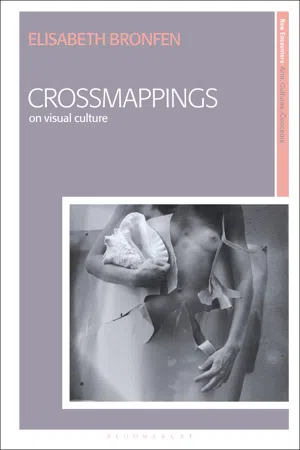
The great, influential cultural critic, Elisabeth Bronfen, sets out in this book a conversation between literature, cinema and visual culture. The crossmappings facilitated in and between these essays address the cultural survival of image formulas involving portraiture and the uncanny relation between the body and its visual representability, the gendering of war, death and the fragility of life, as well as sovereignty and political power. Each chapter tracks transformations that occur as aesthetic figurations travel from one historical moment to another, but also from one medium to another. Many prominent artists are discussed during these journeys into the cultural imaginary, include Degas, Francesca Woodman, Cindy Sherman, Paul McCarthy, Eva Hesse, Louise Bourgeois, Wagner, Picasso, and Shakespeare, as well as classic Hollywood's film noir and melodrama and the TV series, The Wire and House of Cards.
Information
PART I
TRAVELLING IMAGE FORMULAS
1
FACING DEFACEMENT
Degas’ Portraits of Women
In his memoirs of the artist, the painter Georges Jeanniot quotes Edgar Degas as saying:
It is all very well to copy what you see, but it is much better to draw only what you still see in your memory. This is a transformation in which imagination collaborates with memory. Then you only reproduce what has struck you, that is to say the essential, and so your memories and your fantasy are freed from the tyranny which nature holds over them.1
Even though this gesture of privileging the belated recreation over the actual event is not specific to Degas’ portraiture of women, the transformation at stake contains a particular resonance when the tyranny of nature to be outwitted refers to the face of another human being. For the portrait, intended first and foremost to represent a particular woman in her specific context, comes in the process to depict its very opposite as well – the effacement of the model as she is turned into a figure, signifying something other than herself.
This ambivalence is, of course, written into the very definition of portraiture. In its simplest terms, a portrait is a painting of an individual meant to intensify an aspect of something seen by the artist. It is the result of a sympathetic visual response to another human being. But given that the artist must always make choices in respect to gesture, pose and setting, the question that any viewing of a portrait immediately raises is whether it is merely the imitation of a particular model or whether it does not also signify the painter himself. Indeed, the Latin etymology – protrahere – suggests that the act of picturing is not just one of drawing or painting a figure upon a surface so as to represent a human face by mirroring reality. Rather, the act of copying from life is one that reveals by drawing forth, by bringing to light, by extending something seen in the sitter’s appearance, by prolonging a physiognomic detail, a gesture, a pose. The act of producing a simulacrum of any given human face with a body – whether this be an exact or an idealized likeness – entails a rendition of the visible and a reproduction of the invisible. Thus Hegel can argue in his Aesthetics that ‘a portrait must be an expression of individual and spiritual character. This nobler element in a man, which the artist introduces into the portrait, is not ordinarily obvious in a man’s features.’2 As the portrait painter draws out something from the appearance of the sitter, he also introduces something by virtue of his vision that is not seen by the ordinary eye. The portrayer is not a mere copier but rather part of the transformational process. The individual psychology of the portrayed can emerge only because the painter has brought it out in his impression of the uniqueness of this personality.
In his portrait of Elena Primicile Carafa di Montejasi Cicerale (1875), for example, Edgar Degas captures a moment of intimacy, as his cousin, comfortably seated in a flowered armchair, looks up from her reading. Rather than maintaining a distance from the sitter, he stages a scene of proximity and familiarity. The particular impression he chooses to draw forth is above all one of a marked discrepancy between the relaxed and self-assuredly poised body on the one hand and an enigmatic facial tension on the other. The pouting mouth, the rigid tilting of the head, the sharply questioning, weary and annoyed gaze all indicate her irritation. Yet her expression remains equivocal. Is hers an irritation at having been interrupted in her reading, a general discomfort with her bourgeois life or a statement about being portrayed? Privileging what he considered to be an essential expressive quality in the physiognomy of his cousin over any verisimilitude, Degas allows a haughty, withholding and at the same time challenging feminine figure to emerge on his canvas, who can be read either as a particular woman, or as a representative of a given class, or indeed as an example for the situation of the model in general.
One could say that Edgar Degas characterizes her as a woman well aware of her privileged position in a socially powerful family. At the same time, the portrait could also be read as depicting the artist’s anxiety about his model’s resistance to his portraying her. The X-ray of this painting corroborates the more oblique interpretation that, in addition to a personality or status study, the woman’s image comes to signify the artist as well. It shows that initially her face was turned to the left, away from Degas, with her eyes looking at some unidentified object outside the pictorial frame.3 The decision to have his cousin look directly at him was apparently a belated choice. If, as Degas concentrated on what he could still see after the actual portrait-session, memory mixed with imagination induced him to turn her head to confront both his and the spectator’s gaze, then that may explain the startling quality of her facial expression. The disempowering look she casts upon him – and implicitly us – is in fact also a sign of his empowerment. For this glance that seemingly challenges our visual appropriation of her appearance is precisely a look he invented in elaboration of his impression of her, over and against the tyranny nature posed to his remembrance and his fancy. At the same time, Degas breaks the convention that the viewer be, in Griselda Pollock’s words, ‘both absent from and indeed independent of the scene while being its mastering eye/I’.4 Countering the conventional mastery of the artist’s gaze over his passive object – the model – he stages an interchange of a parity of gazes.
The act of portraying, then, conjoins disparate gestures. A portrait is the pictorial copy of a particular human face and body within a specific historical and geographical context, with similitude linking the model and the image. In a transitive sense, however, to portray also means to adorn a surface with a picture or a figure, so that the emphasis is on the artistic medium rather than on the reality of the rendered person. Finally, in the figurative sense, a portrait also entails the act of forming a mental image of something that represents or typifies something else by virtue of resemblance to the depicted figure. Thus, while the portrait implies a binding relation to a particular referent, it also implies its very opposite, namely the artist’s freedom from any naturally given context. To return to Edgar Degas’ desire to liberate himself from the tyranny nature has over memory and fancy, to portray someone also means to picture to oneself, to conceive or fashion. Ultimately, to portray means to invent in reference to, but also surpassing, a given empirical body. Furthermore, once portraiture has become as explicitly subjective and impressionistic as Degas’ representations of women have, it inadvertently enmeshes three aspects that need to be explored in greater detail – the model’s desire to have herself portrayed as a sign of social status, the traditional fear of having one’s image taken as a sign of disempowerment, and the prominence with which the artist’s signature came to be endowed by the late nineteenth century, as portraiture turned into self-portraiture.
Dialectic of displacement
Traditionally, portraits were always meant as visual embodiments of power, commissioned and financed by patrons so as to assert inherited or achieved positions of authority. The social status of the model was usually as important – if not more so – than any personal appearance, and the sitters were often cast in roles, while a formal distance was maintained to the staged scene. Given that most conventional portraits represented someone who in turn was representative of a particular privileged class and its interests, the face and body depicted readily transformed into a figure for the social values he or she stood for, be this wealth, culture or, as in the case of some women, beauty, and social graces. As Gordon and Forge argue, ‘a portrait was both a likeness and a social statement. The particular and the general supported and authenticated each other’,5 the individual always also representative of a type, the likeness always also signifying a social station.
Although Edgar Degas painted comparatively few commissioned portraits, choosing primarily to render himself or his family, his relatives and his friends, the depersonalizing shift from face to figure can, nevertheless, be found in his portraits insofar as his sitters often disappear behind their role as model. It is significant that many of the names of the female models have not been recorded. With labels such as Portrait of a Woman, Young Woman, Woman in Black, their portraits merely attest their anonymity. Obliterating to a degree the precise historical reference, Degas transforms his models into types, reproducing not only the physiognomy of a particular character, but also placing the portrayed within the milieu for which each is typical – be this a particular métier, a specific geographical area or a prominent social group.6 The refigured women function as representatives of the contemporary mode, placed within spaces at times intimate and domestic, at times public, yet always defined by the urban bourgeois culture surrounding them.
Like his contemporaries, Edgar Degas no longer took for granted that outward appearances mirror the inner truth of a person, believing that an objective rendition of another human being was in fact not possible. Rather, he explicitly chose to disturb any easy correspondence between physiognomy and essential being by using imprecise lines as well as a mixture of clarity and obscurity to signify his subjective vision imposed on the portrayed. One part of the body or the face will often be imperfectly drawn, smudged over or even entirely obliterated while another part will appear in exquisite, minutely descriptive detail. Nevertheless, Degas believed that a person’s appearance does signify, albeit as an equivocal expression of contemporaneity. In one of his studio notebooks, he dictated to himself, ‘make the expressive heads [academic style] a study of modern feeling – it is Lavater, but a more relativistic Lavater, so to speak, with symbols of today rather than the past’.7
The contradiction at stake is, then, that while many of his portrayed women seem to pose as typical figures for what is specific about the late nineteenth-century individual, they are in fact removed from their concrete historical context and relocated as actresses in a multifarious spectacle of urban modernity, with Degas as director. The woman standing behind a bench in what could be a private garden or a public park, a reddish-brown oval hat squarely placed on her head, a blue-green shawl lightly draped beneath her shoulders to offer some warmth, sturdy bootlets on her feet, possibly meant to indicate a robust walking nature, her gaze alertly fixing some unseen object, remains unidentified except as a representative of English culture enjoying the freedom of mobility that the modern city offers her (L’Anglaise, c. 1880). The woman in a rust-coloured dress with white collar, a bit of a hand visible as she clasps herself across her chest while bending over one side of her sofa, listlessly staring into the space before her as though in a trance or in agony, is simply a figure for melancholia (La mélancolie (Melancholy), c. 1867–70), representative of the fatigue, weariness, dislocation and isolation that, too, is characteristic of the modern city. Even when the models are known, such as his aunt, the Duchess of Montejasi Cicerale, the specific details of their individual character come together in such a manner that they could also be perceived as a composite type. Regally posed on her red-cushioned sofa, her arms tightly crossed over her black gown to indicate poise but also containment, her face expressing dignity, authority, resignation and benevolence all in one, with the oil lamp placed almost ironically behind and partially above her head like a source of crowning light, Degas’ aunt comes to signify a stately figure representative of the privileges, leisure and constraints of an entire age and class (Duchessa di Montejasi Cicerale, 1868).
The dialectic of displacement at work in such transformations, however, cuts both ways. For even as family members or friends are drawn into typified scenes, with their faces, the comportment of their bodies, their characteristic gestures turned into tropes for contemporaneity, these stagings nevertheless also illuminate their individual characters. Degas is thus one of the first to explore the belief so prevalent in modernity that a subject emerges precisely as the result of the multiple roles she or he performs. For he turns to portraiture as an epistemological tool because it allows him to straddle fiction and realistic rendition, as though to illustrate that we need to turn a familiar person into a figure in a narrative in order to discover her essential being.
In that sense, Charles Baudelaire’s distinction between a historical and a novelistic understanding of portraiture is apt. While members of the former school of thought, as archivists of what they see, render the model as truthfully, severely and minutely as possible by focusing on her most characteristic physiognomic attitude and spiritual or psychic comportment, the followers of the latter understanding, as storyteller, add an allegorical dimension by turning the portrait into a tableau, a poem filled with fanciful accessories, the product of imagination rather than reproduction. Baudelaire’s conclusion – that ‘a good portrait always appears like a dramatic biography, or rather like the natural drama inherent to every man’8 – actually only confirms that the portrait invariably calls forth an oscillation between verisimilitude and imagination. However, allowing the reference to a specific historical woman to be obliterated by the role or type she is meant to play in one of many scenes dramatizing both modern life in general and the artist’s subjective vision in particular not only points up the uneasy alliance between the appearance of a woman and her essential being. Further, it articulates the fact that power resides with the one who can negotiate the boundary between model and image, between reference and figure, between visibility and obscurity.
Gendering the scene of portraiture
European folklore has always believed the portrait to be a double of the portrayed, with the body or part of it translated into the picture that represents it. The portrait has thus always served as a pictorial site where the boundary between a vital representation and the vital presence of the portrayed becomes blurred. To picture the human face was, therefore, not only seen as a sign of social authority. Functioning rather as the diametrical opposite of the traditional representational portrait, the likeness of the human face came also to be seen as an embodiment of demonic or magic powers that ...
Table of contents
- Cover
- Title Page
- Contents
- List of Illustrations
- Series Preface
- Foreword: Introducing Elisabeth Bronfen
- Introduction: Crossmappings – Visual Readings as a Critical Intervention in the Cultural Imaginary
- Part I: Travelling Image Formulas
- Part II: Gendering the Uncanny, Imaging Death
- Notes
- Index
- eCopyright
Trusted by 375,005 students
Access to over 1.5 million titles for a fair monthly price.
Study more efficiently using our study tools.
Frequently asked questions
Yes, you can cancel anytime from the Subscription tab in your account settings on the Perlego website. Your subscription will stay active until the end of your current billing period. Learn how to cancel your subscription
No, books cannot be downloaded as external files, such as PDFs, for use outside of Perlego. However, you can download books within the Perlego app for offline reading on mobile or tablet. Learn how to download books offline
Perlego offers two plans: Essential and Complete
- Essential is ideal for learners and professionals who enjoy exploring a wide range of subjects. Access the Essential Library with 800,000+ trusted titles and best-sellers across business, personal growth, and the humanities. Includes unlimited reading time and Standard Read Aloud voice.
- Complete: Perfect for advanced learners and researchers needing full, unrestricted access. Unlock 1.5M+ books across hundreds of subjects, including academic and specialized titles. The Complete Plan also includes advanced features like Premium Read Aloud and Research Assistant.
We are an online textbook subscription service, where you can get access to an entire online library for less than the price of a single book per month. With over 1.5 million books across 990+ topics, we’ve got you covered! Learn about our mission
Look out for the read-aloud symbol on your next book to see if you can listen to it. The read-aloud tool reads text aloud for you, highlighting the text as it is being read. You can pause it, speed it up and slow it down. Learn more about Read Aloud
Yes! You can use the Perlego app on both iOS and Android devices to read anytime, anywhere — even offline. Perfect for commutes or when you’re on the go.
Please note we cannot support devices running on iOS 13 and Android 7 or earlier. Learn more about using the app
Please note we cannot support devices running on iOS 13 and Android 7 or earlier. Learn more about using the app
Yes, you can access Crossmappings by Elisabeth Bronfen in PDF and/or ePUB format, as well as other popular books in Art & Art Theory & Criticism. We have over 1.5 million books available in our catalogue for you to explore.