The must-read summary of Bertrand Cesvet, Tony Babinski and Eric Alper's book: "Conversational Capital: How to Create Stuff People Love to Talk About".
This complete summary of the ideas from Bertrand Cesvet, Tony Babinski and Eric Alper's book "Conversational Capital" shows the importance of injecting intensity into ordinary products and services to turn them into experiences that consumers love and will rave about to others. In their book, the authors explain the benefits of using this method to gain customers in today's modern media market. By reading this summary, you will learn why conversational capital is the most important thing you will ever learn and the endless benefits it will have for your company.
Added-value of this summary:
• Save time
• Understand key concepts
• Expand your business knowledge
To learn more, read "Conversational Capital" and learn the secrets to reaching customers and getting your brand out there.

eBook - ePub
Summary: Conversational Capital
Review and Analysis of Cesvet, Babinsky and Alper's Book
- English
- ePUB (mobile friendly)
- Available on iOS & Android
eBook - ePub
Summary: Conversational Capital
Review and Analysis of Cesvet, Babinsky and Alper's Book
About this book
Information
Subtopic
AdvertisingIndex
BusinessSummary of Conversational Capital (Bertrand Cesvet, Tony Babinski and Eric Alper)
1. Defining conversational capital
Conversational capital has been happening for years, but very few people have ever paused to identify it, name it or even clearly articulate its benefits. In essence, conversational capital is created whenever firms provide customers with outstanding and meaningful experiences which help those customers do what they want to do. In return those customers talk positively about their experiences to others.
Conversational capital is created whenever customers are willing to talk about what they have purchased with their friends, families and coworkers. Consumers are generally only willing to do this:
- If they are pleased and/or delighted with what they’ve purchased because it resonates strongly with their personal values at some level.
- If their purchase strengthens their personal identity and somehow reflects their personal preferences.
Conversational capital works and is relevant to the modern world for five main reasons:
- Consumers today are faced with more choices than ever before for almost all kinds of products. It’s easy to get confused when faced with so many choices.
- Almost everyone have time constraints. Consumers are therefore becoming more sophisticated and discriminating.
- As people become more sophisticated, they tend to turn to products and services which deliver a rich and coherent customer experience more and more.
- It is these rich experiences which get talked about the most. Many customers relate well to hearing about the experiences of others and are anxious to take advantage of the inside secrets others have learned in various ways.
- As more of the engines of conversational capital get incorporated into better designed products and services, customers are enjoying increased meaning and cohesion in what they buy.
Note conversational capital is different from buzz:
- Buzz is manufactured and needs media coverage to spread. Conversational capital is embedded in the experience itself and relies solely on peer-to-peer endorsements.
- Buzz is high impact but usually has a short lifespan – people move on to the next big thing. Conversational capital has an enduring place in the minds of consumers.
- Buzz is all about making noise and getting attention. Conversational capital is about doing something so well it has complete integrity and meaning.
Conversational capital is also quite different and distinct from the idea of becoming a customer advocate. In practice, conversational capital raises the stakes of customer advocacy even higher than before. Conversational capital creates true converts to a company, product or service and not just advocates. Conversational capital is created whenever the customer experience becomes an integral component of the customer’s lifestyle. That level of significance is quite profound and is certainly more resonant than advocacy has ever been.
There are eight “engines” or “drivers” of conversational capital:
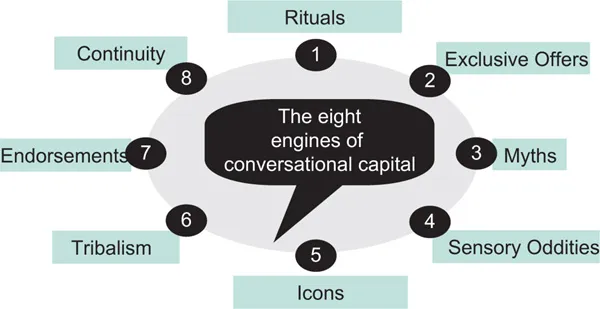
- Rituals – highly structured events which create and formalize some kind of meaning for the participants.
- Exclusive products offerings – where customers can mix and match until they come up with a combination of products and services which meets their needs. When companies over deliver and exceed customer expectations, this can make the customer experience unique and memorable.
- Myths – narratives which come to be accepted as part of the experience. Myths provide important clues about what an experience should mean.
- Sensory oddities – specific items which challenge the senses in memorable and noteworthy ways. When the human senses are presented with something extraordinary, a far-reaching experience can occur.
- Icons – signs and symbols which differentiate the customer experience. Icons come in all kinds of shapes and sizes from Coke’s distinctive bottle right through to the three trademark stripes on adidas shoes.
- Tribalism – customers gathering into user groups dictated by the items purchased and used. Tribes and groups allow like-minded individuals to swap ideas and interact.
- Endorsements – when someone credible speaks for a product or service and its relevance.
- Continuity – your reputation which will be the combined result of three different factors:
 The closer these three factors are to each other – or in other words, the smaller this triangle is – t...
Table of contents
- Cover
- Book Presentation: Conversational Capital by Bertrand Cesvet, Tony Babinski and Eric Alper
Trusted by 375,005 students
Access to over 1.5 million titles for a fair monthly price.
Study more efficiently using our study tools.
Frequently asked questions
Yes, you can cancel anytime from the Subscription tab in your account settings on the Perlego website. Your subscription will stay active until the end of your current billing period. Learn how to cancel your subscription
No, books cannot be downloaded as external files, such as PDFs, for use outside of Perlego. However, you can download books within the Perlego app for offline reading on mobile or tablet. Learn how to download books offline
Perlego offers two plans: Essential and Complete
- Essential is ideal for learners and professionals who enjoy exploring a wide range of subjects. Access the Essential Library with 800,000+ trusted titles and best-sellers across business, personal growth, and the humanities. Includes unlimited reading time and Standard Read Aloud voice.
- Complete: Perfect for advanced learners and researchers needing full, unrestricted access. Unlock 1.5M+ books across hundreds of subjects, including academic and specialized titles. The Complete Plan also includes advanced features like Premium Read Aloud and Research Assistant.
We are an online textbook subscription service, where you can get access to an entire online library for less than the price of a single book per month. With over 1.5 million books across 990+ topics, we’ve got you covered! Learn about our mission
Look out for the read-aloud symbol on your next book to see if you can listen to it. The read-aloud tool reads text aloud for you, highlighting the text as it is being read. You can pause it, speed it up and slow it down. Learn more about Read Aloud
Yes! You can use the Perlego app on both iOS and Android devices to read anytime, anywhere — even offline. Perfect for commutes or when you’re on the go.
Please note we cannot support devices running on iOS 13 and Android 7 or earlier. Learn more about using the app
Please note we cannot support devices running on iOS 13 and Android 7 or earlier. Learn more about using the app
Yes, you can access Summary: Conversational Capital by BusinessNews Publishing in PDF and/or ePUB format, as well as other popular books in Business & Advertising. We have over 1.5 million books available in our catalogue for you to explore.