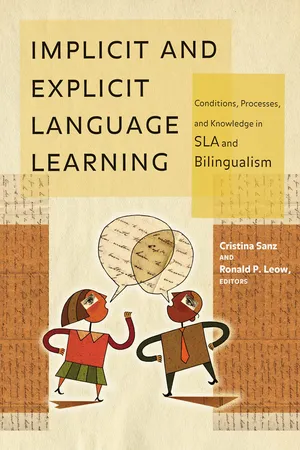
Implicit and Explicit Language Learning
Conditions, Processes, and Knowledge in SLA and Bilingualism
- 242 pages
- English
- PDF
- Available on iOS & Android
Implicit and Explicit Language Learning
Conditions, Processes, and Knowledge in SLA and Bilingualism
About this book
Over the last several decades, neuroscientists, cognitive psychologists, and psycholinguists have investigated the implicit and explicit continuum in language development and use from theoretical, empirical, and methodological perspectives. This book addresses these perspectives in an effort to build connections among them and to draw pedagogical implications when possible.
The volume includes an examination of the psychological and neurological processes of implicit and explicit learning, what aspects of language learning can be affected by explicit learning, and the effects of bilingualism on the mental processing of language. Rigorous empirical research investigations probe specific aspects of acquiring morphosyntax and phonology, including early input, production, feedback, age, and study abroad. A final section explores the rich insights provided into language processing by bilingualism, including such major areas as aging, third language acquisition, and language separation.
Frequently asked questions
- Essential is ideal for learners and professionals who enjoy exploring a wide range of subjects. Access the Essential Library with 800,000+ trusted titles and best-sellers across business, personal growth, and the humanities. Includes unlimited reading time and Standard Read Aloud voice.
- Complete: Perfect for advanced learners and researchers needing full, unrestricted access. Unlock 1.4M+ books across hundreds of subjects, including academic and specialized titles. The Complete Plan also includes advanced features like Premium Read Aloud and Research Assistant.
Please note we cannot support devices running on iOS 13 and Android 7 or earlier. Learn more about using the app.
Information
Table of contents
- Cover
- Contents
- List of Illustrations
- Acknowledgments
- 1. Introduction
- PART I: THEORY
- PART II: METHODOLOGICAL ISSUES AND EMPIRICAL RESEARCH ON AWARENESS, PEDAGOGICAL CONTEXTS, AND INDIVIDUAL DIFFERENCES IN SLA
- PART III: EMPIRICAL RESEARCH ON L2 PHONOLOGY
- PART IV: EMPIRICAL STUDIES ON KEY ISSUES IN BILINGUALISM: AGING, THIRD LANGUAGE ACQUISITION, AND LANGUAGE SEPARATION