"A forceful, encyclopedic study."—Michael Eric Dyson, New York Times
A history of how political philosophy was recast by the rise of postwar liberalism and irrevocably changed by John Rawls's A Theory of Justice
In the Shadow of Justice tells the story of how liberal political philosophy was transformed in the second half of the twentieth century under the influence of John Rawls. In this first-ever history of contemporary liberal theory, Katrina Forrester shows how liberal egalitarianism—a set of ideas about justice, equality, obligation, and the state—became dominant, and traces its emergence from the political and ideological context of the postwar United States and Britain.
In the aftermath of the civil rights movement and the Vietnam War, Rawls's A Theory of Justice made a particular kind of liberalism essential to political philosophy. Using archival sources, Forrester explores the ascent and legacy of this form of liberalism by examining its origins in midcentury debates among American antistatists and British egalitarians. She traces the roots of contemporary theories of justice and inequality, civil disobedience, just war, global and intergenerational justice, and population ethics in the 1960s and '70s and beyond. In these years, political philosophers extended, developed, and reshaped this liberalism as they responded to challenges and alternatives on the left and right—from the New International Economic Order to the rise of the New Right. These thinkers remade political philosophy in ways that influenced not only their own trajectory but also that of their critics.
Recasting the history of late twentieth-century political thought and providing novel interpretations and fresh perspectives on major political philosophers, In the Shadow of Justice offers a rigorous look at liberalism's ambitions and limits.
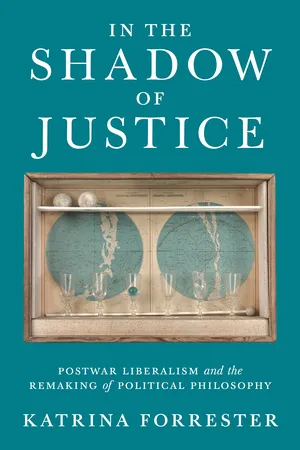
eBook - ePub
In the Shadow of Justice
Postwar Liberalism and the Remaking of Political Philosophy
- 424 pages
- English
- ePUB (mobile friendly)
- Available on iOS & Android
eBook - ePub
In the Shadow of Justice
Postwar Liberalism and the Remaking of Political Philosophy
About this book
Information
Publisher
Princeton University PressYear
2019Print ISBN
9780691216751
9780691163086
eBook ISBN
9780691189420
Topic
PhilosophySubtopic
Political Philosophy1
The Making of Justice
WHEN JOHN RAWLS published A Theory of Justice in 1971, it made him the most famous political philosopher in the English-speaking world. Enormously detailed and painstakingly executed, it was, Rawls wrote, “a long book, not only in pages.”1 Across six hundred pages and three parts, he worked out his vision of a just and “well-ordered society” regulated by the conception of justice he called “justice as fairness.”
The book was understood as a revival of the liberal social contract tradition, in part because of its most famous and evocative idea, the “original position.” There, “persons” meet behind a “veil of ignorance” that blinds them to their social characteristics—the things they have acquired because of social contingency and natural accident. Once behind the veil, they agree how a just society would be structured without letting these contingent facts get in the way of their choices. Rawls said they would choose two principles of justice as a set of standards for judging the justice of a society. The first was a principle of liberty, which affirmed citizens’ basic rights and liberties. The second was a principle of equality. It included the “difference principle,” which arranged social and economic inequalities so that they worked to the benefit of the least-advantaged members of society and stipulated that offices and positions must be open to all under conditions of “fair equality of opportunity.” Society was conceived as a “cooperative venture for mutual advantage.” One benefited more from being in it than outside it. The principles were there to make sure the advantages of membership were divided up in a fair and just way. They ensured that the things people had were not theirs because of luck, and that rewards for the efforts of individuals did not get in the way of social stability.
The second of five sons, two of whom died in childhood of diseases they contracted from him, Rawls knew a thing or two about luck.2 He spent a lifetime working away relentlessly at a single theory that made him the most celebrated political philosopher of his generation, so he knew something about effort and reward too. After A Theory of Justice was published, Rawls’s ideas would be pulled in different philosophical and political directions. But he began to work on them long before, in a moment just after the Second World War when the contours of liberalism were being reconfigured.
It is often said that in the dry, dusty scene of midcentury analytical ethics, philosophers cared more about whether to cross the lawn of an Oxford college than politics. Yet when a young Rawls returned home from three years of service in the Pacific Theater to begin his graduate studies at Princeton in the spring of 1946, politics was inescapable.3 Rawls soon set about constructing a “social philosophy” to make sense of the era of total war and the world it created. Over the course of the 1940s and 1950s, the young Rawls would search widely across the human sciences for the conceptual tools to do so. A philosopher by training and by temperament, Rawls was also an intellectual magpie. Writing in the mid-1950s, he conceived of his aims as threefold. First, social philosophy, like sociology, economics, history, political theory, and jurisprudence, aimed to provide a “conception of society and the human person involving acceptance of certain general facts as true about society.” Second, like the rest of philosophy, it described a system of evaluative principles, in this case ethical ones. Third, it offered a vision, a “total picture of man and society,” Rawls wrote, borrowing from Joseph Schumpeter, that tied the whole together and made it “come alive for us.”4 Rawls’s search for these three pillars began within the ideological context of postwar liberalism.
By the time Rawls elaborated his mature system, it was so complex and introduced so many novel concepts that it was hard to see its original motivations. He began his philosophical career at a moment in the late 1940s when liberals were increasingly concerned with a defense of the freedom of individuals and a critique of the institution that, paradoxically, would be submerged in Rawls’s mature theory: the administrative state. In the aftermath of the New Deal and the Second World War, Rawls initially took on a barebones liberalism that tried to limit state intervention and planning. At the level of both argument and metaphor, he borrowed from various strands of anti-statist and pluralist liberalism. During the decade after 1945, Rawls’s conception of society and the person initially owed more to Wittgenstein, Hume, Tocqueville, and Hegel than to Kant, and it was concerned with the limitation of concentrations of power accumulated in the administrative state as much as with redistribution. His attempt to find procedures for ethical evaluation sprang from a set of worries—about how to limit the effects of prejudice and ideology and yet preserve the sanctity of individual judgments—that were common among midcentury moral and political philosophers. A Theory of Justice must thus be understood as a book of the postwar, not as a response to the years of the Great Society. Its preoccupations originate in these earlier years.
Rawls’s first efforts generated a number of lasting ideas. His explorations of how to set up a society in ways that made state intervention unnecessary led him, at the turn of the 1950s, to the notion of a “property-owning democracy” that later underpinned his ideal vision of society. A number of the ideas associated with the writings of the later Rawls began here too: his concern with consensus and deliberation and his quasi-Hegelian emphasis, which many later saw as underpinning his turn from Kant to Hegel.5 But in the first instance, Rawls left many of these early concerns behind. Over the next years, he developed the contours of his mature theory. He moved left in line with the debates about equality and social justice that preoccupied the revisionist wing of the British Labour Party, whose thought Rawls encountered during a year at Oxford in 1952. It was social democratic Britain as much as Cold War America that provided the political theories and orientation that shaped Rawls’s own, and that showed him the political work his ideas could do. In these years, as he broadened his political vision and expanded his toolkit to include not only welfare economics and ethics but sociology and moral psychology, Rawls developed the conceptual framework and terms of art that would become so influential: the original position, the basic structure, and his principles of justice. He was searching for the right forms of philosophical abstraction to give shape to the vision of person and society that he found in liberal ideas and institutions. By the end of the 1950s, the architecture of his theory was in place.

The liberalism of postwar America had a dual character. In the aftermath of the Depression, there had been widespread acceptance of the need for state control and intervention in social and economic life. The warfare state forged by the Second World War made many citizens see government as more legitimate than ever.6 After the war, a corporate liberalism—characterized by an openness to the state, opposition to radical labor, and a commitment to a corporative economy and “noncoercive” solutions—thrived at the highest levels of politics.7 Yet this liberalism also marked a retreat from the acceptance of planning and state intervention in the economy that characterized the First New Deal. The Keynesian consensus that underpinned the “growthmanship” of the 1950s circumscribed the role of the state to the task of stabilization, a move that to many marked the “end of reform.”8
This retreat from state-planned redistribution was in part a function of the rise of anti-totalitarianism and the redefinition of liberalism in opposition to the “totalitarian threat.”9 Fears about the collapse of liberal society into militarism proliferated, with worries that America was becoming what Harold Lasswell called a “garrison state.”10 These fears were invoked not only by those who worried about totalitarianism but by opponents and critics of the New Deal as well. Anti-statists described government’s role as limited to that of an “umpire,” or guardian of the “free enterprise system.” Business leaders claimed society was standing on the edge of a fateful line between capitalist freedom and statist slavery.11 “Critical liberals” rejected the politics of planning and sought to check the power of the administrative state’s expert agencies with legal oversight and to roll back New Deal reforms.12 Having for a time accommodated the labor politics unleashed by a decade of depression, reform, and war, many liberals were increasingly wary of labor radicalism.13 After the war emergency subsided, they deployed ideals of liberty, law, and the Constitution, as well as the Bill of Rights, or “constitution of rights,” against mass politics and executive power.14 When Friedrich Hayek published The Road to Serfdom in 1944 to widespread acclaim, it tapped into this persistent and “powerful strain of Jeffersonian anti-statism.”15
Among certain liberal thinkers in this moment, there was a growing effort to develop moral theories to judge the limits of state institutions.16 This marked a departure from the interwar years and the triumph of Progressivist theories. Then, many legal realists, sociologists, economists, and theorists of public administration who supported the New Deal state and economic planning had appealed to social and economic “facts” instead of moral rules and principles, separating value from fact, and ethics from science. Logical positivism and its offspring emotivism had rendered the study of substantive ethical questions nonsensical.17 But since then, critics of the administrative state had challenged “relativistic,” pragmatist, and “value-free” strains of American democratic theory for enabling totalitarianism.18 In the early 1940s, with anti-totalitarianism at fever pitch and even John Dewey attacked as a “threat to democracy,” many lawyers, philosophers, and political scientists claimed democratic morality as a bulwark against totalitarianism.19 Natural law theory underwent a revival.20 A wariness of concentrated political and economic power—of the state, of corporations, of labor unions—returned to certain quarters of liberalism, which now elevated the individual and associational life. Some argued that a new constitutionalist order had to be built, by restoring what the Harvard liberal theorist Carl Friedrich called “faith” in the “rationality of the common man.”21 The philosopher and former colonial official Walter Stace, who was Rawls’s adviser at Princeton, called for a moral defense of democracy from totalitarianism’s attack on the “belief in the individual’s infinite value.”22 Anti-totalitarian democracy required a new kind of “objective ethics”—a universal but non-absolutist moral theory.
Rawls grew up on these ideas. He was born in 1921 in Baltimore to an affluent Episcopalian family. As an undergraduate at Princeton in the early 1940s, he was already concerned with ethics in non-state communities and with individuals as the source of value. At first, this took a theological form. Rawls developed a vision of community in which morality was not defined by the state or the pursuit of a highest good, but located in interpersonal human relations.23 Salvation was not earned through work and action, but through the proper “recognition” of human persons “as persons”—as members of a universal moral community.24 Against the social contract tradition, with its “egotism” and view of society as the result of “bargaining” between atomized individuals, and against Pelagian moralities based on merit, which rewarded individual actions, Rawls took “persons” as the basic unit of his ethics.25 He carved a space between collectivist theories, which gave little space to individuals, and individualist ones, which abstracted individuals from their social contexts.26 Rawls’s theological interests were dulled by the war, though his philosophy retained traces of theodicy and in many respects took the form of a secularized liberal Protestantism.27 When he began his doctoral work on the GI Bill, he embarked on a project that shared much with those who saw in totalitarianism a crisis for social science and its capacity to explain social developments: Rawls sought to construct a system of objective standards for judgment that would stand without a God, or a state, to ground it.
Rawls entered the Cold War university at a time when “Western Civilization” courses wer...
Table of contents
- Cover Page
- Title Page
- Copyright Page
- Dedication Page
- Contents
- Preface
- 1 : The Making of Justice
- 2: Obligations
- 3: War and Responsibility
- 4: The New Egalitarians
- 5: Going Global
- 6: The Problem of the Future
- 7: New Right and Left
- 8: The Limits of Philosophy
- Epilogue
- Acknowledgments
- Notes
- Index
- A Note on the Type
Trusted by 375,005 students
Access to over 1.5 million titles for a fair monthly price.
Study more efficiently using our study tools.
Frequently asked questions
Yes, you can cancel anytime from the Subscription tab in your account settings on the Perlego website. Your subscription will stay active until the end of your current billing period. Learn how to cancel your subscription
No, books cannot be downloaded as external files, such as PDFs, for use outside of Perlego. However, you can download books within the Perlego app for offline reading on mobile or tablet. Learn how to download books offline
Perlego offers two plans: Essential and Complete
- Essential is ideal for learners and professionals who enjoy exploring a wide range of subjects. Access the Essential Library with 800,000+ trusted titles and best-sellers across business, personal growth, and the humanities. Includes unlimited reading time and Standard Read Aloud voice.
- Complete: Perfect for advanced learners and researchers needing full, unrestricted access. Unlock 1.5M+ books across hundreds of subjects, including academic and specialized titles. The Complete Plan also includes advanced features like Premium Read Aloud and Research Assistant.
We are an online textbook subscription service, where you can get access to an entire online library for less than the price of a single book per month. With over 1.5 million books across 990+ topics, we’ve got you covered! Learn about our mission
Look out for the read-aloud symbol on your next book to see if you can listen to it. The read-aloud tool reads text aloud for you, highlighting the text as it is being read. You can pause it, speed it up and slow it down. Learn more about Read Aloud
Yes! You can use the Perlego app on both iOS and Android devices to read anytime, anywhere — even offline. Perfect for commutes or when you’re on the go.
Please note we cannot support devices running on iOS 13 and Android 7 or earlier. Learn more about using the app
Please note we cannot support devices running on iOS 13 and Android 7 or earlier. Learn more about using the app
Yes, you can access In the Shadow of Justice by Katrina Forrester in PDF and/or ePUB format, as well as other popular books in Philosophy & Political Philosophy. We have over 1.5 million books available in our catalogue for you to explore.