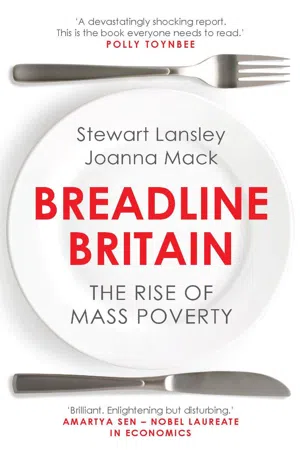
Breadline Britain
eBook - ePub

Breadline Britain

The Rise of Mass Poverty

  1. 256 pages
  2. English
  3. ePUB (mobile friendly)
  4. Available on iOS & Android
eBook - ePub

Breadline Britain

The Rise of Mass Poverty

About this book

Poverty in Britain is at post-war highs and - even with economic growth -is set to increase yet further. Food bank queues are growing, levels of severe deprivation have been rising, and increasing numbers of children are left with their most basic needs unmet.

Based on exclusive access to the largest ever survey of poverty in the UK, and its predecessor surveys in the 1980s and 1990s, Stewart Lansley and Joanna Mack track changes in deprivation and paint a devastating picture of the reality of poverty today and its causes. Shattering the myth that poverty is the fault of the poor and a generous benefit system, they show that the blame lies with the massive social and economic upheaval that has shifted power from the workforce to corporations and swelled the ranks of the working poor, a group increasingly at the mercy of low-pay, zero-hour contracts and downward social mobility.

The high levels of poverty in the UK are not ordained but can be traced directly to the political choices taken by successive governments. Lansley and Mack outline an alternative economic and social strategy that is both perfectly feasible and urgently necessary if we are to reverse the course of the last three decades.

One of Listmuse's Greatest British Politics books
Frequently asked questions

Yes, you can cancel anytime from the Subscription tab in your account settings on the Perlego website. Your subscription will stay active until the end of your current billing period. Learn how to cancel your subscription.
At the moment all of our mobile-responsive ePub books are available to download via the app. Most of our PDFs are also available to download and we're working on making the final remaining ones downloadable now. Learn more here.
Perlego offers two plans: Essential and Complete
  • Essential is ideal for learners and professionals who enjoy exploring a wide range of subjects. Access the Essential Library with 800,000+ trusted titles and best-sellers across business, personal growth, and the humanities. Includes unlimited reading time and Standard Read Aloud voice.
  • Complete: Perfect for advanced learners and researchers needing full, unrestricted access. Unlock 1.4M+ books across hundreds of subjects, including academic and specialized titles. The Complete Plan also includes advanced features like Premium Read Aloud and Research Assistant.
Both plans are available with monthly, semester, or annual billing cycles.
We are an online textbook subscription service, where you can get access to an entire online library for less than the price of a single book per month. With over 1 million books across 1000+ topics, we’ve got you covered! Learn more here.
Look out for the read-aloud symbol on your next book to see if you can listen to it. The read-aloud tool reads text aloud for you, highlighting the text as it is being read. You can pause it, speed it up and slow it down. Learn more here.
Yes! You can use the Perlego app on both iOS or Android devices to read anytime, anywhere — even offline. Perfect for commutes or when you’re on the go.
Please note we cannot support devices running on iOS 13 and Android 7 or earlier. Learn more about using the app.
Yes, you can access Breadline Britain by Stewart Lansley,Joanna Mack in PDF and/or ePUB format, as well as other popular books in Social Sciences & Business Ethics. We have over one million books available in our catalogue for you to explore.
1
To live or to exist: Defining poverty in an age of plenty
It’s not unfair and it is unfair, ’cos like other people get to have their houses, all the money and sometimes people don’t have the money even if they save up.
Eleven-year-old, London 20121
Jennie lives in temporary accommodation in Redbridge, north London. She is a single mother with three sons over the age of ten, all of whom have disabilities. While she tries to make sure her sons are properly fed, she struggles: ‘Chicken drumsticks, which I am going to do today for the kids for their dinner, with some chips, beans and spaghetti. They mainly have fruit and veg over the weekends and then usually if I do get fruit, ’cos [there’s] three sons, they tend to eat it as soon as I get it. I can’t go and get any more because I don’t have the money. I have to budget.’
She sometimes gets offered food by friends and neighbours, but in order to ensure that her children are properly fed, she regularly goes without herself. ‘I only tend to eat one meal a day and that does me, ’cos I like to make sure I’ve got [enough] for my children.’
Jennie worked as a hairdresser when she left school, but her middle son, Mark, contracted meningitis as a baby leaving him visually impaired. Jennie, now forty-one, left work to care for him. Having separated from her husband when the children were young, she moved to a women’s refuge and has lived in a variety of temporary accommodation for the last ten years.
Most of the family’s benefit income goes on food, fuel, school clothes and local travel, with rent paid by housing benefit. They rarely socialise and have never had a holiday. They do have a television set, a fridge and a washing machine. Jennie often runs out of money: ‘But I have to stay strong for myself and for my children, and I hate being in the situation that I’m in now.’
Despite their situation, the family don’t necessarily see themselves as poor. Thirteen-year-old Mark: ‘We’ve got this house; we’ve got friends and stuff like that. So I don’t think we are actually poor. Sometimes I think we’re poor, because like we can’t get money to spend on like things we want, so I kind of think and I kind of don’t think we are poor.’ And eleven-year-old Michael, the youngest: ‘We’re not actually poor like in a living on the streets way. We ain’t got the perfect clothes in the world, clothes that other people’s kids have, but we’re happy with what we’ve got as long as we can live.’ ‘I don’t like the word poor,’ is how Jennie puts it. ‘I mean, in a way, yes, I am poor. Poor – it means you can’t afford anything. You can’t afford what you need.’
So are Jennie and her family in poverty? Their standard of living is well below that of most people in the UK, and they experience deprivation in a variety of ways – but are they too poor? The family recognise that their situation could be worse, even drawing some comfort from this. They have a roof – however insecure - over their head. They just get by on food – even if they run short quite regularly. They have a higher standard of living than the poor of a century, or a half century ago – they have access to health services and education. They are not starving.
This question of how to define poverty has long divided opinion between those who see it in more relatives terms and those who see it in more absolute ones. This is not just some academic debate. Definitions of poverty matter. They set the standards by which we determine whether the incomes and living conditions of the poorest in society are acceptable or not and are essential for assessing questions of fairness. From these definitions follow actions to help the poorest. Which approach is adopted has different implications for the scale of and trends in poverty. The narrower the definition, the less action is needed and the more the problem can be swept away. Conversely, too broad a definition will not chime with people’s experiences and risks alienating the wider public.
Absolute measures have traditionally been seen in terms of minimal, subsistence standards, sufficient to secure the barest of living standards. More recently, they have also been used as a measure fixed at a particular point in the past and updated only in line with rising costs. This can provide a useful measure of progress – or lack of progress – over short periods of time. Typically, though, absolute measures, with their emphasis on situations such as hunger and homelessness, have often been employed as a way of underplaying the extent of poverty.
Relative measures, on the other hand, are based on contemporary norms and social standards, and are higher than absolute standards. They change over time, not just in relation to the cost of living but also in relation to changing incomes, needs and social habits. For a period, the debate seemed to have been settled in favour of a relative approach, but in the last few years, just when levels of hardship have become more widespread, these questions have become, once again, more and more hotly disputed.
Apart from the question of whether to take a more absolute or relative approach, there are two main ways of tracking poverty: by looking at income, or people’s actual living standards. Both income- and living-standards-based measures can be either absolute or relative.
Using income to measure poverty
In 1999, when invited to give the ‘Beveridge revisited’ lecture, the Labour prime minister, Tony Blair, stunned his audience by promising to halve child poverty within a decade and ‘eradicate’ it within twenty years. The promise came out of the blue and, while widely welcomed, raised the eyebrows of almost all the leading social policy academics, advisers and journalists in the lecture hall. The move was as ambitious as it was unprecedented. The scale of the task and the timetable laid down were certainly daunting but, as a result, tackling poverty was turned into a central political aim and was never going to be far from the headlines.
The goal set by Blair was based on a clearly defined relative income measure: the proportion of the population with incomes falling below sixty percent of the household income at the mid-point of the income range (known as the median income). This was the first time such a measure had been formally adopted by government and was, in effect, being made the official measure of poverty in Britain.2 It is one that has also become widely used internationally. A year earlier, the Statistical Program Committee of the European Union agreed that such a threshold should be used when making international comparisons of poverty across its member nations. Based on data which is readily available, it allows comparisons between countries and of trends over time.
That poverty should be defined in this relative way also came to be endorsed across the political spectrum. ‘All forms of poverty – absolute and relative – must be dealt with,’ Iain Duncan Smith, the Conservative lead on welfare, wrote in 2006. ‘We should reject completely the notion that poverty can be defined in absolute terms alone. Relative poverty matters because it separates the poor from the mainstream of society.’3 It was a commitment echoed by the Conservative party leader, David Cameron, in the same year: ‘I want this message to go out loud and clear: the Conservative Party recognises, will measure and will act on relative poverty.’ 4
Just over a decade after Blair’s speech, with some, clear progress made towards the goal,5 Labour – now under a new prime minister, Gordon Brown – introduced the 2010 Child Poverty Act. Backed by all the major parties, the Act made reducing the numbers of children living in families below sixty percent of the median household income a legal duty for the government of the UK.6 A statutory recognition that poverty is relative, it was a significant turning point in the long debate on how to measure poverty.
In the agreement to form a coalition government signed by the Conservatives and the Liberal Democrats in May 2010, the two partners specifically committed themselves to its aims: ‘We will maintain the goal of ending child poverty in the UK by 2020.’7 Yet, within weeks of taking office in 2010, in a swift political U-turn, senior ministers launched a number of attacks on the Act’s central poverty measure. The new government now wanted to shift the emphasis in tackling poverty away from income. They were also uncomfortable with the target itself. Iain Duncan Smith, the new Work and Pensions secretary, recruited Frank Field – Labour MP for Birkenhead, former director of the Child Poverty Action Group and one of the country’s leading authorities on welfare – to review the case for reform. Field’s task was to examine whether there should be a shift away from income-based measures to ones that included ‘non-financial elements’. 8 The setting up of the review was soon followed by a series of statements dismissing the income-based target as just ‘poverty plus a pound’.9
Initially, it seemed that this might be a move to tackle the deeper causes of poverty. In November 2010, Nick Clegg, the deputy prime minister, wrote: ‘Poverty plus a pound is simply not an ambitious enough goal.’10 He argued that instead we needed to invest in ‘mobility’. In December 2010, the then children’s minister, the Liberal Democrat MP, Sarah Teather, reiterated the government’s new approach: ‘The Government is clear that tackling child poverty requires more than simply treating the short-term symptoms of poverty or moving families across an arbitrary income line.’ 11
In fact it soon became clear that senior ministers were seeking a fundamental change in direction on the poverty question, in definition as well as policy, in ways that directly challenged the principles at the heart of the 2010 Act. Iain Duncan Smith increasingly dismissed the income target itself, arguing that ‘increased income and increased wellbeing do not always follow the same track.’12 Taking this a step further, Frank Field argued that some of the money used to support children should be redirected from benefits to improving ‘life chances’.13
As well as questioning the importance of income in tackling poverty, the government also set out to challenge the relative nature of the sixty percent of median household income measure, claiming inherent problems with the way the target worked. ‘You get this constant juddering adjustment with poverty figures going up when, for instance, upper incomes rise,’ was how Duncan Smith put it shortly after the election.14 Frank Field expanded on this idea arguing that a target based on relative income was impossible to achieve. ‘Any candidate sitting GCSE maths should be able to explain that raising everybody above a set percentage of the median income is rather like asking a cat to chase...

Table of contents

  1. Cover
  2. About the Authors
  3. Title Page
  4. Imprint Page
  5. Contents
  6. Figures
  7. Preface
  8. Chapter 1
  9. Chapter 2
  10. Chapter 3
  11. Chapter 4
  12. Chapter 5
  13. Chapter 6
  14. Chapter 7
  15. Chapter 8
  16. Chapter 9
  17. Appendix
  18. Acknowledgments
  19. Notes