![]()
1
Introduction
Chapter contents
Communication with people with severe autism
Using body language
The autism-friendly environment
There is now a great surge of interest in autism. Many books are being written (those written by people with autism are particularly useful) and films being made. Most of these are about children who are on the more able end of the autistic spectrum. What this handbook offers is a simple and practical way of getting close to those children and adults with very severe autism, some who also have severe learning disability, many of whom do not speak and some of whom are showing serious or extreme behavioural distress. We feel as cut off from them as they are from us.
Throughout this handbook, we shall refer to the child or adult with whom we are working as our communication partner or simply partner. Intensive Interaction uses body language to communicate with children and adults in a way that establishes attention and emotional engagement. Sensory Integration uses physical sensations to focus attention. The reason for combining these two approaches in a single handbook is that when put together they provide an extremely powerful structure to help the confused brain of an autistic child or adult know what they are doing. In a world that appears frightening and chaotic, what the approaches have in common is that both put in place signals that the brain can recognise and on which it can focus. In a situation where, for example, Thérèse Jolliffe (who is autistic) tells us that she lives in terror and spends her whole life trying to work out what is happening, we are trying to construct a map that has meaning for our partner.
As practitioners, both authors have benefited from what they have learned from each other. For example, Jane finds that when she uses Intensive Interaction to tune in to the rhythm of a child’s movements, she can get through to her much more quickly than would otherwise be the case. On the other hand, Phoebe finds that there are times when using the techniques of Sensory Integration in parallel with body language helps her partner to know what they are doing and where they are in space.
This handbook is selective. It does not address the question of diets, nor does it compare all the different educational systems such as the PECS (Picture Exchange Communication System) and TEACCH (Treatment and Education of Autistic and related Communication-handicapped CHildren) that are used to try and teach people on the autistic spectrum to deal with the world they live in. On the subject of the intestinal symptoms that a proportion of people on the autistic spectrum experience, we take the view that, as is the case for those who are not on the spectrum, medical problems require medical solutions.
However, since we cannot teach anyone anything if they are not listening to us, in this handbook we shall be focusing on getting our autistic partner’s attention, in a way that their brain finds non-invasive and intriguing. By providing an environment that is user-friendly, Intensive Interaction lays the ground for further, more strictly educational approaches. It does not claim to be a cure for autism. Its effect is in establishing emotional communication. It does not cost anyone anything. Many parents and support staff working with adults who use Intensive Interaction say such things as ‘My daughter is happy now’. Her brain is able to make sense of what is going on round her without getting snarled up in a faulty processing system.
COMMUNICATION WITH PEOPLE WITH SEVERE AUTISM
First of all we need to think about what we mean when we talk about communication. Communication is about our ability to share our lives with other people.
We are born with the need to do this since we shall not survive if we cannot communicate our need for warmth, food, shelter, etc. From birth we cannot live independently; we need a mother or mother figure who will nurture us and with whom we can engage. As we grow older, however much we strive for independence, we are dependent on the society in which we live. We feel estranged from those with whom we cannot communicate and make strenuous efforts to learn a mutual language. And if our children cannot speak, we devise symbol and sign systems to bridge the gap that we feel exists between us and those to whom we cannot talk. But despite our best efforts, there are some people on the autistic spectrum who still seem to be beyond our reach. They have little or no meaningful speech. They do not respond to our approaches or only to a very limited extent. So what can we possibly mean when we talk about having a conversation with children and adults who are not only non-verbal but also seem to reject our attempts to get in touch and even reject us as people? To be treated with the casualness with which one might treat a piece of furniture reduces us to an object and we feel alienated.
If we are going to discuss communication, it helps if we think about the nature of the way that we, neurotypical people, communicate with each other. What sort of conversations do we have with each other?
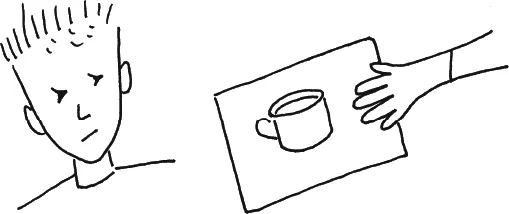
Figure 1.1 Want a cup of tea?
Functional communication
First of all there is functional communication, through which we make our needs known to each other and convey information. We greet each other. We talk to each other. We negotiate and we discuss things that interest us.
Note that functional communication need not be verbal; it is also served by communication systems such as PECS and sign systems. If our partner is on the spectrum, then the less able they are, the more concrete the system we use needs to be. The more abstract a communication system is, the more difficult it will be for our partner to make sense of it, since it will involve interpretation and so suffer from at least some of the same disadvantages as speech, in that it will also involve faulty processing, one of the underlying roots of stress in people on the autistic spectrum. In practice I find that, when working with less able people on the spectrum, the most effective interventions, those that aim to establish a need, use simple gesture and also objects of reference. Objects of reference are objects which are directly linked to an activity, for example a towel refers to ‘bath’. Even some of our more able partners may find these supplements helpful. For example, objects which have weight and texture can be a clearer mode for conveying information than vision for some partners since they can continue to ‘feel’ the communication during the event. They can hang on to it; it does not so easily slip out of the brain’s conscious grasp.
The problem is that if we focus exclusively on functional communication, there is the danger that we direct our partner’s attention towards manipulating the world rather than helping them to share it. Even if we help them express ‘happy’ and ‘sad’ by choosing a face that expresses that feeling, it is distanced, it is not something that we share together. Better than nothing, it remains an observation rather than a mutual experience, communication fact rather than flow. It does not help us to feel in tune with each other.
So what other sorts of conversation can we expect?
Emotional engagement
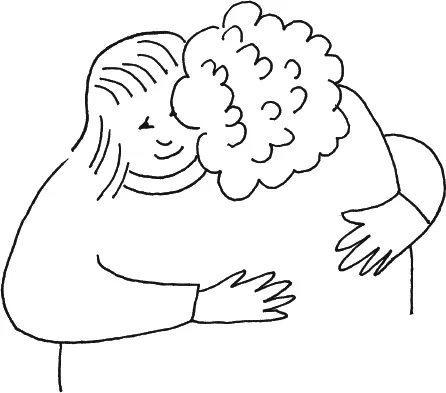
Critically, emotional engagement lets us know how we feel about each other. However, it is an aspect of communication that is commonly thought to be missing in our interactions with our autistic partners. While both functional communication and emotional engagement are clearly desirable, when we look at Figures 1.1 and 1.2 – ’Want a cup of tea?’ and ‘Aaaahh!’ – the difference between them is obvious. It can be summed up in a single word: relationship. Emotional engagement addresses the fundamental human need to connect and belong. Donna Williams, who has autism, describes her aloneness when she talks about how ‘she had all her relationships which she should have had out there, with the shadow people in her inner world’.1 However much we fulfil our partner’s physical needs they will continue to feel isolated – ‘an alien in a foreign land’ – unless we can find a way of helping them to experience human bonding. We see a change in our partners when they begin to enjoy human company. They start to smile, look at us, refer back to us and seek our company.
How can we bring about this transformation?
USING BODY LANGUAGE
Intensive Interaction is the name given to an approach that uses body language to communicate and its aim is to establish emotional engagement. Although we may not be aware of it, we are doing this all the time. We are scanning, not just what our partners say but how they are saying it, what their facial expression and posture are telling us – and simply the way they are saying it, the tone, pitch, speed and rhythm of their speech. What does this tell us about how they are feeling? For example, does what they are saying and what they are expressing through their facial language tell the same story? We find ourselves uneasy if they do not – ‘Something, I can’t quite put my finger on it, doesn’t add up.’
We all use facial expression and hand movements to supplement our communications. Do we make these in a calm or agitated manner? For example, the same hand movement may be welcoming or threatening. We use our perception of how it is done to decode how our partner feels – and we use our own body language to let them know how we feel, even if we are not aware of what we are doing at the time. How we do respond will convey how we feel. In fact body language is the voice of affect (how we feel). It is through reading our partner’s body language and responding with our own that we come to emotional understanding. In a negative sense, the classic example of contradiction is of a person who folds their arms across their chest, frowns and says through gritted teeth, ‘I’m perfectly all right, thank you.’ Their body language is contradicting the sense of what they are saying. We could say the ‘vibes’ are all wrong.
Body language helps us to tune in to each other’s affective state; how they feel. The extent to which we are able to be sensitive to how others feel will allow us to build emotional engagement and trust.
There is some suggestion that up to 80 per cent of what we communicate with each other is through exchange of body language, rather than through exchange of verbal information. The use of Intensive Interaction is going to focus our attention on this aspect of exchange: not only what our partner is doing but also how they are doing it.
Two processes underpin Intensive Interaction and settle it in its place in communication. The first is the infant–mother paradigm, the first communicative interactions between mother and baby. Even at 20 minutes’ old, the baby will copy its mother if she sticks out her tongue. Mother and baby are talking to each other from the moment of birth.
If the infant says, ‘Boo’, the mother will answer, ‘Boo’. When she has sufficiently confirmed the infant sound (or movement) the baby tries out something else, say, ‘Da’. The pattern that emerges is that when the baby initiates, the mother confirms and the baby is able to move on. The mother’s confirmation of the baby’s sound or movement appears to act as a release mechanism. This process remains hidden in our psyche all our lives and as adults we may be surprised to find, for example, that if we get stuck in anger, we are released only when an outside ‘mother figure’ confirms our distress. (As we discuss in the section on speech in Chapter 7, sometimes a ‘hiccup’ develops, where the grown child fails to achieve independence from the mother figure and is unable to proceed from intention to action until confirmed by the mother figure or substitute.)
The second process underlying Intensive Interaction relates to the operation of a network of nerve cells in the brain known as the mirror neuron system. It is the mirror neuron system that allows us to recognise what another person is doing (and hence be able to copy their action).
Let us imagine that John is looking at Mary. Mary moves her hand. If we look at what is happening in Mary’s brain through a scanner while she is making this movement, we see that her action is accompanied by the firing of a particular pattern of nerve cells. John is also under a scanner, so we can watch what happens when he sees Mary’s movement. What is so extraordinary is that, as he looks at her activity, the same pathway fires in John’s brain. Simply watching her, his own brain has reproduced an identical map of neuron activity to hers.
Even more fascinating is that this recognition works for emotions as well as for actions. If I see you looking sad, it may well evoke an empathetic wave of sadness in me (although whether or not I notice this depends on where my attention is focused; I may even recognise the feeling later on, acknowledging it to myself with the comment, ‘Oh, I missed that’).
One suggestion about autism is that the mirror neuron system is not working, which is why some people on the spectrum are said to have difficulty in actions such as copying hand movements – and, by extrapolation, understanding how other people are feeling. However, experiments designed to test this idea use actions that are not necessarily part of the person with autism’s normal repertoire. Putting aside for the present that the problem for some people with autism is that they are over-sensitive to emotional feelings rather than under-sensitive, in practice, if you engage your partner through the activities that are part of their life experience and t...