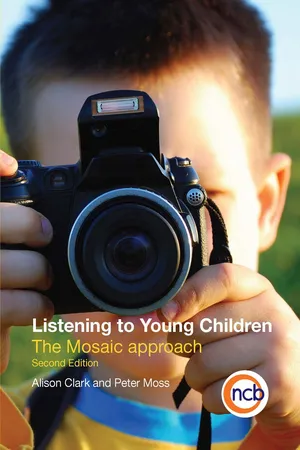
Viewing children as 'experts in their own lives', the Mosaic approach offers a creative framework for listening to young children's perspectives through talking, walking, making and reviewing together.
Serving as a tool to ensure that children's views and experiences become the focus for reviewing quality in early childhood provision, it explains how children's own photographs, tours and maps can be joined to interviews and observations to enable adults to gain deeper understandings of young children's lives. This updated second edition builds on the authors' original ground-breaking work, and offers case studies of the Mosaic approach in action, as well as guidance on using and adapt the framework in different settings. The Mosaic approach can also be adapted to work with older children, particularly those with communication difficulties or for whom English is an additional language.
Listening to Young Children is required reading for practitioners in nurseries, children's centres, pre-schools and schools and residential settings. It will also be welcomed by early childhood students and other researchers looking for new theoretical, practical and imaginative ways of listening to young children.