![]()
II
POEMS AND
STORIES FROM
MUSIC THERAPY
![]()
LET THE CHILDREN
TEACH YOU
— Alison Talmage —
‘Let the children teach you’ – the words of music therapy pioneer Clive Robbins, during his final visit to Auckland in 2007. Through spontaneous play – musical, physical, imaginative, solitary, collaborative – children reveal their joys, strengths and difficulties. Children’s worlds are not neatly divided by subject boundaries. Many children arrive at the music therapy room with an expectation that singing, playing and dancing will be at the heart of our work together. Others find a wonderful space for running, climbing, hiding, pretend play, or a place that they don’t initially understand and would prefer to exit. I meet children with extensive experience of music; others with none. Children with extensive song repertoires; others just beginning to explore their voices. Children who can create and sustain complex rhythm patterns; others with a barely emerging sense of pulse. Children who sound the xylophone bars in order, up and down, down and up; others who take the instrument apart and line up bars and beaters on the floor. I love to see children’s play through children’s eyes, to enter their world as well as inviting them into a world of music, to extend their capacity for play, self-expression, self-regulation and relationships.
When child-centredness comes first, music-centred play may be immediate or may gradually emerge. Inviting children to participate, rather than directing, gives them permission to bring themselves more fully into the music therapy room. Framing my role as witness and play partner, or listener and fellow musician, means emphasising safety, music, relationships, but also following the children’s interests.
This collection of poems recalls experiences of music therapy with children with autism, who have difficulty connecting with other people and the world around them. All the children depicted are composite characters, to protect individual identities. The poems illustrate my understanding that all behaviour is communication, and portray children as active players, however tentative or dynamic, from the start of our work together.
Beginning 1
| alert self-absorbed eyes averted muscles tense circling, tiptoeing hugging the walls keeping your distance wailing suddenly you rush close slam the piano shut snatch my drumsticks push the xylophone cover your ears retreat into echoing silence avoiding contact | curious I sing your name watch softly mark your footsteps reach tentatively into the space between I breathe in…out… surprised hear your fear give you space keep you safe listen wait before singing again inviting hope |
| some people concerned, anxious might take your hand and sit you down and make you play and tell you how to be hurry you to do the same be the same as everyone slowly this space will seem safer with eyes and ears open you will edge closer to me the piano, drum, xylophone | I patiently show you how my hands tap rhythms sound melodies suggest possibilities take time to understand your uniqueness your voice gradually here trust will grow we will both learn to play together new sounds, colours, thoughts |
| sounding our selves making new songs connecting becoming |
Beginning 2
A child-sized whirlwind hurtles through the door spins twizzles twirls turns discards shoes socks jersey we keep our shirts on in the music room bag books toys except for the one indispensable thing that can’t possibly wait in Mum’s bag for later so we’ll drive it into the music room let’s go, the wheels on the bus go round and round, round and round, round and round…round the room whizzing whirling here we are in the music room squeezing behind the piano you and me in the music room reappearing hurrying scurrying bounding pounding drumbeats matching footsteps won’t stop can’t stop after sitting sitting sitting in class in the car in the rush hour rush past fast cast a glance good to see you today left right left right drum cymbal crash splash running jumping leaping in time with you laughing loving the fun the freedom the feeling of being alive slowing down as you drift to the corner dragging the chair across the room moving closer keeping you safe clambering up gazing out of the window we are inside looking outside jump down up again inside looking outside down round and round we are dancing round and round the driver on the bus says please sit down crouching sit down here crawling here we are in the music room sitting here we are together.
The big gathering drum is…
my voice
calling, yelling,
telling you I’m here
a hiding place
when I feel playful,
cheerful, sorrowful
a wheel
driving across the room
from you to me
a sailing boat
braving stormy seas
while you sing me safely home
a gymnast’s springboard
when I climb, count, jump,
and you catch me
anything I imagine
somewhere we share music
and more.
Improvisation
One
sound, then
twos and threes,
my melody steps, leaps, repeats.
I see motifs, play phrases,
clusters in the spaces,
I find sounds and silence,
clashing discords and gentle harmony.
Listen, listen, listen
before you sing me your song.
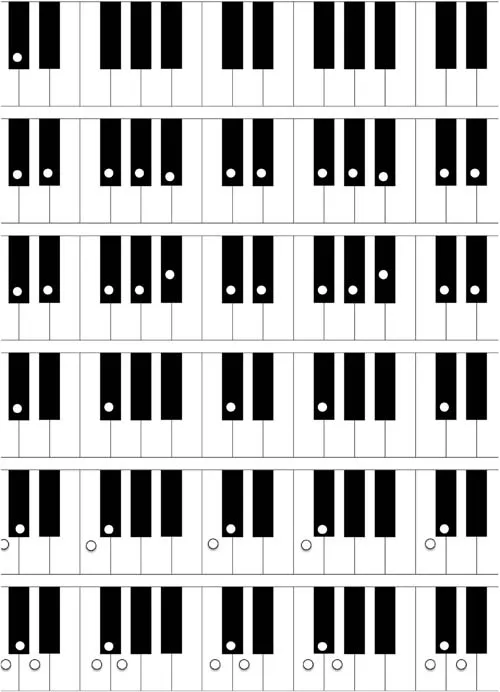
I love watching and listening to spontaneous piano playing by young children, including those who have autism. Children are curious about the orderly layout of the keyboard with its intriguing asymmetry of black keys in pairs and threes, and the predictable left to right, low to high sounds. I have listened to endless scales, up and down, up and down on every white key, then up and down, up and down on every black key. While I might worry about rigid thinking and the child’s reluctance to let me join in, I believe this free exploration also signifies a sense of control, self-confidence and creativity.
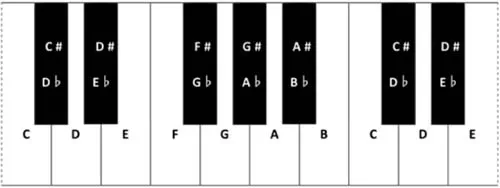
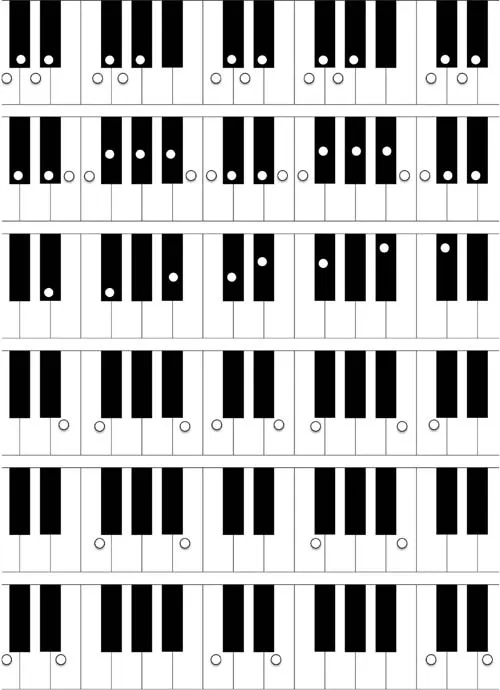
While improvisational music therapy encourages exploration and free play, with no need for theoretical knowledge, some readers who are not pianists might like to refer to the keyboard diagram that shows the repeated A-G labelling of the white keys and dual naming of the black keys as higher (‘sharp’ or #) and lower (‘flat’ or
) than the adjacent keys.
Things I like in the music room
Round things for tapping, banging, hitting,
And a shiny circle for crashing, splashing, spinning.
The huge round sound of a sea storm,
And the small round jingly not-quite-a-drum.
Twelve wooden squarish sticks lined up on a box,
And more long, short, thick, thin sticks
for lining up on the floor or making noise.
Long strings on funny shaped boxes
To pull, twang, stroke, strum.
Red orange yellow green blue turquoise purple white
red again
things to shake and ring,
Red orange yellow green blue turquoise purple white
red again
boxes sounding the same.
The giant thing with a hiding place behind,
In front the black and white noise-makers.
The person who plays and lets me play,
Sings, shares, shows and lets me try,
And knows the names of these favourite things.
![]()
THE NOTEBOOK
— Claire Molyneux —
Five years old. Normal birth and delivery. Quiet, placid baby. Preschool teacher first to raise concern: autism, developmental delay. First-born. No siblings to make a comparison. At 18 months, no language, did not respond to name. Little eye contact. Very active, climbing, no sense of danger. Loves music. Always responds to familiar songs. As a baby would rock and bounce in time. Gets upset when music is played or when parents sing particular songs. Attends preschool. Doesn’t play with other children.
‘My boy’, she told me, ‘has no words.’ But his communication ran much deeper than words. His gaze, albeit infrequent, was filled with intent.
‘My boy’, she told me, ‘plays alone at kindy, he doesn’t mix with the other children…but he watches them.’
The boy lies on the floor of the therapy room. His back is against the wall in a space he has chosen that is just big enough for his body but not his legs which stretch out into the room. Above him there is a window and ...