Drawing on avant garde and classical Japanese dance traditions, the Alishina Method offers a systematized approach to Butoh dance training for the first time in its history. With practical instruction and fully illustrated exercises, this book teaches readers:
· basic body training and expression exercises
· exercises to cultivate Qi (energy) and to aid improvisation
· about katas (forms) and how to develop your own
· the importance of voice, sound and music in Butoh
· to collaborate and be in harmony with others
· techniques to manipulate time and space
· how to develop the imagination and refine the senses to enrich performance.
This authentic approach to Japanese dance will be compelling reading for anyone interested in contemporary dance, performance arts, Japanese culture or personal development techniques.
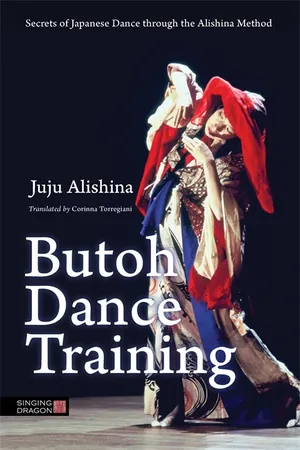
eBook - ePub
Butoh Dance Training
Secrets of Japanese Dance through the Alishina Method
- 296 pages
- English
- ePUB (mobile friendly)
- Available on iOS & Android
eBook - ePub
Butoh Dance Training
Secrets of Japanese Dance through the Alishina Method
About this book
Information
Subtopic
Danza~ Part 1 ~
Body training:
basic exercises
basic exercises
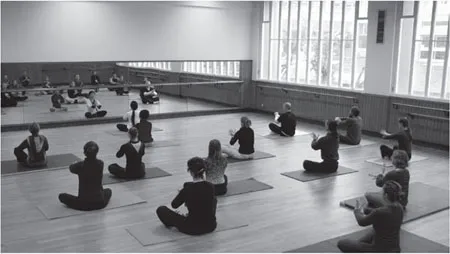
Butoh class in Paris
Photo: KOS-CREA 2007
~ 1.1 ~
Seiza, breathing and relaxation technique
Seiza and greeting
I always start and end the class with the seiza position and the Japanese greeting (a bow). Wherever we may be, this is basic.
How is the seiza position done correctly? Sit with your legs folded onto your bottom, stretch your body as if you were pulling your head towards the sky, concentrate all your force into the tanden (the point over the navel in the abdomen), release the tension in your shoulders and ease your breathing. Once you succeed in sitting in seiza correctly, bend over deeply, with all your heart, honoring this moment that you are sharing with the master in the same ba (place). Never do this in a careless or routine way.
As the saying goes: “When in Rome, do as the Romans do.” My daily life is permeated by French customs and traditions. However, during my classes I ask my students, no matter which country they come from, to comply with Japanese customs. The limited time–space dimension of my classes is the “Japanese” dimension, so students can feel as if they were in Japan.
How to stand up straight and sit
If you find it difficult to sit with your legs bent, you can sit in a way that is more comfortable for you. Suffering should be avoided, but at the same time it is important not to give up too soon. If you cannot maintain the position despite your efforts, you can stop. While training, try to gradually increase the amount of time you can sit in this position.
This is the way to stand up in traditional Japanese dance: first raise your heels; then lift your left leg, then the right in order to stand straight with your feet together. To sit, put your right leg back and bend your legs. Now bring your left knee onto the floor then sit on your bottom.
Training can be done by bending your knees and keeping your back straight. The exercise consists of standing up, sitting down and standing up again while balancing a book on one’s head. The correct way to stand up may be seen in Part 2, 2.5, Standing up, walking.
I will refer to the terms below as follows:
~In pairs: exercise for two people.
~Group: exercise involving more than two people.
~Individual/group: exercise done by the entire group which can also be developed on one’s own.
Unless otherwise specified, an exercise is meant to be individual.
Breathing technique
Adult lung capacity is about five liters (1.32 US gallons). However, in the usual breathing process, humans use just a quarter of this capacity. The more nervous or stressed one gets, the more one’s breathing capacity diminishes.
When breathing in and out, the human body inhales oxygen and exhales carbon dioxide through blood vessels, which is why breathing is so important. Deep breathing allows for the complete exchange of impure air with fresh air. The following exercises are performed at the beginning of each class.
Candle breathing technique

Concentrating on breathing is a healthy exercise. In Japan, it is believed that deep breathing increases lifespan. Certain types of yoga consider the ideal exhalation length to be 30 seconds, while in normal breathing it usually does not last more than 20 seconds. Time the maximum duration of your exhalation and try to gradually increase it over time.
Qi (air) change by humming
TRAINING THE CIRCULATION OF QI OVER THE BODY
Table of contents
- Cover
- Half Title
- Of Related Interest
- Title Page
- Copyright
- Dedication
- Contents
- Preface
- The Future of Butoh
- Teaching Method
- Part 1 Body training: basic exercises
- Part 2 Qi training, improvisation
- Part 3 Application
- Afterword
- Bibliography
- Biography
- Also available
Trusted by 375,005 students
Access to over 1.5 million titles for a fair monthly price.
Study more efficiently using our study tools.
Frequently asked questions
Yes, you can cancel anytime from the Subscription tab in your account settings on the Perlego website. Your subscription will stay active until the end of your current billing period. Learn how to cancel your subscription
No, books cannot be downloaded as external files, such as PDFs, for use outside of Perlego. However, you can download books within the Perlego app for offline reading on mobile or tablet. Learn how to download books offline
Perlego offers two plans: Essential and Complete
- Essential is ideal for learners and professionals who enjoy exploring a wide range of subjects. Access the Essential Library with 800,000+ trusted titles and best-sellers across business, personal growth, and the humanities. Includes unlimited reading time and Standard Read Aloud voice.
- Complete: Perfect for advanced learners and researchers needing full, unrestricted access. Unlock 1.5M+ books across hundreds of subjects, including academic and specialized titles. The Complete Plan also includes advanced features like Premium Read Aloud and Research Assistant.
We are an online textbook subscription service, where you can get access to an entire online library for less than the price of a single book per month. With over 1.5 million books across 990+ topics, we’ve got you covered! Learn about our mission
Look out for the read-aloud symbol on your next book to see if you can listen to it. The read-aloud tool reads text aloud for you, highlighting the text as it is being read. You can pause it, speed it up and slow it down. Learn more about Read Aloud
Yes! You can use the Perlego app on both iOS and Android devices to read anytime, anywhere — even offline. Perfect for commutes or when you’re on the go.
Please note we cannot support devices running on iOS 13 and Android 7 or earlier. Learn more about using the app
Please note we cannot support devices running on iOS 13 and Android 7 or earlier. Learn more about using the app
Yes, you can access Butoh Dance Training by Juju Alishina, Corinna Torregiani in PDF and/or ePUB format, as well as other popular books in Medios de comunicación y artes escénicas & Danza. We have over 1.5 million books available in our catalogue for you to explore.