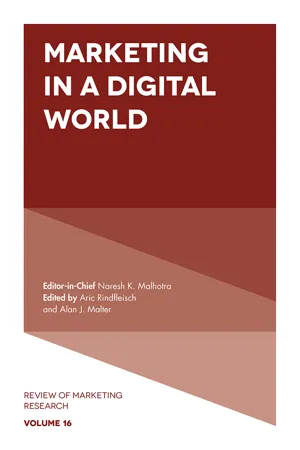
eBook - ePub
Marketing in a Digital World
- 226 pages
- English
- ePUB (mobile friendly)
- Available on iOS & Android
eBook - ePub
Marketing in a Digital World
About this book
Marketing in a Digital World focuses on how the digital revolution has affected the science and practice of marketing. Consisting of nine essays authored by some of the world's leading marketing scholars, this volume of Review of Marketing Research is forward-looking and illuminating. The book considers the nature and consequences of a number of important new digital technologies and practices, including human-machine communication, software, mobile marketing, online reviews, big data, 3D printing and a wide range of other digital innovations. Many of these technological developments were completely unanticipated and as such the transformation is still unfolding. Therefore, whilst consumers have largely embraced and actively co-create many of these new innovations, there are also growing concerns about privacy and other adverse effects of digital technology. Each essay provides a thoughtful examination of this rapidly shifting landscape and offers a set of bold ideas regarding its future impact on the foundations of marketing and consumption. The volume is essential reading for both scholars and managers seeking fresh insights into marketing and offers a number of exciting new concepts, propositions and predictions about marketing in the digital world.
Information
SELF-MANUFACTURING VIA 3D PRINTING: IMPLICATIONS FOR RETAILING THOUGHT AND PRACTICE
ABSTRACT
Retailing thought and practice is premised on the assumption that consumers visit retailers to search for and acquire objects produced by manufacturers. In essence, we assume that the acts of consuming and producing are conducted by separate entities. This unspoken yet familiar premise shapes the questions retail scholars ask and the way retail practitioners think about their industry. Although this assumption accurately depicted retailing since the Industrial Revolution, its relevance is being challenged by a growing set of individuals who are equipped with new digital tools to engage in self-manufacturing. In this chapter, we examine self-manufacturing with a particular focus on the recent rise of desktop 3D printing. After discussing this new technology and reviewing the literature, we offer a conceptual classification of four distinct types of 3D printed objects and use this classification to inform a content analysis of over 400 of these objects. Based on this review and analysis, we discuss the implications of self-manufacturing for retailing thought and practice.
Keywords: 3D printing; digital revolution; self-manufacturing; retailing; Thingiverse; content analysis
Twenty years from now, we’ll have Star Trek replicators that can make anything. (Neil Gershenfeld, MIT)
Marketing scholarship in general, and retailing research in particular, operates under the assumption that products are made by firms, sold by retailers, and bought by consumers. For example, many topics of current interest to retailing scholars, including omnichannel retailing (Cao & Li, 2018), the retail experience (Jahn, Nierobisch, Toporowski, & Dannewald, 2018), and shopper marketing (Lee et al., 2018), largely regard retailers as places (physical or virtual) where people acquire objects made by manufacturers. In addition to informing our scholarly worldview, this assumption is also congruent with our lived experience, as most of the things we use on a daily basis are obtained in this manner. Thus, this assumption holds considerable theoretical and practical relevance and is seldom questioned by marketing scholars.
The practice of buying (largely from retailers) the things we use is commonplace among those raised in contemporary industrialized economies. In the words of Galbraith (1958), this manufacturer → retailer → consumer channel is “conventional wisdom.” However, across the scope of human history, this wisdom was anything but convention. Until the mid-to-late nineteenth century, most people consumed objects that were created by themselves, their family, or their local community. Indeed, department stores were an outgrowth of large-scale manufacturing enabled by the Industrial Revolution and didn’t begin to dot the American landscape until around 1875 (Lancaster, 1995). Thus, the contemporary role of retailers and our knowledge of this domain are largely dependent upon an economic model in which the things we consume are manufactured by a distant firm and sold via a retailer.
Although still dominant, this model is beginning to crack. Concerns about large-scale manufacturing and big retail are increasing in frequency and volume and cover a wide array of issues, including ecological sustainability, human rights abuses, and financial viability (Helm, Kim, & Van Riper, 2019; Mohr, Price, & Rindfleisch, 2016; Yang, Song, & Tong, 2017). Indeed, some scholars have declared this model a failure and call for a return to more locally sourced production (Davis, 2013). Such calls are more than just idyllic academic banter; they are a growing economic reality.
Spurred by the decreased cost of digital design and manufacturing tools, such as desktop 3D printers, a growing number of individuals have begun to make (often at home) a wide variety of objects. For example, someone interested in creating a customized case for their new smartphone can obtain a free design template from Thingiverse.com, customize this template using Google Sketchup (also free), and then manufacture it using a low-cost desktop 3D printer. According to Wired magazine, digital manufacturing tools such as 3D printers represent “The Next Industrial Revolution” (Anderson, 2010). Although development and diffusion of 3D printing technology is predicted to disrupt a variety of industries, retailing appears to be particularly vulnerable to the rise of self-manufacturing (Ben-Ner & Siemsen, 2017; Hornick, 2015; Laplume, Petersen, & Pearce, 2016). Cutting et al. (2015) estimate that self-manufacturing via 3D printing could soon reduce US retail sales by nearly 30%.
Given its recent rise and opposition to conventional wisdom, self-manufacturing has been under the radar screen of most academicians, and there is scant academic research on its implications for marketing. Thus, the goal of our chapter is to bring self-manufacturing to the attention of marketing scholars, consider its implications for retailing thought and practice, and stimulate future research in this domain. In addition to its scholarly implications, this movement should also be of considerable interest to retailing practitioners, as the rise of self-manufacturing could dramatically alter the way they do business. As noted by Shankar and Yadav (2011), “the need to innovate for retailers and manufacturers has never been more critical” (p. S1). This statement is especially pertinent considering that self-manufacturing bypasses both retailers and manufacturers. Indeed, the former CEO of MakerBot Industries, Bre Pettis, openly declared: “My hope is that instead of going to a store, people will just go online and download what they need and print it out.”
In the next portion of this chapter, we provide an overview of self-manufacturing and a brief review of the 3D printing literature. We then offer a look at the types of objects that 3D printers are being used to self-manufacture via a conceptual classification and content analysis of over 400 of these objects. Based on this review and analysis, we conclude with a discussion of the implications of self-manufacturing for retailing thought and practice. Our hope is that this chapter will draw attention to this important emerging movement and stimulate others to direct their research attention toward understanding self-manufacturing via 3D printing and the implications of this activity for the science and practice of marketing in general and retailing in particular.
SELF-MANUFACTURING
The marketing literature has traditionally focused on product exchanges between buyers and sellers (Bagozzi, 1975; Vargo & Lusch, 2004; Webster, 1992). This dominant orientation presumes that these products have been created via an industrial (i.e., mass) manufacturing process. Hence, the idea that individuals can self-manufacture their own products without engaging in a marketplace exchange is likely to be a foreign concept to both marketing scholars and practitioners. As a starting point, we define Self-manufacturing as the use of low-cost and widely accessible digital design and manufacturing tools to create (rather than buy) objects. As described by Anderson (2012), self-manufacturers (whom he calls, “makers”) are able to create their own products “using digital tools, designing onscreen, and increasingly outputting to desktop fabrication machines” (pp. 20–21). In contrast to the broader do-it-yourself (DIY) phenomenon (e.g., gardening, home repair, etc.), self-manufacturing is characterized by “the materialization of digital information” (Ratto & Ree, 2012, p. 2). This movement is largely enabled by the same two forces that spurred the development of other recent user-led production models (e.g., open-source software), namely (1) the democratization of the tools of production and (2) the emergence of a supportive online community that openly shares their creations (Anderson, 2012; von Hippel, 2018). Due to these two forces, individuals increasingly have the capability to design and manufacture the objects they consume, many of which are complex and technical in nature. For example, by combing 3D printing tools with open-sourced microcontrollers, individuals can now self-manufacture a wide variety of objects, ranging from a Wi-Fi weather station to a full-bodied Iron Man suit (McCue, 2019).
Typically, self-manufacturers design their objects using a cheap or freely available computer-aided design (CAD) program such as Solidworks, Tinkercad, or Google Sketchup. These designs can then be freely shared via online communal websites (e.g., MyMiniFactory, Thingiverse, and Youmagine) and manufactured through a variety of new digital platforms (von Hippel, 2018). For example, a maker may elect to send a digital file to an online manufacturing service such as Shapeways.com, craft it at one of the thousands of local hackerspaces across the globe, such as Noisebridge in San Francisco or NYC Resister in Brooklyn, or make it at home using a desktop 3D printer such as a MakerBot or Ultimaker. Although they differ in their degree of proximity, all of these emerging forms of manufacturing are readily accessible to individuals, low in cost, and designed to create batches of one. Thus, the ability to make things has become democratized (Anderson, 2010; Hornick, 2015; von Hippel, 2018). As noted by Behar (2012), the tools of design and manufacturing are “increasingly cheap, powerful, and available to all” (p. 134). Of these various manufacturing tools, 3D printing is the most personalized (i.e., on one’s desktop) and has received the greatest attention from social commentators (Anderson, 2010; Leno, 2009; Vance, 2012). Thus, in the remainder of this chapter, we focus on desktop 3D printing as the technological exemplar of the self-manufacturing movement.
An Overview of 3D Printing
In essence, a 3D printer is a manufacturing tool that creates physical objects using a variety of additive m...
Table of contents
- Cover
- Editorial Advisory Board
- Transitioning to a Digital World
- Marketing in the Digital Age: A Moveable Feast of Information
- The Impact of Digital Innovations on Marketing and Consumers
- Big and Lean is Beautiful: A Conceptual Framework for Data-based Learning in Marketing Management
- The Growing Importance of Software as a Driver of Value Exchange
- Mobile Marketing 2.0: State of the Art and Research Agenda
- All’s Not Well on the Marketing Frontlines: Understanding the Challenges of Adverse Technology–Consumer Interactions☆
- Perceived Deception in Online Consumer Reviews: Antecedents, Consequences, and Moderators
- Self-manufacturing via 3D Printing: Implications for Retailing Thought and Practice
- Index
Trusted by 375,005 students
Access to over 1.5 million titles for a fair monthly price.
Study more efficiently using our study tools.
Frequently asked questions
Yes, you can cancel anytime from the Subscription tab in your account settings on the Perlego website. Your subscription will stay active until the end of your current billing period. Learn how to cancel your subscription
No, books cannot be downloaded as external files, such as PDFs, for use outside of Perlego. However, you can download books within the Perlego app for offline reading on mobile or tablet. Learn how to download books offline
Perlego offers two plans: Essential and Complete
- Essential is ideal for learners and professionals who enjoy exploring a wide range of subjects. Access the Essential Library with 800,000+ trusted titles and best-sellers across business, personal growth, and the humanities. Includes unlimited reading time and Standard Read Aloud voice.
- Complete: Perfect for advanced learners and researchers needing full, unrestricted access. Unlock 1.5M+ books across hundreds of subjects, including academic and specialized titles. The Complete Plan also includes advanced features like Premium Read Aloud and Research Assistant.
We are an online textbook subscription service, where you can get access to an entire online library for less than the price of a single book per month. With over 1.5 million books across 990+ topics, we’ve got you covered! Learn about our mission
Look out for the read-aloud symbol on your next book to see if you can listen to it. The read-aloud tool reads text aloud for you, highlighting the text as it is being read. You can pause it, speed it up and slow it down. Learn more about Read Aloud
Yes! You can use the Perlego app on both iOS and Android devices to read anytime, anywhere — even offline. Perfect for commutes or when you’re on the go.
Please note we cannot support devices running on iOS 13 and Android 7 or earlier. Learn more about using the app
Please note we cannot support devices running on iOS 13 and Android 7 or earlier. Learn more about using the app
Yes, you can access Marketing in a Digital World by Aric Rindfleisch, Alan J. Malter, Aric Rindfleisch,Alan J. Malter in PDF and/or ePUB format, as well as other popular books in Negocios y empresa & Marketing. We have over 1.5 million books available in our catalogue for you to explore.