For over 130 years, Imperial Oil dominated Canada's oil industry. Their 1947 discovery of crude oil in Leduc, Alberta transformed the industry and the country. But from 1899 onwards, two-thirds of the company was owned by an American giant, making Imperial Oil one of the largest foreign-controlled multinationals in Canada. Imperial Standard is the first full-scale history of Imperial Oil. It illuminates Imperial's longstanding connections to Standard Oil of New Jersey, also known as Exxon Mobil. Although this relationship was often beneficial to Imperial, allowing them access to technology and capital, it also came at a cost, causing Imperial to be assailed as the embodiment of foreign control of Canada's natural resources. Graham D. Taylor draws on an extensive collection of primary sources to explore the complex relationship between the two companies. This groundbreaking history provides unprecedented insight into one of Canada's most influential oil companies as it has grown and evolved with the industry itself.

eBook - ePub
Imperial Standard
Imperial Oil, Exxon, and the Canadian Oil Industry from 1880
- 380 pages
- English
- ePUB (mobile friendly)
- Available on iOS & Android
eBook - ePub
About this book
Information
• PART ONE •
FOUNDATIONS 1860–1917
1
Origins
Gesner
Abraham Gesner seemed destined to failure. The son of a Loyalist forced to emigrate from New York to Nova Scotia after the American Revolution, Gesner had tried his hand at horse trading, only to see his investment go down with a ship off Bermuda; Gesner then turned to farming and narrowly avoided debtors’ prison. His father-in-law financed an education in medicine at St. Bartholomew’s Hospital in London, England; but Gesner did not enjoy the practice. An enthusiastic, self-taught rockhound, in 1837 he wangled a position as “geologist for New Brunswick,” but his estimates of the province’s coal seams were found to be overly optimistic and he lost the job after his patron, the lieutenant-general of New Brunswick, was removed from power. But Gesner had two redeeming qualities: an insatiable curiosity about the natural world—a common characteristic of Victorian-era gentlemen—and ability as a public lecturer, which enabled him to earn fees to offset losses in other pursuits.
In 1846 Gesner delivered a series of lectures at Charlottetown, Prince Edward Island that covered his geological research in that province and assorted other topics, including the possibility of developing an alternative source of illumination to replace lamps using whale oil and coal oil. Whaling, particularly in New England, was booming, based on the distillation of oil from sperm whales. But Nova Scotia was a minor participant in the industry, and prices were rising for consumers as the depletion of the whale population drove the fleets further afield, into the South Atlantic and beyond. Since the early 1800s a gas distilled from coal had been used in England for illumination, but Gesner believed he could produce a brighter and less hazardous fuel. He maintained that a gas distillate based on a bitumen called “albertite” that he had discovered in New Brunswick could produce a cheaper and more efficient source of lighting which he designated “kerosene,” and he presented the audience with a demonstration of his experiments.
Back in Halifax Gesner continued his research—focused, critically, on the use of liquid fuel rather than gas for lighting. His work in this new field was supported by the British Admiral Lord Thomas Cochrane who arranged for supplies of “pitch” (asphaltum) to be shipped to Halifax from Trinidad. In 1850 Gesner and Cochrane set up a company to provide gas lighting in Halifax; but at this point bad luck intervened again. A rival group, the Halifax Gas Company, acquired the franchise, while at the same time he was blocked from mining bitumen in New Brunswick by a coalition of coal owners in that province, including some who had earlier backed his enterprise. He had, however, had the foresight to file as well for a patent in the US, and in 1853 he moved to New York and was hired by the North American Gas Light Company, to produce kerosene based on his process. Gesner designed and built the first kerosene refinery in North America the following year.
But misfortune continued to plague him: James Young, a scientist in Scotland, claimed an earlier US patent to a process similar to Gesner’s kerosene; additionally, Gesner had turned over his patent rights to the company and found himself sidelined. In 1857 he lost his position with North American Gas Light Company, replaced by Luther Atwood who had worked with Young. He returned to Nova Scotia where he wrote A Practical Treatise on Petroleum, Coal and Other Distilled Oils, published in 1860, which he came to regard as his most lasting contribution. Thereafter he set himself up as a consultant, which took him—among other places—to the petroleum fields that were being exploited in what is now Ontario.1
Oil Springs
In 1849, Thomas Sterry Hunt of the Geological Survey of Canada noted the presence of “asphaltum or mineral pitch” in swampy areas of Enniskillen Township. The township was located in Lambton County in the southwestern corner of “Canada West” as it was then designated. As was the case with Gesner’s work in New Brunswick, the geological survey was intended, in part, to identify resources with commercial potential; and Hunt’s associate, Alexander Murray, provided a more detailed examination of the area over the next two years. The material in the “gum beds” of Enniskillen had been used by the Ojibway in the area to caulk boats and possibly for medicinal purposes, but colonial settlement was sparse because the area was not considered good for farming. The Ojibway had never ceded claims to the land (or its subsurface rights) and would later challenge their exploitation, although by then most of the resources there had been depleted.
Murray was cautious in projecting the economic benefits of the gum beds, but his work attracted the attention of Charles and Henry Tripp of Woodstock, Ontario. They acquired a lot in Enniskillen in 1852, and sent samples for analysis of the asphaltum there to Thomas Antisell, a chemist in Washington, DC who had played a role in procuring the contentious patent for James Young. At the same time they petitioned the provincial government for a charter to establish the International Mining and Manufacturing Company, which was to be capitalized at 1,250 (British) pounds sterling with seven partners, including two Americans. The charter was not issued until 1854, but in the meantime they had expanded their land purchases and begun operations that involved literally digging up the surface bitumen to be processed (minimally) into asphalt for caulking and paving material for roads. Although Antisell’s report indicated that the bitumen they were mining was suitable for refining into “fluids and gas for illuminating purposes,” the Tripps continued to focus on selling asphalt in a solid state, which proved costly as the Enniskillen oil fields were distant from markets for their products in Hamilton and London: roads were poor and there was no railway connection in the area until 1858.
By this time the Tripps, heavily in debt, had been forced out of business. One of their creditors, James Miller Williams, a successful carriage and wagon maker in Hamilton, bought up the entire 600 acres of gum beds that the Tripps had accumulated and commenced operations there in 1857, with Charles Tripp now working for him. Within a year Williams and Tripp were drawing petroleum in a liquid form beneath the surface, which Williams shipped to Hamilton where he established a refinery in 1858. Bragging rights to the “first oil well” have been accorded to Williams as his company was bringing in subsurface petroleum for refining at least a year before “Colonel” Edwin Drake successfully drilled his first well in Titusville, Pennsylvania in 1859.
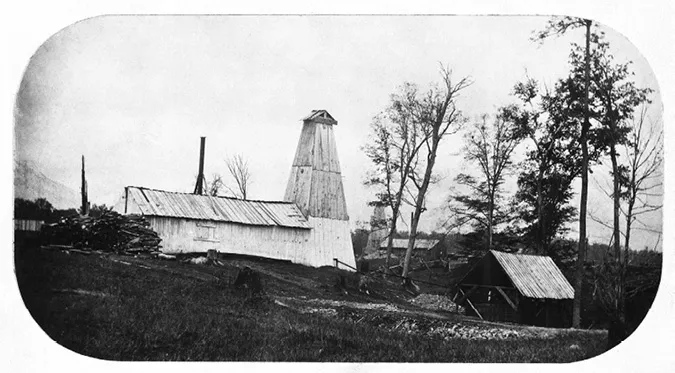
Figure 1.1. Drilling operations in Lambton County, Ontario, 1870s. Glenbow Archive IP-1a-71, Imperial Oil Collection.
In 1860 Williams incorporated his venture as the Canadian Oil Company, capitalized at $42,000 (CAD), in which he held the controlling shares. By this time he had accumulated over 1,400 acres in what was now being called “Oil Springs.” Gesner, who was in Hamilton in 1861, may have acted as a consultant in the development of the refinery there. In the following year his company’s entry at the International Exhibition in London won two gold medals, which Williams expected would boost exports outside Canada. Williams’s success ignited the first “oil boom” in Canada as hundreds of prospectors flocked to Oil Springs, many of who found they had to lease mineral rights from Williams. By the middle of 1861 over 100 wells had been undertaken in Enniskillen, although few were actually producing much oil. In the following year several producers began following the lead of Pennsylvania oilmen by drilling into the limestone several hundred feet beneath the surface. Drillers discovered several “gushers” producing hundreds of barrels per day, encouraging even more activity.
But problems were emerging. Transportation remained a challenge. Although the Great Western Railway had extended a line to Sarnia, producers in Oil Springs still had to find ways of carrying their crude twelve miles to the railhead. As new wells came in, production outran the capacity of local markets. Crude oil prices fluctuated wildly, falling from 70 cents to 10 cents per barrel in 1861–62. This situation was aggravated by a short-lived oil boom in the nearby community of Bothwell. Producers had to store their excess oil in tanks and barrels, which were often so poorly built that much oil was lost. The oil itself contained impurities, particularly sulphur, which refiners could not eliminate (although Williams claimed to have done so in 1861). Imported kerosene from Pennsylvania made inroads as consumers in British North America rejected locally produced “skunk oil.” This issue would continue to plague the Canadian industry for the next forty years.2
Then in 1863 the boom at Oil Springs suddenly collapsed as wells began to dry up. Crude prices began to climb again, to more than $1.00 per barrel. Activity shifted to another part of Enniskillen Township, the vicinity of Bear Creek, which would soon be called “Petrolia” and was officially incorporated as a village with that name in 1866. Conditions in Petrolia were somewhat different from Oil Springs: the area of potential development was substantially larger: at twenty-six square miles it was more than ten times the size of the Oil Springs oil fields. But oil wells had to be drilled deeper, between 500 and 1000 feet, while at Oil Springs gushers had been brought up at 200 to 400 feet; more investment was required for equipment. Additionally, some of the more successful producers in Oil Springs had already been acquiring land in Petrolia, notably John H. Fairbank, an American emigrant who emerged as a dominant figure in the town, establishing a general store, supplying equipment to other drillers, and opening a bank as well as producing and refining his own oil. In 1866 Fairbank played a major role in building a spur line to connect Petrolia to the Great Western Railway, a boon to all the producers.
The development of Petrolia was more orderly than at Oil Springs, although the boom and bust atmosphere persisted. When Benjamin King, working for an oil company from Saint Catherine’s, struck oil in Petrolia he ignited a new run with a horde of new investors, including John Carling of the London brewing dynasty and a number of Americans from neighbouring Michigan joining in. In 1865 crude oil prices had risen to $5.00 per barrel, surging even higher but then dropping rapidly to less than a dollar per barrel in 1867.3
The Refiners
During this period, the refining sector of the industry began to consolidate. In 1858 James M. Williams had established a refinery in Hamilton; in part this was to enable him to develop measures to reduce the sulphur content of Oil Springs crude through the addition of sulphuric acid in the distillation process. This proved to be a short-lived solution, however, as the effects of the treatment diminished when the lamp oil was stored for more than a few weeks. But locating in a larger city was useful, because he could get coopers and stavers to prepare barrels, and with the railway line Hamilton was closer to potential markets.
In the next year Williams joined up with William Spencer, an aspiring refiner from Woodstock, to build a plank road from Oil Springs to the railhead of the Great Western at Wyoming. Both participants would benefit, as the crude oil would be carried to their refineries in locations better suited to reach urban consumers. Within a short time Spencer had moved his operations to London, which was on the Great Western line, and formed a partnership with the Waterman brothers—clothiers from Germany who later split from him and set up their own operation. Refining at this stage was not a particularly capital-intensive operation, so competition thrived in the first decade of the industry. But the booms and busts of the 1860s winnowed the ranks of refiners, and by 1870 the six largest companies were located near London.
Petroleum refining was not exactly a community-friendly activity. Early refineries were hazardous: during the 1860s at least one refinery in Petrolia had burned down and another had exploded. The refining of sulphur-laden crude produced an exceptionally offensive odour that observers at the time likened to a “sea of rotten eggs;” furthermore the refiners, having extracted lamp oil, dumped the remaining waste material in local creeks and waterways. For obvious reasons city dwellers objected to these activities, and the London refiners, seeking to avoid municipal regulations, located beyond urban boundaries whenever possible and resisted efforts at annexation that would result in regulation.4
The problem of sulphur continued to bedevil the Canadian oil industry. The US market, which was supplied by lamp oil refined from “sweet” Pennsylvania crude, was off limits. In 1862 Canadian oil was banned from the ports of Liverpool and London in England, and ships carrying it were ordered to keep away from vessels with food cargoes. The limitation imposed on exports was a major cause (although not the only one) of the boom and bust cycle in the Canadian oil business. In 1868, Spencer and a neighbouring refiner in London, William Peters, discovered a new process developed in France that would “sweeten” Petrolia oil by adding an alkaline solution of lead oxide, called “litharge” to the refining. Surprisingly, they shared the process (at a price) with other London refiners, and within two years Canadian oil exports rose from 3,500 barrels to 130,000 barrels, representing more than half of the industry’s output, and peaking at about twice that level in 1873. This foothold in the English and European markets provided a degree of stability that had not existed before. The litharge treatment did not in fact address the underlying problem of sulphur content in Canadian crude oil, but it did at least salvage the floundering Canadian oil industry for the next five years.5
The advent of Canadian Confederation in 1867 offered an opportunity to address another issue: the continuing threat of American competition. In 1862 the government of Canada (then comprising Ontario and Quebec) had imposed an import duty on kerosene, which extended to crude oil two years later; but this did not cover the Maritime provinces. The new federal government established duties of 15 cents per “wine gallon” on refined oil imports (including naptha and kerosene), although this was offset by an excise tax on refined products exported from Canada. Over the following decade, as its export markets shrank, the industry would become increasingly dependent on tariffs and other barriers to expansion of the “St...
Table of contents
- Table of Contents
- Illustrations
- Acknowledgements
- Introduction
- Prologue
- • PART ONE • FOUNDATIONS 1860–1917
- Origins
- When Empires Collide
- Resurrection
- • PART TWO • Before Leduc 1917–1947
- Adventures in the Tropics
- Cogs in the Wheel
- The Winning of the West
- • PART THREE • After Leduc 1947–1980
- Golden Age
- Diversification
- A More Complex World
- Northern Visions
- • EPILOGUE • Since 1980
- The Roller Coaster
- Exxon and Imperial: Ties That Bind
- A Change in the Climate
- Conclusion
- Appendices
- Notes
- Bibliography
- Index
Trusted by 375,005 students
Access to over 1.5 million titles for a fair monthly price.
Study more efficiently using our study tools.
Frequently asked questions
Yes, you can cancel anytime from the Subscription tab in your account settings on the Perlego website. Your subscription will stay active until the end of your current billing period. Learn how to cancel your subscription
No, books cannot be downloaded as external files, such as PDFs, for use outside of Perlego. However, you can download books within the Perlego app for offline reading on mobile or tablet. Learn how to download books offline
Perlego offers two plans: Essential and Complete
- Essential is ideal for learners and professionals who enjoy exploring a wide range of subjects. Access the Essential Library with 800,000+ trusted titles and best-sellers across business, personal growth, and the humanities. Includes unlimited reading time and Standard Read Aloud voice.
- Complete: Perfect for advanced learners and researchers needing full, unrestricted access. Unlock 1.5M+ books across hundreds of subjects, including academic and specialized titles. The Complete Plan also includes advanced features like Premium Read Aloud and Research Assistant.
We are an online textbook subscription service, where you can get access to an entire online library for less than the price of a single book per month. With over 1.5 million books across 990+ topics, we’ve got you covered! Learn about our mission
Look out for the read-aloud symbol on your next book to see if you can listen to it. The read-aloud tool reads text aloud for you, highlighting the text as it is being read. You can pause it, speed it up and slow it down. Learn more about Read Aloud
Yes! You can use the Perlego app on both iOS and Android devices to read anytime, anywhere — even offline. Perfect for commutes or when you’re on the go.
Please note we cannot support devices running on iOS 13 and Android 7 or earlier. Learn more about using the app
Please note we cannot support devices running on iOS 13 and Android 7 or earlier. Learn more about using the app
Yes, you can access Imperial Standard by Graham D. Taylor in PDF and/or ePUB format, as well as other popular books in Business & Business History. We have over 1.5 million books available in our catalogue for you to explore.