eBook - ePub
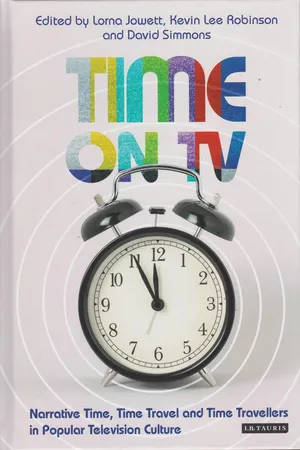
Time on TV
Narrative Time, Time Travel and Time Travellers in Popular Television Culture
- 192 pages
- English
- ePUB (mobile friendly)
- Available on iOS & Android
eBook - ePub
Time on TV
Narrative Time, Time Travel and Time Travellers in Popular Television Culture
About this book
From early examples such as Star Trek and Sapphire and Steel to more contemporary shows including Life on Mars and The Vampire Diaries, time has frequently been used as a device to allow programme makers to experiment stylistically and challenge established ways of thinking. Time on TV provides a range of exciting, accessible, yet intellectually rigorous essays that consider the many and varied ways in which telefantasy shows have explored this subject, providing the reader with a greater understanding of the importance of time to the success of genre on the small screen.
Information
1
Timey Wimey Stuff: Introduction to Time on TV
Lorna Jowett, Kevin Robinson and David Simmons
‘The representation of time within individual television texts relates to larger concerns in the media environment’
(Booth, 2012: 5)
If someone travelled back in time and, say, killed Hitler, would this change the past? Would it wipe out our present? Countless TV episodes and series have taken this science fictional ‘what if...?’ question as their focus, presenting complex concepts about time and how it works to wide audiences. Moreover, in the twenty-first century, time seems to be increasingly malleable in relation to TV: television drama now operates as anything from a weekly episode taking up a one-hour slot, to a webisode five minutes long; cult audiences often ‘binge’ on DVD box sets, watching episodes in rapid succession rather than waiting a week for the next instalment. It seems therefore not just appropriate but imperative to examine the nature of time on television, and especially its contribution to cult genres like science-fiction, fantasy and horror.
Time as a television concept has been an under-discussed area, at least until very recently. While there have been numerous publications on television shows which have utilized notions of time, little has been written which considers the concept in the wider arena. For example Doctor Who is much discussed as a television product and a cultural phenomenon but little is written about its presentation of time specifically. Similarly, although screen and narrative time have been explored in film studies, there has been comparatively little said of these in the context of television time, particularly when presented as, for example, flashback or alternative perspectives on the nature of time. When we proposed this collection on time in television, there were no other existing publications. There are now at least two. Paul Booth’s Time on TV: Temporal Displacement and Mashup Television (2012), as the title suggests, examines how representations of time on television have been affected by and seek to negotiate broader technological and social changes that affect our understanding of time. Digital culture, he argues, as well as a range of social networking and online communications have introduced new forms of media and new aesthetics, while also ‘remaining tethered to old processes and uses’ (Booth 2012: 8, original emphasis). While Booth analyses certain conventions (such as temporal displacement via flashback or flashforward) in particular television texts, he does so in order to form an argument about digital culture and social change. The other recent book dealing with TV time is Time and Television Narrative: Exploring Temporality in Twenty-First Century Programming, edited by Melissa Ames (2013), and is a wide-ranging collection with sections on industry, the cultural moment, narrative structure, genres, formats and audiences.
Our project here is somewhat different, though clearly it overlaps with both of these books. Popular television, and particularly those productions notionally categorized as cult TV, is replete with examples of time as a concept, a narrative component, a telefantasy trope and a televisual construct. These essays explore aspects of time as presented in a range of television texts, from classic to contemporary. Addressing children’s drama, cult horror and science-fiction, to name a few, this collection explores the narrative and cultural significance of time on television via the presentation of a series of case studies, held together by an emphasis on telefantasy. While Ames’ collection restricts itself to twenty-first century television, in order to make a case about shifts in television production, structures and consumption, chapters in this book cover a number of contemporary and classic productions, demonstrating how time has always been an important aspect of television drama. Chapters examine particular aspects of how we experience time from the affective (nostalgia, memory), to the chronologic (apocalypse, immortality) to the structural (flashbacks, reboots). Our contributors approach the topic from a variety of perspectives and disciplines, applying psychoanalytic theory or philosophy, examining form and structure, or situating the TV shows within the contexts of industry, production and authorship, thus offering a variety of perspectives on associated television cultures and narratives. The aim is to provide the student reader with a source of varied discussion in support of key concepts within television studies and also the wider study of genre, while for the casual reader the essays provide accessible explorations of familiar shows and concepts.
Underpinning the analysis offered by the various contributors to this book is awareness of certain key elements in television drama. In the rest of this introduction, we sketch in what we see as the three most important contexts that inform the chapters that follow: the conventions that have arisen and developed in television to represent time; industry developments that affect how time is negotiated in television drama; and how nostalgia has become a significant element of both content and consumption in terms of television.
Conventions of Time on TV
Television has an established set of conventions for representing and dealing with time. Some are derived from storytelling in general, others from other visual media like cinema. Thus audiences are familiar with how montages, ellipses, flashback and even flashforward operate. Viewers can, for example, tell when what we see is intended as a memory (a flashback) from a different time frame than the present because of certain cues, visual, aural or structural. The nature of television also means that backstory has enhanced importance, often taking on more significance than it might have in, say, a 90-minute movie. Character development in television frequently relies on what we know about a character’s history, their past experiences and relationships, and their origins (see Gwyneth Peaty’s examination of Once Upon a Time 2011–, for instance). With a long running television drama, audiences might even have years of televized narrative to draw on when responding to characters and plotlines viewed at a given moment (as with any soap opera, or with a long-running science-fiction series such as Star Trek which first aired in 1966 and finished with prequel series Star Trek: Enterprise in 2005). Thus while some types of TV have each episode reset to default for the start of the next instalment, in others, history or series-memory might form part of complex narrative arcs that develop serially. Many drama series that draw on that memory include ‘previously on’ segments at the beginning of an episode, to remind viewers of significant events from earlier in the year, or even longer ago. Such reminders can also select and highlight particular memories, perhaps even reordering or revaluing a particular instance in terms of its relative significance.
All of these conventions contribute to the complex narratives and spectacular narrative aesthetic now common in ‘quality’ TV drama. Viewers of such series take pleasure in working out – or simply keeping up with – the narrative twists and turns of any given show. As Booth notes, ‘temporally complex television “plays” with narrative, forcing the audience to reconstruct the plot from fragments of story scattered around the discourse’ (2012, 33). Approaching narrative complexity from a different angle, Matt Hills observes how official and unofficial episode guides indicate the complexity of narrative structures and the many strategies available for reordering and apprehending these narratives. We can thus see, he argues, such guides as tools ‘to manage seriality’ in a complex serial narrative ‘and make its repetitions and differences, its temporal unfoldings, more orderly and immediately present to fans as “archived” knowledge’ (2005: 192). As Hills points out, this can also be an effective commercial strategy for DVD sales, with ‘collections’ of episodes organized around particular themes or characters (like the Barnabas Collins collection of Dark Shadows 1966–1971 episodes).
In addition, some TV shows engage with epic timescale (miniseries such as Roots 1977) that can span generations and take in several different time periods. Such timescales offer the pleasures of period drama as well as of epic narrative: costume, sets and character reflect the given period and establish atmosphere. Vampire television uses its vampire characters as a means of doing this, either more or less frequently as the style of the series and perhaps the budget allows (see Lorna Jowett’s chapter). Series engaging with the fantastic might even use the concept of time travel as a means of moving into such a period setting. This can also extend to tackling the cultural attitudes and expectations of a different period, as Nicola Allen demonstrates in her evaluation of Life on Mars (2006–2007) and Ashes to Ashes (2008–2010). Other dramas might dip into different periods on an episodic basis, such as Quantum Leap (1989–1993), a series mentioned by several of our contributors.
The continuing and the domestic nature of television also mean that it can offer more sense of ‘real time’. TV productions of all kinds align themselves with the season, offering special holiday episodes which are frequently notable ‘events’ in the calendar of television, attracting large audiences: the Doctor Who Christmas specials, for instance. Television drama, like other forms of TV, can also readily respond to or reference current events as well as history. Science-fiction series Fringe (2008–2013) includes several parallel worlds or timelines and in one of these New York City retains its Twin Towers. In another sense, time passing in the real world can be mirrored by familiar characters growing up as the TV show they inhabit unfolds over the years, or, at the very least, by reflecting the same sense of ageing or time passing as the target audience experience. Booth suggests that the gradual evolution of complex narrative in the televisual representation of time is a reflection of our own fragmented post-modern experience of both fractured and reconstituted narratives (2012: 25).
TV has been traditionally identified as a medium that offers sameness and stability, familiarity and reassurance. Many of the series discussed here, however, address notions of change. Time travel shows such as Quantum Leap (1963–1989) or Doctor Who (2005–) often engage with paradoxes and returns, with characters debating whether history, or the future, can be altered. Character development is frequently related to this notion too, and several of the series discussed in this volume debate individual as well as historical change and redemption. This is related to the requirements of long-form narrative on television which aims to balance familiarity (with a particular structure, premise, situation, setting and cast of characters) and novelty (new locations, changes to the cast, developing plotlines and character arcs, ‘bubble’ episodes). Some of these changes can be caused by external factors such as regular actors leaving to pursue new opportunities, the shooting location shifting from one city or country to another, or a change in showrunners or writing personnel. In such cases, change is inevitable, though some productions seek to revitalise ideas even when a series is successful. Any long-running series is likely to attract both praise and criticism for attempting to innovate on a winning formula, with some viewers wishing it had stayed the same, or others complaining it has lost its spark.
The way we consume TV has also changed in relation to time. Raymond Williams’ popular and influential concept of television as one constant ‘flow’ has been developed and critiqued. Advances in technology and shifts in the industry of television mean that TV is no longer as ephemeral or as embedded in flow as it once might have been. Recording technologies leading to archived viewing have changed viewing habits, and audiences no longer rely on reruns for repeat viewing of favourite series or episodes. While watching weekly broadcast episodes forced viewers to wait for the next instalment, sales of boxsets allow us to binge through a series as quickly as we like. In this case, we might choose to fastforward through the ‘previously on’ segment that precedes an episode, as it may only be minutes since we finished watching the preceding one. Such relatively new viewing strategies also circumvent the suspense inherent in cliffhanger endings. This structural strategy is common to many types of television from episode to episode, as frequently seen in soap opera. Ever since the massive success of the ‘Who shot J.R.?’ season finale of primetime soap Dallas (1978–1991), serial drama has also adopted cliffhangers as a season to season structure – leaving viewers with an unresolved problem or crisis to chew over until the series returns in the following year.
On the other hand, faithful viewers and fans may choose to watch their favourite show as appointment viewing, in order to be as up to date as possible and to join in with the often instantaneous discussion of a new episode as soon as it concludes. Some may even try to get ahead by seeking out ‘spoilers’ and information about what’s coming up next. Jonathan Gray describes how fans of Lost (2004–2010) could actively seek out, or stumble across, a whole range of spoilers from ‘leaked plot points, leaked clues, leaked photos of filming, casting information, and plenty of “foilers” (fake spoilers) too’ (2010, 147). Such practice demonstrates not only how certain types of TV drama deliberately aim for temporal complexity within their narratives, but also how viewers can actively engage with such complexity both within the world of a show, and outside of it.
Industry
As we finalized the content for the book, probably the most important example of the time travel narrative on television was celebrating its fiftieth anniversary. The term ‘celebrating’ is used in its loosest sense here, though. Doctor Who was more than celebrated. It was canonized, lionized and idolized as one of the biggest achievements of not only telefantasy but also the television industry in general. There were numerous shows and events celebrating what is undoubtedly a landmark and possibly an unrepeatable success for a ‘genre’ show. There can be little doubt that Doctor Who is a unique and mercurial series that has managed to stay a viable product in some form for half a century while weaving its own mythology into British popular culture. In addition, it has become internationally successful as both current popular television broadcasting and as part of the science-fiction landscape.
In terms of academia it is perhaps fair to say that, along with shows such as Star Trek (1966–2005) and The Prisoner (1967–68), Doctor Who has become one of the most written about and studied shows in television history and, in the months preceding and following its golden anniversary, a plethora of studies, guides and other publications were filling the shelves. These included everything from weighty academic tomes through to children’s colouring books that helped perpetuate and expand the Whoniverse and Who studies.
The fiftieth anniversary of Doctor Who was celebrated by the television industry and, of course, specifically by the BBC and its allies with the same canon of supporting shows as you would expect to see surrounding a royal event. This is hardly surprising as, in telefantasy terms at least, Doctor Who has legitimate claim to the crown. The pomp and ceremony surrounding the landmark episode has ranged from party celebrations resplendent with celebrities and ex-cast members, through to light-hearted and serious documentaries about aspects of the show, and even independent productions featuring previous doctors attempting to crash the fiftieth anniversary special (The Five-ish Doctors Reboot). The loudest industry shout of celebration came in the BBC Two dramatization An Adventure in Space and Time which explored the events surrounding the creation of the show. The attachment of writer Mark Gatiss and actors such as Brian Cox and David Bradley to the drama suggest the BBC anticipated high audience numbers and good critical response for the production. Indeed, it was well-received at a critical level. Daily Telegraph critic Michael Hogan gave a report similar to most other critical sources, stating that ‘A warm glow radiated from the screen and bathed the viewer in TV magic.’ Critical and audience figures aside (it played to a very respectable 2.71 million viewers, making it a top five show for BBC Two) An Adventure in Space and Time is in itself a remarkable television event. The presentation was part docudrama, part historical record, and part stand-alone character drama. Interestingly, the narrative referenced the current incarnation of the show with a ghostly appearance by incumbent doctor Matt Smith acknowledging the ailing Hartnell, and by echoing the departing lines of David Tennant’s tenth doctor, ‘I don’t want to go’.
With audio productions, books, stage plays, and a plethora of toys and merchandise, it would seem the Doctor is as much a survivor of the countless changes and pressures of the media industries as he is of repeated assaults by Daleks, Cybermen, Weeping Angels and every rubber-clad or computer generated monster he has faced. As in his on-screen adventures, the Doctor is aided and abetted in his production adventures by his trusted companions of loyal audience, commercial viability and critical success. Indeed, Doctor Who’s production stands as a metaphor for the industry surrounding it.
Television narrative’s presentation of time, time travelling and telefantasy in general is subject to the same industrial pressures as on any show. Success is at the mercy not only of the whims of the audience in terms of viewing figures, but also of international television topography, of the technological requirements of series and ...
Table of contents
- Cover
- About the Author
- Title Page
- Contents
- List of Contributors
- Acknowledgements
- 1. Timey Wimey Stuff: Introduction to Time on TV
- Part I: Structuring Time
- Part II: Experiencing Time
- Work Cited
- TV and Filmography
- Index
- eCopyright
Trusted by 375,005 students
Access to over 1.5 million titles for a fair monthly price.
Study more efficiently using our study tools.
Frequently asked questions
Yes, you can cancel anytime from the Subscription tab in your account settings on the Perlego website. Your subscription will stay active until the end of your current billing period. Learn how to cancel your subscription
No, books cannot be downloaded as external files, such as PDFs, for use outside of Perlego. However, you can download books within the Perlego app for offline reading on mobile or tablet. Learn how to download books offline
Perlego offers two plans: Essential and Complete
- Essential is ideal for learners and professionals who enjoy exploring a wide range of subjects. Access the Essential Library with 800,000+ trusted titles and best-sellers across business, personal growth, and the humanities. Includes unlimited reading time and Standard Read Aloud voice.
- Complete: Perfect for advanced learners and researchers needing full, unrestricted access. Unlock 1.5M+ books across hundreds of subjects, including academic and specialized titles. The Complete Plan also includes advanced features like Premium Read Aloud and Research Assistant.
We are an online textbook subscription service, where you can get access to an entire online library for less than the price of a single book per month. With over 1.5 million books across 990+ topics, we’ve got you covered! Learn about our mission
Look out for the read-aloud symbol on your next book to see if you can listen to it. The read-aloud tool reads text aloud for you, highlighting the text as it is being read. You can pause it, speed it up and slow it down. Learn more about Read Aloud
Yes! You can use the Perlego app on both iOS and Android devices to read anytime, anywhere — even offline. Perfect for commutes or when you’re on the go.
Please note we cannot support devices running on iOS 13 and Android 7 or earlier. Learn more about using the app
Please note we cannot support devices running on iOS 13 and Android 7 or earlier. Learn more about using the app
Yes, you can access Time on TV by Lorna Jowett, Kevin Robinson, David Simmons, Lorna Jowett,Kevin Robinson,David Simmons in PDF and/or ePUB format, as well as other popular books in Media & Performing Arts & Television History & Criticism. We have over 1.5 million books available in our catalogue for you to explore.