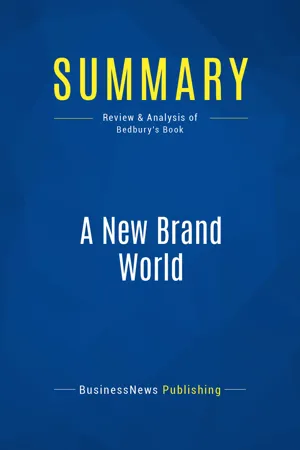
The must-read summary of Scott Bedbury's book: "A New Brand World: 8 Principles for Achieving Brand Leadership in the 21st Century".
This complete summary of the ideas from Scott Bedbury's book " A New Brand World" shows that a strong set of brand values can be a company's most important asset. In their book, the authors outline eight principles for creating a solid 21st century brand, giving useful and well-known industry examples to highlight the main points. An impressive amount of information has been condensed into this neat and digestible format, making it a great guide for anyone looking to build a memorable brand for the 21st century, whether you are building on existing foundations or starting entirely from scratch.
Added-value of this summary:
• Save time
• Understand key concepts
• Increase your business knowledge
To learn more, read "A New Brand World" and find out how to create a solid 21st century brand based on values.
- English
- ePUB (mobile friendly)
- Available on iOS & Android
eBook - ePub
About this book
Information
Subtopic
AdvertisingIndex
BusinessSummary of A New Brand World (Scott Bedbury)
Principle #1: Brands need to be more concerned about relevancy and resonance than awareness.
Main Idea
Brand awareness and recognition are just superficial measures of any brand’s effectiveness. More importantly, good brands build relationships with consumers. They are relevant to what consumers want and resonate with them.
Supporting Ideas
First, how exactly do you define a brand? One definition is:
“A brand is the sum of the good, the bad, the ugly and the off-strategy. It is defined by your best product as well as your worst product. It is defined by award-winning advertising as well as by the awful ads that somehow slipped through the cracks, got approved and, not surprisingly, sank into oblivion. It is defined by the accomplishments of your best employee as well as by the mishaps of the worst hire you ever made. It is also defined by your receptionist and the music your customers are subjected to when placed on hold. For every grand and finely worded public statement by the CEO, the brand is also defined by derisory consumer comments overheard in the hallway or in a chat room on the Internet. Brands are sponges for content, for images, for fleeting feelings. They become psychological concepts held in the minds of the public, where they may stay forever. As such you can’t entirely control a brand. At best you only guide and influence it.”
In short, branding is the art of taking something common and making it more valuable. For example, Starbucks took coffee beans and turned it into a branded product people know and ask for. Nike took sneakers and turned them into a brand that is now inseparably connected with the rewards of sport and fitness in the minds of the consumer. That illustrates the alchemical power of brands to take something common and turn them into gold.
In previous generations, the “holy grail” of branding was to generate awareness – to ensure as many people as possible knew about your product. The theory was if your product was on everyone’s radar screen, they would not want to buy your competitor’s product. The only problem with that is that by solely creating awareness, pretty soon your product loses any meaningful degree of differentiation, and then customers start wondering why you spend so much on marketing.
Thus, good brands are not merely well known. Instead, good brands make an emotional connection with customers. They are relevant to the customer’s needs and they resonate deeply. How do brands achieve this? There are a number of different ways:
- By offering mass customization – a broad array of niche products which customers can choose from to create the product just the way they want it.
- By staying at the cutting edge – either by obsoleting their own products with successive generations of better products (Intel) or by continually bringing out new and better products which advance the state-of-the-art (Nike).
- By constantly reinventing and refreshing themselves – so that no matter which way consumer tastes are moving, the brand will still remain in sync with consumer tastes.
- By consistently evolving marketing communications – to match changes which are occurring in the consumer marketplace constantly. That way, the marketing never wears out its welcome.
Good brands consistently and constantly evoke positive feelings. Each time a new product or service is added, or a new marketing campaign is launched, good brands become refreshed and reinvigorated. The very best brands have one core theme or idea. New products and new services are drawn into the ongoing narrative as another chapter in the unfolding story of the brand, with the proviso that each new chapter has the customer as the main character rather than the company.
In particular, brands are important because:
- Strong brands build up a reservoir of public goodwill which can enable companies to ride out the inevitable rough sports which crop up from time to time.
- Products and services will come and go, but if customers have a great experience with any specific brand, they will be predisposed to do more business in the future.
- Brands are living concepts that reside in the minds of the customer. A brand is no more than a composite of all the experiences and interactions with that business. And since brands are living concepts, some elements that go into them are purely emotional and often irrational.
- Brands have “karma” – they set themselves apart from the mainstream by making people feel good.
Key Thoughts
“Even the best advertising cannot create something that is not there. If a company lacks soul or heart, if it doesn’t understand the concept of the ‘brand’, or if it is disconnected from the world around it, there is little chance that its marketing will resonate deeply with anyone. It’s a lot like putting lipstick on a pig.”
– Scott Bedbury
“The best brands never start out with the intent of building a great brand. They focus on building a great – and profitable – product or service and an orga...
Table of contents
- Cover
- Book Presentation: A New Brand World by Scott Bedbury
Trusted by 375,005 students
Access to over 1.5 million titles for a fair monthly price.
Study more efficiently using our study tools.
Frequently asked questions
Yes, you can cancel anytime from the Subscription tab in your account settings on the Perlego website. Your subscription will stay active until the end of your current billing period. Learn how to cancel your subscription
No, books cannot be downloaded as external files, such as PDFs, for use outside of Perlego. However, you can download books within the Perlego app for offline reading on mobile or tablet. Learn how to download books offline
Perlego offers two plans: Essential and Complete
- Essential is ideal for learners and professionals who enjoy exploring a wide range of subjects. Access the Essential Library with 800,000+ trusted titles and best-sellers across business, personal growth, and the humanities. Includes unlimited reading time and Standard Read Aloud voice.
- Complete: Perfect for advanced learners and researchers needing full, unrestricted access. Unlock 1.5M+ books across hundreds of subjects, including academic and specialized titles. The Complete Plan also includes advanced features like Premium Read Aloud and Research Assistant.
We are an online textbook subscription service, where you can get access to an entire online library for less than the price of a single book per month. With over 1.5 million books across 990+ topics, we’ve got you covered! Learn about our mission
Look out for the read-aloud symbol on your next book to see if you can listen to it. The read-aloud tool reads text aloud for you, highlighting the text as it is being read. You can pause it, speed it up and slow it down. Learn more about Read Aloud
Yes! You can use the Perlego app on both iOS and Android devices to read anytime, anywhere — even offline. Perfect for commutes or when you’re on the go.
Please note we cannot support devices running on iOS 13 and Android 7 or earlier. Learn more about using the app
Please note we cannot support devices running on iOS 13 and Android 7 or earlier. Learn more about using the app
Yes, you can access Summary: A New Brand World by BusinessNews Publishing in PDF and/or ePUB format, as well as other popular books in Business & Advertising. We have over 1.5 million books available in our catalogue for you to explore.