Reading Sideways explores the pivotal role that various art forms played in American literary fiction in direct relation to the politics of gender and sexuality in works of modern American literature. It tracks the crosswise circulation of aesthetic ideas in fiction and argues that at stake in the aesthetic turn of these works was not only the theorization of aesthetic experience but also an engagement with political arguments and debates about available modes of sociability and sexual expression. To track these engagements, its author, Dana Seitler, performs a method she calls "lateral reading," a mode of interpretation that moves horizontally through various historical entanglements and across the fields of the arts to make sense of—and see in a new light—their connections, challenges, and productive frictions.
Each chapter takes a different art form as its object: sculpture, portraiture, homecraft, and opera. These art forms appear in some of the major works of literature of the period central to negotiations of gender, race, and sexuality, including those by Henry James, Davis, Willa Cather, Du Bois, Sarah Orne Jewett, and Mary Wilkins Freeman. But the literary texts that each chapter of this book takes as its motivation not only include a specific art form or object as central to its politics, they also build an alternative aesthetic vocabulary through which they seek to alter, challenge, or participate in the making of social and sexual life. By cultivating a counter-aesthetics of the unfinished, the uncertain, the small, the low, and the allusive, these fictions recognize other ways of knowing and being than those oriented toward reductively gendered accounts of beauty, classed imperatives established by the norms of taste, or apolitical treatises of sexual disinterestedness. And within them—and through "reading sideways"—we can witness the coming-into-legibility of a set of diffuse practices that provide a pivot point for engaging the political methods of minoritized subjects at the turn of the twentieth century.
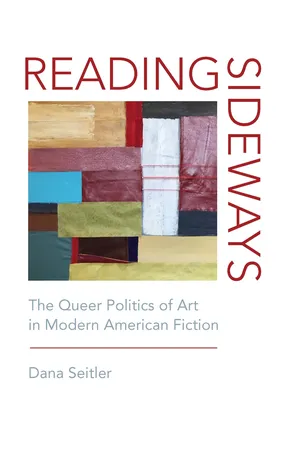
- 208 pages
- English
- ePUB (mobile friendly)
- Available on iOS & Android
eBook - ePub
About this book
Information
Publisher
Fordham University PressYear
2019Print ISBN
9780823282616
9780823282623
Edition
1eBook ISBN
9780823282630
CHAPTER 1
Strange Beauty
Near the middle of the first book of Little Women (1868), Jo, Meg, Laurie, and the whole crew sit down for a game of “Rigmarole”: “One person begins a story, any nonsense you like, and tells as long as they please, only taking care to stop short at some exciting point, when the next takes it up, and does the same. It’s very funny, when well done, and makes a perfect jumble of tragical comical stuff to laugh over.”1 Everyone takes a turn and, as they do so, employs agile knowledge of the various generic conventions available to nineteenth-century readers: fairy tale (“Once upon a time” [125]), romance (“A ravishing lovely lady” [125]), adventure (“Instantly Sir What’s-his-name recovered himself, pitched the tyrant out of the window, and turned to join the lady” [126)], the Gothic (“A tall figure, all in white, with a veil over its face, and a lamp in its wasted hand” [126]), comedy (“Thankee,” said the knight […] and sneezed seven times so violently that his head fell off” [126]), the seafaring novel (“the jolly tars cheered like mad” [127]), and so on. “What a piece of nonsense we have made!” exclaims Sallie (128). This piece of nonsense, though, signals Alcott’s own aptitude for manipulating literary convention and, therefore, potentially her awareness of the conventions she herself was reinforcing when writing Little Women. It also serves to mark and upset neat taxonomies of reading and writing. Unsurprisingly, a later incarnation of “Rigmarole” became popular amongst the surrealists, who renamed the game “exquisite corpse” after a sentence formed when they first played it: “Le cadavre exquis boira le vin nouveau” (“The exquisite corpse will drink the new wine”).2 In this version, phrases were written down on a piece of paper, and then folded to conceal part of the writing before being handed to the next player. Enjoyed by the likes of Breton, Duchamp, Miró, and Tzara, Exquisite Corpse (and Rigmarole before it) emphasizes the pleasure of accident and embraces the spirit of collective verbal collage. It also registers the banality of literary convention and the standardization of storytelling. These are games that allow players to perform their literary erudition that, in turn, points out the near-coagulation of literary form. But in producing “a perfect jumble,” Rigmarole in Little Women might also be aspirational (124).
These days, the term “aspirational” is usually linked to neo-liberal corporate-speak. Aspiration in this context acts as a form of social hope based on the fantasy of individualized socioeconomic mobility. But, historically, an aspirational narrative might be thought of as a text dissatisfied with available conventions of expression and representation. An aspirational narrative might repeat certain conventions but develops its story, style, or form in such a way as to record the problems of doing so. We might think of the aspirational narrative, then, as one that, like Little Women, codifies the very genre it represents but also registers the act of codification within its own terms. But if Little Women can be considered aspirational in this sense, to what does it aspire? The genre of American sentimental fiction to which nineteenth-century women writers were consigned? The ardent game of Rigmarole eschews such a reading and, in its place, emphasizes both the obvious knowledges produced by literary genres and styles and the fund of possibility that such knowledges simultaneously offer. Alcott stages child’s play as literary play and, in so doing, aspires not so much to a specific literary form or style but toward a practice of the critique of style. Can we take Little Women as our (perhaps surprising) North Star and let it guide us toward other such practices of aesthetic critique, practices that we might find in places we don’t think we will? If queer and feminist literary accounts of Little Women, by and large, have revealed how the play of female intimacy and adolescent expansion in it are given space only so that they may be parlayed into patriarchialized gender training and the closure of heterosexual marriage in the end, the girls’ game of Rigmarole points us toward an awareness and a critique of that narrative as well as that social imperative.
One of the more crucial questions this critique poses concerns how aesthetic form may help or hinder us to imagine new political and social modes, especially when the material and aesthetic resources to do so are all but non-existent. Rebecca Harding Davis’s 1861 novella, Life in the Iron Mills, also takes this problem as its central question. It does so by playing a game of Rigmarole. Grappling with questions of genre, reading, and writing—winding its way through romance, the Gothic, sentimentality, and an inchoate realism—Iron Mills poses political questions as aesthetic ones, and vice versa.3 The text posits a coterminous relation between art and politics in the nineteenth century, most especially in its use of sculpture to dramatize class struggle and, indirectly, the problem of the woman writer. The text’s efforts culminate in its central figure: the korl woman statue carved by Hugh Wolfe in his off hours out of the waste material of the iron manufacturing process. The sculpture represents Wolfe’s thirst “to know beauty,” a knowledge that would allow him to become “something other than he is.”4 The explicitly feminized art object is what seems to quench this thirst insofar as it transforms his experience of deprivation into form. But the sculpture—described as “rough” and “ungainly”—in its atypical expression of the feminine simultaneously disables any easy aesthetic distance that would result in the attribution of beauty normatively defined (IM 74). Instead, its particular non-normative form of femininity formalizes what the text attempts to call into being. At stake here is not the foregrounding of the political problem of the oppressed, subordinated subject who can use art as a form of escape, but a foregrounding of the aesthetic problem of what forms of representation exist or do not exist at any given moment that make imaginable new forms of personhood or even social change.
Aspiration as Critique
My thoughts about aspirational texts as critical texts are intended as an experiment in thinking through the socially structured expectations of genre. If personhood is always an aesthetic event—if notions of persons are played out as any variety of generic mappings and fictive scripts—how has literature participated in this event? My thoughts along these lines have many sources, perhaps, beginning, as José Muñoz does, with Ernst Bloch’s work in The Spirit of Utopia (1918) and The Principle of Hope (1938–47).5 In those works, Bloch argues that the intricacies of hope can be unearthed in even the most ideological of products (but also in various forms of music, art, and poetry), which contain emancipatory moments that project visions of a space beyond the organization and structure of life under capitalism.6 Lauren Berlant’s and Michael Warner’s early essay on queer studies—“What Does Queer Theory Teach Us about X?”—understands aspiration not as immanent in the object, as does Bloch, but born of practice, and thus demonstrates the various optimisms that buoy much queer work. Berlant and Warner discuss “queer commentary” as work that “aspires to create publics, […] publics whose abstract spaces can also be lived in, remembered, hoped for.” But these publics are less finite social formations than imagined forms of belonging: “membership in them is more a matter of aspiration than it is the expression of identity or history.”7 The work of aspiring to a community, politics, or aesthetic project enables a kind of dreaming forward, a vision of both a present and a future in relation to how we participate in the creative practices that can produce a world.
More recent interest within queer studies in notions of aspiration continues this line of thinking about how we might create new forms of collectivity and produce new forms of aesthetic analysis that don’t succumb to the pressures of political pessimism and negation. Muñoz, who weds Bloch to the lessons of queer commentary, writes, “We must dream and enact new and better pleasures, other ways of being in the world, and ultimately new worlds.”8 For Muñoz, the aim is to embrace what Bloch called the “not-yet-here,” a practice that harnesses the stark reality of the everyday to a collective ideality; that inhabits an optimism understood not as a species of false consciousness, or misguided ambition, but as a mode of cultural critique and political resistance.9 The forms of critical aspiration evinced by Bloch, Berlant, Warner, and Muñoz alike are about sustaining a space of inquiry—a project driven by the form of a question, and yet comfortable with those questions remaining open and sometimes unanswerable.10
As Berlant and Warner’s earlier work makes clear, various investments in aspirational forms have been around for a while, finding particular expression in queer and feminist poststructuralist theory.11 Feminist film theory, in its earliest incarnations, is instructive here. Laura Mulvey, Kaja Silverman, and Mary Ann Doane, among others, while presenting divergent analyses of film culture, all labored in solidarity to search for a cinema that did not enclose the female body within its masculinist scopic logic. Mulvey called for “a total negation of the ease and plenitude of the narrative fiction film” and Silverman for relentless feminist textual intervention: “It can only be through the creation and circulation of alternative images and words that [the subject] can be given access to new identificatory coordinates.”12 Such claims resonate with those of Luce Irigaray and Hélène Cixous who, bracingly and unabashedly, called for the invagination of language. While Cixous argued that “woman must write her self,” Irigaray sought to locate the “elsewhere” of female pleasure and thus to wrest the question of the feminine away from the economy of the logos.13 Intimating an intense intimacy, Irigaray urges, “Let’s hurry and invent our own phrases.”14 She wasn’t the only one with this ardent desire: from Donna Haraway’s embrace of “the promise of monsters” in feminist science fiction to Jane Gallop’s re-focusing of our psychoanalytic attention on women as desiring subjects to Kathryn Bond Stockton’s crucial insistence that “we need to discourse upon escapes from discourse,” we can see how, along with analysis of the different genres of subjectivity that women are compelled to repeat, came an equally urgent call for new ways to imagine the relation between language and signification.15
Regardless of their differences and the various accusations of essentialism some of them have garnered, these projects instruct us on the political necessity of engaging the aesthetic. As much as they are challenged, generic conventions never go away, making their undoing an ongoing political and aesthetic necessity. The question that thus drives me here is this: Is there a history of aesthetic refusal that can teach us ways to rethink the binding narratives of compressed personhood? By paying closer attention to already existing histories of aesthetic resistance, might we be able to de-historicize—understand as less dominant—the stabilizing force of genre and style and the horizon of expectation they create about how to think, feel, and be in the world? Finally, how might thinking historically about critical aesthetic forms help us to expropriate the language and logic of aspiration from neo-liberal co-optations of it as part and parcel of capitalist subjectivity? Is there a counter-aesthetics of aspiration to uncover here?
Standardized accounts of nineteenth-century “aspirational narratives” already exist, as do the narratives themselves, ones that so assuredly thematize American individualism and its attendant fantasies of the acquisition of wealth and power (Ragged Dick, Sister Carrie, and the like). This late-nineteenth-century boot-strap ideology corresponds quite readily to contemporary accounts of the neoliberal entrepreneurial subject, imagined as operating with freedom and autonomy in an inexhaustible marketplace. Aspiring to something in these contexts means attaching yourself to a set of conditions that relocate you within the very narrative you hoped to surpass: in this case, one of economic inequality and class difference.16 These narrative forms point to the problem whereby even hope and happiness—what we wish for and work toward—are accommodated to a capitalist enterprise. Their entrenchment may well explain why Life in the Iron Mills takes the dreamscape of class mobility and capitalist industrialism as its context. Here, I am trying to develop a different conversation about the aspirational, not one in which our cathexis to aspiration impedes our ability to thrive, nor one in which our potential to survive coercive contexts exists in the always receding horizon of a utopian future. I want to think about how aspiration has been historically wedded to critique. I turn to late-nineteenth-century questions of form and genre as a nodal moment in which aesthetic relations are in flux, and in which a number of texts usually conceived as fixed, including Little Women and Iron Mills, formally register the pressures of their aesthetic and social constraints. Existing on the cusp of the solidification of the subsequently powerful categories of realism and naturalism, Iron Mills makes concrete some of the costs of that solidification and our reliance on these generic categories to organize understandings of late-nineteenth- and early-twentieth-century literature and culture. To think about a narrative that aspires toward something other than what it is means eschewing a desire for generic permanence and instead thinking about narrative as productively incompetent to the story it strives to tell.
Ungenre
Since its reprint in 1971, Life in the Iron Mills has been consistently pored over for its hybrid tendencies and ultimately upheld as an anticipatory example of American realism. Nonetheless, because Iron Mills emerged from a mid-nineteenth-century culture of sentimental fiction, a central literary-critical debate concerns the tensions between the novella’s realism and its sentimentality. While Sharon Harris suggests that Davis should be thought of as a “metarealist” whose work “synthesize[s] several modes (romanticism, sentimentalism, realism),” she ultimately concedes, “realism remains [her] most explicit focus.”17 Jean Pfaelzer, on the other hand, looks closely at the function of sympathy in the novella, which “flows across class and gender lines in a transcendent motif of female subjectivity.”18 In addition to realism and sentimentality in Iron Mills, though, readers will also notice the text’s Gothic tendencies, its ambivalent transcendentalism, and its recourse to religious discourse. In part, this displays Davis’s literary erudition, as was a common practice for nineteenth-century women writers, who demonstrated in print the strength and scope of their intelligence as a way to legitimize their authorship. It also puts into practice an active search for narrative form—for the manner of storytelling that would best serve the aims and objectives of the story.
If the novella’s primary literary modalities have sparked critical debate, there exists an equally significant discussion of its major themes. Some critics, like Pfaelzer and Harris, focus on the historical condition of women, others, such as Rosemarie Garland Thomson, on the disabled body (via Deb’s hunchback form).19 Still others, such as Amy Schrager Lang and Laura Hapke, shift the conversation from gender to class, cogently arguing that class relations in the text are not simply metaphors for the struggles of the woman writer but a vital subject in themselves.20 Eric Schocket analyzes the text’s racial constructions of both class and whiteness, and Gavin Jones emphasizes the material conditions of the working poor on display in the story.21 Each of these arguments has made a significant contribution to our understa...
Table of contents
- Cover
- Half Title
- Title Page
- Copyright
- Contents
- List of Illustrations
- Half Title
- Introduction
- 1. Strange Beauty
- 2. Small Collectivity and the Low Arts
- 3. The Impossible Art Object of Desire
- 4. Willa Cather and W. E. B. Du Bois Go to the Opera
- Conclusion
- Acknowledgments
- Notes
- Index
- About the Author
Trusted by 375,005 students
Access to over 1.5 million titles for a fair monthly price.
Study more efficiently using our study tools.
Frequently asked questions
Yes, you can cancel anytime from the Subscription tab in your account settings on the Perlego website. Your subscription will stay active until the end of your current billing period. Learn how to cancel your subscription
No, books cannot be downloaded as external files, such as PDFs, for use outside of Perlego. However, you can download books within the Perlego app for offline reading on mobile or tablet. Learn how to download books offline
Perlego offers two plans: Essential and Complete
- Essential is ideal for learners and professionals who enjoy exploring a wide range of subjects. Access the Essential Library with 800,000+ trusted titles and best-sellers across business, personal growth, and the humanities. Includes unlimited reading time and Standard Read Aloud voice.
- Complete: Perfect for advanced learners and researchers needing full, unrestricted access. Unlock 1.5M+ books across hundreds of subjects, including academic and specialized titles. The Complete Plan also includes advanced features like Premium Read Aloud and Research Assistant.
We are an online textbook subscription service, where you can get access to an entire online library for less than the price of a single book per month. With over 1.5 million books across 990+ topics, we’ve got you covered! Learn about our mission
Look out for the read-aloud symbol on your next book to see if you can listen to it. The read-aloud tool reads text aloud for you, highlighting the text as it is being read. You can pause it, speed it up and slow it down. Learn more about Read Aloud
Yes! You can use the Perlego app on both iOS and Android devices to read anytime, anywhere — even offline. Perfect for commutes or when you’re on the go.
Please note we cannot support devices running on iOS 13 and Android 7 or earlier. Learn more about using the app
Please note we cannot support devices running on iOS 13 and Android 7 or earlier. Learn more about using the app
Yes, you can access Reading Sideways by Dana Seitler in PDF and/or ePUB format, as well as other popular books in Literature & Art Theory & Criticism. We have over 1.5 million books available in our catalogue for you to explore.