- 248 pages
- English
- ePUB (mobile friendly)
- Available on iOS & Android
eBook - ePub
About this book
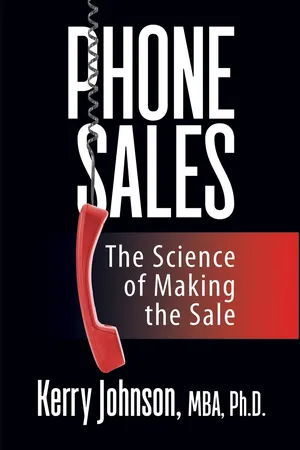
How can you get through gate-keepers? How can you get calls returned? How can you reach more prospects instead of their voicemails? Phone Sales will make your phone a profit center. This book includes actual phone sales calls from top producers.
Some of the skills you'll learn are:
• The 3 best closes to use on the phone
• How to book appointments
• What to say when someone says, "I'm not interested"
• How to avoid telephone tag
• How to get your calls returned
• How to beat "call reluctance"
Dr. Kerry L. Johnson is a best selling author and speaker. He speaks to audiences around the world at least 8 times a month ranging from Hong Kong to Halifax, and from New Zealand to New York. Traveling 8,000 miles each week, Dr. Johnson presents such topics as "How to Read Your Customers Mind," "The Trust Connection" and Peak Performance: How to Increase Business by 80% in 8 weeks."
In addition to speaking, Kerry heads Peak Performance Coaching. Professionals around the world use Dr. Johnson and his coaches to increase business often by 300%.
Kerry currently writes monthly for fifteen national trade and management magazines whose editors have dubbed him, "The Nation's Business Psychologist." He is also the author of nine best-selling books including: MASTERING THE GAME, PEAK PERFORMANCE: HOW TO INCREASE YOUR BUSINESS BY 80% IN 8 WEEKS, and WILLPOWER: THE SECRETS OF SELF-DISCIPLINE. Kerry spent two years competing on the International Grand Prix Tennis Tour. He played both singles and doubles matches against some of the worlds top tennis players. Kerry was also recognized by the U.S. Jaycees as one of the Most Outstanding Men in America.
Information
Topic
Desarrollo personalSubtopic
Ventas
Eleven
The Presentation
So far you’ve learned how to approach your prospect or client and get through the secretarial screen to the decision maker. You have also learned how to use a script to become more articulate and prepared on the telephone. You’ve additionally learned how to probe to find out your prospect and client’s needs.
In this chapter, we’ll not only cover how to present your product or service ideas, but more importantly, how to present those ideas in the way your prospect wants to buy. This section on presenting is probably the one that’s talked about the most by sales trainers coast to coast.
The difference is that on the phone you have to be able to present your ideas more concisely and succinctly, using each word to grab your prospect. Unlike a face-to-face interview, you can’t talk indirectly about benefits, hoping your prospect will suddenly buy them. In a face-to-face interview, you can use a shotgun approach. This is much more difficult on the telephone, where you have to rifle-shot the product benefit in exactly the way your prospect wants to perceive it. If you do this, you will make a sale.
The first rule of presenting on the telephone is not just explaining your ideas but selling them. Most salespeople from coast to coast explain and try to educate. They typically answer questions and explain the technical makeup of the product. This will help your prospects find out a lot more about your product than they previously knew, but won’t put any dollars in your pocket.
I have a friend who sold annuities—an insurance product. We had her over for Christmas Day at a family reunion recently. She enjoyed talking to prospects but felt uncomfortable pushing them. I helped her realize that she wasn’t really pushing her prospects as much as helping them reach a decision. I explained something all sharp phone salespeople understand: if you only educate your prospects, they will buy from somebody else, but if you present the product in terms of what the prospect needs and wants, they will see it as a benefit and buy.
Often during the probing stage, your prospects will share their needs and desires. They’ll tell you their wants and will often let you know whether they can benefit from your product. All you have to do then is simply match their needs to your product’s benefits. But few salespeople understand that if they present more benefits than the prospect wants to hear, the prospect may lose interest. The salesperson may blow himself right out of the sale. This happens all too frequently. Salespeople often feel they have to explain the product or service to the point that the prospect becomes bored or even disinterested.
It’s a little like the young boy who went to his father one day and said, “Dad, where did I come from?” The father, realizing this was “the time,” explained about procreation for a solid two hours. The father then said to the boy, “Do you understand all this?” The boy said, “Yes, Dad, I do, but Jimmy came from Detroit, and I just want to know where I came from.”
You may be explaining a whole lot more than your prospect wants to hear. There’s a popular saying in the professional speaking business: the only way a speaker can say less is to speak longer.
If you get one thing from this chapter on presenting on the phone, it should be to present those product benefits that answer your prospect’s needs. Avoid the temptation to tell your prospect everything. Keep your mouth shut.
Once I consulted with a financial planner. During an interview, my client asked his client what he most wanted to gain from investments. The client said, “I want growth and cash flow.” The financial planner then presented a few limited partnerships. He discussed growth and cash flow, but also mutual funds, annuities, stocks, and bonds. He presented basically three times as much as the prospect was interested in. You could see confusion and frustration on the prospect’s face. Although the prospect was polite and didn’t try to interrupt the planner, that sale was lost within the first ten minutes.
Here’s a key idea for you. The better job you do on the telephone in matching your product benefits to the information you received during the probing stage, the fewer objections you will receive when you try to close. This means a lot, because it states that the better you listen during the probing or fact-finding stage, the more committed your prospect will be to buying your product.
Think for a moment. What are the features of a mechanical pencil? It has an eraser on the end. It has lead that sticks out of the tip without the need to be sharpened. It is also durable and lasts a lot longer than a regular pencil. But there’s a big difference between the features I just named and the benefits.
The features of a mechanical pencil are the characteristics that make it salable. The benefits of the pencil are how those features help the prospect.
The benefits of an eraser on a mechanical pencil are that it allows me to quickly and easily get rid of mistakes without leaving a trace. The benefit of a clicker is to advance the lead smoothly without sharpening. Another benefit of the mechanical pencil is durability: I won’t have to go and buy a new pencil very often. The pencil fits nicely into my hand. It’s not as thin as most pencils, thereby enabling me to write for longer periods of time without fatigue.
Effectively presenting product benefits is more important on the telephone than it is face-to-face, because you have less time to probe and present. It’s critical to focus on listening. The more benefits you can match to your prospect’s needs, the quicker you’ll be able to sell.
There are two kinds of benefits: primary and secondary. A primary benefit is totally dependent on your prospect’s needs. It’s your prospect’s most important need, such as the ability to advance the lead, or an eraser that lasts for a long time. You can only learn what the primary benefit is by asking the prospects what their most important needs are.
A secondary benefit is also important, but it is lower down on the priority ladder—for example, the width of a mechanical pencil. It feels good in my hand, but it’s not as important as the clicker, which advances the lead. The color of the mechanical pencil could be secondary. It’s important for aesthetic reasons, but could take second place to a primary benefit, such as that of an eraser. Again, it is impossible to know a product benefit until you first find out what the prospect wants. Which features are beneficial?
Have you ever seen the commercial on television selling Hanes underwear? Have you seen inspector number 12? She’s a woman in her late fifties, and her sole job is to inspect men’s briefs. Her line is, “It doesn’t say Hanes until I say it says Hanes.” The same is true of a product benefit. It doesn’t say benefit until your prospect says it says benefit.
I was recently called by a woman selling conference-call discount services. She didn’t ask any questions at all during the conversation, but her approach was good, so I listened for three or four minutes. She told me about her Webex type of service. It was with a nationwide company, and she explained that the discount would be between 10 and 30 percent below Webex. She also said I could use an 800 number to access the call line and then dial in my unique code. I would also have individualized statements depending on the code number used.
After she was done, I said, “Thank you very much. I’m not interested.” I was interested in a discount bridge-line service, but I was not interested in her product features. I’d been using join.me for a few years. I was not especially loyal but was looking for a better deal. I was interested in making a change, but I did not need her product features. I did need her to listen to my needs and to match how her features with them, explaining what could have been beneficial to me. If she had taken some time to probe, she would have known what features to present and then translated those into benefits. If she knew what you know now about features and benefits, she would have said, “Do you travel a lot?”
Of course I’d say, “Yes, I do.”
Then she would have said, “Do you ever travel to more rural areas or just to major cities?”
“Both.”
“It might be beneficial to you to use our toll-free access code. Whether you’re in Podunk, Iowa, or Chicago, Illinois, or even abroad, your clients can call in toll-free. Will that work?” That would have been very beneficial.
She could have said, “Would you like to know just how much it’s costing you right now to use your current vendor versus us?” I would have said yes to that.
She then could have explained to me that I could get an itemized statement depending on the access code used. She would have discovered that the international toll-free number was more important to me than the itemized statements. This primary benefit probably would have sold me on its own, without her presenting the secondary, itemized-statement benefit.
I live and work in Portugal one month per quarter. I have to dial in two sets of Skype numbers followed by two sets of conference-call numbers. Dialing fewer numbers is really important to me. But she never asked.
Make sure that when you do present your product benefits, you support your statements. Prove what you say. Make supporting statements that your prospect can understand. If you sell mutual funds, make sure you cite independent reports from Financial Service Times magazine or Research magazine. Show that your fund is number one in the country. Pull out a copy of Money magazine, which rated your fund as number one last year, with an average growth rate of a net asset value of 8 percent.
There are three things to do after you present product benefits. Number one is to prove it. Number two is to prove it. Guess what number three is—prove it. If you can prove benefits exactly when your prospect wants to hear about them, you will keep your prospect in agreement most of the time. If you can keep your prospect in agreement with you most or all of the time, you’ll save a lot of time and cut down the sales cycle.
I had a phone conversation with the regional director for a very large financial-products firm that sold products through stockbrokers. They were evaluating whether to use me to help their brokers increase their closing ratios. At one point, I told him on the telephone that if his firm sponsored me to speak at this company’s regional conferences, he would generate more loyalty as the brokers increased sales.
I mentioned the feature that using me would increase sales. But he said a few minutes earlier that throwing cocktail parties and sponsoring golf tournaments did nothing for increasing business. When I mentioned loyalty as a product benefit, he became skeptical. (You really can determine a lot by silence during a phone conversation.)
I immediately made a supporting statement. I read two lines from a letter from a company president who also used me for conferences. I had given a speech in Tahiti sponsored by another company. The president of this firm specifically mentioned in his letter that his salespeople increased the company’s sales and had paid for my appearance.
This grabbed my prospect’s attention. He became much more excited about using me, thinking he could get the same benefit. In other words, I incorporated supporting proof when talking about the benefit he would receive from using my services.
There are three things your prospect thinks about when you present solutions and benefits. They will either help make or break a phone sale. Number one is need, number two is money, and number three is urgency. Nearly all your prospect’s objections are based on these three issues. whether they voice them or not. That is, “I have no need, I have no money, and I’m in no hurry.”
When there is no need, it’s tough to sell anything. The objective is to convince your prospect they actually need or, better yet, want your product. How do you this? It’s very simple. Madison Avenue has spent enormous amounts of money trying to convince us that we need to put a filmy substance underneath our arms to keep from smelling bad. But if you’re clean and take a bath every day, chances are others won’t be able to smell you.
A few years ago, an ad campaign ran trying to let people know that they actually had bad breath. Employees of companies would try to figure out how they could tell the boss his breath was unbearable. The ad even went so far as to let consumers know that if they told the offending boss he had breath, they’d get fired.
In one commercial, two furniture movers walking up a staircase with a piano displayed this concern. One worker on the lower side of the piano told his friend he had bad breath. His friend let the piano fall, rolling over the other worker as it slid down the staircase. This was Madison Avenue’s attempt to say if you tell someone they have bad breath, they may feel insulted. You just have to know when your breath is bad, because no one else will tell you. In this way, you can create a perceived need. If you can convince your prospect in order to help them achieve their goals, they need your product (in this case mouthwash), they will buy.
In a similar example, a discount cloud-storage salesperson tried to convince me that if my goal was to save money on data storage, I needed to have his system to accomplish my objectives. This often works fairly well. Again, in order to find out whether your prospect needs your service, you must first find out their goals and objectives. Then you can provide a solution.
The second roadblock your prospect will create is, “I don’t have any money.” Your prospect is constantly trying to convince himself that your product is too expensive. Every prospect thinks the same thing. They spent too much money already and don’t want to spend any more.
Recently I did a screening-first appointment with coaching prospect. Within the first five minutes, he said he couldn’t afford my fees. I asked what he thought my coaching fees were. He said, “Too much.” Without establishing value, everything is too expensive.
Again Madison Avenue has eased the impact of the money problem. They say, “You can pay over the next 30 years. You won’t have to pay until February.” An easier ploy is to convince your prospect that they have money for things that are important. (Sure, you can offer credit terms, but today it may not make that much of a difference.) As I mentioned earlier, it’s very likely your prospect has more money than time. In other words, making your product easy to use and get may mean more than making it cheaper.
The third roadblock to your presentation success is your prospect’s attitude of “I’m not in hurry.” Have you heard this before? “I don’t have to make a decision right now. Let me go think about it.”
This is probably the worst objection, because it’s such a reflex response: it is said automatically without much thought. For example, you might visit a clothing store. The salesperson says, “Can...
Table of contents
- Cover
- Title Page
- Copyright
- Contents
- Introduction
- One: Getting Through
- Two: The Power of Referrals
- Three: Following Up
- Four: Read the Script
- Five: Polishing Your Voice
- Six: Perfecting the Art of Listening
- Seven: How to Qualify a Prospect
- Eight: Probing
- Nine: Reconnecting with Prospects
- Ten: Key Words and Phrases
- Eleven: The Presentation
- Twelve: Handling Objections
- Thirteen: The Art of the Close
- Fourteen: Dealing with Difficult Customers
- Fifteen: Hiring the Perfect Telemarketer
- Summary: What You Learned in This Book
Trusted by 375,005 students
Access to over 1.5 million titles for a fair monthly price.
Study more efficiently using our study tools.
Frequently asked questions
Yes, you can cancel anytime from the Subscription tab in your account settings on the Perlego website. Your subscription will stay active until the end of your current billing period. Learn how to cancel your subscription
No, books cannot be downloaded as external files, such as PDFs, for use outside of Perlego. However, you can download books within the Perlego app for offline reading on mobile or tablet. Learn how to download books offline
Perlego offers two plans: Essential and Complete
- Essential is ideal for learners and professionals who enjoy exploring a wide range of subjects. Access the Essential Library with 800,000+ trusted titles and best-sellers across business, personal growth, and the humanities. Includes unlimited reading time and Standard Read Aloud voice.
- Complete: Perfect for advanced learners and researchers needing full, unrestricted access. Unlock 1.5M+ books across hundreds of subjects, including academic and specialized titles. The Complete Plan also includes advanced features like Premium Read Aloud and Research Assistant.
We are an online textbook subscription service, where you can get access to an entire online library for less than the price of a single book per month. With over 1.5 million books across 990+ topics, we’ve got you covered! Learn about our mission
Look out for the read-aloud symbol on your next book to see if you can listen to it. The read-aloud tool reads text aloud for you, highlighting the text as it is being read. You can pause it, speed it up and slow it down. Learn more about Read Aloud
Yes! You can use the Perlego app on both iOS and Android devices to read anytime, anywhere — even offline. Perfect for commutes or when you’re on the go.
Please note we cannot support devices running on iOS 13 and Android 7 or earlier. Learn more about using the app
Please note we cannot support devices running on iOS 13 and Android 7 or earlier. Learn more about using the app
Yes, you can access Phone Sales by Kerry Johnson in PDF and/or ePUB format, as well as other popular books in Desarrollo personal & Ventas. We have over 1.5 million books available in our catalogue for you to explore.