Metals in Medicine
eBook - ePub

Metals in Medicine

  1. English
  2. ePUB (mobile friendly)
  3. Available on iOS & Android
eBook - ePub

Metals in Medicine

About this book

Working from basic chemical principles, Metals in Medicine, 2nd Edition describes a wide range of metal-based agents for treating and diagnosing disease. Thoroughly revised and restructured to reflect significant research activity and advances, this new edition contains extensive updates and new pedagogical features while retaining the popular feature boxes and end-of-chapter problems of the first edition.

Topics include:

  • Metallo-Drugs and their action
  • Platinum drugs for treating cancer
  • Anticancer agents beyond cisplatin including ruthenium, gold, titanium and gallium
  • Responsive Metal Complexes
  • Treating arthritis and diabetes with metal complexes
  • Metal complexes for killing bacteria, parasites and viruses
  • Metal ion imbalance and its links to diseases including Alzheimer's, Wilson's and Menkes disease
  • Metal complexes for detecting disease
  • Nanotechnology in medicine

Now in full colour, Metals in Medicine, 2nd Edition employs real-life applications and chapter-end summaries alongside feature boxes and problems. It provides a complete and methodical examination of the use of metal complexes in medicine for advanced undergraduate and postgraduate students in medicinal inorganic chemistry, bioinorganic chemistry, biochemistry, pharmacology, biophysics, biology and bioengineering. It is also an invaluable resource for academic researchers and industrial scientists in inorganic chemistry, medicinal chemistry and drug development.
Frequently asked questions

Yes, you can cancel anytime from the Subscription tab in your account settings on the Perlego website. Your subscription will stay active until the end of your current billing period. Learn how to cancel your subscription.
At the moment all of our mobile-responsive ePub books are available to download via the app. Most of our PDFs are also available to download and we're working on making the final remaining ones downloadable now. Learn more here.
Perlego offers two plans: Essential and Complete
  • Essential is ideal for learners and professionals who enjoy exploring a wide range of subjects. Access the Essential Library with 800,000+ trusted titles and best-sellers across business, personal growth, and the humanities. Includes unlimited reading time and Standard Read Aloud voice.
  • Complete: Perfect for advanced learners and researchers needing full, unrestricted access. Unlock 1.4M+ books across hundreds of subjects, including academic and specialized titles. The Complete Plan also includes advanced features like Premium Read Aloud and Research Assistant.
Both plans are available with monthly, semester, or annual billing cycles.
We are an online textbook subscription service, where you can get access to an entire online library for less than the price of a single book per month. With over 1 million books across 1000+ topics, we’ve got you covered! Learn more here.
Look out for the read-aloud symbol on your next book to see if you can listen to it. The read-aloud tool reads text aloud for you, highlighting the text as it is being read. You can pause it, speed it up and slow it down. Learn more here.
Yes! You can use the Perlego app on both iOS or Android devices to read anytime, anywhere — even offline. Perfect for commutes or when you’re on the go.
Please note we cannot support devices running on iOS 13 and Android 7 or earlier. Learn more about using the app.
Yes, you can access Metals in Medicine by James C. Dabrowiak in PDF and/or ePUB format, as well as other popular books in Biological Sciences & Biochemistry. We have over one million books available in our catalogue for you to explore.

Information

Publisher
Wiley
Year
2017
Print ISBN
9781119191308
eBook ISBN
9781119191346

1
Inorganic Chemistry Basics

1.1 Introduction

No description of the metal-containing compounds that have found their way into medicine would be useful without first providing basic information on the bonding in metal complexes, their spectral and magnetic properties and, most importantly, the manner in which they react with water and biological targets in the cell. The approach taken in this chapter assumes background knowledge of general and organic chemistry with no previous exposure to inorganic chemistry, as would occur in a junior- or senior-level course at most universities. The concepts presented are for the most part intuitive, requiring basic knowledge of chemistry and physics, but sometimes more abstract issues like quantum mechanics – which explains the spectral properties of metal complexes – will also need to be covered. The overall goal of this chapter is to bring all readers to a common level, providing them with the ‘core’ of information needed to understand how and why, from the chemical perspective, metal complexes play important roles in medicine.

1.2 Crystal Field Theory

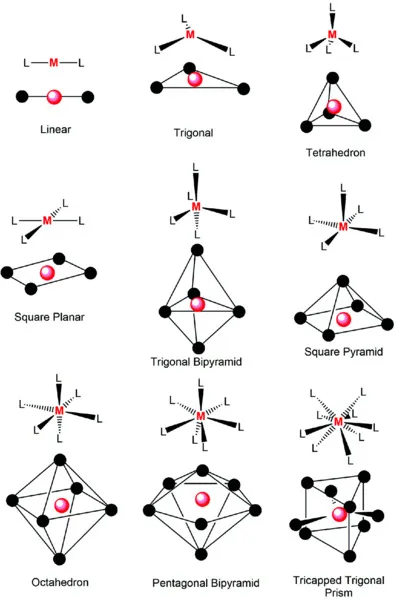
The bonding that exists in metal complexes, their spectral and magnetic properties and their chemical reactivity are not easily explained using a single theory. However, one approach that is often used in a basic presentation of bonding concepts in transition metal chemistry is crystal field theory (abbreviated CF theory), which because it is based on simple electrostatic arguments, is relatively easy to understand. In CF theory, the interactions between the metal ion (M) and the groups attached to it (called ligands and denoted by L) are considered to be electrostatic in nature, and the bonding in the compound is described as being salt-like in character. The metal ion, a cation, electrostatically interacts with a series of surrounding ligands, which are usually negatively charged or, if they are uncharged, have the negative end of a dipole directed toward the metal ion. Barring any serious steric interactions between the ligands, the arrangements about the metal ion generally have high-symmetry geometries. For example, a six-coordinate complex – that is, a compound with six ligands attached to the metal ion – has an octahedral arrangement of ligands, while five-coordinate complexes have square or trigonal bipyramidal arrangements, four-coordinate structures are tetrahedral and square planar, and so on. These geometries, along with compounds and intermediates commonly encountered in metal complexes used in medicine, are shown in Figure 1.1.
Chemical bonding structure shows common geometrics of metal complexes and intermediates, which are formed with metal ion and ligands, like linear, trigonal, tetrahedron, square planar, et cetera.
Figure 1.1 Common geometries of metal complexes and intermediates found in inorganic chemistry.

1.2.1 Octahedral Crystal Field

The first-row transition metal series, which begins with scandium, Sc, fills the 3d level of the atom, while the second- and third-row transition metal series, which begin with yttrium, Y, and lanthanum, La, respectively, fill the 4d (second row) and 5d (third row) orbitals of the atom. The transition metal ions and the electronic configurations of common oxidation states are shown in Figure 1.2. Since ions of these elements have electron occupancies in the d level, which is considered the ‘valence’ lev...

Table of contents

  1. Cover
  2. TitlePage
  3. Copyright
  4. Feature Boxes
  5. Preface to the Second Edition
  6. Preface to the First Edition
  7. Acknowledgments
  8. About the Companion Website
  9. 1 Inorganic Chemistry Basics
  10. 2 Metallo-Drugs and Their Action
  11. 3 Platinum Drugs for Treating Cancer
  12. 4 Anticancer Agents Beyond Cisplatin
  13. 5 Responsive Metal Complexes
  14. 6 Metal Complexes for Treating Arthritis and Diabetes
  15. 7 Metal Complexes for Killing Parasites, Bacteria and Viruses
  16. 8 Metal Ion Imbalance in the Body
  17. 9 Metal Complexes for Detecting Disease
  18. 10 Nanomedicine
  19. Eula