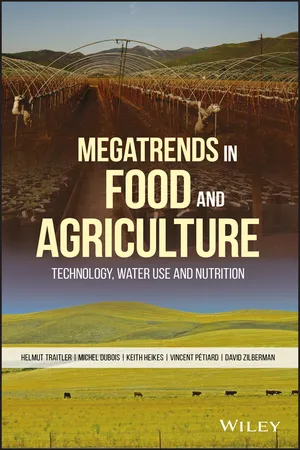
Highlights and examines the growing convergence between the food and agricultural industries—the technological, environmental, and consumer-related drivers of this change, and the potential outcomes
This is the first book of its kind to connect food and the food industry with agriculture, water resources, and water management in a detailed and thorough way. It brings together a small community of expert authors to address the future of the food industry, agriculture (both for plants and animals), and water—and its role in a world of increasing demands on resources.
The book begins by highlighting the role of agriculture in today's food industry from a historical perspective—showing how it has grown over the years. It goes on to examine water management; new ways of plant breeding not only based on genetic modification pathways; and the attention between major crops (soy, corn, wheat) and so-called "orphan crops" (coffee, cocoa, tropical fruits). The book then turns towards the future of the food industry and analyzes major food trends, the new food, and "enough" food; discusses possible new business models for the future food industry; and analyzes the impact that the "internet of everything" will have on agriculture and the food industry. Finally, Megatrends in Food and Agriculture: Technology, Water Use and Nutrition offers scenarios about how agriculture, food, and the food industry might undergo some radical transformations.
Assesses the evolution of food production and how we arrived at today's landscape
Focuses on key areas of change, driven by both innovation and challenges such as new technologies, the demand for better nutrition, and the management of dwindling resources
Highlights the role of better-informed consumers who demand transparency and accountability from producers
Is written by industry insiders and academic experts
Megatrends in Food and Agriculture: Technology, Water Use and Nutrition is an important resource for food and agriculture industry professionals, including scientists and technicians as well as decision makers, in management, marketing, sales, and regulatory areas, as well as related NGOs.
1 The Role of Agriculture in Today’s Food Industry
The ultimate goal of farming is not the growing of crops, but the cultivation and perfection of human beings.
—Masanobu Fukuoka
1.1 Introduction
In every form, agriculture has always been and most likely will always remain the twin sibling of food and especially the food industry. We all seem to be rather clear on what “agriculture” stands for but let me provide a short definition, so that we are on the same page.
Agriculture means to use natural resources to produce commodities which maintain life, including food, fiber, forest products, horticultural crops, and their related services. This definition includes arable farming or agronomy, and horticulture, all terms for the growing of plants, animal husbandry and forestry.
(“Agriculture,” n.d.)
Merriam‐Webster gives a slightly shorter, yet rather similar definition:
The science, art, or practice of cultivating the soil, producing crops, and raising livestock and in varying degrees the preparation and marketing of the resulting products.
(“Agriculture,” n.d.)
There are some important keywords to be found in both of these definitions, such as: arable farming, cultivating the soil, crops, horticultural crops, fibers, forest products, growing plants, livestock, animal husbandry, preparation and marketing of resulting products, and food.
The most important message though is using natural resources to produce commodities (mostly food but also fibers for cloths and wood for shelter and fuel, at least in part), which maintain life. Maintaining life and all that goes with it is really the major driver here; agriculture in all its forms and shapes and all that derives from it is the basis of life. Without it we could not really exist, let alone survive.
Although all this is pretty obvious, it is definitely worthwhile to remind us of these various elements and roles and to put them in a right perspective. So let’s briefly list and define the four major building blocks that are necessary for life and agriculture to exist in the first place.
1.1.1 The Four Building Blocks
These supporting building blocks are necessary not only for life at large but also agriculture in any form.
The first building block is water and hasn’t been mentioned yet. Water plays a crucial role; it is one of the cornerstones of life and growth on this planet. Interestingly enough, whenever my colleagues at JPL/NASA launch a rover to Mars, one of the great questions they want to find answers to is: “Is there or was there water on that planet?” Seems that there was and actually still is—at least traces—and that could mean that, although quite some time ago (maybe hundreds of millions or even billions of years back), there was enough water on Mars to sustain growth of agricultural matter of one kind or another.
This just shows how critical the presence of water is for any organic growth—water, together of course, with other compounds such as oxygen, hydrogen, carbon, nitrogen, sulfur, and phosphor, to name just the most important ones. These atoms, in their various molecular permutations form the backbone of every living matter as we know it and, together with water could be called the “dirty half dozen” of forming and sustaining life, including the growth of plants and animals. This combination of a multitude of such molecules forms the second building block.
Let me add one more critical element, light, that is, mainly visible light. It is the third building block. Without light, the two first building blocks would not be able to work together and support the growth of life, organic matter, and animals and plants, let alone humans. I do realize that there are life forms on our planet earth that grow and thrive in the absence of light, but when it comes to traditional agriculture for both plants and animals, light is a crucial element.
The fourth building block is temperature. Life as we know it does not really thrive in extreme temperatures, such as below 273 K (–0.15 °C) or above 325 K (~52 °C). Yes, there are bacteria or even specially adapted types of frogs that are known to grow or survive below 273 K (–0.15 °C) or even close to temperatures at which water is boiling in volcanic environments. The latter goes for bacteria, not the frog! Animals in arctic or Antarctic environments can survive at temperatures as low as 220 K (–53 °C) because they have developed survival strategies, both genetic as well as behavioral. So the range in which life as we know it can exist is probably larger than described here and could range from 220 K (–53 °C) to 370 K (97 °C).
Enough of this excursion into these basics; I just want to make sure that we have the same basic understanding of the topic ahead and accept these definitions of the major required building blocks of water, molecular composition, light, and temperature as baseline for this book. I know that this is rather short and only scratches on the surface, but believe that this is setting the tone of this book appropriately.
Figure 1.1 depicts in a simplified form the four main building blocks for growth and sustenance of life.
Figure 1.1 The four building blocks of growth.
1.1.2 Some History of Agriculture
In case you know it all already or are typically not interested in history of any kind, including the one that describes agriculture at large, then please skip this section and move on to the next section. Although I do hope that I can convince you to read on through this section.
The drive for survival, which includes searching and finding food and water as well as breathing air, is the most important basic physiological need according to Maslow (1943): “Air, water, and food are metabolic requirements for survival in all animals, including humans. Clothing and shelter provide necessary protection from the elements.”
It can safely be said that since the dawn of time, or since the beginning of animal life in any form, this drive for survival has always existed and has preoccupied all life forms in important ways. Even plants, solidly rooted in the ground, strive for growth and existence by feeding on nutrients in the ground “breathing” oxygen, assimilating carbon dioxide and reaching out for light. Animals, irrespective of whether they are prey or predator, are in constant search of food and water, while breathing air and, for many different reasons, they also need light.
Humans, by most definitions, are predators, although they might be hunted as prey by large carnivores in some parts of the world. Their first and foremost task during all periods of evolution, and to this very day, is to find enough “fuel” or enough food and water to grow, to survive, to exist, and be able to expand their activities to whatever they have chosen them to be. However, satisfaction of basic physiological needs, or in simpler words, making the body function properly, is still the main driver. Unless we all become robots, this is not likely to change any time soon.
Although debated by some, humans, at least in more recent times, are omnivores (i.e., eating just about anything, from plants to animals and most recently even cheap and crappy food). With some exceptions, every type of food is welcome into the stomachs of human beings. Not surprisingly, exceptions are rather numerous and include people who don’t eat certain foods for...
Table of contents
Cover
Title Page
Table of Contents
Foreword
Acknowledgments
Part 1: Agriculture and the Food Industry
Part 2: The Future of the Food Industry
Part 3: The New Food World
Index
End User License Agreement
Trusted by 375,005 students
Access to over 1.5 million titles for a fair monthly price.
Study more efficiently using our study tools.
Frequently asked questions
Yes, you can cancel anytime from the Subscription tab in your account settings on the Perlego website. Your subscription will stay active until the end of your current billing period. Learn how to cancel your subscription
No, books cannot be downloaded as external files, such as PDFs, for use outside of Perlego. However, you can download books within the Perlego app for offline reading on mobile or tablet. Learn how to download books offline
Perlego offers two plans: Essential and Complete
Essential is ideal for learners and professionals who enjoy exploring a wide range of subjects. Access the Essential Library with 800,000+ trusted titles and best-sellers across business, personal growth, and the humanities. Includes unlimited reading time and Standard Read Aloud voice.
Complete: Perfect for advanced learners and researchers needing full, unrestricted access. Unlock 1.5M+ books across hundreds of subjects, including academic and specialized titles. The Complete Plan also includes advanced features like Premium Read Aloud and Research Assistant.
Both plans are available with monthly, semester, or annual billing cycles.
We are an online textbook subscription service, where you can get access to an entire online library for less than the price of a single book per month. With over 1.5 million books across 990+ topics, we’ve got you covered! Learn about our mission
Look out for the read-aloud symbol on your next book to see if you can listen to it. The read-aloud tool reads text aloud for you, highlighting the text as it is being read. You can pause it, speed it up and slow it down. Learn more about Read Aloud
Yes! You can use the Perlego app on both iOS and Android devices to read anytime, anywhere — even offline. Perfect for commutes or when you’re on the go. Please note we cannot support devices running on iOS 13 and Android 7 or earlier. Learn more about using the app
Yes, you can access Megatrends in Food and Agriculture by Helmut Traitler,Michel Dubois,Keith Heikes,Vincent Petiard,David Zilberman,Michel J. F. Dubois in PDF and/or ePUB format, as well as other popular books in Technology & Engineering & Food Science. We have over 1.5 million books available in our catalogue for you to explore.