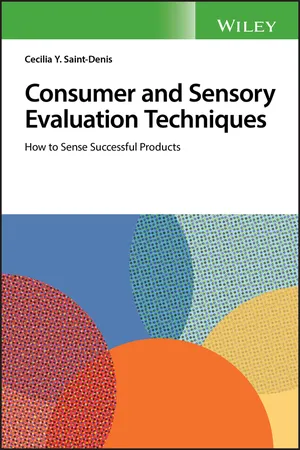
Practical reference on the latest sensory and consumer evaluation techniques available to professionals and academics working in food and consumer goods product development and marketing
This unique manual describes how to implement specific sensory and consumer methods based on context and objective. Presented in a direct and straightforward language that will speak to the industry professionals and academics who are on the ground attempting to solve technical questions, it reviews, step by step, the various stages of a product evaluation. Included are practical examples from many industries that practitioners can relate to. The book also shows how to build a sustainable short-, medium-, and long-term product evaluation strategy, and guides readers on how to create customized methods, or even completely new approaches.
Consumer and Sensory Evaluation Techniques speaks to management and decision-makers within organizations and addresses the main questions (eg: "How much will it cost?" and "How quickly can it be achieved?") that are faced when developing and testing new products before a launch. Chapters cover: the pillars of good consumer and sensory studies; sensory profile of a product: mapping internal sensory properties; the foundations of consumer evaluation; study plans and strategy—sustainable short, mid and long-term vision; real-life anticipation with market factors: concept, price, brand, market channel; and internal studies versus sub-contracting.
Uses examples from multiple sectors to show how to build a sustainable product evaluation strategy
Analyses the critical milestones to follow and the pitfalls to avoid
Supports the decision-making process while developing fast yet robust test strategies that will increase the likelihood of a product's success
Consumer and Sensory Evaluation Techniques is the perfect resource for students, faculty and professionals working in product development, including formulators and marketers.
1 The Pillars of Good Consumer and Sensory Studies
1.1 Leveraging Existing Consumer Insight Prior to Building a Test Plan: What Do We Already Know?
For a long time, three major departments in companies have taken the lead: Research, Marketing and Sales. A new product was developed and a consequent budget was put in place to push it into consumers’ homes. Within the past couple of decades, the media universe that surrounds us has changed in such a way that this simple approach does not suffice anymore. Marketing environment has become way too complex. Companies must deal with hundreds of cable channels, satellite networks and online social media. This makes the interaction between companies, their brands and consumers more complicated and risky (Blackshaw 2008). As explained by Kietzmann et al. (2011) a simple negative post or tweet could turn into a boomerang. At the same time, interaction with consumers has reached a more personal level. This has forced most companies to embrace what is called Consumer Insight in their mind‐set and develop ad hoc teams within their organization (Stone et al. 2004).
The consumer insight objective is to go way beyond figures and statistics that were traditionally analysed by marketers. Consumer insight research gathers skills from multiple backgrounds: marketers, psychologists and ethnographers. The idea behind it is to get into the consumer’s mind understanding what they purchase, why, how this fits into their daily routines, when, as an individual, as a group, as a community. Consumer insight is now the binder that provides understanding on who consumes what and why. Consumer insight digs into geography, seasons, gender, ethnic and cultural background, age differences and the role these factors play in the consumption of each product category. The goal is to find the truth on existing and emerging behaviours, experiences, beliefs, wants and needs. Consumer insight is the tool that allows researchers and marketers to make a new product that coincides with consumer’s needs by either finding the appropriate market space for something creators have envisioned or by finding the need gap to be fulfilled that steers and inspires creators with new ideas. Consumer insight serves for both push and pull processes (Walsh 1984). Some distinguish the terms insight and foresight. Insight being the ability to interpret present trends to then predict and prepare the future as the foresight approach.
With that in mind, it is easy to understand why, before engaging in the evaluation of any new product, it is crucial to conduct a full consumer insight research on that category. Oddly enough, in many cases, consumer insight gathers information that everyone already knows. It is just a question of putting it together in a meaningful way that will speak by itself and make sense.
After the Canadian writer Coupland (1991) popularized the expression Generation X to designate the individuals that succeeded baby boomers, all other new sociological designations just flowed out naturally for sociologists to segment the different age groups in our societies. Consumer insight often observes behaviours based on this breakdown (e.g. Kumar and Lim 2008). Whether we want to address, for example, Baby Boomer1 women skin beauty needs, Gen X2 men soda drinking drivers, Gen Y3 (Howe and Strauss 2000) reading habits or Gen Z4 social media activity, the approach will always be the same. What geographical region are we considering? What is the existing market offer? What are the key benchmarks and the more ‘niche’ players? Is there a seasonal aspect to be taken into account, and what are the trends, the drivers, the needs and the gaps?
In many cases, companies have a lot of information internally into which they can dig before doing any further research (data mining of existing ‘primary research’ sources is often called ‘secondary research’): intrinsic background knowledge, previous small‐ or large‐scale studies done in that category, marketing and sales data are the first sources to consider. Usage & Attitude (U&A) studies are often conducted every 2–5 years for large categories. Very popular in the 1970–1980s these long and costly studies had been misused in the 1990s. However, they quickly came back as a necessity with the drastic evolution of behaviours in multiple categories and with the expansion of many industries towards new emerging markets. Also, running those types of studies became easier thanks to online tools. Ultimately, it is always important to confront knowledge and beliefs within the company itself with up‐to‐date data to avoid a priori certainties.
Social media are an immense source of information: blogs, forums, reviews on electronic commerce sites (broad ones like Amazon or Alibaba, or ones more specialized in a certain category), posts on Twitter, YouTube, Pinterest, all the way to public conversations on Facebook or Instagram. Safko (2010) gives a very comprehensive anatomy of modern social media and how they have become an unprecedented and unavoidable window into our society. Depending on the resources the company has, this research, often called ‘social listening’ can be done internally or externalized to numerous market‐research companies who offer the service. Over the past years, several powerful analytic tools and platforms to systematically process the information have been launched on the market, some being free (broadly general such as www.socialmention.com or targeting one single media like Twitter or Google) and some requiring a monthly fee.
The efficacy of them can be assessed in what they measure and how they represent it versus the needs a company has. Many platforms offer online active dashboards and alerts on pre‐set keywords (Table 1.1).
Table 1.1 Typical monitored parameters on social media.
Measure
Description
Audience volume
Number of posts, comments, tweets, reviews per unit of time for defined key words on designated media
Audience categories
Definition of who is speaking: gender, age, professional or not, and so on. This is usually assessed through clear identification or languages hints
Audience influence
Passive observers or stronger influencersa. Level of influence is now often measured not only by popularity and number of connections of individuals, but also by their forwarding activity with specific algorithms as shown in Romero et al. (2011)
Competitors
Usually assessment of a number of brands mentioned per unit of time in designated media
Sentiments
Positive, negative or neutral connotation of the conversations. This is usually assessed through language systematic analysis by appropriate software or by linguists (Chamlertwat et al. 2012)
aUnderstanding the level of influence certain individuals, groups or formal bloggers (professionals or not) may have becomes a tool that goes beyond consumer insight objectives (Agarwal et al. 2008). Online word of mouth has become extremely powerful. Therefore, it is vital for companies to track it down to head off anything that could be negative or damaging and to empower happy consumers to share to an infinite audience (Blackshaw 2008; Berger 2016), very often now through the influence of an expert authority or a celebrity endorsement.
Online social media are a tremendous resource to understand consumers. However, depending on the subject or target audience, in some cases, information found through them may not be representative enough. Millennials and centennials are undeniably present for most categories. However, if the target audience is Gen X or Boomers, information found may be more partial. Furthermore, depending on socio‐economic categories being considered, regions or countries, prevalence of internet and phones may not always ensure total representativeness if research is only done via online social media. Lastly, one must keep in mind that even though people tend to be more and more vocal online, whether they are happy or unhappy with a product or service, human nature does not c...
Table of contents
Cover
Title Page
Table of Contents
Preface
Acknowledgements
1 The Pillars of Good Consumer and Sensory Studies
2 Sensory Profile of a Product: Mapping Internal Sensory Properties
3 The Foundations of Consumer Evaluation
4 Study Plans and Strategy: Sustainable Short‐, Mid‐ and Long‐Term Vision
Access to over 1.5 million titles for a fair monthly price.
Study more efficiently using our study tools.
Frequently asked questions
Yes, you can cancel anytime from the Subscription tab in your account settings on the Perlego website. Your subscription will stay active until the end of your current billing period. Learn how to cancel your subscription
No, books cannot be downloaded as external files, such as PDFs, for use outside of Perlego. However, you can download books within the Perlego app for offline reading on mobile or tablet. Learn how to download books offline
Perlego offers two plans: Essential and Complete
Essential is ideal for learners and professionals who enjoy exploring a wide range of subjects. Access the Essential Library with 800,000+ trusted titles and best-sellers across business, personal growth, and the humanities. Includes unlimited reading time and Standard Read Aloud voice.
Complete: Perfect for advanced learners and researchers needing full, unrestricted access. Unlock 1.5M+ books across hundreds of subjects, including academic and specialized titles. The Complete Plan also includes advanced features like Premium Read Aloud and Research Assistant.
Both plans are available with monthly, semester, or annual billing cycles.
We are an online textbook subscription service, where you can get access to an entire online library for less than the price of a single book per month. With over 1.5 million books across 990+ topics, we’ve got you covered! Learn about our mission
Look out for the read-aloud symbol on your next book to see if you can listen to it. The read-aloud tool reads text aloud for you, highlighting the text as it is being read. You can pause it, speed it up and slow it down. Learn more about Read Aloud
Yes! You can use the Perlego app on both iOS and Android devices to read anytime, anywhere — even offline. Perfect for commutes or when you’re on the go. Please note we cannot support devices running on iOS 13 and Android 7 or earlier. Learn more about using the app
Yes, you can access Consumer and Sensory Evaluation Techniques by Cecilia Y. Saint-Denis in PDF and/or ePUB format, as well as other popular books in Technology & Engineering & Food Science. We have over 1.5 million books available in our catalogue for you to explore.