From contaminated infant formula to a spate of all-too familiar headlines in recent years, food safety has emerged as one of the harsher realities behind China's economic miracle. Tainted beef, horse meat and dioxin outbreaks in the western world have also put food safety in the global spotlight.
Food Safety in China: Science, Technology, Management and Regulation presents a comprehensive overview of the history and current state of food safety in China, along with emerging regulatory trends and the likely future needs of the country. Although the focus is on China, global perspectives are presented in the chapters and 33 of the 99 authors are from outside of China.
Timely and illuminating, this book offers invaluable insights into our understanding of a critical link in the increasingly globalized complex food supply chain of today's world.
eBook - ePub
Food Safety in China
Science, Technology, Management and Regulation
- English
- ePUB (mobile friendly)
- Available on iOS & Android
eBook - ePub
Food Safety in China
Science, Technology, Management and Regulation
About this book
Information
Part 1
Introduction
Chapter 1
Shared Responsibility of Food Safety
Joseph J. Jen
California Polytechnic State University, USA
1.1 Introduction
Part of the content of this chapter was adopted from the chapter I wrote for the book, Food Safety in China: Past, Present and Future [1]. Food safety has been a hot topic in the world in recent years. The horse meat case in the European Union (EU), the cantaloupe case in the United States of America (US) and the melamine case in China all received global attention. Although it has been the focus of attention for consumers in certain regions of the world for some time, it was not a major topic of concern for the government, food industry, media and the general public in China and the rest of the world till 2008. The turning point of global attention to food safety can be traced back to China's melamine event. More than 50,000 infants and children were hospitalized and there were six confirmed deaths due to the illegal addition of melamine to milk and infant formula [2]. The event was in the global news for a long time. The New York Times had a special series of reports tracing the origin of the event. The Chinese government reacted quickly and published the first “China Food Safety Law” in 2009 [3]. Many people started to ask the question: who are the people responsible for food safety?
No doubt, food safety is not the responsibility of one person, one group of people, nor of an industry or a government agency. It is the shared responsibility of many people and organizations, in fact everyone.
The term, “shared responsibility” for food safety was first coined by the World Health Organization (WHO) [4]. WHO defined shared responsibility as the “collaboration between all sectors, including government, consumer organizations and food processors to achieve a safer and wholesome food supply.” The definition was inadequate to cover the whole spectrum of food safety.
The European Commission published a white paper on food safety in 2000, which led to the formation of the European Food Safety Authority (EFSA) in 2002. In the white paper, it states that “feed manufacturers, farmers, and food operators have the primary responsibility for food safety. Competent authorities monitor and enforce this responsibility through the operation of national surveillance and control systems. Consumers must also recognize that they are responsible for the proper storage, handling and cooking of foods.” By this definition, only industry, government and consumers share responsibility for food safety.
Jen [5] presented a paper at the first International Forum on Food Safety in Beijing that defined food safety as a shared responsibility by all who are dealing with foods. The food industry and government agencies have a major responsibility for food safety. Academia and media have their special responsibilities. Every consumer and everyone who eats food has to share responsibility for food safety. The five pillars of food safety (Figure 1.1) are dependent on each other and form the basis for achieving maximum food safety in any organization, country, region and the world.
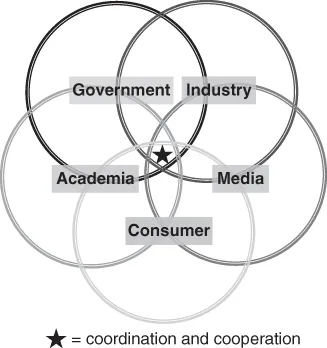
Figure 1.1 The five pillars of food safety.
The agricultural and food processing industries, being the producers of food products for consumption, have to bear the major responsibility for food safety. In developed countries, the industry knows the responsibility well. They have little, if any, intentional adulteration of food causing food safety problems. Nevertheless, accidents take place from time to time. China, being in the transition period in becoming a developed country, is faced with many intentional food adulteration and food fraud problems. China's food industry has not developed a spirit of goodwill towards society and many enterprises are still driven by a “quick profit above all else” attitude. However, some large food companies are taking food safety seriously, but it takes a while for the food safety culture to spread to all company employees. Also, China's agricultural production and processing industries are still dominated by small enterprises with few employees. A merger and consolidation process into medium and large corporations will take place in the future.
Government, as the watchdog of the agricultural and food processing industries, also has a major responsibility for food safety. Government has to issue food safety laws, regulations and guidelines for the industry to follow, and to perform inspections to ensure the laws, regulations and guidelines are followed to minimize food safety incidents. In addition, government agencies need to provide funds for food safety research and education, and be transparent with the public on food safety outbreaks. Establishing laws are only the first step. Implementation of the laws, regulations and guidelines is a long-term process. The Chinese central government has done a great job in establishing laws and regulations, but is a long way to go to spread that to every corner of the vast counties, down to the town and village levels.
Academia is responsible for training food safety workers, performing food safety research and providing the correct scientific information about food safety to society, including government agencies and industry. China's education system for food safety is just in the early stages and has a long way to go to catch advanced countries of the world.
The media should report food safety events in a truthful manner and not try to cause public panic by sensationalizing minor food safety accidents. The media also shares responsibility for educating consumers on food safety knowledge, and informing the public of any new food safety laws and regulations. It should also try to report new scientific technology in layman's terms for the public to understand. China's media has experienced rapid growth in this field.
Consumers should acquire adequate food safety knowledge and practice food safety in handling foods at home. They should also report any unsanitary conditions in public eating places to the authorities. Most importantly, consumers should not spread food safety information on the Internet that is not based on scientific fact. Leighton and Sperber [6] recently published an article stating that “good consumer practices are necessary to further improve global food safety.” They declared that “food safety is the responsibility of all along the farm to table continuum.”
1.2 History
China's population is anticipated to peak at 1.4 billion in 2025 [7]. Traditionally, China has been concerned with food security rather than food safety. Lester Brown published his classic text Who will feed China? in 1995 [8]. China has only 7–9% of the world's arable land, but 20% of the world's population, as estimated by the United Nations (UN) Food and Agriculture Organization (FAO) [9]. With the successful development of hybrid rice and other cereals, and high agricultural inputs, China gained self-sufficiency in food security in the 1990s, and began to shift their nutritional diet to animal products [10], mimicking that of developed countries in Western Europe and North America.
To sustain agricultural production, the Chinese government has invested billions to support research on transgenic varieties of rice, wheat, maize, cotton, soybean, pigs, cows and sheep. However, commercialization of the genetically engineered products has not taken place, mainly due to consumer misunderstanding of the technology. Water is the other major concern in China's agricultural production. China's water and sanitation infrastructure is at a much earlier stage of development [11], and thus the risks to the food supply are much greater. Meanwhile, chemical pollution is a major threat to both agricultural land and freshwater supplies [12]. With increased input, China's use of pesticides and veterinary drugs have increased to such a level that China is now the largest producer and exporter of pesticides in the world [13]. Lastly, the excessive use of food additives and food fraud are increasingly becoming major concerns for food safety in China.
To the credit of the Chinese government, they have made tremendous efforts to reform food safety standards, laws and regulations in recent years. With a country as vast as China, the changes are slow to reach every part of the country. The UN Resident Coordinator in China [14] has suggested that the regulatory control of food safety is a shared responsibility among national, provincial and local government authorities. A clear chain of command and responsibilities, a set of common and consistent standards, and a well-coordinated central steering committee would strengthen China's implementation of existing food safety laws and regulations.
1.3 The Food Chain and Food Safety Laws
Food is simple, but food safety is complex. The food chain is a long process from farm to table. An interesting example can be drawn from the consumer dollar (Figure 1.2) published by the Economic Research Service (ERS) of the United States Department of Agriculture (USDA).
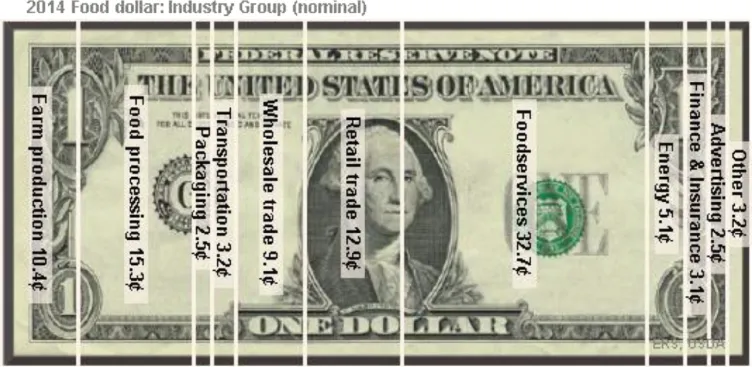
Figure 1.2 The food dollar.
The 2014 ERS food dollar [15] shows the percentage distribution of one US consumer dollar to all industry and business when dealing with food expenditure from farm to table. It shows that the food service segment takes the largest share of the consumer spending dollar, which means this segment has the major share of the food safety responsibilities. The food processing industry, wholesalers and retail trades are next. Farmers and agribusiness only receive 10.4 cents of the consumer dollar. When government spends funds to monitor and inspect industries for the sake of food safety, it may be wise to have this consumer food dollar distribution in mind.
Besides the United Kingdom (UK), the US probably has the longest history in the world when it comes to official food safety laws and regulations. US food safety law started with the Food and Drug Act, passed by US Congress on June 30, 1906. It prohibits interstate commerce in misbranded and adulterated food, drink and drugs. The Meat Inspection Act was passed on the dame day. The USDA had been given the responsibility and authority to enforce both Acts [16]. In 1938, Congress passed the Federal Food, Drug and Cosmetic Act, which amongst others, authorized standards of identity, quality and fill-of-container for foods, and authorized the USDA to be responsible for food processing factory inspections [17].
In 1940, the Food and Drug Administration (FDA) was formed and the office was transferred from the USDA to the Department of Federal Security (now the Department of Health and Human Services (HHS)). The move split the responsibility for food safety from a single agency to multiple agencies. The move was politically motivated at the time, but it forever changed the fo...
Table of contents
- Cover
- Title Page
- Copyright
- Table of Contents
- List of Contributors
- Preface
- Part 1: Introduction
- Part 2: Food Microbiology
- Part 3: Food Chemistry
- Part 4: Risk Assessment and Communication
- Part 5: Risk Management
- Part 6: Commodities
- Part 7: New Technology
- Index
- End User License Agreement
Trusted by 375,005 students
Access to over 1.5 million titles for a fair monthly price.
Study more efficiently using our study tools.
Frequently asked questions
Yes, you can cancel anytime from the Subscription tab in your account settings on the Perlego website. Your subscription will stay active until the end of your current billing period. Learn how to cancel your subscription
No, books cannot be downloaded as external files, such as PDFs, for use outside of Perlego. However, you can download books within the Perlego app for offline reading on mobile or tablet. Learn how to download books offline
Perlego offers two plans: Essential and Complete
- Essential is ideal for learners and professionals who enjoy exploring a wide range of subjects. Access the Essential Library with 800,000+ trusted titles and best-sellers across business, personal growth, and the humanities. Includes unlimited reading time and Standard Read Aloud voice.
- Complete: Perfect for advanced learners and researchers needing full, unrestricted access. Unlock 1.5M+ books across hundreds of subjects, including academic and specialized titles. The Complete Plan also includes advanced features like Premium Read Aloud and Research Assistant.
We are an online textbook subscription service, where you can get access to an entire online library for less than the price of a single book per month. With over 1.5 million books across 990+ topics, we’ve got you covered! Learn about our mission
Look out for the read-aloud symbol on your next book to see if you can listen to it. The read-aloud tool reads text aloud for you, highlighting the text as it is being read. You can pause it, speed it up and slow it down. Learn more about Read Aloud
Yes! You can use the Perlego app on both iOS and Android devices to read anytime, anywhere — even offline. Perfect for commutes or when you’re on the go.
Please note we cannot support devices running on iOS 13 and Android 7 or earlier. Learn more about using the app
Please note we cannot support devices running on iOS 13 and Android 7 or earlier. Learn more about using the app
Yes, you can access Food Safety in China by Joseph Jwu-Shan Jen, Junshi Chen, Joseph Jwu-Shan Jen,Junshi Chen in PDF and/or ePUB format, as well as other popular books in Technology & Engineering & Food Science. We have over 1.5 million books available in our catalogue for you to explore.