The first advanced textbook to provide a useful introduction in a brief, coherent and comprehensive way, with a focus on the fundamentals. After having read this book, students will be prepared to understand any of the many multi-authored books available in this field that discuss a particular aspect in more detail, and should also benefit from any of the textbooks in photochemistry or spectroscopy that concentrate on a particular mechanism.
Based on a successful and well-proven lecture course given by one of the authors for many years, the book is clearly structured into four sections: electronic structure of organic semiconductors, charged and excited states in organic semiconductors, electronic and optical properties of organic semiconductors, and fundamentals of organic semiconductor devices.
- English
- ePUB (mobile friendly)
- Available on iOS & Android
eBook - ePub
About this book
Information
1
The Electronic Structure of Organic Semiconductors
1.1 Introduction
Organic semiconductors are a class of materials that combine the electronic advantages of semiconducting materials with the chemical and mechanical benefits of organic compounds such as plastics. Thus, the ability to absorb light, conduct electricity, and emit light is united with a material structure that can easily be modified by chemical synthesis, for example, to tailor electronic properties such as the desired emission wavelength, to render it soluble, or to allow for mechanically robust, light-weight, and flexible thin films. These properties imply that semiconductor applications such as displays, lighting panels, or solar cells may be produced with a variety of solution-processing techniques or vacuum deposition methods (Figure 1.1). The technological exploitation is, naturally, in a constant flow of development. At the time of writing this book, industrial interest focuses on replacing vacuum deposition by printing techniques such as the reel-to-reel coating familiar from the fabrication of plastic foil or ink-jet printing. Applications on flexible foils, such as solar cell foils or lighting sheets seem attractive. The already established commercialization of organic semiconductor comprises display applications, lighting applications, and photocopier machines. The large-scale exploitation of organic semiconductor materials in the xerographic process of any common photocopier machine is present in any typical office (Figure 1.1d). Organic light-emitting diode (OLED)-based displays are, for example, employed in the Galaxy smartphone series by Samsung, and are thus also widely distributed (Figure 1.1c). More geared toward a designer market, at the time of writing, are OLED-based lighting panels, for example, from Osram (Figure 1.1e). In addition to established products, there is a constant flow of ideas for novel, innovative products that needs to be evaluated (Figure 1.1a,b). Overall, it is evident that there is a large industry involved in the present day and in the future exploitation of organic semiconductors. Consequently, there is also a need for highly qualified personnel familiar with the conceptual premises that govern electronic processes in organic semiconductors.
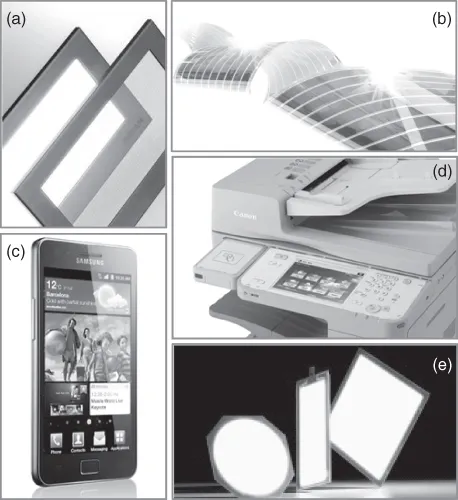
Figure 1.1 Examples of present and perhaps future organic semiconductor applications. (a) Prototype for a luminescent window made by OSRAM with an organic electroluminescent semiconductor. When switched off, the window provides a view to the outside, yet when switched on, it emits light thus functioning as panel lighting. (b) Prototype for a continuous, flexible solar cell foil by Konarka Power Plastic employing an organic semiconductor. (c) Samsung Galaxy smartphone featuring an OLED display. (d) Photocopier using organic semiconductors for the xerographic process by Canon. (e) Lighting tiles by OSRAM.
Over the last decade, the number of research groups that are active in the field of organic semiconductors has increased strongly. Summer schools, graduate training programs, and advanced lecture courses, typically in the context of an MSc degree or PhD, aim to educate students in many aspects of this field. With this book, we wish to contribute to this process by providing a basic and broad introduction to organic semiconductors that should enable the reader to explore the different aspects of this fascinating field later on in more depth.
1.1.1 What Are “Organic Semiconductors”?
The term organic semiconductors implies (i) that the materi...
Table of contents
- Cover
- Related Titles
- Title Page
- Copyright
- Table of Contents
- Preface
- Table of Boxes
- Chapter 1: The Electronic Structure of Organic Semiconductors
- Chapter 2: Charges and Excited States in Organic Semiconductors
- Chapter 3: Electronic and Optical Processes of Organic Semiconductors
- Chapter 4: Fundamentals of Organic Semiconductor Devices
- Appendices
- Index
- End User License Agreement
Trusted by 375,005 students
Access to over 1.5 million titles for a fair monthly price.
Study more efficiently using our study tools.
Frequently asked questions
Yes, you can cancel anytime from the Subscription tab in your account settings on the Perlego website. Your subscription will stay active until the end of your current billing period. Learn how to cancel your subscription
No, books cannot be downloaded as external files, such as PDFs, for use outside of Perlego. However, you can download books within the Perlego app for offline reading on mobile or tablet. Learn how to download books offline
We are an online textbook subscription service, where you can get access to an entire online library for less than the price of a single book per month. With over 1.5 million books across 990+ topics, we’ve got you covered! Learn about our mission
Look out for the read-aloud symbol on your next book to see if you can listen to it. The read-aloud tool reads text aloud for you, highlighting the text as it is being read. You can pause it, speed it up and slow it down. Learn more about Read Aloud
Yes! You can use the Perlego app on both iOS and Android devices to read anytime, anywhere — even offline. Perfect for commutes or when you’re on the go.
Please note we cannot support devices running on iOS 13 and Android 7 or earlier. Learn more about using the app
Please note we cannot support devices running on iOS 13 and Android 7 or earlier. Learn more about using the app
Yes, you can access Electronic Processes in Organic Semiconductors by Anna Köhler,Heinz Bässler in PDF and/or ePUB format, as well as other popular books in Technology & Engineering & Electrical Engineering & Telecommunications. We have over 1.5 million books available in our catalogue for you to explore.