Research and development represents a vast spread of topics and can be an arena for controversy. In academia, such controversy may stem from conflicting interpretations of data and subsequent conclusions, the question of who was first to discover a particular finding and whether or not the said finding is of any value to the scientific community. R&D in corporate environments is mostly defined and driven by costs and clearly identified, consumer-focused targets. There is, however, common ground between these two approaches as both strive to maximize knowledge, though for different reasons and in differnt ways. The equipment and scientific rigor may be similar or identical, however their usage, approach and interpretation are different.
This book discusses the history and background of today's food industry R&D as seen by consumers, academia and the industry itself, with several chapters dedicated to new and disruptive approaches. A must-read for all professionals in the packaged goods industry as well as students who aspire to contribute to this new industry, forcefully driven by R&D.
1 A typical food R&D organization: Personal observations
I know that our R&D probably costs twice of what it could cost but I don’t know which half to cut.
Helmut Maucher
1.1 INTRODUCTION
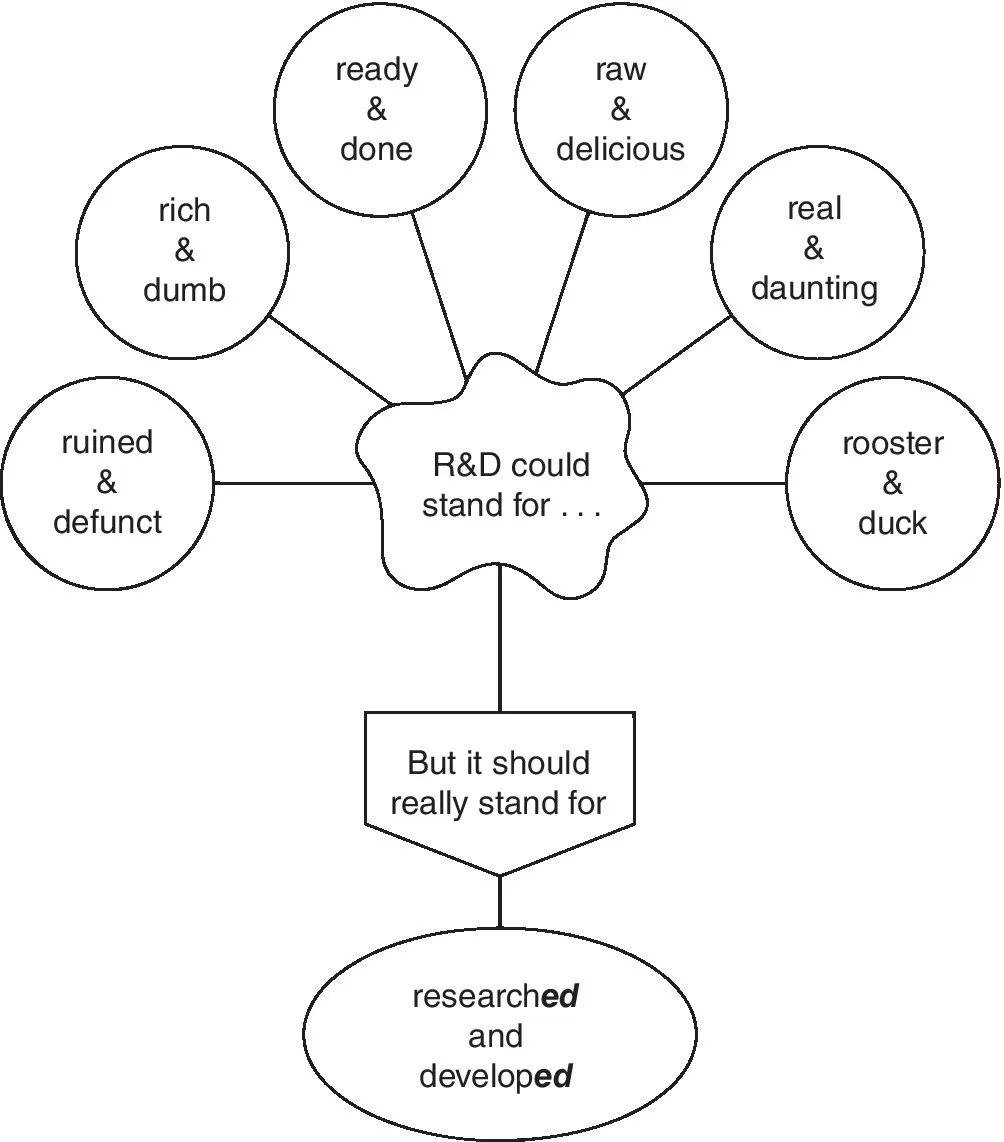
Let us play a game. I like playing games. Research and Development is typically abbreviated to “R&D,” and that’s good, because otherwise books, publications, presentations, discussions, and such would become too long, always repeating “Research and Development” instead of using the short, catchy, and dynamic sounding “R&D.” The game is easy: find as many other meanings for R&D as you possibly can and list your favorite ones. Let me give you a few examples: rich and dumb, raw and delicious, real and daunting, rooster and duck, ready and done, ruined and defunct, researched and developed. Ooops! The last one is almost the same as research and development, however, there is an important difference: research and development means that everything—or almost everything—is still ahead of you, while researched and developed means: done, ticked off, executed, found, and made. I can tell you from deep and longstanding personal experience that the past tense R&D (the “Red & Ded”) is the real dream of every company executive in just about any company in any area that you can imagine, while the “R&D” is a real headache for them.
This book is mostly about this headache and how to heal it. It’s not about “pills” that can help the headache go away but rather a change of lifestyle, or more correctly a new approach to R&D, especially in the food industry so that the headache goes away by “natural” means or doesn’t even come up in the first place. This is not an easy feat, yet it is worthwhile, no, essential to undertake, otherwise R&D in the food industry will cease to exist because in case of doubt which half to cut, CEOs and executives of the food industry will simply cut it entirely, partly out of frustration and partly out of simply not knowing better. Members of the business and commercial community and even those of the manufacturing and procurement community seem to have little understanding for anything that is R&D “tainted” and a bit more basic and difficult to understand. This is unfortunate but it’s a reality, which cannot be neglected easily or even discussed away. Chapter 10 will in much detail discuss the scenario of an R&D‐centric food industry organization in which scientists and engineers “call the shots” and hold the reins of the company. I can already hear business and commercial leaders shout out in unmistakable ways what they think of such a scenario. Their discontent will even be bigger when the following hypothesis will be discussed and analyzed.
1.1.1 Business people always know better
Commercial experts mostly know all about their field of action and because science is not easy to understand, let alone being learned in evening school, they don’t even attempt to understand scientific and technical or engineering details. On the other hand, there are oodles of scientists and engineers who have ventured out to get an MBA degree in addition to their technical degree. What I want to say here is simply that scientists can fairly easily acquire expertise in business, whereas commercial and business people hardly ever, or better never go back to college and do a science degree; it’s simply too time consuming and not an easy undertaking. At least that’s true for the food industry. The situation is different in the pharmaceutical and even chemical industry. And it’s even more so true for the finance and banking industry, although it is difficult to assume that scientists could have come up with a bigger mess than the good people in banks and the world of finance in recent years.
But let’s get back to our topic. Not to let scientists and engineers get ideas that they could rise in the hierarchy, they have to be put within their boundaries and not get the idea that they could become CEO of a company. Best shot is CTO and that’s that. However, the hard‐to‐dispute reality is that it is possible for a scientist or engineer to acquire a business degree, but it’s virtually impossible and almost unheard of that business leaders acquire a science degree. There are of course exceptions to this and, again, especially the pharmaceutical industry has many examples in which medical doctors or scientists have become CEO.
Well, after this initial rant, which sets the tone of the book, quite on purpose, let’s get to business and talk about R&D in the food industry, what it is, what it might evolve to, and lastly, what it really could be.
1.2 A LOOK BACK IN WONDERMENT
Corporations always had R&D departments or functions or labs or just a few “crazy” guys inventing something. The strange—or maybe not so strange—fact seems to be that most corporations in the past were founded based on a great idea and invention by a technical genius or guru who then, together with partners, mostly business savvy ones, turned this idea into some great business of sorts. History shows that most often the tech gurus who were the inventors and the real basis for the new company to exist in the first place and to grow were quickly put to the side and so‐called business people, the serious guys, the guys who knew, took over. This pattern over so many years has been rather successful; rare are the exceptions that it is taken for granted today that corporations have to be led by business representatives and not the technical guys.
1.2.1 Innovation is everyone’s business
This is not to say that all innovation and invention is of technical nature and only technical people can innovate; far from it. Technical innovation would not fly if it were not accompanied by business innovation. There are many important business innovations especially in logistic and supply chain, manufacturing, stock keeping, procurement, and purchasing, and even accounting and financing and new approaches to legal matters have come to pass. What I definitely do not count in this list is cost cutting. Cost cutting is probably the antithesis of progress, innovation, and sustainability. When highly paid managers don’t know any further they either go “back to basics” or call for a “cost‐cutting initiative” or worse, they do both. I emphasize this so much because at first sight this really is counterproductive to innovation and progress. On the other hand, restricting means and tools and making life a bit more difficult for everyone is, after all, not such a bad thing. Restriction and scarcity of available means can actually provoke and even sustain innovation. As for all things in life, the balance and especially timing are of the utmost importance to steer the ship of R&D smoothly and successfully.
My first venturing into corporate R&D dates many years back to the late 1970s and happened while I was working as assistant professor at the university in Vienna, Austria. The department in which I had worked on my thesis has had a long‐standing contract with a U.S.‐based pulp and paper company and was mainly interested in knowing all about lignin, this “nasty” side product that you get when you work wood, mainly pine wood, to paper and cardboard. Lignin is almost like gold in as much as it almost can’t be broken down into useful chemicals and so, in these days and to a high degree even today, went into asphalt or hair dyes as additive and similar, low‐added value applications. The chemical structure of lignin, a “compound” of several aromatic (six carbon atoms) rings, would make it a highly valuable candidate for many applications if it could only be broken up in meaningful and cost‐effective ways. Anyhow, the company wanted to really turn lignin into something valuable and had supported, financially and with a lot of patience, ongoing research in this area in our department for many years, however, without too many striking results to say it nicely.
1.2.2 Let’s go and have a drink
Management representatives of the company visited us twice a year and made the “sacrifice” to come to Vienna from somewhere in the Carolinas and meet with us, hear us out, encourage and criticize us, and mostly also to go out with us in the evening, preferably to one of the rather famous—or infamous—“Heurigen” restaurants where you drink the local wine and, if you would like to, bring your own food.
The wine is served in glasses of a quarter liter, so they are rather big; enthusiasm and the atmosphere easily carry you away to drink more than you actually can take, especially if you are not used to it. You can imagine that the mood soon became cheerful and everyone was happily complimenting everyone else for the good work, the great results, and so on. This was the first time in my professional career that I totally grasped the real meaning of “wining and dining” and especially its central importance in the corporate world.
The next day was always extremely tough and demanding. This was partly because the hangover that typically resulted partly from overindulgence (a euphemism) and partly from the tough questions that were asked during the meetings. We had to prepare reports and the running joke was that the company representatives would always expect results that were similar to “diluting water with water” and make everything even more cost efficient and ultimately cheap. In those days, writing reports meant typing them on typewriters and then duplicating them on “spirit duplicators.” We had photocopy machines, however, the costs of one copied page were still rather high, so we went to this cost‐efficient and ultimately cheap device of duplicator, and I vividly remember having rolled out hundreds, if not thousands, of pages for such meetings. So, on top of having come to an intimate understanding of the term wining‐and‐dining, I also learned the true meaning of rolling out early on in my R&D career.
1.2.3 Never give up and continue to hope
Interestingly enough, these meetings in my recollection never turned “bloody,” messy, or unpleasant. We always came to good conclusions and expectations of even more promising and especially conclusive results next time. I was in charge of the research group for the better part of 3 years but the group had already existed for more than 10 years when I took over. So, looking back, I have to assume that the results were always sufficiently promising that the company continued to ask for more work to be done and more discoveries to be made, as little and insignificant as they might have appeared. This was another important early learning what R&D and especially corporate R&D was, and still is, all about: Hope. “Sister Hope” is probably the foremost driving force in R&D, even when looking back (Note: hindsight is the only exact science!) one can see that the road of discovery is filled with cobblestones of misadventures, deceptions and disappointments. But wait, there is hope beyond Hope: “Never give up” is the younger brother of the first born sister “Hope” in the world of R&D. I have to admit that these two siblings are rather weak reasons for R&D to exist, would they not have another sister, the youngest and most volatile of th...
Table of contents
Cover
Title Page
Table of Contents
About the Authors
Foreword
Preface
Acknowledgment
Part 1: What we have today and how we got here
Part 2: Possible future of the food industry
Part 3: Disruptive outlook for the food industry’s R&D
Index
End User License Agreement
Trusted by 375,005 students
Access to over 1.5 million titles for a fair monthly price.
Study more efficiently using our study tools.
Frequently asked questions
Yes, you can cancel anytime from the Subscription tab in your account settings on the Perlego website. Your subscription will stay active until the end of your current billing period. Learn how to cancel your subscription
No, books cannot be downloaded as external files, such as PDFs, for use outside of Perlego. However, you can download books within the Perlego app for offline reading on mobile or tablet. Learn how to download books offline
We are an online textbook subscription service, where you can get access to an entire online library for less than the price of a single book per month. With over 1.5 million books across 990+ topics, we’ve got you covered! Learn about our mission
Look out for the read-aloud symbol on your next book to see if you can listen to it. The read-aloud tool reads text aloud for you, highlighting the text as it is being read. You can pause it, speed it up and slow it down. Learn more about Read Aloud
Yes! You can use the Perlego app on both iOS and Android devices to read anytime, anywhere — even offline. Perfect for commutes or when you’re on the go. Please note we cannot support devices running on iOS 13 and Android 7 or earlier. Learn more about using the app
Yes, you can access Food Industry R&D by Helmut Traitler,Birgit Coleman,Adam Burbidge in PDF and/or ePUB format, as well as other popular books in Technology & Engineering & Food Science. We have over 1.5 million books available in our catalogue for you to explore.