- English
- ePUB (mobile friendly)
- Available on iOS & Android
eBook - ePub
Sustainability Challenges in the Agrofood Sector
About this book
Sustainability Challenges in the Agrofood Sector covers a wide range of agrofood-related concerns, including urban and rural agriculture and livelihoods, water-energy management, food and environmental policies, diet and human health. Significant and relevant research topics highlighting the most recent updates will be covered, with contributions from leading experts currently based in academia, government bodies and NGOs (see list of contributors below). Chapters will address the realities of sustainable agrofood, the issues and challenges at stake, and will propose and discuss novel approaches to these issues. This book will be the most up-to-date and complete work yet published on the topic, with new and hot topics covered as well as the core aspects and challenges of agrofood sustainability.
Information
1
Food Sustainability Challenges in the Developing World
Rajeev Bhat
Food Science Department, College of Engineering, Science & Technology (CEST) School of Sciences, Campus – Nabua, Fiji National University, Fiji Islands
SUMMARY
This chapter highlights some of the current issues and topics of concern facing the agriculture and food sustainability sectors. Special emphasis is placed on the various challenges facing low‐ and medium‐income countries. Some of the major obstacles to sustainability and the factors affecting it are examined, as are novel approaches to the management strategies employed for various issues in agriculture (e.g. biodiversity, agricultural development, pests/rodents, organic farming, livestock, poultry and aquaculture) and food security (e.g. poverty, hidden hunger and diseases, stability of food supply and access to safe, high‐quality food, food diversification, dietary health supplements, food wastage, food safety and challenges in the food industry).
1.1 Introduction
In a global context, ‘sustainability’ has been defined as ‘the ability to accomplish the needs of our present generation by ensuring that the desires of the future generation remain uncompromised’. According to Asheim (1994), sustainability is expressed as a requirement of the present generation to manage its resources in such a way that the current average quality of life can potentially be enjoyed by all future generations. Sustainability is from the Latin (sustinere) and means to ‘hold up’, ‘support’ or ‘maintain.’ However, according to Phillis and Andriantiatsaholiniaina (2001), sustainability is very difficult to define or to be measured as it is an ambiguous and complex concept about which there is no consensus as to its definition or on how it is to be measured. And so Phillis and Andriantiatsaholiniaina developed the Sustainability Assessment by Fuzzy Evaluation model, which provided a reliable mechanism to measure sustainability development that considers both ecological and human inputs.
Before we look at sustainability issues in any depth and the various challenges the world is facing now, a few basic questions need to be answered. For example: Why sustainability? Does sustainability matter? If it does matter, then to whom? Why do we need to be concerned about the agrofood sector? Well, the answer to all these questions is simple: there is only one earth where rich biodiversity and life exists, and hence sustainability matters! The majority of the world’s population, it seems, including expert researchers, believes that sustainability is just about ecology and going green. However, technically, sustainability goes beyond this. Indeed, what does ‘agriculture sustainability’ and ‘food sustainability’ mean precisely? Are there any appropriate definitions available? What is the link between these two concepts? This chapter focuses on current sustainability issues and the trends and challenges facing the agrofood sector, especially in the developing regions of the world.
1.2 Agriculture and the Food Sustainability Sector
According to the Food and Agriculture Organization of the United Nations (FAO), ‘Sustainable agriculture needs to nurture healthy ecosystems and support the sustainable management of land, water and natural resources, while ensuring world food security.’ Besides, it has been clearly stated (FAO 2015a) that sustainable agriculture should encompass a global governance system which can respond to the various issues of food security (e.g. trade regime, trade policies and agricultural policies) in order to promote agricultural marketing locally and regionally. When agriculture is of concern, sustainability is referred to as a complete system involved in producing high‐quality and safe agrofood products that also takes care of the social and economic conditions of farmers, as well as that of the surrounding environment.
Theoretically, sustainable agriculture symbolizes a system that integrates socio‐economic equity with that of economic success and environmental health. The concept of agricultural sustainability is presented effectively by Corwin et al. (1999), who stated that this is about finding the elusive balance between maximizing crop productivity while minimizing destructive effects on the environment and sustaining the economic stability of the whole system. Several novel methods have been proposed and reviewed with regard to agricultural sustainability, all of which concentrate on sustainability indicators, including considering socio‐economic and environmental issues (Binder et al. 2010; Rao and Rogers 2006; Roy and Chan 2012; Speelman et al. 2006). And yet an agricultural system that aims at sustainability can also have a negative impact. In many developing countries, the inappropriate sharing of knowledge on technological innovations and engineering, and mistimed practical applications of the new techniques, have had a devastating effect on the natural flora and fauna of the agriculture region. Today’s modern agricultural practices have added to global warming (e.g. deforestation to grow crops as well as to raise livestock), climatic changes, increased greenhouse gases (e.g. methane released from agriculture farms and nitrous oxide from fertilizers) and polluted water and soil (e.g. run‐off water from fields nourished with fertilizers and organic manure). The scarcity of natural water resources and the depletion of groundwater resources have tremendously increased in recent years, owing to human intervention (Hoekstra 2015; Pfeiffer 2006). In fact, stress has been laid on the importance of rain‐dependent agriculture in order to improve global food security and assure environmental sustainability (Bastos et al. 2013; Yang et al. 2006). Approximately 85% of the natural water resource in developing countries is used for irrigation (IAASTD 2008). The importance and threats of cultural eutrophication, acidification of fresh water, depletion of natural resources or biodiversity and emerging respiratory diseases (owing to elevated levels of nitrate concentrations in the water as well as in the air) have been identified by the European Nitrogen Assessment forum (Sutton et al. 2011). Added to this, natural disasters can have serious implications for the agriculture system as a whole. According to Misselhorn et al. (2012), almost one billion people experience famine or suffer from malnutrition in the world today. Developing an ecological and agriculture/food footprint as well as a water footprint for an individual region/country is very important to overcome recurring issues. In Figure 1.1, a conceptual model based on the concepts of ecological footprints, trust and human values is depicted.
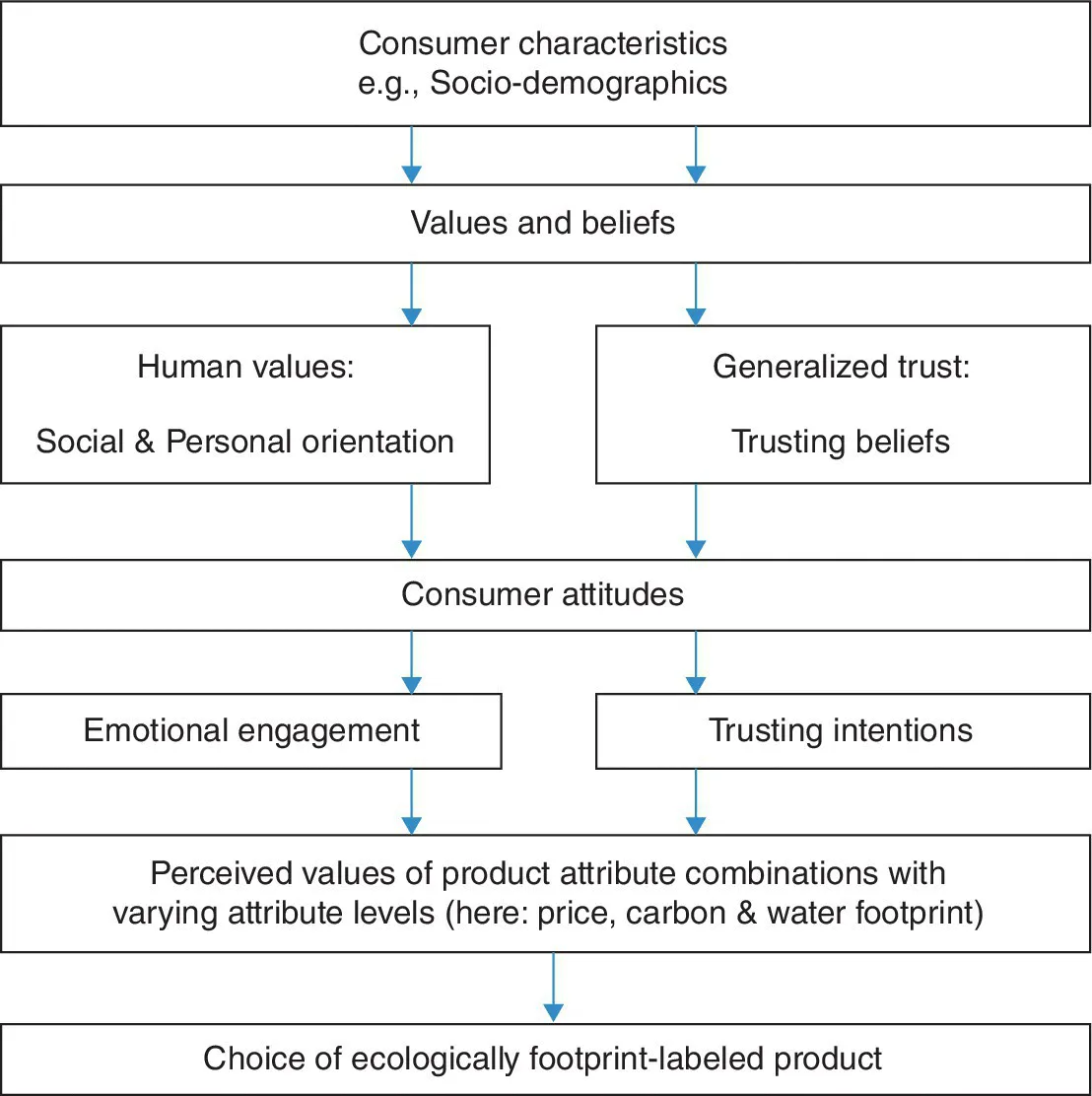
Figure 1.1 Conceptual model.
Source: Grebitus et al. 2015. Reproduced with permission of Elsevier.
Further, when it comes to food sustainability, can ‘food sustainability’ or ‘sustainable foods’ be segregated from ‘agriculture sustainability’ or are they interdependent concepts? From a broader perspective, food sustainability encompasses a wide array of multidisciplinary themes, which can have an extensive paradigm (development and implementation of novel concepts, hypotheses, policies, theories and ideas, etc.) relevant to the socio‐economic state of affairs of the agro‐ecological food sector. Food sustainability is linked to ensuring food security (quality and s...
Table of contents
- Cover
- Title Page
- Table of Contents
- List of Contributors
- Foreword
- Preface
- Introductory Note: Future of Agrofood Sustainability
- 1 Food Sustainability Challenges in the Developing World
- 2 The Role of Small-scale Farms and Food Security
- 3 Sustainability Challenges, Human Diet and Environmental Concerns
- 4 Sustainable Challenges in the Agrofood Sector
- 5 Dynamics of Grain Security in South Asia
- 6 Local Food Diversification and Its (Sustainability) Challenges
- 7 Sustainable Supply Chain Management in Agri-food Chains
- 8 How Logistics Decisions Affect the Environmental Sustainability of Modern Food Supply Chains
- 9 Strengthening Food Supply Chains in Asia
- 10 Revolutionizing Food Supply Chains of Asia through ICTs
- 11 Sustainability, Materiality and Independent External Assurance
- 12 Environmental Sustainability of Traditional Crop Varieties
- 13 Cradle-to-gate Life Cycle Analysis of Agricultural and Food Production in the US
- 14 Ensuring Self-sufficiency and Sustainability in the Agrofood Sector
- 15 Sustainability Challenges Involved in Use of Nanotechnology in the Agrofood Sector
- 16 Sustainability of Nutraceuticals and Functional Foods
- 17 Innovation and Sustainable Utilization of Seaweeds as Health Foods
- 18 Agrofoods for Sustainable Health Benefits and Their Economic Viability
- 19 Sustainability Challenges in Food Tourism
- 20 Diversification, Innovation and Safety of Local Cuisines and Processed Food Products
- 21 Soil Health, Crop Productivity and Sustainability Challenges
- 22 Analysing the Environmental, Energy and Economic Feasibility of Biomethanation of Agrifood Waste
- 23 Agricultural Waste for Promoting Sustainable Energy
- 24 Membrane Technology in Fish-processing Waste Utilization
- 25 Sustainability Issues, Challenges and Controversies Surrounding the Palm Oil Industry
- 26 Sustainability Challenges in the Coffee Plantation Sector
- 27 Food Safety Education
- 28 Sustainability Challenges and Educating People Involved in the Agrofood Sector
- Index
- End User License Agreement
Trusted by 375,005 students
Access to over 1.5 million titles for a fair monthly price.
Study more efficiently using our study tools.
Frequently asked questions
Yes, you can cancel anytime from the Subscription tab in your account settings on the Perlego website. Your subscription will stay active until the end of your current billing period. Learn how to cancel your subscription
No, books cannot be downloaded as external files, such as PDFs, for use outside of Perlego. However, you can download books within the Perlego app for offline reading on mobile or tablet. Learn how to download books offline
Perlego offers two plans: Essential and Complete
- Essential is ideal for learners and professionals who enjoy exploring a wide range of subjects. Access the Essential Library with 800,000+ trusted titles and best-sellers across business, personal growth, and the humanities. Includes unlimited reading time and Standard Read Aloud voice.
- Complete: Perfect for advanced learners and researchers needing full, unrestricted access. Unlock 1.5M+ books across hundreds of subjects, including academic and specialized titles. The Complete Plan also includes advanced features like Premium Read Aloud and Research Assistant.
We are an online textbook subscription service, where you can get access to an entire online library for less than the price of a single book per month. With over 1.5 million books across 990+ topics, we’ve got you covered! Learn about our mission
Look out for the read-aloud symbol on your next book to see if you can listen to it. The read-aloud tool reads text aloud for you, highlighting the text as it is being read. You can pause it, speed it up and slow it down. Learn more about Read Aloud
Yes! You can use the Perlego app on both iOS and Android devices to read anytime, anywhere — even offline. Perfect for commutes or when you’re on the go.
Please note we cannot support devices running on iOS 13 and Android 7 or earlier. Learn more about using the app
Please note we cannot support devices running on iOS 13 and Android 7 or earlier. Learn more about using the app
Yes, you can access Sustainability Challenges in the Agrofood Sector by Rajeev Bhat in PDF and/or ePUB format, as well as other popular books in Technology & Engineering & Food Science. We have over 1.5 million books available in our catalogue for you to explore.