Chapters cover foods and food ingredients from both animal and plant marine sources, focusing on those which demonstrate biological properties and whose constituent compounds have been isolated and identified as potentially active. This book further addresses the biological activities of PUFAs (Polyunsaturated fatty acids), oils, phospholipids, proteins and peptides, fibres, carbohydrates, chitosans, vitamins and minerals, fucoxantin, polyphenols, phytosterols, taurine, amongst others. These components, found in a variety of marine-derived foods, have been demonstrated to have preventative properties with regard to hypertension, oxidative stress, inflammation, cardiovascular diseases, cancer and other human diseases.
Extraction methods and analysis techniques are also addressed. Intended for food scientists, food technologists and food engineers in academia, industry and government, this book reviews the substantial quantity of current research in this fast-moving and commercially valuable sector of food and nutrition science.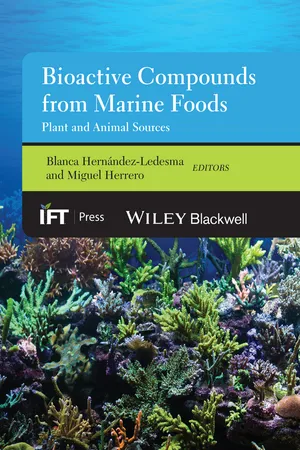
eBook - ePub
Bioactive Compounds from Marine Foods
Plant and Animal Sources
- English
- ePUB (mobile friendly)
- Available on iOS & Android
eBook - ePub
Bioactive Compounds from Marine Foods
Plant and Animal Sources
About this book
Part of the IFT Press series, this book reviews the myriad published information on bioactive components derived from marine foods, enabling researchers and product developers to select appropriate functional ingredients for new products.
Information
1
An Update on the Biomedical Prospects of Marine-derived Small Molecules with Fascinating Atom and Stereochemical Diversity
1.1 INTRODUCTION
In this chapter we discuss a selection of structurally diverse marine-derived small molecules (MDSMs) with potent and/or specific bioactivity and analyze their biomedical applications. The compounds included have been isolated either from marine macroorganisms, including sponges, ascidians (tunicates), bryozoans, and molluscs, or from microorganisms, such as bacteria and fungi. Our inquiry begins with a look back in time at a selection of important marine natural products, with particular focus on compounds in the clinical pipeline. The chapter continues with an analysis of a biosynthetically diverse assortment of 22 MDSMs and their structural elements of atom and stereochemical diversity. Entries have been divided into five biosynthetic classes: terpene, polyketide, alkaloid, depsipeptide, and polyketide–peptide. Enormous structural variety is represented by the marine natural products treated herein. The compounds selected can be considered to represent case examples of significant biomolecules with positivity and, in some cases, potent bioactivity accompanied by an unusual mechanism of action.
1.1.1 Overview of known compounds, highlighting molecules of significance
The ocean covers more than 70% of the earth's surface and is home to exceptional biodiversity: more than one million marine species and an estimated one billion different kinds of marine microbe (Census of Marine Life Press Release 2010). We and others firmly believe that MDSMs represent a continuing resource for tools important in cell biology research and in the design of the next-generation leads for drug discovery and development. The record to date firmly illustrates that the structures of natural products continue to be invaluable in expanding pharmacophore structural space. For example, Newman and Cragg recently provided a detailed analysis of the last 30 years of natural products in drug discovery, wherein they contended that, “Nature's ‘treasure trove of small molecules’ remains to be explored, particularly from the marine and microbial environments” (Newman & Cragg 2012).
It is appropriate to return to a theme expressed in the past based on ecology and natural history. Simply stated, marine-derived biosynthetic products must have unprecedented chemodiversity (National Research Council 2002) in comparison to those from the terrestrial realm, due to the difference in biosynthetic machinery that must exist between the macroorganisms abundant in these different environments. The structures shown in this review will provide the reader with up-to-date information related to these results. On the horizon is the demonstration that stunning natural products will be discovered from marine-derived strains isolated and re-cultured grown under saline conditions (Imhoff et al. 2011). Thus, many of the molecules discussed in this chapter have been chosen to illustrate the headway being made in this direction.
This treatise extends to recent annual reviews in the literature, which focus on several important issues. At the top of the list are discussions of marine natural products in biomedical investigations, and there is a steady stream of such comprehensive papers (Hughes & Fenical 2010a; Radjasa et al. 2011; Gerwick & Moore 2012). The dynamic pipeline of MDSMs into “marine pharmaceuticals” has been well documented by reviews in the peer-reviewed literature (Newman & Cragg 2004, 2012; Fenical 2006; Molinski et al. 2009; Mayer et al. 2010; Montaser & Luesch 2011). It is also important to be aware of accounts of marine natural products structural revisions (Suyama et al. 2011). Central to efforts to confirm structure assignment and absolute stereochemistry has been the interplay between total syntheses and reexamination of the spectroscopic data (Suyama et al. 2011). Lastly, a further indication of the importance of MDSMs in biomedical discovery is a recent in-depth review dedicated to aspects surrounding the organic synthesis of biologically active marine natural products (Morris & Phillips 2011).
1.1.1.1 Clinical candidates and MDSM chemical probes
Marine macro- and microorganisms are sources of tremendous chemodiversity and offer new scaffolds for biomedical exploration. The connection between an MDSM's structure, biological activity, and biological target for mechanism of action is at the crux of collaborative investigations by the marine natural products, synthetic, and chemical biology communities. Illustrated in Figure 1.1 is a selection of four important marine-derived natural products which summarize those molecules that are (a) presently used as synthetic clinical therapeutics and (b) employed as chemical probes in chemical biology, biochemistry, and molecular genetics to further our understanding of biological function. The biosynthetic classes, biological targets, and commercial sources, if available, are given below the structures, as is additional citation information useful in further current-awareness searches.
Figure 1.1 A snapshot of marine-derived natural products highlighting (a) clinical therapeutics (Irvalec® (Elisidepsin, PM02734) and Halaven® (Eribulin mesylate, E7389)) and (b) chemical probes (Jasplakinolide and Psammaplin A).

There are two complex structures in Figure 1.1, either of which can be considered a poster child for exotic yet exceedingly important scaffolds. Both possess a blizzard of chiral centers and a density of functionalization. But the pathways to their respective developments as preclinical or clinical agents were slightly different. The former possesses a virtually identical synthetic scaffold to the natural product. Here is a brief outline. Irvalec® (panel A1), under development by PharmaMar (Spain; www.pharmamar.com), is an unnatural salt of isokahalalide F, a natural product congener co-isolated with kahalalide F (11 in Figure 1.2) (Gao et al. 2009). Alternatively, eribulin mesylate (E7389) represents a reduced-complexity analogue of a very complex natural product. This compound is marketed as Halaven® (Eisai, Japan; www.eisai.com) and gained US Food and Drug Administration (FDA) approval in November 2010 for treatment of metastatic breast cancer unresponsive to other drug treatments (Jefferson 2010). A combined synthetic—structure–activity relationship (SAR) investigation found that the entire western portion of halichondrin B (2) could be truncated without a deleterious effect on the therapeutic activity (Qi & Ma 2011).
Figure 1.2 A glimpse into the past via a selection of 14 invertebrate- and microorganism-derived natural products in clinical use or of therapeutic potential.

Two additional compounds are shown in Figure 1.1b, which represent commercially available MDSM chemical probes. We have adopted the definition of a “chemical probe” set forth in an editorial in Nature Chemical Biology (Editorial 2010) and elaborated on in a commentary by Frye (2010): “Potent, selective and cell-permeable small molecules that perturb a biological target in a dose-dependent manner [and] can be used to dynamically ‘probe’ the role of the target in biology.” Terrestrial and marine natural-product chemical probes were recently reviewed by Carlson (2010), and the reader is encouraged to refer to the literature for additional perspective. The notion that natural products have evolved for specificity towards biological macromolecules, particularly proteins and genes, is supported by the community (Clardy & Walsh 2004; Piggott & Karuso 2004; Carlson 2010). The sponge-derived probes jasplakinolide and psammaplin A are both important MDSM chemical probes and the reader is directed to recent literature surrounding their biological function (Boulant et al. 2011; Baud et al. 2012).
1.1.2 Selected important marine sources of MDSMs
The annual review “Marine Natural Products” by Blunt et al. (2005, 2006, 2007, 2008, 2010, 2011, 2012) in Natural Products Reports (NPR) provides a detailed perspective on the publication record of peer-reviewed compounds, with an emphasis on new compounds and their biolog...
Table of contents
- Cover
- IFT Press
- Title Page
- Copyright
- Series
- List of Contributors
- Chapter 1: An Update on the Biomedical Prospects of Marine-derived Small Molecules with Fascinating Atom and Stereochemical Diversity
- Chapter 2: Antihypertensive Peptides from Marine Sources
- Chapter 3: Bioactive Peptides from Marine Processing Byproducts
- Chapter 4: Development of Marine Peptides as Anticancer Agents
- Chapter 5: Using Marine Cryptides against Metabolic Syndrome
- Chapter 6: Bioactive Phenolic Compounds from Algae
- Chapter 7: Bioactive Carotenoids from Microalgae
- Chapter 8: Omega-3 Fatty Acid-enriched Foods: Health Benefits and Challenges
- Chapter 9: Sterols in Algae and Health
- Chapter 10: Biological Effects and Extraction Processes Used to Obtain Marine Chitosan
- Chapter 11: Biological Activity of Algal Sulfated and Nonsulfated Polysaccharides
- Chapter 12: Taurine Content in Marine Foods: Beneficial Health Effects
- Chapter 13: Seaweed Antimicrobials: Isolation, Characterization, and Potential Use in Functional Foods
- Chapter 14: Seaweed-based Functional Foods
- Chapter 15: Sea Cucumber as a Source of Bioactive Compounds: Current Research on Isostichopus badionotus and Isostichopus fuscus from Mexico
- Chapter 16: Advanced Extraction Processes to Obtain Bioactives from Marine Foods
- Chapter 17: Extraction of High-added-value Compounds from Codfish (Gadus morhua) Salting Wastewater
- Chapter 18: Toxicity Risks Associated with the Recovery of Bioactive Compounds from Marine Sources
- Index
Trusted by 375,005 students
Access to over 1.5 million titles for a fair monthly price.
Study more efficiently using our study tools.
Frequently asked questions
Yes, you can cancel anytime from the Subscription tab in your account settings on the Perlego website. Your subscription will stay active until the end of your current billing period. Learn how to cancel your subscription
No, books cannot be downloaded as external files, such as PDFs, for use outside of Perlego. However, you can download books within the Perlego app for offline reading on mobile or tablet. Learn how to download books offline
Perlego offers two plans: Essential and Complete
- Essential is ideal for learners and professionals who enjoy exploring a wide range of subjects. Access the Essential Library with 800,000+ trusted titles and best-sellers across business, personal growth, and the humanities. Includes unlimited reading time and Standard Read Aloud voice.
- Complete: Perfect for advanced learners and researchers needing full, unrestricted access. Unlock 1.5M+ books across hundreds of subjects, including academic and specialized titles. The Complete Plan also includes advanced features like Premium Read Aloud and Research Assistant.
We are an online textbook subscription service, where you can get access to an entire online library for less than the price of a single book per month. With over 1.5 million books across 990+ topics, we’ve got you covered! Learn about our mission
Look out for the read-aloud symbol on your next book to see if you can listen to it. The read-aloud tool reads text aloud for you, highlighting the text as it is being read. You can pause it, speed it up and slow it down. Learn more about Read Aloud
Yes! You can use the Perlego app on both iOS and Android devices to read anytime, anywhere — even offline. Perfect for commutes or when you’re on the go.
Please note we cannot support devices running on iOS 13 and Android 7 or earlier. Learn more about using the app
Please note we cannot support devices running on iOS 13 and Android 7 or earlier. Learn more about using the app
Yes, you can access Bioactive Compounds from Marine Foods by Blanca Hernández-Ledesma, Miguel Herrero, Blanca Hernández-Ledesma,Miguel Herrero in PDF and/or ePUB format, as well as other popular books in Technology & Engineering & Food Science. We have over 1.5 million books available in our catalogue for you to explore.