Design Optimization of Fluid Machinery: Applying Computational Fluid Dynamics and Numerical Optimization
Drawing on extensive research and experience, this timely reference brings together numerical optimization methods for fluid machinery and its key industrial applications. It logically lays out the context required to understand computational fluid dynamics by introducing the basics of fluid mechanics, fluid machines and their components. Readers are then introduced to single and multi-objective optimization methods, automated optimization, surrogate models, and evolutionary algorithms. Finally, design approaches and applications in the areas of pumps, turbines, compressors, and other fluid machinery systems are clearly explained, with special emphasis on renewable energy systems.
Written by an international team of leading experts in the field
Brings together optimization methods using computational fluid dynamics for fluid machinery in one handy reference
Features industrially important applications, with key sections on renewable energy systems
Design Optimization of Fluid Machinery is an essential guide for graduate students, researchers, engineers working in fluid machinery and its optimization methods. It is a comprehensive reference text for advanced students in mechanical engineering and related fields of fluid dynamics and aerospace engineering.
Fluid machinery is classified as those devices that transform fluid energy to shaft work or vice versa. The history of fluid machinery is long and the design technology of fluid machinery has developed with the development of fluid mechanics. Although the exact governing equations for single phase Newtonian viscous fluid, that is, the Navier–Stokes equations, were derived in middle of the nineteenth century, various approximate analysis methods, such as those with inviscid assumptions, were still used in the analysis of fluid flow before the Navier–Stokes equations were practically solved by numerical analysis using electronic computers more than a hundred years later. Thereafter, owing to the rapid development of computers, computational fluid dynamics (CFD), which solves the governing differential equations, becomes practical in the analysis of fluid flow.
Due to the complexity of the flow path in fluid machinery, application of three‐dimensional (3D) CFD to the aerodynamic or hydrodynamic analysis of fluid machinery was somewhat delayed, but recently, CFD has been widely used in the analysis and design of fluid machinery. In the early stages, CFD was only used in the analysis of flow fields in fluid machinery due to the long computing time. But, continuous enhancement in computing power made the design optimization of fluid machinery using CFD practical. Thus, now CFD is utilized not only in the analysis of the flow in fluid machinery, but also in design through systematic optimization algorithms. However, instead of replacing the conventional design methods of fluid machinery, design optimization using CFD is being used as a supplementary design due to excessive computing times when it is used for the entire design of a fluid machine.
A typical design procedure recommended for the design of fluid machinery using CFD is as follows; a preliminary design using an approximate analysis method to determine a basic model of the fluid machine considered, a parametric study using 3D CFD to find the sensitivities of performance parameters on some selected geometric/operational parameters, and single‐ or multi‐objective design optimization of the fluid machine using the design variables selected through parametric study. The design optimization requires repeated evaluations of the objective function(s), which is selected among the performance parameters of the fluid machine, and the number of objective function evaluations depends on the number of design variables and the optimization algorithm employed. An increase in the number of design variables in an optimization is generally expected to improve the results of the optimization, but the number of design variables for optimization is restricted mainly by the computational time. Therefore, design optimization could become more popular in fluid machinery design if computing power is further enhanced.
1.2 Fluid Machinery: Classification and Characteristics
The fluid machines that transform fluid energy to shaft work are called turbines; more specifically, gas, steam, wind, and hydraulic turbines, depending on the working fluid. The other group of fluid machines that transform shaft work to fluid energy includes pumps, fans, blowers, and compressors. All the machines in this group using liquids are called pumps. But, if gases are used for the work, machines in this group are divided into fans, blowers, and compressors, depending on the magnitude of pressure rise.
Fluid machinery is also divided into two categories; turbomachinery and positive displacement fluid machinery. In turbomachinery, rotating blades (rotors) perform continuous energy transfer from or to the fluid flow passing through the blade passages. However, in positive displacement fluid machinery, there is a displacement of a certain amount of working fluid without relative motion between the fluid and moving part of the machine in rotating or reciprocating motion. In other words, the working fluid does not flow in certain parts of these machines. The following sections in this chapter are mostly concerned with turbomachinery.
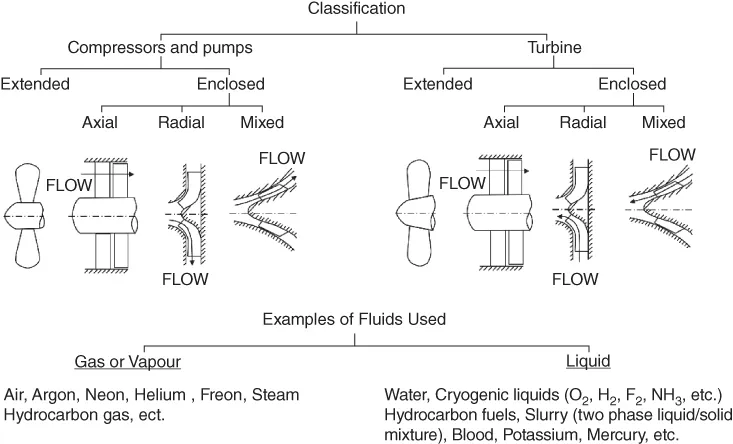
Turbomachinery can be also categorized according to the change in the flow direction through the impeller as shown in Figure 1.1. If the flow direction does not change through the impeller, those machines are called axial flow turbomachines. Machines where the flow direction changes perpendicularly through the impeller are called radial flow (or centrifugal) turbomachines. If the change in flow direction is neither axial nor radial, the machines are called mixed flow turbomachines. Also, the rotors of turbomachinery may be enclosed in a casing or exposed to the environment without. Most turbomachines belong to the former group of enclosed turbomachines, but some, such as the wind turbine, prop fan, and ship propeller, belong to the latter group of extended turbomachines.
Figure 1.1 Classification of turbomachinery types. Source:
An important flow phenomenon found only in fluid machinery employing liquid as the working fluid is cavitation, which indicates generation of gas bubbles at normal temperature of operation due to a decrease in the local static pressure. In pumps or hydraulic turbines, cavitation occurs by the rotating blades that cause low local pressure. Repeated breaking down of bubbles near the solid wall induces erosion damage and also noise. Thus, cavitation is an important factor to be considered in the design of hydraulic machinery. On the other hand, in fluid machines that use gas as a working fluid and operate at high speed, the compressibility of gas causes unique flow phenomena such as shock waves that are not found in hydraulic machinery.
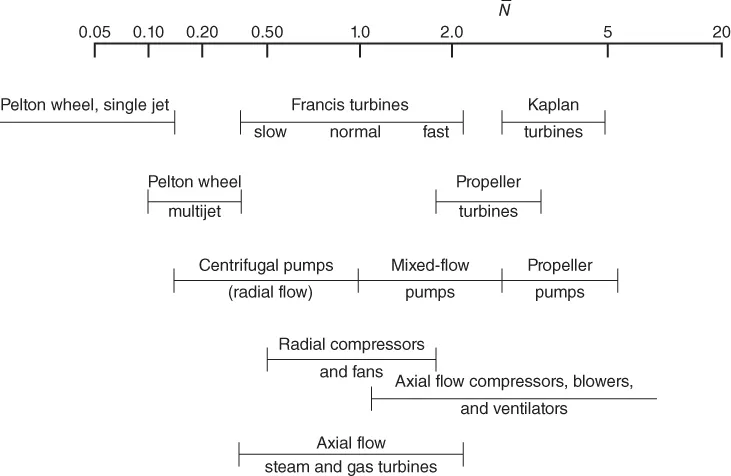
A typical parameter, which is used to classify various types of turbomachinery, is specific speed. The specific speed is defined as a non‐dimensional parameter combining operating parameters of turbomachinery as follows;
(1.1)
Constant specific speed indicates the flow conditions that are similar in geometrically similar turbomachinery. However, if the gravitational acceleration, g, is assumed constant, the parameter becomes a dimensional parameter, NQ1/2/(ΔH)3/4. The specific speed, Ns is the most important parameter in turbomachinery that can be used in the selection of turbomachinery type as shown in Figure 1.1 . The range of specific speeds for a specified type of turbomachinery shown in Figure 1.2 indicates the range where the turbomachine type shows maximum efficiency.
Figure 1.2 Specific speed suitability ranges of various designs. Source:.
Csanady 1964
1.3 Analysis of Fluid Machinery
Analysis of turbomachinery should involve the analyses ...
Table of contents
Cover
Table of Contents
Dedication
Preface
1 Introduction
2 Fluid Mechanics and Computational Fluid Dynamics
3 Optimization Methodology
4 Optimization of Industrial Fluid Machinery
5 Optimization of Fluid Machinery for Renewable Energy Systems
Nomenclature
Index
End User License Agreement
Trusted by 375,005 students
Access to over 1.5 million titles for a fair monthly price.
Study more efficiently using our study tools.
Frequently asked questions
Yes, you can cancel anytime from the Subscription tab in your account settings on the Perlego website. Your subscription will stay active until the end of your current billing period. Learn how to cancel your subscription
No, books cannot be downloaded as external files, such as PDFs, for use outside of Perlego. However, you can download books within the Perlego app for offline reading on mobile or tablet. Learn how to download books offline
Perlego offers two plans: Essential and Complete
Essential is ideal for learners and professionals who enjoy exploring a wide range of subjects. Access the Essential Library with 800,000+ trusted titles and best-sellers across business, personal growth, and the humanities. Includes unlimited reading time and Standard Read Aloud voice.
Complete: Perfect for advanced learners and researchers needing full, unrestricted access. Unlock 1.5M+ books across hundreds of subjects, including academic and specialized titles. The Complete Plan also includes advanced features like Premium Read Aloud and Research Assistant.
Both plans are available with monthly, semester, or annual billing cycles.
We are an online textbook subscription service, where you can get access to an entire online library for less than the price of a single book per month. With over 1.5 million books across 990+ topics, we’ve got you covered! Learn about our mission
Look out for the read-aloud symbol on your next book to see if you can listen to it. The read-aloud tool reads text aloud for you, highlighting the text as it is being read. You can pause it, speed it up and slow it down. Learn more about Read Aloud
Yes! You can use the Perlego app on both iOS and Android devices to read anytime, anywhere — even offline. Perfect for commutes or when you’re on the go. Please note we cannot support devices running on iOS 13 and Android 7 or earlier. Learn more about using the app
Yes, you can access Design Optimization of Fluid Machinery by Kwang-Yong Kim,Abdus Samad,Ernesto Benini in PDF and/or ePUB format, as well as other popular books in Physical Sciences & Mechanics. We have over 1.5 million books available in our catalogue for you to explore.