Empowered Educators in China
eBook - ePub

Empowered Educators in China

How High-Performing Systems Shape Teaching Quality

  1. English
  2. ePUB (mobile friendly)
  3. Available on iOS & Android
eBook - ePub

Empowered Educators in China

How High-Performing Systems Shape Teaching Quality

About this book

BEST PRACTICES FROM CHINA'S HIGH-PERFORMING SCHOOL SYSTEM

Empowered Educators in China is one volume in a series that explores how high-performing educational systems from around the world achieve strong results. The anchor book, Empowered Educators: How High-Performing Systems Shape Teaching Quality Around the World, is written by Linda Darling-Hammond and colleagues, with contributions from the author of this volume.

Empowered Educators in China describes the nation's policy reforms that built the modern Chinese educational system and the educational practices that are considered typical in China. The book spotlights Shanghai's system which is distinctive and superior. Shanghai offers a clear illustration of an educational system that continually invests in educating a diverse student population and, by measures of international comparison tests, is achieving outstanding results. Many factors contribute to the Shanghai system's ongoing success, including the students' motivation toward strong performance, the parental support for education that is culturally ingrained throughout the country, the focus that teachers place on high expectations for students, and the individual tutoring they provide. The author argues that these factors are only a partial explanation of Shanghai's success and then closely describes educational policies that support teachers' preparation, hiring, ongoing development, and opportunities for awards and leadership. These policies are based on the assumption that teachers are key to the nation's future and must be appropriately supported in order to contribute to student performance and achievement, an assumption that is also explicitly stated within Chinese law. This volume offers specific descriptions of how these national policies are translated, adapted, and enacted in Shanghai.
Trusted by 375,005 students

Access to over 1 million titles for a fair monthly price.

Study more efficiently using our study tools.

Information

Publisher
Jossey-Bass
Year
2017
Print ISBN
9781119369653
eBook ISBN
9781119369639

1
THE SURPRISING SUCCESS OF SHANGHAI STUDENTS

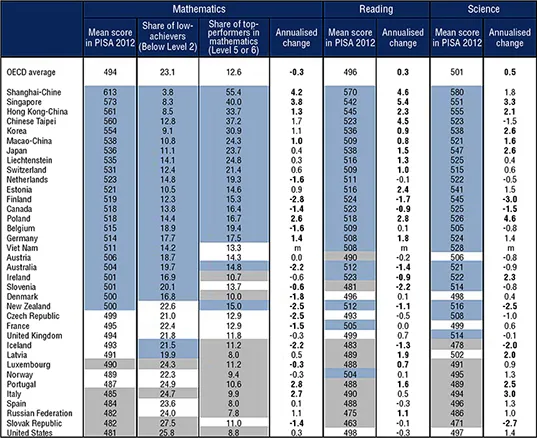
IN 2009 SHANGHAI PARTICIPATED for the first time in the Organization for Economic Co-operation and Development’s (OECD) triennial Programme for International Student Assessment (PISA). PISA exams are administered to a random sample of 15-year-olds in participating jurisdictions in three subject matter areas: reading, mathematics, and science. Typically, nations, not municipalities, are represented in PISA. In 2009, however, Shanghai was among the 74 jurisdictions and in 2012 it was among the 65 jurisdictions participating in the assessment (Beijing and other Chinese provinces also participated in 2009 but only in an exploratory manner). Shanghai surprised the global education community by scoring at the top of the charts in reading, mathematics, and science in 2009 and then repeating that ranking in the 2012 results. Figure 1.1 shows that Shanghai’s students’ performance in all three tested areas is well above the OECD average student performance. In addition, Shanghai had the smallest percentage of students performing in the lowest levels of mathematics and the highest percentage of students performing at the highest levels of PISA exams. These results have left many people in the policy and school reform communities asking how Shanghai has managed to create a system that supports its students to perform so well on these measures of student achievement.
Sheet showing the performance of mathematics, reading, and science of different countries with OCED average in rows, and mean score, annualised change, et cetera, in columns.
Figure 1.1 Snapshot of performance in mathematics, reading, and science
OECD, 2014, p. 5.
One typical response1 to explaining Shanghai students’ performance on PISA exams is that the Asian educational approach is based primarily on memorization, repetition, and exam preparation. Certainly, exam preparation helps a great deal and there is no doubt that students in Shanghai learn how to prepare for exams. However, the PISA tests are not directly linked to school curriculum. The tests are “designed to assess to what extent students at the end of compulsory education, can apply their knowledge to real-life situations and be equipped for full participation in society . . . The tests are a mixture of open-ended and multiple-choice questions that are organised in groups based on a passage setting out a real-life situation” (OECD, n.d.). Based on the rigor and design of the test questions, rote memorization of school texts is not Shanghai’s secret to success. When interviewed about Shanghai’s performance on the 2009 PISA exams, Andreas Schleicher, the PISA program’s designer at OECD, summarized:
Shanghai’s education system is distinctive and superior—and not just globally, but also nationally. Hong Kong, Beijing, and ten Chinese provinces participated in the 2009 PISA, but their results reflected education systems that were still the same-old knowledge acquisition models, whereas Shanghai had progressed to equipping students with the ability to interpret and extrapolate information from text and apply it to real world situations—what we would normally refer to as “creativity.” Twenty-six percent of Shanghai 15-year-olds could demonstrate advanced problem-solving skills, whereas the OECD average is 3 percent.
(Jiang, 2011)
Many other factors seem to be at play within the overall Shanghai system, including the students’ motivation toward strong performance, the parental support for education that is culturally engrained throughout the country, the focus that the teachers place on high expectations for students and the individual tutoring they provide (sometimes without additional pay and sometimes with a consulting fee) (Tan, 2013). These cultural values for education in general and the role of adults in supporting the younger generations toward their educational potential and success in life are well accepted as partially explaining the high performance of several Asian countries on international comparison exams (Cheng, 2014).
Beyond the cultural explanation that education is the “key to social mobility” for the individual who works hard, Cheng (2014) points out that the cultural value for education is represented also in the financial and policy investments in expanding and improving the educational systems serving vast populations of children. With this systems frame in mind, the question that follows from the Shanghai results is: How is the educational system—its culture, policies, and practices—set up to support the kind of student performance we see in the Shanghai results? In particular, how does the system structure teaching, and the role and quality of teachers, to contribute to these outcomes?

This Study

In the text that follows, I attempt to do two things in order to answer these questions. I describe the national geographic and economic context of China, the nation’s policy reforms over time that built the modern Chinese educational system, and the educational practices that are considered typical in China. I give primary focus to policies and practices that contribute to the preparation, hiring, and ongoing professional support for teachers within the system based on the assumption that teachers are a key feature of the education system that contributes to student performance and achievement (this assumption is also explicitly stated within Chinese law).
I then delve into specific descriptions of how these national policies are translated, adapted, and enacted in Shanghai. The case of Shanghai allows us to see an illustration of an educational system that has been investing in educating a diverse student population for three decades and, by measures of international comparison tests, is achieving success. Certainly, Shanghai does not represent the educational practices and conditions in all corners of China. The limited local resources of the western villages create a very different educational context than the densely populated urban throng of Shanghai. Since the early part of the 19th century Shanghai has been a center for international business, shifting over time from industry to finance. Yet, Shanghai is but one of several urban metropolises in China that is working toward educational improvement through experimentation with new curriculum and teaching practices. And Shanghai operates its educational system under the same national laws and within the same cultural traditions as the rest of China. As a large economic center that has a history of innovation and international exposure, I will treat Shanghai as a case of seeing the possibilities of what a developing nation can accomplish within its educational systems.
To construct this text, I drew on several sources of information. I summarize national laws and regulations of China retrieved from the national Ministry of Education website. I also draw on published refereed research, data from national surveys and reports, summaries of the educational context and policies in China and Shanghai published by organizations such as OECD, UNESCO, the Asia Society, and NCEE, and news accounts of policy launches and public reaction. Finally, I conducted field research in Shanghai for four weeks in November 2013. I was generously hosted by higher education colleagues at East China Normal University who made arrangements for me to visit schools and interview teachers, principals, education officials, and university professors and students in education. I also observed classrooms, teacher meetings, and a parent feedback session (Link 1-1).
As an education professor in the United States, I was well aware that I was entering new cultural territory as well as a political system that would be hard to interpret through my Western lived experience. I had some concept of schooling experience in China being driven by examinations, that classrooms had more students than I typically experienced in the US, and that teachers spent less time with children in their typical work week than US teachers. These characteristics are oft-repeated in Western conversations about Chinese education. I was not, however, prepared to understand how deeply the school structure of China influences the overall educational experience of children, or to appreciate the collective nature of teaching within schools, or to grasp the enormous challenges of managing a national school system that serves 200 million children. These elements of Chinese education are described in more detail in the text that follows.

NOTES

1A discussion of claims that Shanghai excluded migrant children from rural provinces who live in the city from its public schools and from the PISA sample follows in later sections.

2
SITUATING SHANGHAI IN CHINA’S NATIONAL EDUCATION POLICY CONTEXT

THE PEOPLE’S REPUBLIC OF CHINA (PRC) is governed by the Communist Party with the collaboration and support from eight additional parties. The PRC includes 5 ethnic autonomous regions, 22 provinces, 4 province-level municipalities (Beijing, Chongqing, Shanghai, and Tianjin), and 2 primarily self-governing special administrative regions (Macao and Hong Kong). Provinces and ethnic autonomous regions are further divided into administrative units of prefectures, counties, towns, and villages. Municipalities are divided into districts (e.g., Shanghai comprises 16 districts and one county) which are then also divided into township-level divisions and subdistricts.
According to the World Bank, China is the world’s most populous country, with a population of 1.36 billion people (mainland China only). By comparison, the United States, the world’s third most populous country, has 316.1 million people, a quarter of the number of people in China. China’s population comprises 56 different ethnic groups that are officially recognized. However, 92% of Chinese identify within the Han Chinese group. The other ethnic groups are growing at a faster rate than Han Chinese but, because the Han are overwhelmingly dominant in the population, these increases are not expected to dramatically alter China’s ethnic composition.
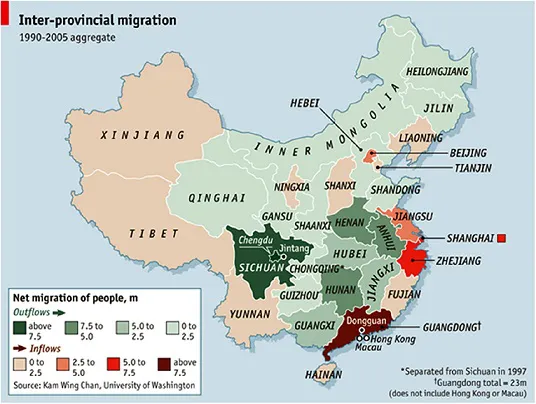
The people of China are almost evenly distributed across urban and rural regions, with 47% of the population living in urban areas and 53% in rural areas. However, the vast deserts of the west and the mountains in the south create an urban population concentration in the eastern coastal cities, such as Shanghai. Since the 1990s, mass migration from rural areas to urban centers has been driven by people’s search for better economic opportunities in manufacturing jobs and other rapidly developing industries (see Figure 2.1) and Shanghai feels the effects of this migration on its economy and school infrastructure.
Map showing mass migration pattern in mainland China with inflow and outflow marked from western rural to eastern coastal provinces between year 1990-2005.
Figure 2.1 Migration patterns within mainland China show the mass migration from the western rural provinces to the eastern coastal provinces
We like to move it move it, 2012.
The national migrant population in China reached 245 million people in 2013, representing 18% of the total population (United Nations Children’s Fund, 2014). In Shanghai, the migrant population reached almost 10 million people (Shanghai Municipal Statistics Bureau, 2015). The internal national migration is almost a third of all people globally estimated by the UN to be migrating within the borders...

Table of contents

  1. Cover
  2. Title page
  3. Copyright
  4. Foreword
  5. Acknowledgments
  6. About the Sponsoring Organizations
  7. About the Authors
  8. Online Documents and Videos
  9. 1 The Surprising Success of Shanghai Students
  10. 2 Situating Shanghai in China’s National Education Policy Context
  11. 3 China’s Educational System Today
  12. 4 Education in Shanghai
  13. 5 Teaching in China and Shanghai
  14. 6 Teacher Preparation in China and Shanghai
  15. 7 Supporting Teacher Professional Learning in Shanghai
  16. 8 Conclusion: How Teaching Culture, Policies, and Practices SUPPORT Student Performance
  17. References
  18. EULA

Frequently asked questions

Yes, you can cancel anytime from the Subscription tab in your account settings on the Perlego website. Your subscription will stay active until the end of your current billing period. Learn how to cancel your subscription
No, books cannot be downloaded as external files, such as PDFs, for use outside of Perlego. However, you can download books within the Perlego app for offline reading on mobile or tablet. Learn how to download books offline
Perlego offers two plans: Essential and Complete
  • Essential is ideal for learners and professionals who enjoy exploring a wide range of subjects. Access the Essential Library with 800,000+ trusted titles and best-sellers across business, personal growth, and the humanities. Includes unlimited reading time and Standard Read Aloud voice.
  • Complete: Perfect for advanced learners and researchers needing full, unrestricted access. Unlock 1.4M+ books across hundreds of subjects, including academic and specialized titles. The Complete Plan also includes advanced features like Premium Read Aloud and Research Assistant.
Both plans are available with monthly, semester, or annual billing cycles.
We are an online textbook subscription service, where you can get access to an entire online library for less than the price of a single book per month. With over 1 million books across 990+ topics, we’ve got you covered! Learn about our mission
Look out for the read-aloud symbol on your next book to see if you can listen to it. The read-aloud tool reads text aloud for you, highlighting the text as it is being read. You can pause it, speed it up and slow it down. Learn more about Read Aloud
Yes! You can use the Perlego app on both iOS and Android devices to read anytime, anywhere — even offline. Perfect for commutes or when you’re on the go.
Please note we cannot support devices running on iOS 13 and Android 7 or earlier. Learn more about using the app
Yes, you can access Empowered Educators in China by Mistilina Sato in PDF and/or ePUB format, as well as other popular books in Education & Education Administration. We have over one million books available in our catalogue for you to explore.