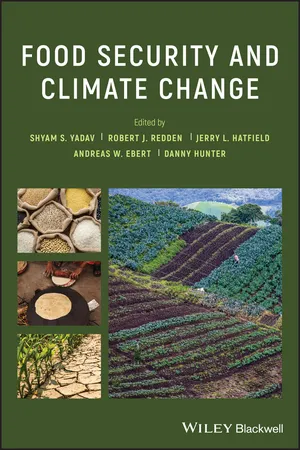
This book looks at the current state of food security and climate change, discusses the issues that are affecting them, and the actions required to ensure there will be enough food for the future. By casting a much wider net than most previously published books—to include select novel approaches, techniques, genes from crop diverse genetic resources or relatives—it shows how agriculture may still be able to triumph over the very real threat of climate change.
Food Security and Climate Change integrates various challenges posed by changing climate, increasing population, sustainability in crop productivity, demand for food grains to sustain food security, and the anticipated future need for nutritious quality foods. It looks at individual factors resulting from climate change, including rising carbon emission levels, increasing temperature, disruptions in rainfall patterns, drought, and their combined impact on planting environments, crop adaptation, production, and management. The role of plant genetic resources, breeding technologies of crops, biotechnologies, and integrated farm management and agronomic good practices are included, and demonstrate the significance of food grain production in achieving food security during climate change.
Food Security and Climate Change is an excellent book for researchers, scientists, students, and policy makers involved in agricultural science and technology, as well as those concerned with the effects of climate change on our environment and the food industry.
eBook - ePub
Food Security and Climate Change
- English
- ePUB (mobile friendly)
- Available on iOS & Android
eBook - ePub
Food Security and Climate Change
About this book
Information
1
Climate Change, Agriculture and Food Security
Shyam S. Yadav1,6, V. S. Hegde2, Abdul Basir Habibi3, Mahendra Dia4 and Suman Verma4
1Manav Foundation, Vikaspuri, New Delhi, India
2Division of Genetics, Indian Agricultural Research Institute, Indian Council of Agricultural Research, New Delhi, India
3Afghanistan Agriculture Input Project, Ministry of Agriculture, Irrigation & Livestock, Kabul, Afghanistan
4Department of Horticultural Sciences, North Carolina State University, Raleigh, North Carolina, USA
5Government Holkar Science College, Devi Ahilya Vishwavidyalaya, Indore, India
6Manav Mahal International School, Lohara, Ami Nagar Sarai, Baghpat, Uttar Pradesh, India
1.1 Introduction
During recent years, worldwide heavy rainfalls and floods, forest fires, occurrences, and the spread of new diseases, as found in the new strains of different pathogens and viruses, abnormal bacterial growth, and higher incidences of insect pests are direct indications of drastic environmental changes globally. It is now well established and documented that anthropogenic greenhouse gas (GHG) emissions are the main reason for the climate change at global level. It is also well recognized that agriculture sectors are directly affected by changes in temperature, precipitation, and carbon dioxide (CO2) concentration in the atmosphere. Thus, early and bold measures are needed to minimize the potentially drastic climate impacts on the production and productivity of various field crops. In most of the developing countries in Africa, Asia, and Asia Pacific regions, about 70% of the population depend directly or indirectly for its livelihood on the agriculture sector and most of this population lives in arid or semiarid regions, which are already characterized by highly volatile climate conditions (Yadav et al., 2015).
Food, from staple cereal grains to high protein legumes and oilseed crops, is central to human development and well‐being (Misselhorn et al., 2012); however, the complexity of global food security is challenging and will be made more so under climate change. The world continues to face huge difficulties in securing adequate food that is healthy, safe, and of high nutritional quality for all (Redden et al., 2014a). Considering the complexity of climatic change, the crop, plants, and livestock are inherently affected by too much or too little water, too high or too low temperatures, the length of the growing season, seasonal variation, other climatic extremes, etc.
If we consider weather extremes during 2010 – 11, in Russia there were severe heat waves and approximately 30% of grain crops were lost due to burning, which resulted in huge losses to the Russian economy. Likewise, in Pakistan, the worst floods in 80 years of history occurred, and it was suggested in different media reports that one–fifth of the country area and more than 14% of cultivated land were submerged. Considering the Indian weather scenarios during recent years some parts are having good rains and some parts are under drought and cultivation of many field crops is difficult in those areas and crop productivity is adversely affected.
The Intergovernmental Panel on Climate Change (IPCC) defined “climate change as any change in climate over a time period that alters the composition of the global atmosphere and this change might be due to natural climate variability or a result of human activity”. According to the United Nations Framework Convention on Climate Change (UNFCC) climate change refers to “a change of climate which is attributed directly or indirectly to human activity that alters the composition of the global atmosphere and is in addition to natural climate variability observed over comparable time periods”. Human activities, most importantly the burning of fossil fuels, natural causes, industrialization, and changes in land use are modifying the concentrations of atmospheric constituents or properties of the surface that absorb or scatter radiant energy. The majority of the warming observed over the last 50 years was likely due to the increase in greenhouse gas concentrations (IPCC, 2001) and future changes in climate are expected to include additional warming, changes in the amount of rainfall and its distribution pattern, rise in sea‐level, and increased frequency and intensity of some climate extreme events such as flood, drought, and temperature severity.
According to the Special Report on Emissions Scenarios (Nakic'enovic' and Swart, 2000), the carbon dioxide concentration (CO2) in the atmosphere which was 284 ppm in 1832 will increase to approximately 550 ppm by 2050. This, in combination with other changes in the atmosphere, is likely to change the Earth's climate, making it warmer by an average of 1.80C to 4.00C by the end of this century (IPCC, 2007). The temperature increase is widespread over the globe, and is greater at higher northern latitudes, while land regions have warmed faster than the oceans. This warming will increase the evapotranspiration of water from wet surfaces and plants, leading to increased but more variable distribution of precipitation. The concentration of ozone (O3) will also increase as a result of industrialization and this will have a negative impact on crop growth and productivity. The global average sea level has risen since 1961 at an average rate of 1·8 mm/year and since 1993 at 3·1 mm/year with contributions from thermal expansion, melting glaciers and ice caps, and the polar ice sheets (IPCC, 2007). The annual average Arctic sea ice extent has shrunken by 2·7% per decade, with larger decreases in summer of 7·4% per decade. Mountain glaciers and snow cover on an average have declined in both hemispheres (IPCC,2007). These general features of climate change act on natural and biological systems. The changes in climate, particularly increases in temperature have already affected a wide range of physical and biological systems in many aquatic, terrestrial and marine environments in various parts of the world. The climate change will increase the risks of extinction of more vulnerable species and loss of biodiversity. The extent of damage or loss and the number of systems affected would increase with the magnitude and rate of climate change. The human systems that are sensitive to climate change mainly include water resources, agriculture and forestry, coastal zones and marine systems, human settlements, and human health. The extent of the vulnerability of these systems depends on the geographical location and environmental conditions. The projected adverse impacts of climate change on human systems (IPCC, 2001) include: i) a general reduction in potential yields of crops in most of the tropical and sub‐tropical regions for increases in atmospheric temperature; ii) a general reduction in potential crop yields in most of the regions in Mid‐latitudes due to increases in annual average temperature of more than a few 0C; iii) decreased availability of potable water for populations in many water‐scarce regions, particularly in the Sub‐tropics; iv) increased incidences of vector‐borne and water‐borne diseases and an increase in heat‐stress mortality; v) increased risk of flooding for many human settlements because of increased occurrences of heavy precipitation and also a rise in the sea‐level; and vi) a general increase in the demand for energy due to higher summer temperatures in different parts of the world. Climate change is also known to have some beneficial effects on the human system (IPCC, 2001). The positive impacts of climate change include: i) an increase in the potential yields of some crops in some of the regions in Mid‐altitudes for increases in temperatures of less than a few 0C; ii) a potential increase in global supply of timber from well managed forests; iii) an increase in the availability of water in some water‐scarce regions in some parts of Southeast Asia; iv) A decrease in the winter‐mortality in mid‐ and high altitudes; and v) reduced demand for energy due to higher winter temperatures.
1.1.1 Climate Change and Agriculture
The world population will continue to grow and is expected to reach 9.1 billion by 2050 (Charles et al. 2010). The total food production will have to be increased by 70–100%, if all these people are to be fed sufficiently (Smil, 2005; World Development Report, 2008). Increasing food production to feed this ever‐increasing world population in a sustainable way is a great challenge, moreso at a time of rapid environmental change with rising temperatures and extreme climate events threatening food production globally. Agriculture is inherently sensitive to climate variability and change, as a result of either natural causes or human activities (Wheeler and Braun, 2013). Climate change caused by emissions of greenhouse gases is expected to directly influence crop production systems for food, feed, or fodder; to affect livestock health; and to alter the pattern and balance of trade of food and food products. Climate change has already started affecting agricultural growth and these impacts will vary with the degree of warming and associated changes in rainfall patterns, as well as from one location to another. According to the Intergovernmental Panel on Climate Change (IPCC, 2014), climate variations affect crop production in several regions of the world, with negative effects more common than positive, and developing countries highly vulnerable to further negative impacts. Climate change is estimated to hav...
Table of contents
- Cover
- Table of Contents
- List of Contributors
- 1 Climate Change, Agriculture and Food Security
- 2 Changes in Food Supply and Demand by 2050
- 3 Crop Responses to Rising Atmospheric [CO2] and Global Climate Change
- 4 Adaptation of Cropping Systems to Drought under Climate Change (Examples from Australia and Spain)
- 5 Combined Impacts of Carbon, Temperature, and Drought to Sustain Food Production
- 6 Scope, Options and Approaches to Climate Change
- 7 Mitigation and Adaptation Approaches to Sustain Food Security under Climate Change
- 8 Role of Plant Breeding to Sustain Food Security under Climate Change
- 9 Role of Plant Genetic Resources in Food Security
- 10 Breeding New Generation Genotypes for Conservation Agriculture in Maize‐Wheat Cropping Systems under Climate Change
- 11 Pests and Diseases under Climate Change; Its Threat to Food Security
- 12 Crop Production Management to Climate Change
- 13 Vegetable Genetic Resources for Food and Nutrition Security under Climate Change
- 14 Sustainable Vegetable Production to Sustain Food Security under Climate Change at Global Level
- 15 Sustainable Production of Roots and Tuber Crops for Food Security under Climate Change
- 16 The Roles of Biotechnology in Agriculture to Sustain Food Security under Climate Change
- 17 Application of Biotechnologies in the Conservation and Utilization of Plant Genetic Resources for Food Security
- 18 Climate Change Influence on Herbicide Efficacy and Weed Management
- 19 Farmers' Knowledge and Adaptation to Climate Change to Ensure Food Security
- 20 Farmer and Community‐led Approaches to Climate Change Adaptation of Agriculture Using Agricultural Biodiversity and Genetic Resources
- 21 Accessing Genetic Diversity for Food Security and Climate Change Adaptation in Select Communities in Africa
- Index
- End User License Agreement
Trusted by 375,005 students
Access to over 1.5 million titles for a fair monthly price.
Study more efficiently using our study tools.
Frequently asked questions
Yes, you can cancel anytime from the Subscription tab in your account settings on the Perlego website. Your subscription will stay active until the end of your current billing period. Learn how to cancel your subscription
No, books cannot be downloaded as external files, such as PDFs, for use outside of Perlego. However, you can download books within the Perlego app for offline reading on mobile or tablet. Learn how to download books offline
Perlego offers two plans: Essential and Complete
- Essential is ideal for learners and professionals who enjoy exploring a wide range of subjects. Access the Essential Library with 800,000+ trusted titles and best-sellers across business, personal growth, and the humanities. Includes unlimited reading time and Standard Read Aloud voice.
- Complete: Perfect for advanced learners and researchers needing full, unrestricted access. Unlock 1.5M+ books across hundreds of subjects, including academic and specialized titles. The Complete Plan also includes advanced features like Premium Read Aloud and Research Assistant.
We are an online textbook subscription service, where you can get access to an entire online library for less than the price of a single book per month. With over 1.5 million books across 990+ topics, we’ve got you covered! Learn about our mission
Look out for the read-aloud symbol on your next book to see if you can listen to it. The read-aloud tool reads text aloud for you, highlighting the text as it is being read. You can pause it, speed it up and slow it down. Learn more about Read Aloud
Yes! You can use the Perlego app on both iOS and Android devices to read anytime, anywhere — even offline. Perfect for commutes or when you’re on the go.
Please note we cannot support devices running on iOS 13 and Android 7 or earlier. Learn more about using the app
Please note we cannot support devices running on iOS 13 and Android 7 or earlier. Learn more about using the app
Yes, you can access Food Security and Climate Change by Shyam Singh Yadav, Robert J. Redden, Jerry L. Hatfield, Andreas W. Ebert, Danny Hunter, Shyam Singh Yadav,Robert J. Redden,Jerry L. Hatfield,Andreas W. Ebert,Danny Hunter in PDF and/or ePUB format, as well as other popular books in Technology & Engineering & Food Science. We have over 1.5 million books available in our catalogue for you to explore.