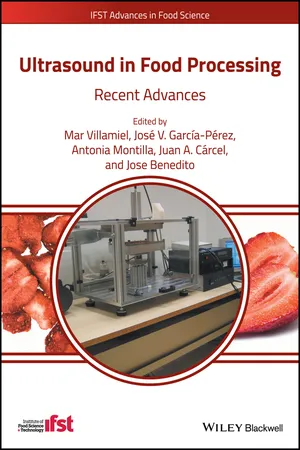
Ultrasound in Food Processing
  1. English
  2. ePUB (mobile friendly)
  3. Available on iOS & Android
eBook - ePub

About this book

Part I: Fundamentals of ultrasound
This part will cover the main basic principles of ultrasound generation and propagation and those phenomena related to low and high intensity ultrasound applications. The mechanisms involved in food analysis and process monitoring and in food process intensification will be shown.

Part II: Low intensity ultrasound applications
Low intensity ultrasound applications have been used for non-destructive food analysis as well as for process monitoring. Ultrasonic techniques, based on velocity, attenuation or frequency spectrum analysis, may be considered as rapid, simple, portable and suitable for on-line measurements. Although industrial applications of low-intensity ultrasound, such as meat carcass evaluation, have been used in the food industry for decades, this section will cover the most novel applications, which could be considered as highly relevant for future application in the food industry. Chapters addressing this issue will be divided into three subsections: (1) food control, (2) process monitoring, (3) new trends.

Part III: High intensity ultrasound applications
High intensity ultrasound application constitutes a way to intensify many food processes. However, the efficient generation and application of ultrasound is essential to achieving a successful effect. This part of the book will begin with a chapter dealing with the importance of the design of efficient ultrasonic application systems. The medium is essential to achieve efficient transmission, and for that reason the particular challenges of applying ultrasound in different media will be addressed.
The next part of this section constitutes an up-to-date vision of the use of high intensity ultrasound in food processes. The chapters will be divided into four sections, according to the medium in which the ultrasound vibration is transmitted from the transducers to the product being treated. Thus, solid, liquid, supercritical and gas media have been used for ultrasound propagation. Previous books addressing ultrasonic applications in food processing have been based on the process itself, so chapters have been divided in mass and heat transport, microbial inactivation, etc. This new book will propose a revolutionary overview of ultrasonic applications based on (in the authors' opinion) the most relevant factor affecting the efficiency of ultrasound applications: the medium in which ultrasound is propagated. Depending on the medium, ultrasonic phenomena can be completely different, but it also affects the complexity of the ultrasonic generation, propagation and application.
In addition, the effect of high intensity ultrasound on major components of food, such as proteins, carbohydrates and lipids will be also covered, since this type of information has not been deeply studied in previous books.
Other aspects related to the challenges of food industry to incorporate ultrasound devices will be also considered. This point is also very important since, in the last few years, researchers have made huge efforts to integrate fully automated and efficient ultrasound systems to the food production lines but, in some cases, it was not satisfactory. In this sense, it is necessary to identify and review the main related problems to efficiently produce and transmit ultrasound, scale-up, reduce cost, save energy and guarantee the production of safe, healthy and high added value foods.   

Trusted by 375,005 students

Access to over 1.5 million titles for a fair monthly price.

Study more efficiently using our study tools.

Information

Year
2017
Print ISBN
9781118964187
Edition
1
eBook ISBN
9781118964163

Part 1
Fundamentals of Ultrasound

1
Basic Principles of Ultrasound

Juan A. Gallego‐Juárez1,2
1 Instituto de Tecnologías Físicas y de la Información (ITEFI), Consejo Superior de Investigaciones Científicas (CSIC), Madrid, Spain
2 PUSONICS S. L, Arganda del Rey (Madrid), Spain

1.1 Introduction

As is well known, acoustics is the science of elastic waves, a broad interdisciplinary field which comprises such diverse areas as life and earth sciences, engineering, and arts. It may be divided into three main branches according to the frequency spectrum and the hearing characteristics to which the human auditory system responds: infrasound, sound, and ultrasound.
Infrasound is the branch dealing with frequencies below the human hearing range (0–20 Hz), sound refers to the human audible range (20Hz–20kHz), and ultrasound covers the very wide range of elastic waves from 20 kHz up to the frequencies associated to wavelengths comparable to intermolecular distances (about 1012 Hz). The basic principles and equations of acoustics are used to explain the general behavior of waves in the three branches. Nevertheless, the special characteristic of the ultrasound and infrasound waves of being inaudible establishes a fundamental difference in their applications with respect to the audio frequency field. The applications and uses of ultrasound are totally different from those of infrasound due to the very large differences in their wavelength ranges, as wavelength is inversely proportional to frequency. Infrasound waves are very long waves (wavelengths in the range of meters) generated by some natural phenomena, such as earthquakes or volcanic eruptions, or by human processes, such as sonic booms or explosions. Ultrasound waves are very short waves (wavelengths in the range of centimeters to nanometers) generally generated by specifically designed technological sources and are applied in many industrial, medical, and environmental processes. However, the human use of ultrasound was long preceded by use by animals, for example bats and dolphins, who use ultrasound for navigation and communication.
Beside the range of frequency, the range of wave intensity broadly influences the phenomena related to the production, propagation, and application of acoustic waves. As a consequence, a sub‐classification within each of the three branches of acoustics should be adopted related to the use of low‐ or high‐intensity waves. In this way ultrasound may be divided into two areas, dealing respectively with low‐ and high‐intensity waves. The boundary between low‐ and high‐intensity waves is very difficult to pinpoint, but it can be approximately established for intensity values which, depending on the medium, vary between 0.1 W/cm2 and 1 W/cm2.
As mentioned earlier, the general feature of ultrasound is its short wavelength, which determines its applications. In fact the short wavelength implies a high degree of discrimination and a high concentration of energy, therefore ultrasonic waves can be used as a means of exploration, detection, and information, and as a means of action. They can also be used as a means of communication, particularly for propagation in water, where electromagnetic waves have many limitations. In exploration, detection, and information, ultrasonic signals are able to determine the characteristics and internal structure of the propagation media without modifying them. For action applications, ultrasonic waves of high intensity are able to produce permanent changes in the medium on which they act. As a means of communication an ultrasonic signal can be modulated and transmit information.
The applications in which ultrasound waves are used as a means of exploration, detection, and information constitute the area of low‐intensity ultrasound or signal ultrasound. The applications in which the ultrasonic energy is used to produce permanent changes in the propagation medium constitute the area of high‐intensity ultrasound or power ultrasound. One specific use of ultrasound for communication is underwater acoustics, where sonic as well as ultrasonic waves are used to detect submerged objects, and for echo ranging, depth sounding, etc.
Typical applications of low‐intensity ultrasound include non‐destructive testing (NDT), process control, and medical diagnosis. High‐intensity applications include a great variety of effects such as cleaning, drying, mixing, homogenization, emulsification, degassing, defoaming, atomization, particle agglomeration, sonochemical reactions, welding, drilling etc. High‐intensity ultrasound also plays an important role in medical therapy.
The history of ultrasound is a modern part of the history of acoustics. In fact, although some studies on high acoustic frequencies were carried out in the 19th century, the real history of ultrasound began in 1915 with Paul Langevin, a prominent French physicist at the School of Physics and Chemistry in Paris. During the First World War, France and Britain launched programs for submarine detection and for this purpose Langevin designed and constructed underwater ultrasonic transducers consisting of a quartz plate sandwiched between two metal pieces (Langevin, 1920a,b, 1924). Following Langevin’s work, in the 1920s Wood and Loomis conducted interesting experiments with high‐intensity ultrasonic waves (200–500 kHz), for example the formation of emulsions, flocculation of particles, etc. (Wood and Loomis, 1927). During the 1930s new effects related to the application of ultrasonic energy were discovered and more than 150 studies were published. In the period 1940–1970 the development of new transducer materials as well as rapid advances in electronics made the production of commercial ultrasonic systems possible. Since 1970, the field of ultrasonics has grown rapidly and presently ultrasound is considered an emerging and expanding field covering a wide range of applications in the industrial, medical, and environmental sectors. Behind any application of ultrasound there is a fundamental scientific basis and the corresponding technology for generation, propagation, and detection of the ultrasonic waves, therefore the development of each specific application requires knowledge of the related basic principles and technologies.

1.2 Generation and Detection of Ultrasonic Waves: Basic Transducer Types

Any device capable of generating and/or detecting ultrasonic waves is called an ultrasonic transducer. As is well known, a transducer converts energy from one form to another. The most common conversion is electrical to ultrasonic energy in the case of transmitters, and ...

Table of contents

  1. Cover
  2. Title Page
  3. Table of Contents
  4. About the IFST Advances in Food Science Book Series
  5. List of Contributors
  6. Preface
  7. Part 1: Fundamentals of Ultrasound
  8. Part 2: Low‐intensity Ultrasound Applications
  9. Part 3: High‐intensity Ultrasound Applications
  10. Epilogue
  11. Index
  12. End User License Agreement

Frequently asked questions

Yes, you can cancel anytime from the Subscription tab in your account settings on the Perlego website. Your subscription will stay active until the end of your current billing period. Learn how to cancel your subscription
No, books cannot be downloaded as external files, such as PDFs, for use outside of Perlego. However, you can download books within the Perlego app for offline reading on mobile or tablet. Learn how to download books offline
Perlego offers two plans: Essential and Complete
  • Essential is ideal for learners and professionals who enjoy exploring a wide range of subjects. Access the Essential Library with 800,000+ trusted titles and best-sellers across business, personal growth, and the humanities. Includes unlimited reading time and Standard Read Aloud voice.
  • Complete: Perfect for advanced learners and researchers needing full, unrestricted access. Unlock 1.5M+ books across hundreds of subjects, including academic and specialized titles. The Complete Plan also includes advanced features like Premium Read Aloud and Research Assistant.
Both plans are available with monthly, semester, or annual billing cycles.
We are an online textbook subscription service, where you can get access to an entire online library for less than the price of a single book per month. With over 1.5 million books across 990+ topics, we’ve got you covered! Learn about our mission
Look out for the read-aloud symbol on your next book to see if you can listen to it. The read-aloud tool reads text aloud for you, highlighting the text as it is being read. You can pause it, speed it up and slow it down. Learn more about Read Aloud
Yes! You can use the Perlego app on both iOS and Android devices to read anytime, anywhere — even offline. Perfect for commutes or when you’re on the go.
Please note we cannot support devices running on iOS 13 and Android 7 or earlier. Learn more about using the app
Yes, you can access Ultrasound in Food Processing by Mar Villamiel, José V. García-Pérez, Antonia Montilla, Juan A. Carcel, Jose Benedito, Mar Villamiel,José V. García-Pérez,Antonia Montilla,Juan A. Carcel,Jose Benedito in PDF and/or ePUB format, as well as other popular books in Technology & Engineering & Food Science. We have over 1.5 million books available in our catalogue for you to explore.